

Mesoscopic and Nanoscale Quantum Physics
A conductor can be diffusive and phase coherent at the same time. Elastic scattering changes an electron’s direction without necessarily erasing the phase relationships that produce interference. Confinement, charge quantization and thermal broadening introduce further, independent questions. “Small” alone does not select a quantum-transport model.
This chapter connects finite geometries to measurable conductance, spectra and charge transfer. Begin with What Is Mesoscopic Physics? for the scale definitions, then choose a branch below. You do not need to read all fifteen subject articles before studying one device.
Helpful background. Band Theory Overview supplies carrier bands and filling. Reflection and Transmission Coefficients distinguishes amplitudes from transmitted current. Chemical Potential explains reservoir energy references. Each branch introduces its additional prerequisites.
Enter this chapter
Section titled “Enter this chapter”| What you want to understand | A starting route |
|---|---|
| Confined modes and conductance steps | Wells or wires → point contacts → conductance quantization |
| Interference in a disordered conductor | Coherence → rings or conductance fluctuations |
| Discrete charge on an island | Dots → Coulomb blockade → single-electron devices |
| Valley and sublattice effects | Graphene and Dirac materials |
| Electron–hole conversion at a contact | Proximity and Andreev physics |
The linked paths below explain these choices. Start by identifying the conducting region, reservoirs, voltage probes and gates. A transverse width sets a different confinement problem from the propagation length between contacts. A ring’s circumference controls travel around it; its enclosed area sets the magnetic flux. An island’s size and tunnel barriers affect different parts of its spectrum.
Next specify the carrier density, electron temperature, magnetic field and applied bias. Distinguish elastic scattering, phase relaxation and energy broadening. Low lattice temperature does not guarantee a cold electronic distribution. Finally choose the measured quantity: terminal conductance, charge-addition energy, optical transition, noise or supercurrent. Conductance is not bulk conductivity, and a gate-voltage interval becomes an energy only after its electrostatic conversion is known. Datta and Nazarov–Blanter develop this device-and-reservoir viewpoint.
Follow a physical path
Section titled “Follow a physical path”Confined layers, wires and point contacts
Section titled “Confined layers, wires and point contacts”Quantum Wells explains confinement in one direction. Continue to Two-Dimensional Electron Gases when that layer is populated, and to Quantum Wires when a second transverse direction is confined. These geometries create subbands: allowed transverse states with continuous motion along the remaining extended directions.
Quantum Point Contacts studies a short constriction, while Conductance Quantization relates plateaus to channel count, degeneracy and transmission. Landauer–Büttiker Formalism supplies terminal currents and voltage-probe conditions. Even a perfectly transmitting ballistic channel has a finite two-terminal resistance; that alone does not demonstrate scattering inside it.
For carriers with valley and sublattice structure, read Graphene and Dirac Materials before using parabolic-band formulas. Questions about twist-induced minibands and correlated filling continue in Moiré Superlattices.
Phase memory, rings and irregular conductance traces
Section titled “Phase memory, rings and irregular conductance traces”Quantum Coherence in Conductors explains how interference reveals phase memory. Aharonov–Bohm Rings follows winding paths around an enclosed area; Universal Conductance Fluctuations explains reproducible, sample-specific conductance patterns. Beenakker relates these phenomena to scattering symmetry and transmission statistics.
Weak Localization concerns an averaged interference correction. A fluctuation trace instead depends on the individual disorder configuration. Reproducibility and field or energy correlation scales help distinguish it from instrumental noise. Likewise, a periodic ring signal needs a physical interpretation: an harmonic can occur in a normal metal.
Islands, charging and single electrons
Section titled “Islands, charging and single electrons”Quantum Dots distinguishes orbital spacing from the energy required to add an electron. Coulomb Blockade explains charging thresholds and stability diagrams; Single-Electron Devices applies them to sensing and controlled transfer.
Use Mesoscopic Transport for charge-state master equations. A sequential-tunneling model needs weak enough coupling and appropriately resolved charge states; small current alone does not establish these conditions. Cotunneling, Kondo correlations and coherent resonant transmission may require different descriptions. Gate lever arms and the division of source–drain bias must also be determined.
Superconducting contacts and device performance
Section titled “Superconducting contacts and device performance”Proximity and Andreev Physics studies induced correlations and electron–hole conversion. BCS Theory explains the parent condensate; Josephson Effect develops phase-dependent transport and circuit behavior. A tunnel spectrum, a supercurrent and a topological invariant answer different questions.
An induced gap or zero-bias peak does not by itself establish a topological phase; Topological Superconductors explains the additional tests. For a qubit, sensor or pump, Nanostructures for Quantum Technology connects initialization, control and readout to useful performance.
Worked route: a coherent diffusive wire
Section titled “Worked route: a coherent diffusive wire”Consider a metallic normal wire with many transverse channels, length , transport mean free path and phase-coherence length . Let its diffusion coefficient be and electron temperature . Assume the wire is shorter than its localization length and connected to well-equilibrated normal reservoirs.
Because , the electron changes direction many times while phase memory can persist across the sample. In a diffusive description the relevant times scale with the squares of displacement lengths:
Here is a characteristic diffusion time, not an exact mean escape time for every boundary condition. measures a diffusive displacement scale; it is not the distance traveled along a zigzag trajectory.
Using the explicit conventions
we obtain
The Thouless energy estimates the scale on which the conductance pattern changes with energy; its precise relation to a measured correlation width depends on geometry. The inequality is not a sharp guarantee that thermal averaging is negligible.
For example, the linear-response Fermi weight has full width at half maximum . Here that is , about . The measured conductance therefore samples an appreciable energy interval even though each energy-resolved scattering state can remain coherent.
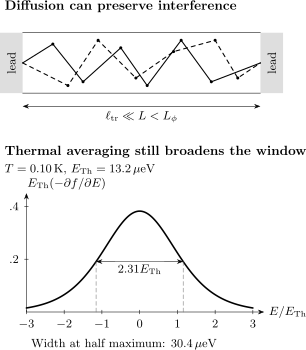
Two different comparisons in the same wire. The upper paths illustrate phase-coherent multiple scattering; they are not classical trajectories used to calculate a particular signal. The lower curve is the Fermi derivative for the stated temperature, with energy measured from the reservoir chemical potential and normalized to the Thouless energy. Its width illustrates energy averaging, without adding any dephasing mechanism.
Start with the scale definitions, then Quantum Coherence and Universal Conductance Fluctuations for this example. A source–drain bias introduces an energy difference , also larger than . Finite-bias energy averaging and possible heating then need analysis. Neither comparison by itself measures a dephasing rate. The detailed convolution and correlation functions are developed in What Is Mesoscopic Physics? and Universal Conductance Fluctuations.
Exercises
Section titled “Exercises”1. The same conductance, different channels
Section titled “1. The same conductance, different channels”At zero temperature and low bias, independent normal-electron channels have transmissions or . Count all degeneracies explicitly and use
Compare conductance and the shot-noise Fano factor. Which additional observable distinguishes the models?
Solution
Both give . The first has , the second : partition noise distinguishes channels that conduct equally well on average. Use Current Noise and Fluctuations for detector and finite-temperature conventions (Blanter and Büttiker). The measured noise includes a thermal contribution outside the stated limit; conductance alone cannot reconstruct the transmissions.
2. A half-flux period
Section titled “2. A half-flux period”A normal ring has effective area and a magnetoconductance component with period . Take . Identify the harmonic. Does it establish superconductivity?
Solution
The period is , so the component is consistent with . Interference of time-reversed paths in a diffusive normal ring can generate this period; higher winding harmonics can also contribute. The period alone does not establish superconductivity. Aharonov–Bohm Rings explains how geometry, averaging and coherence distinguish the mechanisms.
3. Charging visible, orbitals blurred
Section titled “3. Charging visible, orbitals blurred”An island has charging contribution to its addition energy, orbital spacing and tunnel width . The leads are at . In a weak-tunneling single-resonance estimate, compare these energies with the thermal peak width . Is a charge-state master equation already determined?
Solution
Here and the thermal width is . Charging features can remain separated while neighboring orbital peaks overlap. Small tunnel broadening does not remove thermal broadening. The quoted width assumes an isolated thermally broadened resonance; overlapping levels or interactions can change its line shape.
Quantum Dots and Coulomb Blockade explain the spectrum and charge thresholds. A master equation additionally needs accessible states, individual junction rates, gate lever arms and bias division. These numbers alone neither fix those rates nor rule out cotunneling and other correlations.
References
Section titled “References”- C. W. J. Beenakker, “Random-Matrix Theory of Quantum Transport,” Reviews of Modern Physics 69, 731–808 (1997), doi:10.1103/RevModPhys.69.731.
- Ya. M. Blanter and M. Büttiker, “Shot Noise in Mesoscopic Conductors,” Physics Reports 336, 1–166 (2000), doi:10.1016/S0370-1573(99)00123-4.
- S. Datta, Electronic Transport in Mesoscopic Systems, Cambridge University Press, 1995, publisher record.
- Y. V. Nazarov and Y. M. Blanter, Quantum Transport: Introduction to Nanoscience, Cambridge University Press, 2009, publisher contents.