

Proximity and Andreev Physics
Andreev reflection converts an electron into a reflected hole while a pair enters a superconducting condensate. It lets a normal conductor carry current into a superconductor even when the excitation energy is too small to create a propagating quasiparticle there. Repeated conversions can also trap a discrete Andreev level between two superconductors. This page connects the interface amplitudes to conductance, bound-state occupations and the current through a short junction.
Required background. BCS Theory supplies the paired state and bulk excitation gap. Conductance Quantization supplies transmission channels and their degeneracy. Josephson Effect supplies gauge-invariant phase differences and supercurrent.
Electron–hole conversion at an NS interface
Section titled “Electron–hole conversion at an NS interface”Consider a normal metal N next to an isotropic spin-singlet -wave superconductor S. Initially assume matched Fermi velocities, no magnetic or spin-active scattering, an abrupt pair potential and coherent elastic transport. Write the off-diagonal coefficient of the block with spinor as , with . Then
The act on electron and hole components. This off-diagonal coefficient differs by a minus sign from the scalar gap used in the unrotated block of BCS Theory. That constant phase shift changes neither gap magnitudes nor phase differences; the amplitudes below all use the present convention.
For , the parent has no propagating bulk quasiparticle at energy . An electron may instead reflect as a hole: two electrons have then left the normal side and joined the condensate. The hole is an absence of an electron, so its group velocity must be obtained from the hole dispersion, not inferred from its momentum alone.
The Andreev approximation assumes . Near a smooth Fermi surface,
The outgoing hole nearly retraces the incoming electron path. This retroreflection picture can fail near a band edge, with strong spin polarization or with Fermi-surface mismatch. In weakly doped graphene, interband conversion can instead give specular reflection (Beenakker, 2006).
At an ideal transparent interface define
Both amplitudes have unit magnitude below the gap. Their energy-dependent phases matter whenever an electron–hole path closes. Above the gap, quasiparticle transmission becomes possible and reflection alone no longer exhausts the probability.
A barrier changes the Andreev probability
Section titled “A barrier changes the Andreev probability”In the matched one-dimensional Blonder–Tinkham–Klapwijk model, a delta barrier of dimensionless strength has normal transparency (Blonder, Tinkham and Klapwijk, 1982).
There is a useful way to understand its subgap response without memorizing a formula. Choose an equivalent short-barrier scattering convention with reflection amplitude and transmission amplitude . A reflected hole must first cross the barrier as an electron and return through it as a hole. Extra electron–hole round trips contribute a factor each. Summing this geometric series gives
The probability, independent of the chosen channel phases, is
In particular,
A weakly transmitting barrier therefore suppresses low-energy Andreev reflection quadratically. But at any fixed nonzero , as in this ideal model. The peak becomes extremely narrow as decreases. Interchanging the tunnel and gap-edge limits gives different answers; temperature and lifetime broadening can erase this sharp feature.
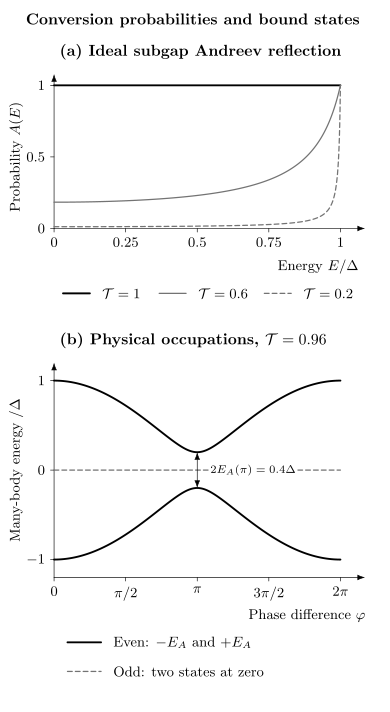
Top: ideal subgap conversion probability for normal transparencies . A tunnel barrier suppresses conversion away from the parent gap edge. Bottom: one spin-degenerate short-junction channel with has many-body energies . The even states are separated by ; the two odd states lie at zero relative to the same phase-independent reference. These are physical occupations of a channel, not four independent BdG branches. At , .
Conductance and pair-transfer noise
Section titled “Conductance and pair-transfer noise”Let label spin-degenerate orbital channels. At zero temperature the spectral NS conductance is
For lossless subgap reflection, . Thus . At zero energy, a time-reversal-symmetric normal scattering region gives (Beenakker, 1992)
Only a perfectly open channel gives exact doubling relative to its normal value. Spin splitting, magnetic scattering and an energy-dependent normal scatterer require their appropriate scattering matrices; the zero-energy eigenvalue relation does not justify replacing all finite-energy amplitudes by the same formula.
For a fixed spectrum, thermal smearing is
Here is the Fermi function. Bias-dependent spectra, heating, instrumental averaging and quasiparticle lifetimes are additional effects. In a tunnel contact, above-gap conductance can approximately probe the parent density of states. At zero temperature, a clean fully gapped parent still has no subgap single-quasiparticle channel, however opaque the barrier is; the remaining ideal subgap current is Andreev current.
Pair transfer also does not imply Poisson noise. For one channel at zero temperature and sufficiently small bias that , the one-sided low-frequency shot noise obeys
Rare conversion events approach charge- Poisson noise, whereas deterministic conversion at has no partition noise (de Jong and Beenakker, 1994). Exercise 2 obtains this from binomial counting.
From closed paths to Andreev levels
Section titled “From closed paths to Andreev levels”In a clean SNS segment of length , an electron traverses the normal region and returns as a hole. Let in a gauge with zero vector potential there. The round-trip phase is
A bound state satisfies . The opposite trajectory replaces by . In a general gauge use the gauge-invariant phase difference. The propagation term and the interface terms have opposite signs; both are needed to obtain the long-junction level spacing.
For a short junction, the normal scattering matrix barely changes over the gap. The condition is
not merely a small geometric length: a resonant barrier can produce a long dwell time. With equal parent gaps, no interactions or spin-active scattering, and orbital transmission , the positive level is (Beenakker, 1991)
Its negative partner is the same fermionic degree of freedom written in the redundant BdG description. Spin provides two physical quasiparticle occupations. For one such channel,
| Quasiparticle occupations | Energy and parity |
|---|---|
| Neither occupied | , even |
| One occupied, either spin | , odd; two states |
| Both occupied | , even |
A parity-preserving microwave transition between the even states costs . Single-quasiparticle poisoning reaches an odd state instead. Hays et al. (2018) used microwave readout to distinguish Andreev-state dynamics and parity switching.
Supercurrent from the occupations
Section titled “Supercurrent from the occupations”Summing Boltzmann weights of these four states, with , gives
Therefore
This equilibrium result permits all occupations to equilibrate. In the ideal channel, a fixed odd occupation carries zero channel current, while the two even states carry opposite currents. A slowly relaxing parity therefore changes the response. In the stated short-junction limit the continuum adds no phase-dependent current; long junctions, unequal gaps or a self-consistently modified parent need a broader spectral calculation.
At the ordinary spectrum touches zero at . That crossing alone is not a topological diagnosis. Reduced transmission opens a gap . Fixed-branch dynamics, equilibrium periodicity and protected Majorana crossings are different questions; see Topological Superconductors.
Induced pairing and a measured gap
Section titled “Induced pairing and a measured gap”A semiconductor coupled to a parent superconductor acquires an energy-dependent self-energy. For the same Nambu convention, real number-conserving tunneling has matrix . The two tunneling factors reverse the anomalous part of the parent propagator. For a wide-band parent with gap magnitude and coupling energy ,
At , expanding gives
The induced pairing coefficient and the semiconductor’s energy scales are renormalized together. For example, stronger coupling can increase pairing while reducing the effective Zeeman response. This simple scalar reduction also assumes that interface-induced band mixing is negligible (Stanescu and Das Sarma, 2013).
is a low-energy coefficient, not an exact spectral edge. For a single bare band at , the full subgap pole obeys
At , , whereas . The expansion is less accurate as the relevant excitation approaches the parent gap. Multiband coupling, disorder and field-dependent parent spectra create further changes. Spatial pair amplitudes and self-consistent minigaps are treated in Superconducting Proximity Effect.
Interpreting a hybrid spectrum
Section titled “Interpreting a hybrid spectrum”| Measurement or feature | Physical limitation |
|---|---|
| Suppressed subgap tunneling | Depends on local spectral weight, temperature and probe coupling |
| Conductance enhancement | Requires a channel and contact model to extract Andreev probabilities |
| Phase-dependent discrete line | May be an ordinary Andreev level; interactions can change its occupations |
| Nonlocal conductance | Contains crossed conversion, elastic cotunneling and other allowed processes |
| Local zero-bias peak | Does not alone determine a bulk topological invariant |
In crossed Andreev reflection an electron from one normal lead returns as a hole in another, depositing a pair in S; the inverse process emits a split pair. A nonlocal trace can contain both directions and elastic cotunneling, so a sign alone is insufficient to isolate pair splitting. Similarly, a dot-induced subgap level or a magnetic impurity cannot always be summarized by a fitted transparency. Keep the Hamiltonian, occupied state and probe geometry explicit when comparing a spectrum with these simple formulas.
Exercises
Section titled “Exercises”1. Barrier transmission and conductance
Section titled “1. Barrier transmission and conductance”For one spin-degenerate mode with , calculate and . For small transparency, estimate how close to the gap edge first reaches .
Solution
, giving
For with , . The half-height condition gives
For , this is about . The ideal gap-edge peak occupies a very small energy interval, so resolving it requires correspondingly small broadening.
2. Pair transfer without Poisson noise
Section titled “2. Pair transfer without Poisson noise”At zero temperature and small positive voltage, a spin-degenerate channel provides incident attempts during a long time . Each transfers charge magnitude with probability , otherwise zero. Derive the mean current and one-sided low-frequency noise.
Solution
For a binomial count , and . Hence
Thus . At , ; at , fluctuations vanish even though every attempt transfers a pair. This excludes thermal noise and assumes no bias dependence across the small transport window.
3. The lowest level in a long clean junction
Section titled “3. The lowest level in a long clean junction”At zero phase difference, take . Estimate the lowest positive Andreev level using the round-trip condition, and compare with the short-junction result.
Solution
The lowest positive root uses . Expanding gives
The full equation gives . A short perfectly transmitting junction instead reaches the continuum edge at zero phase. The long dwell time creates low-lying states that the short-junction approximation misses.
4. Parity and microwave absorption
Section titled “4. Parity and microwave absorption”A short channel has and . Find , the even-state transition energy and the current in each occupation at zero temperature. Use .
Solution
; the even transition costs . The current is the phase derivative of the relevant many-body energy:
“Empty” means no quasiparticles, not an empty electron island. The odd states cannot undergo the same even-to-even pair transition while parity is conserved. Thermal averaging or poisoning changes the observed response.
5. Low-energy coefficient versus exact pole
Section titled “5. Low-energy coefficient versus exact pole”For , obtain the single-band pole equation in terms of . Why should be excluded when manipulating it algebraically?
Solution
The equation is with . Dividing by gives
Squaring yields , whose positive root is . The static coefficient is instead . The apparent solution of the undivided equation sits at the singular parent continuum edge: multiplying the original inverse Green function by a vanishing square root introduced that endpoint, which is not the subgap pole sought here.
References
Section titled “References”- C. W. J. Beenakker, “Universal Limit of Critical-Current Fluctuations in Mesoscopic Josephson Junctions,” Physical Review Letters 67, 3836–3839 (1991), doi:10.1103/PhysRevLett.67.3836; erratum 68, 1442 (1992), doi:10.1103/PhysRevLett.68.1442.2.
- C. W. J. Beenakker, “Quantum Transport in Semiconductor–Superconductor Microjunctions,” Physical Review B 46, 12841–12844 (1992), doi:10.1103/PhysRevB.46.12841.
- C. W. J. Beenakker, “Specular Andreev Reflection in Graphene,” Physical Review Letters 97, 067007 (2006), doi:10.1103/PhysRevLett.97.067007.
- G. E. Blonder, M. Tinkham, and T. M. Klapwijk, “Transition from Metallic to Tunneling Regimes in Superconducting Microconstrictions: Excess Current, Charge Imbalance, and Supercurrent Conversion,” Physical Review B 25, 4515–4532 (1982), doi:10.1103/PhysRevB.25.4515.
- M. J. M. de Jong and C. W. J. Beenakker, “Doubled Shot Noise in Disordered Normal-Metal–Superconductor Junctions,” Physical Review B 49, 16070–16073 (1994), doi:10.1103/PhysRevB.49.16070.
- M. Hays, G. de Lange, K. Serniak, D. J. van Woerkom, D. Bouman, P. Krogstrup, J. Nygård, A. Geresdi, and M. H. Devoret, “Direct Microwave Measurement of Andreev-Bound-State Dynamics in a Semiconductor-Nanowire Josephson Junction,” Physical Review Letters 121, 047001 (2018), doi:10.1103/PhysRevLett.121.047001.
- T. D. Stanescu and S. Das Sarma, “Superconducting Proximity Effect in Semiconductor Nanowires,” Physical Review B 87, 180504(R) (2013), doi:10.1103/PhysRevB.87.180504; author manuscript.
Further reading
Section titled “Further reading”- C. W. J. Beenakker, “Three ‘Universal’ Mesoscopic Josephson Effects,” in Transport Phenomena in Mesoscopic Systems, H. Fukuyama and T. Ando, eds., Springer (1992), pp. 235–253; author manuscript. Develops the full scattering and free-energy derivation, including the continuum contribution.