

Aharonov–Bohm Rings
An Aharonov–Bohm ring converts a difference between electron path phases into an oscillating conductance. Adding flux through its hole changes the relative electromagnetic phase of paths differing by one winding by . The oscillations reveal coherent transport, but their amplitude also depends on arm balance, contacts, temperature, and escape into the reservoirs.
This page develops normal-state ring magnetotransport. A closed ring instead has discrete levels and an equilibrium persistent current. A laboratory field usually penetrates the conducting arms as well as the hole, so it can also change orbital trajectories and spin energies.
Required background. The Aharonov–Bohm effect explains the gauge-invariant flux phase; quantum coherence in conductors distinguishes phase loss from averaging; conductance quantization relates flux-normalized transmission to terminal conductance.
Interfering paths through a ring
Section titled “Interfering paths through a ring”Choose an orientation around the hole. For electrons of charge , the relative magnetic phase is
Here . Reversing the orientation reverses the phase sign without changing the oscillation period. The total phase difference also includes propagation and scattering phases; spin or other internal states may contribute further phases or reduce the overlap of the outgoing states.
For two paths ending in the same outgoing channel, combine their amplitudes:
The nonnegative include injection and recombination, , and . For one resolved spin channel, at zero temperature. To keep this particular transmission probability at most one throughout a phase sweep requires .
This is a useful two-path illustration, not a complete scattering matrix for a two-terminal ring. Junction reflection adds paths that circle several times, and current conservation and reciprocity constrain their sum. Büttiker and colleagues (1985) develop the scattering description; Webb and colleagues (1985) observed normal-metal conductance oscillations.
Even in the two-path limit, perfect coherence need not give perfect contrast. With no extra background, the visibility is
Arm imbalance reduces this quantity without destroying phase coherence. Summing over unresolved modes can reduce it further.
Why a two-terminal phase cannot freely slide
Section titled “Why a two-terminal phase cannot freely slide”In linear response, microscopic reversibility gives for the conductance matrix. Reverse magnetic order and any other time-reversal-odd controls as well. Current conservation then makes the scalar two-terminal conductance even:
For ideal hole flux and fixed device parameters, its periodic part therefore has a cosine expansion
The real coefficients may be positive or negative. Equivalently, a nonzero isolated harmonic has phase or relative to zero flux. A gate can drive through zero, after which the first harmonic has changed sign. Phase rigidity constrains the full terminal measurement even when a local propagation phase changes continuously. Simply inserting that changing phase into an isolated two-path cosine misses the other scattering paths.
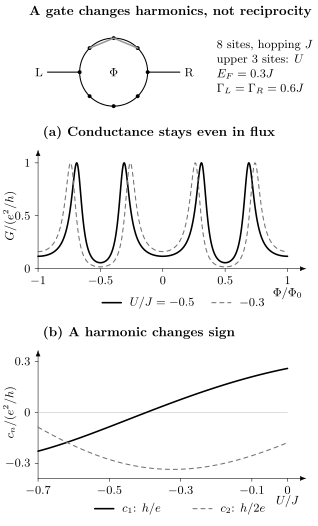
An exactly coherent, spin-resolved model ring. Both conductance traces remain even in flux. The signed first harmonic crosses zero near , while the second remains finite: a strong component needs neither dephasing nor pairing. The nearest-neighbor hopping is , three upper-arm sites have energy , and opposite sites contact reservoirs with energy-independent broadening . The calculation uses and zero temperature.
For readers reproducing the figure, label the sites cyclically. Set with its Hermitian conjugate and ; this chooses the flux orientation. The on-site energies of sites 1–3 are and the others are zero. With ,
Here is the retarded Green function, not the conductance. The imaginary contact term describes escape into ideal reservoirs; it is not an intrinsic dephasing rate.
Yacoby, Schuster, and Heiblum (1996) demonstrate phase rigidity and an enhanced relative second harmonic experimentally. In a multiterminal device reciprocity relates different lead arrangements rather than necessarily making one measured trace even. Nonlinear conductance is also not subject to the same evenness condition; see Leturcq and colleagues (2006). A phase fitted over only a positive-field window, especially after background subtraction or changes in effective area, is not automatically the harmonic phase defined about zero flux.
What h/e and h/2e mean
Section titled “What h/e and h/2e mean”The Byers–Yang argument applies when flux is inserted through an inaccessible hole while the field in the conducting region and other parameters are fixed. Gauge invariance gives an period for a normal charge- system, including interactions treated consistently. It does not require to be the smallest period of every observable: an oscillation is also periodic under .
| Contribution | Physical origin |
|---|---|
| Sample-specific | Interfering paths differ by one winding |
| Higher harmonics | Paths differ by several windings |
| Normal-state after averaging | A diffusive loop interferes with its time reverse |
| Superconducting response | A charge- condensate; a different mechanism |
For time-reversed diffusive loops, the static-disorder propagation phases agree while the magnetic phases have opposite signs. Their difference is twice the single-loop phase, giving . These Altshuler–Aronov–Spivak oscillations survive disorder averaging more readily than the signed sample-specific term (Altshuler, Aronov, and Spivak, 1981; Aronov and Sharvin, 1987). Spin and spin–orbit scattering affect their amplitude and sign. An peak in one normal ring alone does not identify this mechanism: repeated paths already generate the same harmonic.
A uniform-field experiment is less ideal than hole-flux insertion. The field also changes motion within the arms, producing a slowly varying background, weak-localization structure, and aperiodic conductance fluctuations. A ring can exhibit recognizable oscillations without the entire measured curve being exactly periodic.
Temperature, winding, and escape
Section titled “Temperature, winding, and escape”Thermal averaging depends on a delay difference
Section titled “Thermal averaging depends on a delay difference”Linear conductance averages the energy-dependent transmission with , where is the reservoir Fermi function. Consider a two-path contribution with approximately constant amplitudes over that window and
The delay difference is ; for simple ballistic arms it is the difference of traversal times. Averaging the cosine multiplies its amplitude by
The result follows by Fourier transforming the normalized Fermi derivative. It approaches one as and for . Equal delays give no suppression in this model, even if both paths are long. That does not remove environmental phase fluctuations or energy dependence of the junction amplitudes. Thermal averaging and phase breaking can both matter in real rings (Hansen and colleagues, 2001).
A solvable model for diffusive winding
Section titled “A solvable model for diffusive winding”Let a narrow diffusive ring have circumference and diffusion constant . On its unwrapped coordinate, the probability density for a displacement after time is
Suppose phase breaking is exponential and escape is represented by a uniform loss rate. Define . The time-integrated return weight is then
For time-reversed loops, the th winding multiplies . Longer windings are suppressed because they require longer diffusive returns. This is a return weight, not a complete conductance formula: contact geometry, spin, thermal averaging and the conversion from returns to transmission still matter. Localized ring junctions do not generally act like uniform escape.
Even within this simple model, adjacent positive-winding weights obey , which determines rather than . An exponential harmonic envelope therefore cannot, by itself, separate intrinsic dephasing from escape. Use an independently characterized contact model before making that identification.
Reading a field sweep
Section titled “Reading a field sweep”For a nearly fixed enclosed area , the th harmonic has field frequency and period
Thus converting a Fourier peak to area requires the harmonic assignment: . A finite field span gives a characteristic frequency resolution , with a window-dependent prefactor. The corresponding area scale is . Zero padding makes a spectrum look smoother but adds no resolving power. Changing the field window or background subtraction tests whether a peak is stable.
Finite arm width supplies a distribution of orbital areas. For trajectories confined to an annulus, is a useful geometric comparison, not an exact transport theorem. Gate depletion, magnetic deflection and flux focusing can shift it. A broad Fourier peak need not mean a short coherence length.
Finally, electromagnetic flux phase and Berry phase are distinct contributions to an interference experiment. Ordinary metallic rings already show oscillations. Claims about topological surface bands require the predicted gate, spin and flux dependence together with independent characterization of the bands; an peak alone establishes neither a Berry phase nor a bulk topological invariant.
Exercises
Section titled “Exercises”1. Convert a period to an area
Section titled “1. Convert a period to an area”A ring has a first-harmonic field period of . Find its effective area and circular radius. How would the answer change if the peak were the second harmonic?
Solution
For , and . For , the same period gives half the area and a radius smaller by : and . Geometry helps choose the assignment; the period alone does not.
2. Lose contrast without losing coherence
Section titled “2. Lose contrast without losing coherence”Let and . Find the extreme transmissions and visibility. Then let a ballistic delay difference be at . How does thermal averaging change the visibility?
Solution
The extrema are , namely and . Their visibility is . With , the thermal argument is and . The visibility becomes if the constant background is unchanged. Neither reduction requires irreversible phase loss. This calculation uses the two-path illustration, not a complete reciprocal ring model.
3. A phase jump without pairing
Section titled “3. A phase jump without pairing”Suppose , where and remains smooth while crosses zero. Describe the first-harmonic phase and the trace at the crossing.
Solution
The first-harmonic phase is zero for and for when its amplitude is defined to be positive. At that phase is undefined, so a continuous physical change can produce an apparent jump. At the crossing only the term remains in this truncated expansion. The trace stays even in field throughout; no condensate or change of carrier charge has been assumed.
4. What does a harmonic ratio measure?
Section titled “4. What does a harmonic ratio measure?”In the uniform-loss diffusion model, take , and . Find and . If , find and .
Solution
The length is , giving . Subtracting the escape rate gives
Thus and . Ignoring escape would incorrectly identify as the coherence length. A proposed escape rate exceeding would be incompatible with this model and these inputs.
5. Does a smoother Fourier spectrum resolve two areas?
Section titled “5. Does a smoother Fourier spectrum resolve two areas?”A field sweep spans . Two proposed first-harmonic areas differ by . Estimate whether ordinary Fourier peak separation is plausible, and explain what zero padding changes.
Solution
The nominal area resolution is , larger than the proposed separation. Equivalently, the two frequencies differ by about , below the roughly window scale. Zero padding interpolates the same information. A longer useful field window would improve resolution, provided the paths remain approximately stationary. Model-based fitting can use additional assumptions, but closely spaced components then require uncertainty and model checks.
References
Section titled “References”- B. L. Altshuler, A. G. Aronov, and B. Z. Spivak, “The Aharonov–Bohm Effect in Disordered Conductors,” JETP Letters 33, 94–97 (1981).
- A. G. Aronov and Yu. V. Sharvin, “Magnetic Flux Effects in Disordered Conductors,” Reviews of Modern Physics 59, 755–779 (1987), doi:10.1103/RevModPhys.59.755.
- M. Büttiker, Y. Imry, R. Landauer, and S. Pinhas, “Generalized Many-Channel Conductance Formula with Application to Small Rings,” Physical Review B 31, 6207–6215 (1985), doi:10.1103/PhysRevB.31.6207.
- N. Byers and C. N. Yang, “Theoretical Considerations Concerning Quantized Magnetic Flux in Superconducting Cylinders,” Physical Review Letters 7, 46–49 (1961), doi:10.1103/PhysRevLett.7.46.
- A. E. Hansen, A. Kristensen, S. Pedersen, C. B. Sørensen, and P. E. Lindelof, “Mesoscopic Decoherence in Aharonov–Bohm Rings,” Physical Review B 64, 045327 (2001), doi:10.1103/PhysRevB.64.045327.
- R. Leturcq, D. Sánchez, G. Götz, T. Ihn, K. Ensslin, D. C. Driscoll, and A. C. Gossard, “Magnetic Field Symmetry and Phase Rigidity of the Nonlinear Conductance in a Ring,” Physical Review Letters 96, 126801 (2006), doi:10.1103/PhysRevLett.96.126801.
- R. A. Webb, S. Washburn, C. P. Umbach, and R. B. Laibowitz, “Observation of Aharonov–Bohm Oscillations in Normal-Metal Rings,” Physical Review Letters 54, 2696–2699 (1985), doi:10.1103/PhysRevLett.54.2696.
- A. Yacoby, R. Schuster, and M. Heiblum, “Phase Rigidity and Oscillations in a Single-Ring Aharonov–Bohm Experiment,” Physical Review B 53, 9583–9586 (1996), doi:10.1103/PhysRevB.53.9583.