

Addition of Angular Momentum
Two spin- systems have four joint states, but joint rotations organize them into a triplet and a singlet. Angular-momentum addition generalizes this observation: it decomposes a tensor-product representation into definite total- multiplets. The resulting coupled basis can simplify an interaction without changing the physical state or its entanglement merely by rewriting its coordinates.
Helpful background. Tensor products describes the joint space, while angular-momentum algebra gives the states within each multiplet.
Enter this chapter
Section titled “Enter this chapter”| Question | Read next |
|---|---|
| What rotates when two systems rotate together? | Tensor-product representations and total angular momentum |
| Which basis fits the measurements? | Coupled and uncoupled bases |
| What is the simplest complete example? | Two spin- particles and singlet and triplet states |
| How do we change basis and keep the signs consistent? | Clebsch–Gordan coefficients and tables and conventions |
| How does spin couple to orbital motion? | Orbital plus spin and spin–orbit coupling |
| Which angular momenta should be combined first? | Coupling schemes and recoupling |
| How does exchange constrain the state? | Exchange symmetry |
Joint rotations define the total generator
Section titled “Joint rotations define the total generator”For two fixed irreducible angular momenta, . Rotating both by the same physical rotation gives , so
Operators on different factors commute. The resulting obeys the angular-momentum algebra and has . Thus the total projection is additive, , while the total magnitude is determined by the representation decomposition below.
The triangle rule preserves the dimension
Section titled “The triangle rule preserves the dimension”For two angular momenta, the tensor product decomposes as
Equivalently, the allowed total angular momenta are
Each allowed occurs once when exactly two irreducible angular momenta are coupled. For each ,
Dimension counting checks that no states were lost or duplicated:
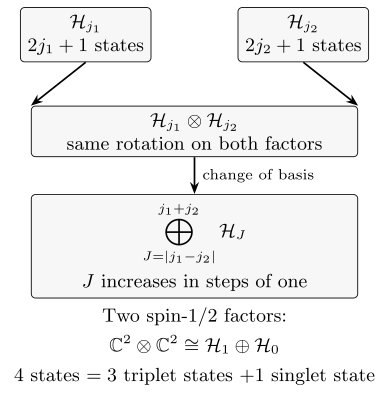
The tensor product is the composite Hilbert space. Under the diagonal rotation action it decomposes into irreducible sectors from through .
For three or more factors, the same total can occur with multiplicity. Extra intermediate-coupling labels are then needed to distinguish equivalent irreducible sectors.
The triplet and singlet make the basis change concrete
Section titled “The triplet and singlet make the basis change concrete”For two spin- factors,
The four-dimensional product space becomes a three-dimensional triplet plus a one-dimensional singlet. In the standard phase convention,
and
The relative sign distinguishes the triplet from the singlet. An overall phase multiplying either complete state would not change its ray.
The inverse relations are equally useful:
Thus a product state with total projection need not have definite total spin. Measuring in gives the triplet and singlet sectors with equal probability.
The coupled states diagonalize ; the product states diagonalize the two individual projections instead of . In the example, remains a product state even when expressed as a superposition of singlet and triplet states. A passive basis change does not physically prepare either entangled state.
For general , the overlaps between these bases are Clebsch–Gordan coefficients. Fix the factor order and phase convention before combining tables. Coefficients vanish unless the triangle condition, the allowed projection ranges, and all hold; these necessary tests do not fix every remaining coefficient.
Scalar interactions are simple in a coupled basis
Section titled “Scalar interactions are simple in a coupled basis”For any two angular momenta,
On a coupled state this becomes the number
Therefore a rotationally invariant Hamiltonian
is diagonal in the coupled basis. The coefficient contains system-dependent dynamics; angular momentum addition supplies the universal eigenvalue pattern.
For two spin- systems the scalar product is in the triplet and in the singlet. Therefore splits the sectors without splitting the three magnetic triplet states. The coefficient has units of energy divided by angular momentum squared. A rotationally invariant interaction with additional multiplicity spaces can act nontrivially on those spaces, so total alone need not completely diagonalize a larger problem.
Orbital and spin coupling needs the Hamiltonian too
Section titled “Orbital and spin coupling needs the Hamiltonian too”For a particle with orbital and spin , the allowed totals are when , and only for . A central spin–orbit interaction is diagonal in the angular labels because
Its two angular eigenvalues are and . The radial multiplication operator still acts on radial wavefunctions; this identity does not diagonalize an arbitrary radial Hamiltonian. In perturbation theory, its expectation in the chosen radial state supplies the corresponding coefficient.
In multi-electron atoms, LS coupling first forms total and total ; jj coupling first combines each electron’s orbital and spin angular momenta. These are useful limiting bases for different interaction hierarchies. When the terms compete, states can mix while total remains exact. Coupling schemes explains how to choose labels from the actual Hamiltonian.
For three or more angular momenta, different intermediate labels distinguish repeated copies of the same total . Wigner symbols change the coupling order of three factors; symbols compare common pairwise couplings of four. They describe basis transformations, not new physical interactions.
Exchange concerns the whole particle state
Section titled “Exchange concerns the whole particle state”Two equal spin- factors have exchange sign in the total-spin- sector. Thus the spin triplet of two electrons is symmetric and the spin singlet antisymmetric. If the state factors into a spin part and a spatial part, and no further internal factors are present, total fermionic antisymmetry requires opposite exchange signs for those two parts. This is exchange of particle labels, not spatial inversion about an origin.
A general spin–spatial state need not be a single such product. The full state must obey the exchange rule in all cases. Continue to spin and spatial wavefunctions for antisymmetrization, and to Composite Systems for subsystem entanglement. Angular-momentum addition itself does not derive the spin–statistics connection.
Exercises
Section titled “Exercises”- Couple and . List the allowed total values and verify the dimension identity.
Solution
The triangle rule gives
The product-space dimension is
The irreducible-sector dimensions are
and as required.
- Add orbital angular momentum to spin . Find the allowed values, check the dimensions, and evaluate in each sector.
Solution
The allowed total angular momenta are
Their dimensions are and , matching
For ,
For ,
- Decompose the representation of three spin- systems and explain why an intermediate coupling label is needed.
Solution
First couple two spins:
Then add the third spin:
The dimensions check:
Total occurs twice. A label such as or distinguishes the two copies in the coupling scheme that combines spins and first. Changing to a basis labeled by is a recoupling transformation governed by a Wigner symbol.
References
Section titled “References”- D. M. Brink and G. R. Satchler, Angular Momentum, 3rd ed., Oxford University Press, 1993.
- C. Cohen-Tannoudji, B. Diu, and F. Laloë, Quantum Mechanics, Wiley, 1977.
- A. R. Edmonds, Angular Momentum in Quantum Mechanics, Princeton University Press, 1957.
- J. J. Sakurai and J. Napolitano, Modern Quantum Mechanics, 3rd ed., Cambridge University Press, 2020.
- R. Shankar, Principles of Quantum Mechanics, 2nd ed., Springer, 1994.
- D. A. Varshalovich, A. N. Moskalev, and V. K. Khersonskii, Quantum Theory of Angular Momentum, World Scientific, 1988.
- R. N. Zare, Angular Momentum: Understanding Spatial Aspects in Chemistry and Physics, Wiley, 1988.