

Core Formalism
Quantum mechanics predicts what can happen when a prepared system evolves and is measured. This volume develops the language behind those predictions: states, observables, amplitudes, probabilities, and the rules for changing or combining systems. The same ideas apply to a spin, an atom, or a particle described by a wavefunction.
Begin with a two-outcome experiment
Section titled “Begin with a two-outcome experiment”Choose two orthonormal states and . A normalized preparation might be
For a measurement in this basis, the probabilities are the squared moduli of the coefficients: and . Their sum is one. The factor does not affect these two probabilities, but it matters for other measurements. This small example introduces the distinction between a state, its amplitudes, and a specified measurement.
Work through The Operational Structure of Quantum Mechanics to see how those same ingredients describe interference. If bra–ket symbols are new, start with the notation guide.
Build the theory in stages
Section titled “Build the theory in stages”| Your next question | Chapter |
|---|---|
| What is a state, and how do coordinates describe it? | States and representations |
| What are the possible values of a measurement? | Observables and operators |
| How do amplitudes give probabilities and averages? | Probability and the Born rule |
| Which quantities can be sharp together? | Compatibility and uncertainty |
| What changes after an outcome is recorded? | Measurement and state update |
| How does a state change with time? | Time evolution |
| How do systems combine? | Composite systems and entanglement basics |
| How do I describe mixtures and subsystems? | Density operators |
| How do the rules fit together? | Postulates and equivalent presentations |
| When does a classical description work? | Classical limit and correspondence |
Use the reference aids for symbols, translations between representations, and practice problems. Mathematical objects and physical meaning develops the distinction between a state and its representations; finite and infinite dimensions explains when matrix intuition needs additional assumptions.
A reading map
Section titled “A reading map”For a first pass, begin with quantum states, observables, and the Born rule. Then explore measurement and evolution alongside tensor products and density operators. Commutators and uncertainty can be studied with the measurement branch; you do not need to finish every earlier article before trying a physical example.
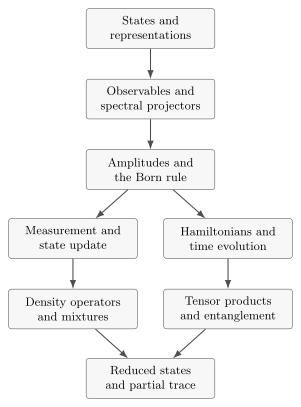
One possible reading order. The two branches introduce state changes and composite systems; both help with reduced states. Arrows suggest a study sequence, not logical prerequisites for every topic. Commutators and uncertainty can be studied alongside the measurement branch.
Coming from wave mechanics? Start with the finite–infinite comparison and wave-mechanics postulates to connect wavefunctions to the abstract language.
Coming from quantum information? Follow states, the Born rule, tensor products, density operators, and measurement; the finite-dimensional postulates collect the matrix formulation. Return to continuous spectra and operator domains when spatial motion enters.
Check the reading map. Choose three arrows and explain why the source topic helps with the target topic.
Solution
States help with the Born rule because probabilities are assigned to states. Observables help because measurement projectors or effects define the outcomes. Tensor products help with entanglement because entanglement is a property of composite-system states in tensor-product Hilbert spaces.
Which topics should you review before calculating a reduced density operator?
Solution
Review states, tensor products, entangled states, and the density-operator trace rule. The partial trace combines the description of a joint state with the requirement to reproduce every local prediction on one subsystem.
Connect a rule to a physical model
Section titled “Connect a rule to a physical model”Learning the Born rule does not yet specify an atom or a barrier. A calculation also needs a Hamiltonian, state space, and physical assumptions. The qubit-precession example shows how a Hamiltonian changes a later measurement probability. Wave Mechanics and Model Systems develops wells, oscillators, and scattering; its current-ratio calculation explains why a transmitted amplitude alone is not generally a transmission probability.
Choose further subjects by the calculation you need: Dynamics and Formulations for propagators and pictures of motion, Approximation Methods for controlled corrections, Scattering Theory for asymptotic amplitudes, and Symmetry for generators and selection rules. Tensor products and density operators lead to Composite Systems and Entanglement; identical particles and Fock space belong to Many-Body Theory. Conditional state update and noise lead to Measurement and Open Quantum Systems, while Foundations examines the assumptions and interpretations behind the rules.
Use Mathematical Toolkit for a missing mathematical step, Mathematical Quantum Mechanics for quantum-specific hypotheses and proofs, and Reference for a compact lookup.
References
Section titled “References”- P. A. M. Dirac, The Principles of Quantum Mechanics, 4th ed., Oxford University Press, 1958.
- A. Peres, Quantum Theory: Concepts and Methods, Kluwer, 1995.
- R. Shankar, Principles of Quantum Mechanics, 2nd ed., Springer, 1994.