

Molecular Quantum Mechanics
A molecule is a quantum system of electrons and nuclei whose internal states can bind, rotate, vibrate, tunnel, dissociate, react, and exchange energy with radiation. Molecular structure is not inserted into the exact Coulomb Hamiltonian as a fixed arrangement of classical nuclei. It emerges through a hierarchy: separate overall translation, solve or approximate the coupled internal problem, exploit the electron–nuclear mass ratio, identify potential-energy surfaces, quantize nuclear motion, and connect transitions among the resulting rovibronic states to spectra and dynamics.
Three cautions organize the subject:
- Nuclei remain quantum particles. “Clamped nuclei” names an auxiliary electronic eigenproblem, not the final molecular model.
- Orbitals and structures are representations. The full observable state is a many-particle wavefunction or density operator with the required symmetries.
- Energy-scale separation is powerful but conditional. Near electronic degeneracies, avoided crossings, dissociation thresholds, and conical intersections, several electronic channels may have to be retained.
This chapter follows the path from the full molecular Hamiltonian to chemical and spectroscopic observables without treating a ball-and-stick picture as a microscopic premise.
Helpful background. The hydrogen atom introduces Coulomb binding; fermions introduces electronic exchange symmetry; Born–Oppenheimer scale separation derives the electronic-channel equations used here.
What Makes Molecules Harder Than Atoms
Section titled “What Makes Molecules Harder Than Atoms”An isolated atom already combines Coulomb interaction, fermionic antisymmetry, angular momentum, correlation, and relativity. A molecule adds several layers.
More dynamical particles
Section titled “More dynamical particles”There are at least two nuclei, so internuclear distances and angles become quantum coordinates. Nuclear motion changes the electronic Hamiltonian, while the electronic state changes the forces governing nuclear motion.
No universal central field
Section titled “No universal central field”Except for special limits, a molecule has no spherically symmetric one-center potential. Orbital angular momentum about one nucleus is generally not conserved. Point-group labels, body-fixed projections, total angular momentum, parity, and permutation symmetry replace the simple hydrogenic label set.
Several nested energy scales
Section titled “Several nested energy scales”Electronic excitation, vibration, rotation, tunneling, spin splittings, and hyperfine structure often occupy different energy ranges. Their hierarchy enables approximations but also produces dense spectra and many couplings.
Several physically relevant asymptotes
Section titled “Several physically relevant asymptotes”A molecular state can correlate with different separated-atom, ion-pair, or fragmentation channels. Binding must be defined relative to the correct threshold, including electronic terms, nuclear motion, and conserved quantum numbers.
Structure is an effective description
Section titled “Structure is an effective description”The isolated Hamiltonian is rotationally invariant, and its eigenstates can be labeled by total angular momentum and a space-fixed projection. A particular magnetic substate need not have an isotropic angular distribution. A body-fixed equilibrium geometry describes internal shape; it is not a set of nuclei fixed at particular laboratory positions.
The Laboratory-Frame Hamiltonian
Section titled “The Laboratory-Frame Hamiltonian”Let electrons have coordinates , and let nuclei have coordinates , charges , and masses . In Hartree atomic units, with nuclear masses expressed in electron-mass units, the nonrelativistic Coulomb Hamiltonian is
Molecular Hamiltonian explains each term, the exact symmetries, center-of-mass separation, and dissociation thresholds.
Each term has a distinct role:
- the first line contains electronic and nuclear kinetic energy;
- the second line contains electron–electron and nucleus–nucleus repulsion;
- the third line contains electron–nucleus attraction.
There is no fundamental “bond potential” added to this Hamiltonian. Bonding, equilibrium geometry, barriers, and molecular spectra arise from its states and from controlled reductions of it.
This Hamiltonian omits relativistic interactions, coupling to external fields, finite nuclear size, radiative corrections, and nuclear internal excitations. Those terms can be added when the target uncertainty demands them.
Exchange symmetry is required twice
Section titled “Exchange symmetry is required twice”Electrons are identical fermions, so the total electronic state is antisymmetric under electron exchange. Identical nuclei must also obey their own bosonic or fermionic exchange symmetry, including nuclear spin. These are separate requirements:
while for identical nuclei and ,
The electronic spatial-spin symmetry, nuclear-spin symmetry, rotation, and vibration must combine consistently. Ortho and para nuclear-spin isomers are a familiar consequence, not an optional spectroscopic correction.
Remove Overall Translation
Section titled “Remove Overall Translation”For an isolated molecule with no external field, translational invariance implies conservation of total momentum. In atomic units, define
and the center-of-mass coordinate
A suitable change to center-of-mass and internal coordinates gives
The wavefunction can be factored into a free center-of-mass state and an internal molecular state,
Exact internal coordinates can generate reduced-mass, mass-polarization, Coriolis, and other kinetic couplings. Their form depends on the coordinate convention; their physical predictions do not. Removing overall translation is exact for the isolated nonrelativistic problem, whereas separating electronic, vibrational, and rotational motion is generally approximate.
Electronic and Nuclear Degrees of Freedom
Section titled “Electronic and Nuclear Degrees of Freedom”After translation is removed, it is useful to classify internal variables by what changes.
| Sector | Typical coordinates or labels | Physical content |
|---|---|---|
| Electronic | electron positions, electronic spin, occupations, electronic symmetry | charge distribution, exchange, correlation, electronic excitation |
| Vibrational | bond stretches, bends, torsions, collective normal coordinates | shape fluctuations, zero-point motion, tunneling, dissociation |
| Rotational | orientation and body-fixed angular momentum | overall molecular rotation and rotational fine structure |
| Nuclear spin | nuclear-spin projections and coupled spin labels | exchange statistics and hyperfine structure |
| Coupled rovibronic | total angular momentum, parity, vibronic symmetry | observable stationary levels of the internal Hamiltonian |
The separation among these sectors is a model organization. The exact internal Hamiltonian can couple all degrees of freedom allowed by symmetry.
Counting nuclear shape coordinates
Section titled “Counting nuclear shape coordinates”For nuclei in three dimensions there are Cartesian coordinates. Remove three overall translations. For a nonlinear equilibrium geometry, remove three rotations, leaving
For a linear molecule, rotation about the molecular axis does not change the nuclear configuration, so only two rotational coordinates are removed:
These counts describe small-amplitude vibrational coordinates near a nondegenerate equilibrium geometry. Floppy molecules, internal rotors, dissociation coordinates, and coordinate singularities may require a less local description.
Born–Oppenheimer Separation
Section titled “Born–Oppenheimer Separation”Born–Oppenheimer in Molecules develops the molecular application in detail, including equilibrium structures, normal modes, isotope scaling, diagonal corrections, and the distinction between bare, adiabatic, and coupled-surface treatments.
The mass ratio
suggests organizing the internal problem into fast electronic and slow nuclear motion. At each nuclear geometry , solve an electronic eigenproblem
There are two common conventions:
- include the internuclear repulsion in , so is already a potential-energy surface;
- exclude from and define
Both are valid when stated and used consistently.
Using a complete electronic basis, including continuum contributions where necessary, an exact channel expansion has the form
The simplest one-surface Born–Oppenheimer equation retains one channel and drops electronic derivative terms, including the diagonal correction:
The electronic state has not disappeared. Its eigenvalue supplies the nuclear potential, and its geometry dependence controls the omitted couplings.
Where the approximation enters
Section titled “Where the approximation enters”The channel expansion itself is exact for a complete electronic basis. Approximation enters when channels are discarded or when nuclear derivatives of are neglected. For nondegenerate channels,
obeys, for away from degeneracy,
A small nuclear velocity does not compensate for a vanishing electronic gap. Avoided crossings and conical intersections can therefore invalidate a one-surface picture even when nuclei are heavy.
What “fast electrons” does not mean
Section titled “What “fast electrons” does not mean”The approximation is not based on assigning classical orbital periods to electrons and nuclei. It is a spectral and asymptotic statement about a slow–fast Hamiltonian, channel gaps, derivative couplings, nuclear momenta, and the region of configuration space occupied by the state.
Potential-Energy Surfaces
Section titled “Potential-Energy Surfaces”A potential-energy surface is an electronic eigenvalue, including internuclear repulsion under the convention used here, as a function of nuclear geometry. Translation and global rotation do not change it. At a generic nonlinear geometry, a local shape-space description has independent coordinates. The normal-mode count at a linear equilibrium is an infinitesimal vibrational count, not the dimension of a regular global shape-space chart; quotienting out rotations is singular at collinear geometries. The dedicated Potential Energy Surfaces page develops coordinate metrics, stationary-point index, reaction paths, barriers, asymptotes, multistate crossings, and fit validation.
Minima and equilibrium geometry
Section titled “Minima and equilibrium geometry”An equilibrium geometry on one surface satisfies
with a positive Hessian in the stable internal directions. The geometry is the minimum of an effective surface. It need not equal:
- the expectation value of a bond length in a vibrational state;
- a thermally averaged diffraction geometry;
- the most probable geometry in every coordinate measure;
- a structure that remains meaningful near dissociation or strong nonadiabatic mixing.
Nuclear zero-point motion samples a region around the minimum even at zero temperature.
Barriers, saddles, and reaction coordinates
Section titled “Barriers, saddles, and reaction coordinates”A first-order saddle on a surface often organizes a reaction pathway: the Hessian has one unstable direction and stable directions transverse to it. The barrier height alone does not determine a rate. Zero-point energies, tunneling, entropy, recrossing, multiple pathways, solvent or environment, and coupling among surfaces can all matter.
Dissociation thresholds
Section titled “Dissociation thresholds”For a diatomic ground-state surface with asymptote and minimum , the well depth is
Neglecting rotation, the dissociation energy from the lowest vibrational level is smaller:
when the separated fragments carry no corresponding vibrational zero-point contribution. Experimental threshold conventions must specify fragment electronic states, isotope, and internal excitation.
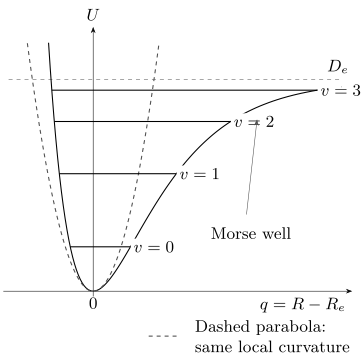
The well depth is measured from the potential minimum. Dissociation from the lowest vibrational level requires the smaller energy , because that level already has zero-point energy. The Morse model also shows why a local harmonic approximation cannot describe every level up to dissociation. See Vibrations of Diatomics for the model and its assumptions.
Adiabatic and diabatic representations
Section titled “Adiabatic and diabatic representations”Adiabatic surfaces are the eigenvalues of and are invariant under a change of electronic basis. In a diabatic representation, the diagonal matrix elements are different curves and off-diagonal potential couplings remain. Derivative couplings also transform. A consistently transformed coupled-channel calculation gives the same physical predictions; a diabatic diagonal curve should not be mistaken for an invariant adiabatic eigenvalue.
Bonding as a Quantum Phenomenon
Section titled “Bonding as a Quantum Phenomenon”A chemical bond is not represented by one unique Hermitian “bond operator.” Several complementary diagnostics answer different questions:
- a bound minimum relative to specified fragmentation thresholds;
- electron-density accumulation or depletion;
- reduced density matrices and pair densities;
- energy decomposition within a declared scheme;
- vibrational frequencies and force constants;
- dissociation energies and reaction energetics;
- localized orbitals, bond orders, or resonance weights defined within a representation.
Chemical Bonding compares these diagnostics with covalent, ionic, and weak-interaction examples.
Molecular-orbital language
Section titled “Molecular-orbital language”Molecular Orbitals develops the one-electron language in detail. Molecular orbitals are often expanded in atom-centered basis functions,
Bonding and antibonding labels describe phase and density patterns within a chosen one-electron model. Occupying orbitals produces an antisymmetrized many-electron reference, not the exact state automatically. Orbital energies, shapes, and localization depend on the approximation and orbital rotations allowed.
H₂⁺ Ion is a worked example connecting this language to a molecular Hamiltonian and potential curve. Because H₂⁺ has only one electron, its exact fixed-center orbital, minimal LCAO approximation, nuclear repulsion, and two-state interpretation can be compared without electron-correlation ambiguities.
Hydrogen Molecule adds the smallest possible electron–electron problem. It compares Heitler–London, restricted molecular-orbital, broken-symmetry, and configuration-interaction descriptions against the same neutral-fragment dissociation test.
Electronic Structure Overview compares the fixed-geometry electronic equation, basis sets, Hartree–Fock, configuration interaction, coupled cluster, density-functional theory, multireference methods, excited-state routes, and validation. Follow its method links for derivations and practical limitations.
Valence-bond language
Section titled “Valence-bond language”Valence Bond Theory develops localized atomic-like orbitals, spin coupling, ionic and covalent structures, and resonance among them. These descriptions can expose local pairing and dissociation physics that a single delocalized determinant hides. Molecular-orbital and valence-bond expansions span the same exact Hilbert space when both are complete; practical truncations emphasize different structures.
Binding is a total-energy statement
Section titled “Binding is a total-energy statement”For fragments and , a molecular state is stable against that channel when
for energies computed with the same Hamiltonian, masses, relativistic content, basis-limit convention, and fragment quantum numbers. Calling one orbital “bonding” is not a substitute for this comparison.
Exchange, electrostatics, kinetic-energy redistribution, polarization, and correlation are not independent fundamental forces. They are useful components of particular analyses of the same interacting quantum state.
Rotations and Vibrations
Section titled “Rotations and Vibrations”Near a stable minimum, nuclear motion can often be organized into normal vibrations and overall rotation.
Harmonic normal modes
Section titled “Harmonic normal modes”Restore explicit in the following nuclear-motion formulas. Near , take small Cartesian displacements and project out rigid translations and rotations; denote the remaining displacement coordinates by . Expanding the surface gives
After mass weighting and diagonalizing the Hessian, one obtains normal coordinates with
The harmonic energies are
Real molecular surfaces are anharmonic. Mode coupling, resonances, large-amplitude motion, torsion, tunneling, and dissociation eventually invalidate independent harmonic oscillators.
Normal Modes of Polyatomics explains the generalized eigenproblem, projection, symmetry, and infrared/Raman activity.
Overall rotation
Section titled “Overall rotation”For a rigid rotor with negligible internal electronic and spin angular momentum, let be physical angular-momentum components along principal axes with moments of inertia . Then
For a linear rotor, use only the two perpendicular rotational degrees of freedom; its moment about the nuclear axis vanishes, so the three-axis formula must not be used by dividing by that zero moment. Spherical, symmetric, and asymmetric tops have different spectra. The spin-free diatomic rotor gives
Vibration changes the moments of inertia, rotation stretches bonds, and body-fixed coordinates generate Coriolis couplings. Thus “rotation plus vibration” is a leading organization, not an exact additive decomposition.
Rotations of Molecules develops this applied rotor hierarchy, including rotational-constant conventions, isotope-sensitive inertia tensors, centrifugal distortion, polyatomic rotor classes, and microwave inference.
Vibrations of Diatomics applies the local oscillator to one molecular bond, distinguishes angular-frequency and spectroscopic-wavenumber conventions, develops anharmonic and Morse models, and connects dipole derivatives to infrared activity.
Rovibrational Coupling reunites these leading rotational and vibrational models into joint term values, P/Q/R branches, state-dependent rotational constants, Coriolis structure, line strengths, and a practical band-assignment workflow.
A typical spectroscopic hierarchy
Section titled “A typical spectroscopic hierarchy”For many stable molecules away from degeneracies,
This is a useful empirical hierarchy, not a theorem. Floppy molecules, weak complexes, Rydberg states, near-degenerate electronic states, and large angular momentum can scramble it.
For a diatomic term expressed in wavenumbers, a common expansion is
The constants are fitted or computed effective parameters. They summarize the local spectrum; they are not a replacement for the underlying Hamiltonian outside their domain.
Electronic Excitations and Vibronic States
Section titled “Electronic Excitations and Vibronic States”An electronic transition changes the electronic channel, but the nuclei do not disappear during the transition. Initial and final states have rovibrational structure on their respective surfaces.
Under a one-surface product approximation,
For the following vibrational overlap, let denote internal shape coordinates and consider a body-fixed transition-dipole component; rotational angular factors are treated separately. Define the electronic transition dipole at fixed shape,
The vibronic transition amplitude is then
In the Condon approximation, is replaced by a nearly constant value over the nuclear wavepacket. The amplitude contains a vibrational overlap; the corresponding Franck–Condon factor in the intensity is its squared modulus:
The familiar “vertical transition” picture means that electronic excitation occurs on a time scale short compared with substantial nuclear displacement. It does not mean the nuclei have zero position uncertainty or that only one geometry contributes.
Vibronic coupling
Section titled “Vibronic coupling”Nuclear displacement can mix electronic states and can make otherwise forbidden transitions acquire intensity. Near a conical intersection, electronic and nuclear labels cannot be assigned independently over the whole relevant region. Geometric phase, nonadiabatic transfer, and ultrafast internal conversion are then central parts of the molecular dynamics.
Molecular Symmetry
Section titled “Molecular Symmetry”Several symmetry groups appear, and they answer different questions.
Point groups at a geometry
Section titled “Point groups at a geometry”The point group of a fixed nuclear framework classifies electronic orbitals, normal modes, and tensor components. Its irreducible representations predict which matrix elements vanish and how degeneracies are organized.
Molecular Symmetry develops the practical workflow from symmetry operations and character reduction to normal-mode, selection-rule, and orbital applications.
Full rotations and parity
Section titled “Full rotations and parity”An isolated field-free molecule is invariant under laboratory rotations. Total angular momentum and its space-fixed projection are therefore exact labels under the usual assumptions. Parity is exact when the Hamiltonian is inversion symmetric, even if a chosen equilibrium geometry is not itself centrosymmetric.
Permutation and inversion
Section titled “Permutation and inversion”Equivalent nuclei can be permuted through feasible or formal operations. Rovibronic and nuclear-spin functions must combine with the correct statistics. For nonrigid molecules, a molecular symmetry or permutation–inversion group can be more appropriate than the point group of one equilibrium geometry.
Symmetry labels do not guarantee purity
Section titled “Symmetry labels do not guarantee purity”States with the same exact symmetry can mix. Conversely, approximate labels such as a dominant normal-mode occupation or electronic configuration can remain useful even when they are not conserved. A spectroscopic assignment should distinguish exact quantum numbers from approximate parentage.
From States to Spectra
Section titled “From States to Spectra”The most basic spectral condition is
A line also requires a nonzero transition matrix element, an initial population, and a line-shape mechanism. Its observable strength depends on quantities such as
with degeneracy, polarization, thermal population, and experimental geometry included as appropriate.
What different spectral regions probe
Section titled “What different spectral regions probe”| Spectral structure | Primary change and information |
|---|---|
| Microwave or rotational | Changes rotational quantum numbers and reveals moments of inertia, geometry, dipole moments, and hyperfine structure. |
| Infrared | Changes vibrational state, often with rotational branches, and probes force constants, anharmonicity, symmetry, and isotope shifts. |
| Raman | Uses polarizability-mediated rotation or vibration and supplies complementary symmetry and mode information. |
| Visible or ultraviolet | Changes electronic state with vibronic structure and probes excited surfaces, transition dipoles, and photodynamics. |
| Photoelectron | Removes an electron while resolving ionic rovibronic states, probing ionization energies, correlation signatures, and nuclear geometry change. |
These are dominant associations, not exclusive categories. Fine, hyperfine, Zeeman, Stark, predissociation, collision, and environmental effects can appear across them.
Frequencies are not enough
Section titled “Frequencies are not enough”A trustworthy interpretation also considers:
- transition selection rules and intensity borrowing;
- isotope dependence;
- temperature and state populations;
- natural, Doppler, collision, transit-time, and instrumental widths;
- unresolved hyperfine or rovibronic components;
- perturbations by nearby states;
- uncertainty and calibration of the measured line position.
Spectroscopy is an inverse problem: the Hamiltonian and assignments are inferred from finite, broadened data. A precise fit can still use an incomplete physical model.
Choose the next lesson
Section titled “Choose the next lesson”For a first pass, follow Molecular Hamiltonian, Born–Oppenheimer in Molecules, and Potential Energy Surfaces. Then work through H₂⁺ and H₂ to see what changes when electron correlation enters.
For spectra, continue through rotation, diatomic vibration, polyatomic normal modes, and rovibrational coupling. Molecular Symmetry explains which states and transitions can mix.
For photochemical dynamics, study Nonadiabatic Coupling and Conical Intersections, then the molecular Berry phase. The Quantum Chemistry Roadmap gives a longer study sequence.
Exercises
Section titled “Exercises”1. Count vibrational modes
Section titled “1. Count vibrational modes”Find the number of small-amplitude vibrational modes of water, carbon dioxide, and methane. Treat water and methane as nonlinear and carbon dioxide as linear.
Solution
Water has nuclei and is nonlinear:
Carbon dioxide also has three nuclei but is linear:
The two perpendicular bending directions are degenerate in the linear equilibrium geometry but count as two normal coordinates.
Methane has nuclei and is nonlinear:
Degeneracy groups frequencies into symmetry multiplets; it does not reduce the number of independent coordinates.
2. Isotope scaling
Section titled “2. Isotope scaling”In a diatomic molecule, hold the electronic potential curve fixed while changing isotopes. Show how the harmonic vibrational frequency and rigid-rotor constant scale with the nuclear reduced mass .
Solution
Near equilibrium,
The harmonic frequency is
so
The equilibrium moment of inertia is
The rotational constant in energy units is
and therefore
The fixed-surface assumption is the leading Born–Oppenheimer isotope model. Adiabatic, nonadiabatic, and isotope-dependent structural corrections produce smaller deviations.
3. Distinguish well depth and dissociation energy
Section titled “3. Distinguish well depth and dissociation energy”A diatomic potential has minimum below its separated-fragment asymptote. Its vibrational zero-point energy relative to the minimum is . Neglect fragment internal excitation. Find and .
Solution
The well depth is measured from the potential minimum:
The lowest vibrational state lies above that minimum, so the energy required to dissociate from that state is
Reporting only “bond energy” would leave the reference ambiguous.
4. Franck–Condon overlap
Section titled “4. Franck–Condon overlap”In the Condon approximation, an electronic transition dipole is independent of . Show how the vibronic amplitude factorizes and explain why a transition between two allowed electronic states can still have a weak vibrational line.
Solution
If
then
The electronic factor may be nonzero while the nuclear overlap is small because the two surfaces have different equilibrium geometries, curvatures, or mode coordinates. The particular vibronic line is then weak even though the electronic transition is symmetry allowed. Intensity is distributed across the Franck–Condon progression.
References
Section titled “References”- P. W. Atkins and R. S. Friedman, Molecular Quantum Mechanics, 5th ed., Oxford University Press (2011).
- M. Born and K. Huang, Dynamical Theory of Crystal Lattices, Oxford University Press (1954), Appendix VIII.
- M. Born and R. Oppenheimer, “Zur Quantentheorie der Molekeln,” Annalen der Physik 389, 457–484 (1927), doi:10.1002/andp.19273892002.
- J. M. Brown and A. Carrington, Rotational Spectroscopy of Diatomic Molecules, Cambridge University Press (2003), doi:10.1017/CBO9780511814808.
- P. R. Bunker and P. Jensen, Molecular Symmetry and Spectroscopy, 2nd ed., NRC Research Press (1998).
- W. Domcke and D. R. Yarkony, “Role of Conical Intersections in Molecular Spectroscopy and Photoinduced Chemical Dynamics,” Annual Review of Physical Chemistry 63, 325–352 (2012), doi:10.1146/annurev-physchem-032210-103522.
- T. Helgaker, P. Jørgensen, and J. Olsen, Molecular Electronic-Structure Theory, Wiley (2000), doi:10.1002/9781119019572.
- G. Herzberg, Molecular Spectra and Molecular Structure I: Spectra of Diatomic Molecules, 2nd ed., Van Nostrand (1950).
- G. Herzberg, Molecular Spectra and Molecular Structure II: Infrared and Raman Spectra of Polyatomic Molecules, Van Nostrand (1945).
- G. Herzberg, Molecular Spectra and Molecular Structure III: Electronic Spectra and Electronic Structure of Polyatomic Molecules, Van Nostrand (1966).
- I. N. Levine, Quantum Chemistry, 7th ed., Pearson (2014).
- H. C. Longuet-Higgins, “The Intersection of Potential Energy Surfaces in Polyatomic Molecules,” Proceedings of the Royal Society A 344, 147–156 (1975), doi:10.1098/rspa.1975.0095.
- D. A. McQuarrie, Quantum Chemistry, 2nd ed., University Science Books (2008).
- NIST, Molecular Microwave Spectral Databases, Standard Reference Databases 114, 115, and 117, accessed 2026-07-21.
- NIST, Chemistry WebBook Guide: Vibrational and Electronic Spectra and Constants of Diatomic Molecules, Standard Reference Database 69, accessed 2026-07-21.
- E. B. Wilson Jr., J. C. Decius, and P. C. Cross, Molecular Vibrations: The Theory of Infrared and Raman Vibrational Spectra, Dover (1980).
- R. G. Woolley and B. T. Sutcliffe, “Molecular Structure and the Born–Oppenheimer Approximation,” Chemical Physics Letters 45, 393–398 (1977), doi:10.1016/0009-2614(77)80298-4.