

Normal Modes of Polyatomics
A normal mode of molecular vibration is a collective infinitesimal displacement pattern in which every nucleus oscillates at one angular frequency and with a fixed relative phase and amplitude. Near a stable equilibrium, mass weighting and diagonalization turn the coupled Cartesian nuclear motion into independent harmonic coordinates. Those coordinates connect four kinds of information:
- the curvature of a molecular potential-energy surface;
- the masses and equilibrium geometry of a chosen isotopologue;
- the symmetry and spatial pattern of each vibration;
- the frequencies and leading intensities expected in infrared and Raman spectra.
Normal modes are local and harmonic objects. They are not literal bond vibrations, unique atomic trajectories, or exact molecular eigenmotions at arbitrary amplitude. Their power comes from being the controlled leading approximation near an equilibrium geometry and a useful basis for systematic improvements.
Required background. Born–Oppenheimer separation and potential-energy surfaces define the Hessian. Coupled oscillators supplies matrix diagonalization, while molecular symmetry supplies representations and transition rules.
Small Oscillations Around Equilibrium
Section titled “Small Oscillations Around Equilibrium”Geometry and displacement vector
Section titled “Geometry and displacement vector”Consider an isolated molecule with nuclei and an equilibrium geometry
Collect the Cartesian displacements into a -component column vector
whose component is the displacement of nucleus along laboratory direction . The Cartesian mass matrix is diagonal:
Thus the mass of each nucleus is repeated for its three Cartesian components.
After the electronic problem and any declared adiabatic corrections have supplied a nuclear potential , expand about the equilibrium geometry:
At an unconstrained stationary geometry,
and the Cartesian Hessian has components
The harmonic kinetic and potential energies are therefore
The Hessian describes curvature, but curvature alone does not determine a frequency. Nuclear masses enter through the kinetic energy.
The generalized eigenproblem
Section titled “The generalized eigenproblem”The linearized equations of motion are
For a trial motion
one obtains
This is a symmetric generalized eigenvalue problem. The eigenvalue is the squared angular frequency, not the frequency itself:
Displacement vectors for distinct eigenvalues are mass-orthogonal; within a degenerate space one may choose a mass-orthonormal basis. Normalize them by
This metric matters. Cartesian eigenvectors that are orthogonal under the ordinary Euclidean dot product do not generally diagonalize the kinetic energy.
Mass Weighting and Normal Coordinates
Section titled “Mass Weighting and Normal Coordinates”Converting to an ordinary symmetric problem
Section titled “Converting to an ordinary symmetric problem”Define the mass-weighted displacement
and the mass-weighted Hessian
Then
The Cartesian and mass-weighted eigenvectors are related by
If the columns of are the orthonormal vibrational eigenvectors, define normal coordinates by
Equivalently,
The inverse transformation on the vibrational subspace is
The harmonic energies become diagonal:
Each mass-normalized has dimensions of mass times length. Some spectroscopy and quantum-chemistry programs rescale or the eigenvectors, so reported displacement columns from two programs need not agree numerically even when they represent the same physical subspace.
Frequency conventions
Section titled “Frequency conventions”Three related quantities are common:
Here is an angular frequency, is a frequency in cycles per unit time, and is a spectroscopic wavenumber, usually reported in . A table headed “frequency” may actually contain wavenumbers. Units and the convention must be checked before comparing calculations.
Removing Translation and Rotation
Section titled “Removing Translation and Rotation”The Cartesian coordinates include motion of the molecule as a whole. Internal vibration remains only after rigid translations and rotations are separated.
Translational vectors
Section titled “Translational vectors”In mass-weighted coordinates, an unnormalized translation along laboratory direction has components
There are always three independent translations for an isolated molecule.
Rotational vectors
Section titled “Rotational vectors”Place the origin at the center of mass. An infinitesimal rotation about unit vector gives the mass-weighted displacement
For a nonlinear molecule, three independent rotation vectors exist. For a linear molecule, rotation about the molecular axis moves no nucleus, so only two independent rotational displacement vectors exist.
After orthonormalizing the external vectors into the columns of , define
The vibrational problem may be solved with the projected matrix
restricted to the range of . Solving in that restricted space avoids mistaking the explicit zero eigenvalues of the projected full matrix for internal vibrations.
Mode count
Section titled “Mode count”For , the count is:
- Nonlinear molecule: translations, rotations, and vibrations.
- Linear molecule: translations, rotations, and vibrations.
The linear formula differs by one because rotation around the molecular axis has no infinitesimal Cartesian displacement. A monatomic species has no internal vibration and should not be forced into either formula.
Why computed external frequencies are rarely exactly zero
Section titled “Why computed external frequencies are rarely exactly zero”Exact translational and rotational invariance at an exact stationary point gives zero external eigenvalues. A calculation may instead produce small positive or negative values because of:
- incomplete geometry optimization;
- finite-difference noise or an asymmetric numerical Hessian;
- finite integration grids and thresholds;
- an external field, embedding environment, or coordinate constraint;
- imperfect projection of rigid motions;
- a geometry represented with rounded coordinates.
A low frequency is not “automatically a rotation.” Inspect the displacement vector and state the projection procedure and numerical thresholds.
What a Normal Mode Means
Section titled “What a Normal Mode Means”A collective pattern, not one bond
Section titled “A collective pattern, not one bond”In mode , nucleus has Cartesian displacement
Even a mode described informally as a C–H stretch can contain motion of many atoms. Local labels such as stretch, bend, rock, wag, or torsion are interpretations of a collective eigenvector, not definitions of the coordinate.
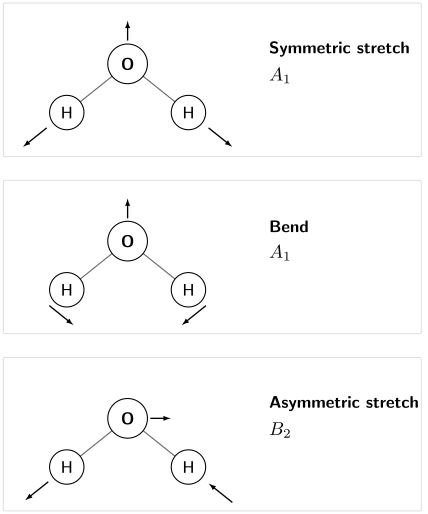
The three vibrational coordinates of nonlinear : symmetric stretch, bend, and asymmetric stretch. Arrow lengths are schematic rather than a program-specific normalization. With along the axis and the molecular plane chosen as , the modes transform as , , and .
Normalization is conventional
Section titled “Normalization is conventional”If is multiplied by a nonzero constant and is divided by the same constant, the Cartesian displacement is unchanged. Common outputs use mass normalization, Cartesian normalization, a chosen reduced mass, or a fixed visualization amplitude. Consequently:
- arrow length in a molecular viewer is not a zero-point amplitude;
- the largest displayed arrow need not identify the atom carrying most kinetic energy;
- “reduced mass of a mode” depends on the coordinate normalization convention;
- frequencies and invariant subspaces are more portable than raw eigenvector columns.
For the mass-normalized coordinate used here, the oscillator length is
The corresponding Cartesian zero-point displacement pattern is
Degenerate modes are subspaces
Section titled “Degenerate modes are subspaces”Suppose eigenvectors share one exact eigenvalue . Any orthogonal rotation inside their span,
is an equally valid eigenbasis. Individual columns in a degenerate pair or triplet are therefore not unique. The invariant objects are:
- the common frequency;
- the -dimensional eigenspace;
- its symmetry representation;
- observables formed without privileging an arbitrary basis inside that space.
Tiny numerical symmetry breaking can rotate or split a degenerate subspace. Comparing columns one by one is then unreliable; compare subspace overlaps or symmetry-adapted combinations.
Quantizing the Harmonic Modes
Section titled “Quantizing the Harmonic Modes”Promote and its conjugate momentum to operators:
The harmonic vibrational Hamiltonian is
where
Its term energies are
The one-dimensional eigenfunctions and ladder algebra are derived in Quantum Harmonic Oscillator. The molecular result here is the reduction of a coupled polyatomic problem to a product of those oscillators.
The harmonic ground-state zero-point energy is
This value depends on the isotopologue through the mass matrix. It also depends on the electronic-structure model through the Hessian and is not an exact dissociation or thermochemical correction.
Symmetry Classification
Section titled “Symmetry Classification”Vibrational representation
Section titled “Vibrational representation”At a symmetry-preserving equilibrium geometry, each point-group operation acts on the Cartesian displacements. Let this representation be . Formally,
The minus signs mean subtraction of representation multiplicities after decomposition into irreducible representations. They are not set subtraction.
For the point group that preserves both the equilibrium geometry and isotope masses, the mass-weighted Hessian commutes with every symmetry operation. Therefore its eigenspaces can be chosen to transform as irreducible representations. Symmetry therefore:
- block-diagonalizes the normal-mode problem;
- predicts exact degeneracies required by multidimensional irreducible representations;
- distinguishes modes that cannot mix while symmetry is preserved;
- supplies selection rules for infrared and Raman activity.
Molecular Symmetry develops the point-group operations, character reductions, and water example. Here the emphasis is how those labels attach to calculated molecular vibrations.
Symmetry-adapted coordinates
Section titled “Symmetry-adapted coordinates”Instead of diagonalizing all Cartesian displacements at once, one may first construct linear combinations that transform according to a chosen irreducible representation . A projection operator has the schematic form
where is the irrep dimension, is the group order, is its character, and acts on displacements. Applying these projectors to trial internal coordinates produces symmetry-adapted linear combinations.
Within one symmetry block, modes of the same irrep can mix. A label such as does not by itself identify “the symmetric stretch”; several modes may exist and exchange character as geometry, isotopic composition, or computational model changes.
Water and carbon dioxide
Section titled “Water and carbon dioxide”Two small molecules expose the counting and symmetry logic:
- Water: is nonlinear and belongs to . It has vibrational coordinates with symmetry .
- Carbon dioxide: is linear and belongs to . It has vibrational coordinates with symmetry .
For water, the two modes are conventionally called the symmetric stretch and bend, while the mode is the asymmetric stretch when the molecular plane is . Choosing the molecular plane as swaps the names and ; some evaluated tables therefore label the same asymmetric stretch . The displacement, degeneracy, and activity do not depend on that coordinate-label choice.
For carbon dioxide, is two-dimensional. The two perpendicular bending coordinates share one frequency in the isolated linear molecule. Thus carbon dioxide has four vibrational coordinates but only three distinct harmonic frequencies:
Counting named motions without counting degeneracy is a common source of the incorrect statement that a linear triatomic has only three normal modes.
Infrared Activity
Section titled “Infrared Activity”Dipole derivative criterion
Section titled “Dipole derivative criterion”Expand the body-fixed electric dipole component in normal coordinates:
For a harmonic fundamental from the vibrational ground state,
The mode is first-order infrared active if at least one component satisfies
A permanent dipole is neither necessary nor sufficient for a particular vibrational fundamental. What matters is the dipole change along that normal coordinate.
Symmetry statement
Section titled “Symmetry statement”For a nondegenerate totally symmetric vibrational ground state, the derivative can be nonzero only if transforms like a component of the dipole vector. In a finite point group this is commonly stated as
The more general transition rule is that
must contain the totally symmetric representation. The conjugate on the final-state representation comes from the bra and matters for complex irreducible representations. This form remains useful for excited vibrational states, combination bands, and vibronic coupling.
Water’s and modes all transform like allowed dipole components in , so all three fundamentals are infrared active. In carbon dioxide, the bend and antisymmetric stretch are infrared active, while the symmetric stretch is not first-order electric-dipole active.
Raman Activity
Section titled “Raman Activity”Polarizability derivative criterion
Section titled “Polarizability derivative criterion”In nonresonant Raman scattering, the leading molecular response is described by the polarizability tensor:
A harmonic fundamental is Raman active in the Placzek approximation when at least one tensor derivative is nonzero:
The relevant symmetry species are those carried by the quadratic functions
Infrared and Raman intensities probe different response derivatives. A strong infrared band need not be a strong Raman band, and a symmetry-allowed band may still be weak because its property derivative is small.
Mutual exclusion in centrosymmetric molecules
Section titled “Mutual exclusion in centrosymmetric molecules”For a molecule with an inversion center:
- dipole components are ungerade;
- polarizability components are gerade;
- every normal mode has either gerade or ungerade parity.
Therefore, within the electric-dipole and first-order Raman approximations, no fundamental normal mode is both infrared and Raman active:
- A gerade mode is infrared forbidden but may be Raman active.
- An ungerade mode may be infrared active but is Raman forbidden.
“Possibly” matters: parity alone does not guarantee activity, because the full irrep must match the relevant vector or quadratic-tensor species.
Carbon dioxide illustrates the rule. Its gerade symmetric stretch is Raman active, while its ungerade bend and antisymmetric stretch are infrared active. Water has no inversion center, so the mutual-exclusion argument does not apply; its fundamentals can be active in both techniques.
Symmetry breaking, suitable isotope substitution, an environment that removes inversion, or higher multipoles can change these conclusions. Resonance or vibronic mixing alone does not remove exact inversion selection rules: one electric-dipole interaction is odd and two are even. Anharmonic combination states must be classified by their total parity; they are not new exceptions for the same fundamental.
Internal Coordinates and the Wilson GF Method
Section titled “Internal Coordinates and the Wilson GF Method”Cartesian normal modes are straightforward computationally, but bond lengths and angles are often chemically easier to interpret. Let a nonredundant vector of infinitesimal internal coordinates be
where is the Wilson matrix evaluated at equilibrium, with independent rows spanning the vibrational tangent space. At a linear geometry use smooth transverse bending components; a single bond angle is singular there. Define
With one common convention, the harmonic energies are
The secular equation is then
Although need not look symmetric, for positive-definite it is similar to the symmetric matrix
The Wilson GF method separates kinetic information, carried by geometry and masses in , from force constants in . It is especially valuable for symmetry coordinates, isotopic comparisons, and spectroscopic force-field fitting.
Real internal-coordinate sets may be redundant. Then has dependent rows, is singular on the redundant directions, and one must impose constraints or work in an independent subspace. Replacing inverses with a pseudoinverse without tracking that subspace can create spurious modes.
Isotope Substitution
Section titled “Isotope Substitution”Within the strict Born–Oppenheimer approximation, changing isotopes leaves the electronic potential and Cartesian Hessian unchanged but changes the mass matrix. Frequencies and eigenvectors are therefore both isotopologue dependent.
For an isolated, nondegenerate mode with
a small mass change at fixed Hessian gives
Since ,
This first-order formula shows that isotope sensitivity is weighted by participation in the mass-normalized mode. It must be replaced by degenerate perturbation theory near degeneracies, and large substitutions should be handled by rebuilding and diagonalizing the new mass-weighted Hessian.
Isotopic substitution can:
- lower frequencies without changing the force field;
- rotate and reorder modes of the same symmetry;
- lift degeneracies when the substitution lowers molecular symmetry;
- activate bands that were symmetry forbidden in the parent isotopologue;
- help identify which atoms participate in an observed vibration.
The diatomic reduced-mass limit is developed in Vibrations of Diatomics.
Computational Normal-Mode Analysis
Section titled “Computational Normal-Mode Analysis”An actual calculation first optimizes the intended electronic state and then computes its Hessian using the same model. After mass weighting and rigid-motion projection, diagonalize the internal block; compute dipole and polarizability derivatives separately when intensities are needed. Vibrational spectra computation provides a runnable CO₂ Hessian example and a diatomic anharmonic benchmark.
Analytic and finite-difference Hessians
Section titled “Analytic and finite-difference Hessians”An analytic Hessian evaluates second derivatives directly within the chosen electronic-structure method. If only gradients are available, a central difference gives
where .
The step must balance truncation error against numerical noise. Useful checks include:
- repeat selected columns with a smaller and larger step;
- verify before symmetrization;
- tighten self-consistent-field, integral, grid, and embedding tolerances;
- preserve the intended molecular orientation and electronic state;
- compare analytic and finite-difference results when both are available.
Finite differences of energies are possible but generally amplify numerical noise more severely than finite differences of gradients.
Stationary-point diagnosis
Section titled “Stationary-point diagnosis”For a mass-weighted Hessian eigenvalue :
- is a stable harmonic direction.
- is a direction with no quadratic restoring force; higher-order terms distinguish a flat minimum from an instability.
- is an unstable harmonic direction.
For , programs often print an “imaginary frequency”
or a negative signed wavenumber. At a nondegenerate unconstrained local minimum, all internal eigenvalues are positive. A degenerate minimum may have zero eigenvalues, as in a quartic well. A nondegenerate first-order saddle has one negative internal eigenvalue; higher-order saddles have more.
This diagnostic requires interpretation. A small negative value dominated by translation or rotation may be numerical contamination. A constrained optimization can be a minimum on the constrained manifold while remaining unstable in a released coordinate. A geometry with nonzero gradient is not classified reliably by Hessian inertia alone.
Frequency scaling and uncertainty
Section titled “Frequency scaling and uncertainty”Computed harmonic wavenumbers differ from measured fundamentals for two separate reasons:
- the harmonic Hessian omits vibrational anharmonicity and mode coupling;
- the electronic-structure model and numerical representation approximate the true potential.
An empirical factor is sometimes applied:
The factor is method-, basis-, dataset-, and target-property dependent. NIST analyses emphasize that fitted scale factors have uncertainty and often justify only about two significant digits. A scaled number is not an anharmonic calculation and should not be reported without the factor’s source, calibration domain, and uncertainty.
Do not apply one global factor mechanically to:
- imaginary modes;
- nearly free internal rotations;
- floppy or large-amplitude coordinates;
- modes strongly mixed by resonance;
- calculations outside the factor’s calibration model.
Intensities and assignments
Section titled “Intensities and assignments”A frequency calculation may also report infrared intensities and Raman activities. These are derived from property derivatives and use program-specific unit and orientation conventions. Validation should distinguish:
- a symmetry label from a visual mode description;
- an activity from an observed integrated intensity;
- a harmonic normal frequency from an experimental band center;
- a fundamental from an overtone, combination band, hot band, or rotationally structured band;
- an isolated-molecule result from a condensed-phase or matrix-isolation measurement.
Agreement in frequency does not establish an assignment by itself. Symmetry, isotope shifts, intensity patterns, rotational structure, temperature dependence, and anharmonic resonance information provide independent tests.
Where the Harmonic Picture Breaks
Section titled “Where the Harmonic Picture Breaks”Mechanical anharmonicity
Section titled “Mechanical anharmonicity”Beyond quadratic order,
The cubic and quartic force constants couple harmonic modes, shift term values, permit overtones and combination bands, and generate resonances. Harmonic quantum numbers then become approximate labels rather than exact constants of motion.
Electrical anharmonicity
Section titled “Electrical anharmonicity”Nonlinear property terms can generate intensity when a leading derivative vanishes accidentally or when higher vibrational excitations are involved; exact symmetry restrictions on the full matrix element still apply. Mechanical and electrical anharmonicity are distinct and can reinforce or cancel one another.
Large-amplitude motion
Section titled “Large-amplitude motion”Torsions, inversions, proton transfers, pseudorotations, and dissociation coordinates may explore regions for which one rectilinear normal coordinate is poor. Typical remedies include:
- curvilinear internal coordinates;
- hindered-rotor Hamiltonians;
- multidimensional variational calculations;
- vibrational self-consistent-field and configuration-interaction methods;
- vibrational perturbation theory with explicit resonance treatment;
- path-based or reaction-coordinate models.
Low-frequency harmonic modes also give fragile entropy estimates because the harmonic density of states grows too quickly as . Quasiharmonic frequency cutoffs regularize this divergent entropy estimate, but a physically justified hindered-rotor or anharmonic treatment is preferable when the coordinate is genuinely rotational.
Electronic and environmental coupling
Section titled “Electronic and environmental coupling”Near electronic degeneracies, conical intersections, or strong nonadiabatic regions, one scalar Hessian on one Born–Oppenheimer surface may not organize the nuclear dynamics. Solvent, crystal, cavity, field, and embedding environments can change both the force field and the meaning of rigid translation and rotation. The model must match the physical boundary conditions.
Exercises
Section titled “Exercises”1. Count modes carefully
Section titled “1. Count modes carefully”Find the number of vibrational coordinates for:
- nonlinear ammonia, ;
- linear acetylene, ;
- nonlinear methane, ;
- a single argon atom.
Explain why the monatomic case is not obtained by blindly substituting into .
Solution
Ammonia has and is nonlinear:
Acetylene has and is linear:
Methane has and is nonlinear:
A single atom has no internal coordinate and therefore no molecular vibration. The linear-molecule count assumes at least two distinct nuclear positions defining an axis and two nontrivial rotations perpendicular to it. Those assumptions fail for .
2. Water activity
Section titled “2. Water activity”The water vibrational representation is
Choose along the axis and the molecular plane as , so transforms as , as , and the quadratic functions include both and species. Determine the first-order infrared and Raman activity of all three modes.
Solution
An infrared-active mode must transform like a dipole component. Both and occur among the vector components, so the two modes and the mode are infrared active.
A Raman-active mode must transform like a quadratic component of the polarizability tensor. Both species also occur among the quadratic functions, so all three are Raman active.
This does not violate mutual exclusion because has no inversion center.
3. Carbon dioxide and degeneracy
Section titled “3. Carbon dioxide and degeneracy”Carbon dioxide has vibrational symmetry
Explain why this gives four normal coordinates but three distinct harmonic frequencies. Classify the leading infrared and Raman activity.
Solution
and are one-dimensional, while is two-dimensional. Hence
normal coordinates occur, but the two bending coordinates are symmetry-degenerate and share one harmonic frequency.
Carbon dioxide is centrosymmetric. The ungerade bend and antisymmetric stretch can be infrared active. The gerade symmetric stretch is Raman active. At leading order no one mode is active in both.
4. First-order isotope shift
Section titled “4. First-order isotope shift”For a nondegenerate mass-normalized mode, suppose only nucleus changes mass by . Use
to show that the frequency decreases and identify when the shift is small.
Solution
The mass perturbation contributes in the three Cartesian components of nucleus :
Every term is nonnegative, so
The first-order shift is small when nucleus has little displacement in that mass-normalized mode. Near a degeneracy, however, isotope substitution can rotate the whole degenerate subspace, so nondegenerate first-order reasoning is insufficient.
5. Diagnose a computed imaginary mode
Section titled “5. Diagnose a computed imaginary mode”A calculation on a nominal minimum reports one internal value of . List a sequence of checks that distinguishes a true instability from numerical or rigid-motion contamination.
Solution
A useful sequence is:
- visualize the eigenvector and measure its overlap with translations and rotations;
- inspect the residual gradient and repeat the geometry optimization with tighter thresholds;
- verify that the Hessian and optimization use the same electronic state, method, basis, grid, and environment;
- tighten electronic and numerical convergence settings;
- if finite differences were used, vary the displacement step and check Hessian symmetry;
- reproject rigid motions using unrounded coordinates and the intended isotope masses;
- displace the geometry in both directions along the internal component and reoptimize or map the energy.
A persistent energy-lowering internal displacement supports a real instability. A value that vanishes under better optimization, projection, or numerical convergence was not a physical imaginary vibration.
6. Intensity in a degenerate bend
Section titled “6. Intensity in a degenerate bend”For two degenerate modes with common frequency , define dipole derivatives . Show that the summed fundamental strength is unchanged when the two normal coordinates are orthogonally rotated.
Solution
Write the derivatives as the columns of . Under , the coordinates satisfy and the derivatives transform as . Summing over both final modes and all dipole components gives
Individual mode columns and their assigned strengths can change; the total for the complete degenerate subspace cannot. For fixed incident polarization, the same argument applies after projecting onto that polarization.
References
Section titled “References”- P. F. Bernath, Spectra of Atoms and Molecules, 5th ed., Oxford University Press, 2025, doi:10.1093/oso/9780197754498.001.0001.
- P. R. Bunker and P. Jensen, Molecular Symmetry and Spectroscopy, 2nd ed., NRC Research Press, 1998.
- G. Herzberg, Molecular Spectra and Molecular Structure. II. Infrared and Raman Spectra of Polyatomic Molecules, Van Nostrand, 1945.
- J. M. Hollas, Modern Spectroscopy, 4th ed., Wiley, 2004.
- K. K. Irikura, R. D. Johnson III, and R. N. Kacker, “Uncertainties in Scaling Factors for Ab Initio Vibrational Frequencies,” Journal of Physical Chemistry A 109, 8430–8437 (2005), doi:10.1021/jp052793n.
- IUPAC, “normal coordinate”, Compendium of Chemical Terminology, 5th ed., 2025, doi:10.1351/goldbook.08644.
- IUPAC, “normal coordinate analysis”, Compendium of Chemical Terminology, 5th ed., 2025, doi:10.1351/goldbook.08645.
- IUPAC, “normal mode”, Compendium of Chemical Terminology, 5th ed., 2025, doi:10.1351/goldbook.08648.
- J. P. Merrick, D. Moran, and L. Radom, “An Evaluation of Harmonic Vibrational Frequency Scale Factors,” Journal of Physical Chemistry A 111, 11683–11700 (2007), doi:10.1021/jp073974n.
- K. Nakamoto, Infrared and Raman Spectra of Inorganic and Coordination Compounds, Part A: Theory and Applications in Inorganic Chemistry, 6th ed., Wiley, 2009.
- NIST Chemistry WebBook, SRD 69, Water vibrational and electronic energy levels, with evaluated spectroscopic compilations.
- NIST Computational Chemistry Comparison and Benchmark Database, Vibrational frequency scaling guidance, Standard Reference Database 101.
- D. Papoušek and M. R. Aliev, Molecular Vibrational-Rotational Spectra, Elsevier, 1982.
- E. B. Wilson Jr., J. C. Decius, and P. C. Cross, Molecular Vibrations: The Theory of Infrared and Raman Vibrational Spectra, McGraw–Hill, 1955; Dover reprint, 1980.