

Rovibrational Coupling
A rovibrational state carries rotational and vibrational quantum structure at the same time. The simplest approximation adds a rigid-rotor term to an independent harmonic or anharmonic vibration. A real molecule is not exactly separable: vibration changes the inertia tensor, rotation changes the effective nuclear potential, and Coriolis terms exchange angular momentum between overall and internal motion.
This coupling is visible directly in a resolved gas-phase infrared band. One vibrational transition becomes a family of rotational lines. Their positions form , , and branches; their spacings determine rotational constants in two vibrational states; their intensities encode populations, angular line strengths, transition-moment variation, and nuclear-spin statistics.
Required background. Molecular rotation, diatomic vibration, and polyatomic normal modes supply the uncoupled states. Rotational selection rules supplies the angular matrix elements.
Rovibrational term values and branch notation
Section titled “Rovibrational term values and branch notation”Spectroscopic formulas are compact only after the conventions are fixed:
- A double prime labels the lower state and a single prime labels the upper state: .
- denotes total angular momentum excluding nuclear spin in the simple closed-shell examples.
- is a vibrational term value and a rotational term value, both in wavenumber units.
- Tildes on , , and emphasize quantities in .
- , , and mean , respectively, with .
- A line label such as uses the lower-state rotational quantum number.
When a source writes in hertz or energy units, factors of and differ from the formulas below. Compare dimensions before comparing numbers.
Separating Rotation and Vibration
Section titled “Separating Rotation and Vibration”Zeroth-order product model
Section titled “Zeroth-order product model”Near one equilibrium geometry, a first approximation is
For a nondegenerate diatomic, neglecting nuclear spin and recoil corrections,
The product states
then have additive energies. This is a controlled organizing limit when rotational spacings are small compared with vibrational spacings and the bond-length distribution is narrow. It is not an exact factorization of the nuclear Hamiltonian.
The exact diatomic radial problem already couples them
Section titled “The exact diatomic radial problem already couples them”On one electronic potential , the reduced radial equation at fixed is
The centrifugal contribution depends on the same coordinate that vibrates. Define
Increasing raises the centrifugal energy and shifts the well minimum toward larger . The separated-fragment threshold is unchanged because the centrifugal term vanishes at infinity. An outer centrifugal barrier can support quasibound levels above that threshold; sufficiently large can eliminate the trapping well. The barrier height measured from the asymptote must not be confused with the depth measured from the shifted minimum. Thus the radial wavefunction is really rather than one shared by every .
With ,
The constant term gives the equilibrium rigid rotor. The terms proportional to , , and higher powers are explicit rotation–vibration interactions.
Polyatomic form
Section titled “Polyatomic form”For a semirigid polyatomic molecule in a molecule-fixed frame, define
The rovibrational Hamiltonian then has the schematic structure
Here:
- contains inverse-inertia coefficients, including the coordinate-dependent corrections of the chosen rovibrational kinetic energy;
- is vibrational angular momentum generated by internal motion;
- represents operator-ordering or pseudopotential terms whose exact form depends on coordinates and convention.
The placement of these coefficients between the momentum operators is consequential: they generally do not commute with vibrational momenta. A specific coordinate measure and Hermitian ordering must accompany an implementation.
An Eckart frame makes translation and rotation locally orthogonal to infinitesimal vibration at the reference geometry and suppresses avoidable first-order kinematic coupling. It does not remove genuine Coriolis coupling or the coordinate dependence of the inertia tensor.
Effective Rovibrational Term Values
Section titled “Effective Rovibrational Term Values”Additive notation with state-dependent constants
Section titled “Additive notation with state-dependent constants”For a simple diatomic state, write
A standard vibrational expansion is
Let
The corresponding semirigid rotational expansion is
The constants depend on . The notation is additive, but the dependence of on the vibrational state already records coupling.
Dunham organization
Section titled “Dunham organization”A more unified expansion is
Leading correspondences are
The mixed coefficients with and are rotation–vibration terms. The correspondences are approximate because alternative spectroscopic constants may absorb higher-order contributions differently.
The Dunham series is an effective local expansion, not a globally convergent representation up to dissociation. Its fitted coefficients are correlated, and the number of retained terms must be justified by the measured range and uncertainty.
Rotational Constants Depend on Vibrational State
Section titled “Rotational Constants Depend on Vibrational State”Diatomic vibrational averaging
Section titled “Diatomic vibrational averaging”If the centrifugal term is averaged over a vibrational state before higher couplings are included, the wavenumber rotational constant is
A common low-order parameterization uses
and writes
For many diatomics, : higher vibrational states sample larger mean separations, so decreases. This is not merely the replacement . The constant averages , and both displacement and variance contribute.
One may define an effective distance
It is a distance inferred from a state-averaged rotational constant, not automatically the equilibrium distance or the expectation value .
Polyatomic constants
Section titled “Polyatomic constants”For a polyatomic molecule, each principal rotational constant changes with all occupied normal modes. A common semirigid expansion is
Here is the mode degeneracy. The constants combine vibrational averaging, anharmonicity, and coordinate conventions. Their signs need not all match.
P, Q, and R Branches
Section titled “P, Q, and R Branches”Master line-position equation
Section titled “Master line-position equation”For absorption from to ,
where the band origin is
The rotational branches are:
- branch: , so .
- branch: , so .
- branch: , so .
These names classify line families after the relevant transition operator and state symmetries have decided which families are allowed.
The simplest parallel diatomic band
Section titled “The simplest parallel diatomic band”For an electric-dipole transition within a closed-shell electronic state,
The and branches occur, while the branch is absent. One angular factor is
For , the sum of the three angular momenta is , which is odd, so this three-j symbol vanishes. The missing branch is therefore a transition-matrix-element result, not a gap inserted into the energy spectrum.
If centrifugal distortion is neglected and the two vibrational states share one constant , then
The lines are separated by approximately within each branch. No line occurs at in this model.
Different upper- and lower-state constants
Section titled “Different upper- and lower-state constants”Set
Then
Introduce the branch index
Define
Both branches then obey the Fortrat form
with no transition in the simple band.
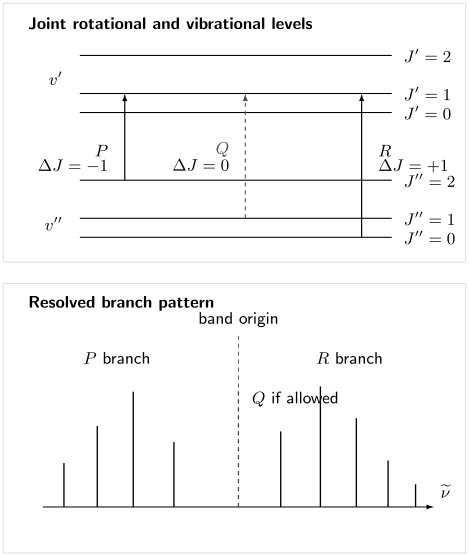
Rovibrational branch logic. The upper and lower vibrational manifolds each contain rotational levels. , , and connect ; the arrow and central stick are shown dashed because that branch is absent for a simple parallel band but allowed in other symmetry and angular-momentum cases.
When a Q branch appears
Section titled “When a Q branch appears”A branch can occur when the rovibrational angular factors and parity rules permit . Examples include:
- perpendicular bands of linear polyatomic molecules;
- transitions involving nonzero electronic angular-momentum projection;
- degenerate vibrations carrying vibrational angular momentum;
- suitable symmetric-top parallel or perpendicular subbands with nonzero projection quantum numbers.
For a linear degenerate bend, the vibrational angular momentum quantum number supplies an internal projection absent from a nondegenerate diatomic stretch. A compact central branch can then be one of the most prominent features of the band.
For symmetric and asymmetric tops, labels classify only . Each branch can contain many -structured subbranches, asymmetry splittings, and parity components. A three-letter label may be needed to specify changes in projection quantum numbers and .
Coriolis Coupling and Vibrational Angular Momentum
Section titled “Coriolis Coupling and Vibrational Angular Momentum”A degenerate vibrational pair can carry angular momentum about a molecular axis; Coriolis matrix elements can also couple distinct nondegenerate modes. Define dimensionless angular-momentum operators
In a normal-coordinate basis, the leading Coriolis interaction in wavenumber units is schematically
where for mass-normalized coordinates, with the sign of defined consistently with the body frame. The expression uses a diagonal equilibrium inertia and omits higher coordinate dependence. The dimensionless coefficients describe how vibrational motion transforms under rotation of the molecule-fixed frame.
Consequences include:
- splitting and mixing of levels within degenerate vibrational manifolds;
- -type doubling in linear molecules;
- -dependent shifts in symmetric tops;
- intensity borrowing between nominal bands;
- avoided crossings and assignment changes when levels of compatible symmetry approach.
For one degenerate bend of a linear molecule, a leading rotational term often contains
with , followed by -doubling and distortion corrections. For a two-dimensional harmonic bend with total excitation , . The exact effective Hamiltonian and parity convention must be stated before comparing fitted constants.
Anharmonic and Centrifugal Corrections
Section titled “Anharmonic and Centrifugal Corrections”Vibrational anharmonicity changes the band origin
Section titled “Vibrational anharmonicity changes the band origin”For the fundamental ,
not simply . Hot-band origins such as are lower for the usual positive anharmonicity:
Overtones and combination bands require both anharmonic term values and nonzero transition moments. Their rotational branches are built around their own band origins and vibrational-state constants.
Centrifugal distortion changes line spacings
Section titled “Centrifugal distortion changes line spacings”Retaining the leading distortion term, let and write
The negative term compresses the rotational ladder at high . For a simple semirigid diatomic, the scale estimate
shows why distortion is usually much smaller than but grows rapidly in importance with rotational excitation. This estimate is not a replacement for a fitted or calculated constant.
Upper and lower states generally have different . Their difference bends a Fortrat plot and shifts a predicted branch head. Higher constants should be added only when residuals and measured range support them.
Resonances defeat isolated-band fits
Section titled “Resonances defeat isolated-band fits”Anharmonic, Coriolis, and centrifugal terms can bring two rovibrational basis states close in energy. If they have compatible exact symmetry, an effective block
produces avoided crossings and mixed eigenstates. Define
The level shifts are then
A high-order polynomial fitted through such a local perturbation may reproduce measured lines while predicting poorly outside them. Explicit coupled-state fitting is more interpretable when the interacting partner can be identified.
Rovibrational Line Intensities
Section titled “Rovibrational Line Intensities”Angular and vibrational factors
Section titled “Angular and vibrational factors”The space-fixed dipole component is obtained by rotating body-fixed components:
In the separable limit, the intrinsic transition strength is assembled from:
- a vibrational transition moment;
- a rotational Hönl–London factor;
- magnetic-sublevel and polarization sums;
Populations and nuclear-spin statistical weights then convert transition strengths into ensemble intensities.
For a band, one common unnormalized convention gives
Their sum is : this convention already sums the lower magnetic substates. When multiplying by the total population of a lower level, use so that its magnetic degeneracy is counted once. Other tables normalize these factors differently.
Population envelope
Section titled “Population envelope”At rotational temperature , define . A simple lower-state population is
Then
Here is the nuclear-spin statistical weight and the expression compares rotational levels within one fixed . Comparing different vibrational manifolds also requires and a common partition function. Intrinsic integrated absorption includes the transition frequency, transition strength, and stimulated-emission factor. A normalized line profile changes the shape but not its area; finite integration windows, overlap, saturation, and instrument response can affect the measured area.
Alternating strong and weak lines can therefore reflect nuclear-spin statistics rather than alternating populations generated by the light source. Missing lines can reflect a selection rule, low population, blending, detector response, or inadequate sensitivity.
Herman–Wallis asymmetry
Section titled “Herman–Wallis asymmetry”Exact rovibrational wavefunctions do not factor into one -independent vibrational transition moment times a pure angular factor. Rotation changes the radial or normal-coordinate wavefunction and samples the coordinate dependence of the dipole moment.
For a diatomic band, this is often summarized by a Herman–Wallis factor
where labels lines and labels lines. The coefficients depend on the band, isotopologue, transition-moment expansion, and convention.
A nonzero odd coefficient makes corresponding and intensities asymmetric even after population and Hönl–London factors are removed. Treating every branch asymmetry as a temperature effect can therefore bias inferred populations.
Spectral Interpretation
Section titled “Spectral Interpretation”Band origin, center, and maximum are different
Section titled “Band origin, center, and maximum are different”The band origin is the difference of vibrational term values at zero rotational contribution. A band center may mean a fitted origin, an intensity-weighted centroid, or a reported peak position. A band maximum depends on temperature, line strengths, broadening, and instrumental resolution.
In a simple band, no transition lies at the origin. In a band with a branch, individual lines can still shift with :
A sharp unresolved feature is not automatically one line exactly at .
Combination differences
Section titled “Combination differences”Combination differences eliminate one state and the band origin. Define the upper-state difference
The lower-state difference is
In the rigid-rotor limit,
The first isolates upper-state spacings; the second isolates lower-state spacings. Combination differences are powerful assignment checks because a common additive calibration offset and the band origin cancel; scale errors and frequency-dependent calibration errors need not.
Branch heads
Section titled “Branch heads”In the distortion-free Fortrat approximation,
where
Treating continuously gives a turning point at
If , then and a positive- -branch head can occur. If , a negative- -branch head is possible. The nearest allowed integer gives only a first estimate; centrifugal distortion, perturbations, population cutoff, and predissociation can move or erase the observed head.
A synthetic line pattern
Section titled “A synthetic line pattern”Consider a hypothetical fundamental with
Ignoring distortion,
The gap around identifies a missing simple-band branch, while the slowly changing line spacings reveal . These four lines do not by themselves justify high-order distortion or a global potential.
A smooth drift of residuals across a branch can indicate missing distortion terms. A localized perturbation instead motivates a check for blending, misassignment, or an interacting state. Vibrational spectroscopy develops the measurement and assignment methods; the coupled-state model above explains why extra polynomial terms alone may extrapolate poorly.
Exercises
Section titled “Exercises”1. Can the rotational constant increase with vibration?
Section titled “1. Can the rotational constant increase with vibration?”Keep the quadratic expansion of but take an exactly harmonic bond coordinate with . Determine the leading dependence of . Why does this differ from the common positive ?
Solution
Using ,
Here the constant increases, corresponding to a negative . In a real asymmetric well the mean displacement also changes: the contribution competes with the positive variance term. A growing mean radius alone does not determine the average of .
2. Derive the simple P and R formulas
Section titled “2. Derive the simple P and R formulas”Assume
Derive the and line positions. Explain why does not exist.
Solution
For the branch, :
For the branch, :
would require , which is not an angular-momentum quantum number. Thus the branch starts at , while the branch starts at .
3. Use combination differences
Section titled “3. Use combination differences”Show that, in the rigid-rotor approximation,
Why is this useful if the absolute wavenumber calibration has a constant offset?
Solution
Both lines start from the same lower level :
Subtracting cancels the lower term and origin:
Therefore
A constant calibration offset appears in both measured line positions and cancels in their difference. Nonlinear calibration error does not necessarily cancel.
4. Locate a branch head
Section titled “4. Locate a branch head”For the synthetic constants
estimate the continuous Fortrat branch-head index and identify the branch.
Solution
Here
Therefore
Positive labels the branch, so the distortion-free model predicts an -branch head near , corresponding roughly to . At such high , centrifugal distortion and population loss are likely important, so this is only a starting estimate.
5. Infer an effective distance ratio
Section titled “5. Infer an effective distance ratio”For one isotopologue,
Find .
Solution
At fixed reduced mass,
Thus
The effective distance increases by about . This ratio does not state that the molecule sits at one sharply defined radius in either vibrational state.
6. Diagnose the Q branch
Section titled “6. Diagnose the Q branch”Why is forbidden in the simple electric-dipole band but possible for a degenerate bending band of a linear polyatomic molecule?
Solution
For the simple parallel band, both body-fixed projections are zero. The angular factor contains
which vanishes because is odd.
A degenerate bend carries nonzero vibrational angular momentum and has perpendicular transition-dipole components. The body-fixed projection quantum numbers in the three-j symbol are then not all zero, and the angular factor can be nonzero when parity and full symmetry also permit it. The label says only ; the internal angular-momentum structure decides its strength.
7. Count magnetic degeneracy once
Section titled “7. Count magnetic degeneracy once”Lines and start from the same . Assume equal transition-frequency prefactors and neglect Herman–Wallis effects. Find their intensity ratio using either total level population or population per magnetic substate.
Solution
With total population , the two strengths are proportional to and . With population per substate , they are and . Both give . Multiplying by the unnormalized factors without dividing by gives an incorrect envelope across different values.
8. Interpret structured residuals
Section titled “8. Interpret structured residuals”A fit with , , , and has random residuals except for a localized antisymmetric excursion around in both branches. What should be tested before adding still higher distortion constants?
Solution
A localized feature is more suggestive of a level interaction or assignment problem than of smooth centrifugal distortion. Test:
- line blending, calibration, and the branch assignments near ;
- parity or unresolved substructure;
- combination differences to identify whether the perturbation lies in the upper or lower state;
- nearby vibrational, electronic, or Coriolis-coupled states of compatible symmetry;
- a small explicit coupled-state Hamiltonian with a physically motivated ;
- whether the feature repeats in another band sharing the perturbed state.
Adding high powers of can hide the excursion while corrupting extrapolation.
References
Section titled “References”- P. F. Bernath, Spectra of Atoms and Molecules, 4th ed., Oxford University Press, 2020.
- J. M. Brown and A. Carrington, Rotational Spectroscopy of Diatomic Molecules, Cambridge University Press, 2003.
- P. R. Bunker and P. Jensen, Molecular Symmetry and Spectroscopy, 2nd ed., NRC Research Press, 1998.
- J. L. Dunham, “The Energy Levels of a Rotating Vibrator,” Physical Review 41, 721–731 (1932), doi:10.1103/PhysRev.41.721.
- R. C. Herman and R. F. Wallis, “Influence of Vibration–Rotation Interaction on Line Intensities in Vibration–Rotation Bands of Diatomic Molecules,” Journal of Chemical Physics 23, 637–646 (1955), doi:10.1063/1.1742069.
- G. Herzberg, Molecular Spectra and Molecular Structure. I. Spectra of Diatomic Molecules, 2nd ed., Van Nostrand, 1950.
- G. Herzberg, Molecular Spectra and Molecular Structure. II. Infrared and Raman Spectra of Polyatomic Molecules, Van Nostrand, 1945.
- H. Hönl and F. London, “Über die Intensitäten der Bandenlinien,” Zeitschrift für Physik 33, 803–809 (1925), doi:10.1007/BF01328367.
- IUPAC, “vibrational term value”, Compendium of Chemical Terminology, 5th ed., 2025, doi:10.1351/goldbook.08709.
- NIST, Diatomic Spectral Database for -Ground-State Molecules, definitions, Dunham coefficients, isotope scaling, and evaluated constants.
- D. Papoušek and M. R. Aliev, Molecular Vibrational-Rotational Spectra, Elsevier, 1982.
- PGOPHER, Intensity formulae, University of Bristol documentation, accessed 13 October 2026.
- J. K. G. Watson, “Hönl–London Factors for Multiplet Transitions in Hund’s Case a or b,” Journal of Molecular Spectroscopy 252, 5–8 (2008), doi:10.1016/j.jms.2008.04.014.
- J. K. G. Watson, “Simplification of the Molecular Vibration-Rotation Hamiltonian,” Molecular Physics 15, 479–490 (1968), doi:10.1080/00268976800101381.
- E. B. Wilson Jr., J. C. Decius, and P. C. Cross, Molecular Vibrations: The Theory of Infrared and Raman Vibrational Spectra, McGraw–Hill, 1955; Dover reprint, 1980.