

H₂⁺ Ion
The hydrogen molecular ion, H₂⁺, contains two protons and one electron. It is the simplest molecular ion and a useful benchmark: its clamped-nuclei electronic equation is a genuine one-electron problem. Other one-electron two-center ions, such as HeH²⁺, share that feature. Here qualitative orbital language can be compared directly with an accurately computed wavefunction.
H₂⁺ is therefore more than a toy model. It separates three ideas that are easily blurred in larger molecules:
- the electronic eigenvalue at a fixed internuclear separation;
- the nuclear-repulsion term that converts that eigenvalue into a molecular potential curve;
- the approximation incurred when the exact two-center orbital is restricted to a small atom-centered basis.
The same system also supplies a concrete two-state model. At large separation, the electron can be described as localized near either proton. Midpoint inversion symmetry combines those alternatives into gerade and ungerade stationary states, and their energy splitting sets the coherent transfer timescale. The analogy is exact only after a two-dimensional subspace and its range of validity have been stated.
Required background. Molecular Hamiltonian and Born–Oppenheimer separation define the fixed-center approximation; molecular orbitals explains the overlap metric, and two-state Hamiltonians supplies coherent evolution.
The molecular-orbital lab implements the minimal LCAO calculation. The two-electron hydrogen molecule additionally requires exchange symmetry and correlation.
One Electron and Two Nuclei
Section titled “One Electron and Two Nuclei”Place identical nuclei and at
and define
Atomic units are used unless otherwise stated, so and energies are in hartrees. With the protons clamped at separation , the electronic Hamiltonian is
Its eigenproblem is
The proton–proton repulsion is a constant in the electronic coordinates. The corresponding Born–Oppenheimer potential curve is therefore
This distinction is essential. An electronic eigenvalue can decrease as the nuclei approach even while the total molecular potential rises because diverges.
Three energy conventions
Section titled “Three energy conventions”For the lowest gerade/ungerade pair, both channels correlate with ground-state H + p. Higher electronic channels can have different atomic thresholds.
| Quantity | Includes ? | Natural separated-atom limit |
|---|---|---|
| electronic eigenvalue | no | |
| Born–Oppenheimer potential | yes | |
| interaction potential | yes |
The equality of the first two limits is special to , where . At finite they are different functions. Some tables instead set the separated H p limit to zero; their tabulated energy is then , not .
Symmetry and labels
Section titled “Symmetry and labels”The fixed-center Hamiltonian commutes with rotations about the internuclear axis. The magnitude of the electronic orbital-angular-momentum projection is labeled
Because the nuclei are identical, inversion through the midpoint is also a symmetry. Even and odd spatial states are denoted gerade () and ungerade (). For states there is an additional reflection label or for a plane containing the molecular axis.
The electron has spin , but the spin coordinate is a spectator in this nonrelativistic electrostatic Hamiltonian. The ground electronic term is
whose conventional one-electron orbital label is . Its lowest ungerade partner is conventionally called and belongs to the term. These labels encode symmetry and correlation limits; they should not be read as literal hydrogenic quantum numbers at every .
The Term Symbol Reference compares these inversion and reflection labels with atomic parity, rovibronic , and nonlinear-molecule notation.
Exact Fixed-Center Structure
Section titled “Exact Fixed-Center Structure”The two-center Coulomb equation is separable, but not in spherical coordinates about either proton. Introduce prolate spheroidal coordinates
with domains
Surfaces of constant are ellipsoids with the nuclei as foci; surfaces of constant are two-sheeted hyperboloids. The Coulomb sum takes the particularly simple form
For a bound state, write
One common separation-constant convention gives
and
Regularity at , , and decay as select discrete compatible values of and . The states have . For these states, gerade and ungerade parity appear as even and odd parity of , respectively. In general inversion also sends , giving an additional factor .
Separation reduces the three-dimensional partial differential equation to two coupled eigenvalue conditions, but it does not produce elementary closed-form energies. Accurate values come from converged series, variational bases, finite-element or spectral discretizations, or high-precision numerical integration. H₂⁺ is exactly separable and still numerically nontrivial; those statements are compatible.
Minimal LCAO Approximation
Section titled “Minimal LCAO Approximation”The simplest atom-centered basis uses normalized hydrogenic functions with the isolated-hydrogen exponent,
Seek an orbital
The basis functions are normalized but not orthogonal. Their overlap is
With
the Ritz equations form a generalized eigenproblem,
Exchange of the nuclei commutes with both matrices, so the eigenvectors are fixed by symmetry before any integral is evaluated:
Their electronic eigenvalues are
The normalization factors are not optional. Replacing them by at finite violates normalization and corrupts expectation values.
Closed-form integrals
Section titled “Closed-form integrals”For the fixed-exponent basis,
It is useful to define the Coulomb and resonance integrals
Direct integration gives
Using the isolated-hydrogen eigenvalue equation,
The total fixed-nuclei curves are consequently
These are analytic curves for a particular two-function variational space, not exact H₂⁺ potentials. Optimizing the exponent or enlarging a nested variational space cannot raise its lowest symmetry-resolved Ritz energy. Solving the separated equations gives an independent route to converged energies.
Bonding and Antibonding States
Section titled “Bonding and Antibonding States”For real functions, the LCAO densities are
The gerade combination has constructive interference between the nuclei. The ungerade combination has a nodal plane at the midpoint, where . That node forces additional spatial variation and is associated with a larger kinetic-energy cost.
The familiar statement that the bonding orbital “puts charge between the nuclei” is descriptively useful but not a complete energy decomposition. Covalent stabilization can be partitioned among kinetic, electron–nuclear, and internuclear terms in representation-dependent ways. Variationally, what is invariant is simpler: allowing coherent amplitude on both centers gives the even state a lower Rayleigh quotient than either isolated-center trial state over the bonding range. The odd state is constrained by its node and lies higher.
Worked value at two bohr
Section titled “Worked value at two bohr”At ,
The minimal-basis total energies are then
The gerade trial state is below the separated H p threshold , whereas the ungerade trial state is far above it at this separation. The result already predicts a covalent well, but the quantitative errors are substantial because an isolated-hydrogen exponent cannot contract toward the united-atom limit or polarize toward the second proton.
What “antibonding” does and does not prove
Section titled “What “antibonding” does and does not prove”Near ordinary bond lengths, the state is destabilized by its internuclear node and is correctly called antibonding. It does not follow that its exact potential is repulsive at every separation. At large , both gerade and ungerade channels inherit the attractive charge-induced-dipole interaction between H and p. The exact curve has an extremely shallow long-range minimum near
That well is only about deep, or , and supports only delicate long-range nuclear states. The fixed-exponent two-function LCAO curve does not resolve this effect. “Antibonding” is a statement about nodal structure and the usual bonding region, not a theorem forbidding all long-range binding.
Overlap and Tunneling Interpretation
Section titled “Overlap and Tunneling Interpretation”The energy splitting can be written directly in terms of the nonorthogonal matrix elements:
This expression is more informative than identifying alone as a hopping amplitude. In a nonorthogonal basis, both the Hamiltonian matrix and the overlap metric enter the physical splitting. Orthogonalization redistributes contributions between diagonal and off-diagonal elements while leaving the eigenvalues unchanged.
In this minimal basis, , , and vanish exponentially as grows, and the gerade and ungerade states become nearly degenerate. Within their two-dimensional subspace define orthonormal localized states
With these definitions and the physical ordering , the projected electronic Hamiltonian is
where
An electron prepared in evolves as
Hence
The first complete transfer occurs at
and the full probability-oscillation period is
A stationary or eigenstate does not shuttle between nuclei: its probability density is time independent. Oscillation requires a coherent superposition of the two parity eigenstates. Environmental dephasing, nuclear motion, or coupling to other electronic states can suppress or modify this ideal two-level motion.
Potential Energy Curves
Section titled “Potential Energy Curves”The electronic eigenvalue is not by itself a bond potential. Adding produces the curves on which nuclear motion is quantized. The minimal LCAO result captures the existence and symmetry of the ground-state well but underestimates its depth and places its minimum too far out.
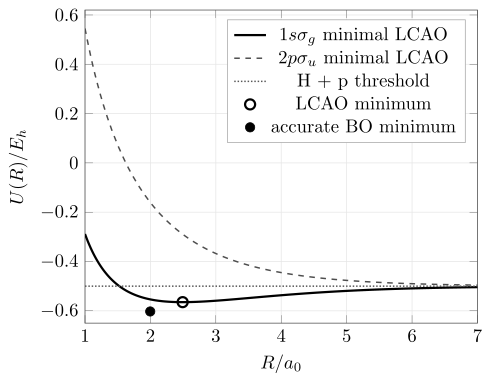
Fixed-exponent LCAO curves including proton–proton repulsion. The open circle marks the minimum of the plotted trial curve; the filled circle marks the accurate Born–Oppenheimer ground-state minimum and is not a point on an exact curve drawn here. The dashed trial curve misses the exact, extremely shallow long-range polarization well.
For the fixed-exponent two-function trial space,
Relative to the dissociation limit , this gives
Accurate clamped-nuclei calculations instead give approximately
The minimal basis therefore recovers only about of the accurate Born–Oppenheimer well depth and overestimates the equilibrium distance by about . This is a useful warning: obtaining the right bonding story does not imply spectroscopic accuracy.
Well depth is not dissociation from the lowest rovibrational level
Section titled “Well depth is not dissociation from the lowest rovibrational level”is the depth from the potential minimum to the separated-fragment asymptote. A molecule in its lowest vibrational state has positive zero-point energy above that minimum, and finite proton masses introduce additional nonadiabatic and relativistic corrections. The dissociation energy from the rovibrational ground state, , is therefore smaller than . Comparisons with experiment must specify isotope, rotational state, energy zero, and which corrections are included.
Force and equilibrium
Section titled “Force and equilibrium”For a normalized exact electronic eigenstate at fixed , the Hellmann–Feynman theorem gives
Equilibrium satisfies : the electronic force balances proton–proton repulsion. In a geometry-dependent finite basis, differentiating a variational energy also produces Pulay terms because the basis functions move with the nuclei. Omitting those terms generally gives an inconsistent force even if the energy is variational.
When Two States Suffice
Section titled “When Two States Suffice”H₂⁺ realizes the abstract two-state Hamiltonian in a spatially transparent way.
| Two-state language | H₂⁺ realization |
|---|---|
| localized basis | electron near nucleus or |
| symmetry eigenbasis | and |
| coupling | half the gerade–ungerade splitting |
| detuning | asymmetry between the two centers |
| coherent oscillation | transfer between localized alternatives |
| avoided crossing | level repulsion when biased localized states mix |
For identical nuclei there is no site-energy bias. If an external field or a heteronuclear substitution makes the localized alternatives inequivalent, the projected Hamiltonian takes the generic form
Its level separation is
This is the same algebra developed for Two-State Hamiltonians and the Tight-Binding Dimer. H₂⁺ supplies microscopic Coulomb matrix elements and a geometry-dependent coupling instead of taking and as phenomenological constants.
Limits of the analogy
Section titled “Limits of the analogy”At fixed with no perturbation, any pair of exact electronic eigenstates spans an invariant subspace, so its internal evolution is exact. Using that pair to describe preparation, fields, or nuclear motion additionally requires negligible coupling to omitted states; a sufficient energy separation often controls this approximation. At short distance, many united-atom orbitals are relevant to localized descriptions. Nuclear motion can couple electronic channels allowed by symmetry. Pure radial motion in field-free homonuclear H₂⁺ does not itself mix the opposite-parity pair; their radial derivative coupling vanishes. In a strong field, polarization and ionization require a larger basis or continuum states. A two-by-two Hamiltonian is a projection, not the full molecule.
Nor are and themselves an orthonormal qubit basis at finite . The localized states above are constructed from orthonormal exact parity eigenstates. Using raw overlapping atomic orbitals as if they were orthogonal changes transition probabilities and matrix elements.
Limiting Cases and Diagnostic Checks
Section titled “Limiting Cases and Diagnostic Checks”Separated fragments
Section titled “Separated fragments”As ,
The splitting vanishes, and any normalized linear combination of the degenerate pair is also an eigenstate in the limit. The localized alternatives then correlate with H p, with the electron on either identical center. At large but finite , exchange produces an exponentially small parity splitting while polarization contributes a common algebraic attraction.
United atom
Section titled “United atom”As , the electronic Coulomb potential approaches that of He⁺,
The exact ground electronic eigenvalue tends to . Nevertheless,
because the nuclear repulsion diverges. The exact gerade state correlates with the He⁺ orbital, while the lowest ungerade state correlates with a -like united-atom orbital.
The fixed-exponent minimal basis cannot reproduce this limit. As the centers merge, and become linearly dependent, , and the ungerade normalization contains . After normalization the odd combination tends, up to sign, to . It has the right angular symmetry but lacks the factor of the He⁺ radial function. The even trial function instead remains a charge-one function rather than contracting to the He⁺ exponent two.
Variational ordering
Section titled “Variational ordering”Within each symmetry sector, the lowest Ritz value is an upper bound to the corresponding exact fixed- electronic eigenvalue. Adding preserves the inequality at that same geometry. It does not imply that an approximate equilibrium distance bounds the exact , because minimizers of two different functions need not be ordered.
The exact nondegenerate ground state of a real scalar Schrödinger operator can be chosen nodeless. In homonuclear H₂⁺ it is consequently the even state. An odd state reported as the converged exact ground state contradicts that theorem. An odd trial energy below a poorly chosen even trial energy need not: uneven approximation errors can reverse trial-state ordering.
Exercises
Section titled “Exercises”1. The missing polarization tail
Section titled “1. The missing polarization tail”The ground hydrogen atom has static polarizability in atomic units. Use its energy shift in the distant proton’s field to derive the leading common attraction of the exact curves. Can the fixed-exponent minimal basis reproduce it?
Solution
The field has magnitude , giving
The neutral atom’s monopole attraction cancels the proton–proton repulsion. This induced-dipole term remains in both channels, alongside their exponentially small exchange splitting. In the minimal basis the surviving corrections after that cancellation are exponential; no polarized atomic excited functions are available to produce the algebraic tail.
2. Overlap checks
Section titled “2. Overlap checks”For
show that , , and for . Explain why these checks matter physically.
Solution
The endpoint values follow directly. Differentiating gives
so
for . Coincident normalized functions must have unit overlap; infinitely separated localized functions must have zero overlap; and increasing separation should reduce their overlap monotonically. Failure of any check signals an integration or convention error.
3. Coherent transfer
Section titled “3. Coherent transfer”An ideal two-state H₂⁺ model has . Find the first complete transfer time from one localized state to the other. Use .
Solution
The first complete transfer occurs at
Therefore
This is about . The result describes coherent electronic evolution at fixed ; it is not automatically the transfer time in a vibrating or decohering molecule.
4. Quantifying the minimal-basis error
Section titled “4. Quantifying the minimal-basis error”Using the minima quoted above, calculate the percentage error in , the fraction of the accurate recovered by minimal LCAO, and the variational energy error at the respective minima.
Solution
The bond-length error is
The recovered fraction of the well depth is
or about . Comparing the minimum energies gives
The positive energy difference is consistent with the variational principle. Because the two values occur at different geometries, it is a comparison of optimized approximate and exact curves, not the fixed-geometry variational error.
5. Distinguishing Dₑ and D₀
Section titled “5. Distinguishing Dₑ and D₀”Suppose a calculation gives a Born–Oppenheimer well depth and a nuclear ground-state energy measured upward from the potential minimum. Ignoring all other corrections, express in terms of these quantities. List three reasons why a precision experimental comparison needs more information.
Solution
With the stated energy zero,
A precision comparison also needs, among other items, the isotopologue and nuclear masses, the initial rotational quantum number, nonadiabatic corrections, relativistic and radiative corrections, and a consistent separated-fragment energy. Quoting only a clamped-nuclei does not specify the measured dissociation threshold.
References
Section titled “References”- P. W. Atkins and R. S. Friedman, Molecular Quantum Mechanics, 5th ed. (Oxford University Press, 2011), Chapters 8–9.
- D. R. Bates, K. Ledsham, and A. L. Stewart, “Wave Functions of the Hydrogen Molecular Ion,” Philosophical Transactions of the Royal Society A 246, 215–240 (1953), doi:10.1098/rsta.1953.0014.
- C. L. Beckel, B. D. Hansen III, and J. M. Peek, “Theoretical Study of H₂⁺ Ground Electronic State Spectroscopic Properties,” Journal of Chemical Physics 53, 3681–3690 (1970), doi:10.1063/1.1674549.
- M. Born and R. Oppenheimer, “Zur Quantentheorie der Molekeln,” Annalen der Physik 389, 457–484 (1927), doi:10.1002/andp.19273892002.
- Ø. Burrau, “Berechnung des Energiewertes des Wasserstoffmolekel-Ions (H₂⁺) im Normalzustand,” Kongelige Danske Videnskabernes Selskab, Mathematisk-fysiske Meddelelser 7(14), 1–18 (1927).
- C. Y. Chao, “The Problem of the Ionized Hydrogen Molecule,” Proceedings of the National Academy of Sciences 15, 558–565 (1929), doi:10.1073/pnas.15.7.558.
- F. M. Fernández and J. Garcia, “Highly Accurate Potential Energy Curves for the Hydrogen Molecule Ion,” ChemistrySelect 6, 9527–9534 (2021), doi:10.1002/slct.202102509.
- L. D. Landau and E. M. Lifshitz, Quantum Mechanics: Non-Relativistic Theory, 3rd ed. (Pergamon, 1977), Section 81.
- C. A. Leach and R. E. Moss, “Spectroscopy and Quantum Mechanics of the Hydrogen Molecular Cation: A Test of Molecular Quantum Mechanics,” Annual Review of Physical Chemistry 46, 55–82 (1995), doi:10.1146/annurev.pc.46.100195.000415.
- I. N. Levine, Quantum Chemistry, 7th ed. (Pearson, 2014), Chapters 13–14.
- M. M. Madsen and J. M. Peek, “Eigenparameters for the Lowest Twenty Electronic States of the Hydrogen Molecule Ion,” Atomic Data and Nuclear Data Tables 2, 171–204 (1971), doi:10.1016/S0092-640X(70)80008-0.
- J. M. Peek, “Eigenparameters for the and Orbitals of H₂⁺,” Journal of Chemical Physics 43, 3004–3006 (1965), doi:10.1063/1.1697265.
- J. M. Peek, “Discrete Vibrational States Due Only to Long-Range Forces: State of H₂⁺,” Journal of Chemical Physics 50, 4595–4601 (1969), doi:10.1063/1.1670939.
- K. Ruedenberg, “Why Does Electron Sharing Lead to Covalent Bonding? A Variational Analysis,” Journal of Computational Chemistry 28, 390–404 (2007), doi:10.1002/jcc.20553.
- Y. P. Zhang, C. H. Cheng, J. T. Kim, J. Stanojevic, and E. E. Eyler, “Dissociation Energies of Molecular Hydrogen and the Hydrogen Molecular Ion,” Physical Review Letters 92, 203003 (2004), doi:10.1103/PhysRevLett.92.203003.