

Term Symbol Reference
A term symbol is a compact description of a state. For example, identifies a triplet atomic P level with and odd parity; describes a molecular electronic state with quite different projection and symmetry labels. This reference helps you read each part and recognize which labels survive when interactions mix states.
A symbol does not give the energy or a complete wavefunction. Configuration labels and LS or jj assignments often describe dominant components, whereas exact angular momentum and parity follow from symmetries of the Hamiltonian. The atomic discussion initially excludes hyperfine coupling and external fields; once nuclear spin is coupled, may replace electronic as the exact total-angular-momentum label.
Required background. Atomic term symbols explains configuration, term, and level. For detailed coupling constructions, see LS coupling and jj coupling.
Atomic and molecular symbols
Section titled “Atomic and molecular symbols”| System | Example | What the main letter means |
|---|---|---|
| atom in LS notation | is total orbital angular momentum | |
| atom in jj notation | subshell angular momenta couple to total | |
| linear molecule | is an axial orbital projection magnitude | |
| nonlinear molecule | is an irrep of a specified point group |
Here supplies additional labels when necessary; is an empirical ground-state name. Molecular inversion and reflection labels are added when the relevant symmetry exists.
Atomic Structural Hierarchy
Section titled “Atomic Structural Hierarchy”Atomic spectroscopy distinguishes four nested objects. Keeping them separate prevents most degeneracy and selection-rule mistakes.
| Object | Schematic label | What is fixed |
|---|---|---|
| configuration | orbital occupations | |
| term | configuration, total , total , parity, and any extra labels | |
| level | a particular total within the term | |
| magnetic state | a particular projection |
For an isolated field-free atom with rotational invariance,
The level contains magnetic states before an external field or another anisotropy resolves them:
The symbol or is deliberately unspecific. Two distinct levels can have the same and parity, so those labels are not always a complete state identifier.
Term, level, and state in data tables
Section titled “Term, level, and state in data tables”Database columns often separate configuration, term, and . A row displaying
refers to the level conventionally written
In formatted NIST Atomic Spectra Database output, a degree sign marks odd parity. In ASCII output, the same information is represented by an asterisk. The typography changes; the parity does not.
Atomic LS Grammar
Section titled “Atomic LS Grammar”In the Russell–Saunders or LS limit, individual orbital angular momenta first form a total orbital angular momentum and individual spins form a total spin:
Those totals then couple to
A full level label can be organized as
| Token | Meaning | Diagnostic |
|---|---|---|
| parent terms, seniority, or other distinguishing information | needed when the visible labels are not unique | |
| electron configuration | occupations, not a term | |
| spin multiplicity | singlet, doublet, triplet, quartet, and so on | |
| total electronic orbital angular momentum | encoded by an uppercase spectroscopic letter | |
| total electronic angular momentum | labels a fine-structure level | |
| spatial inversion parity | even or odd |
Spectroscopic letters
Section titled “Spectroscopic letters”The atomic letter code is:
| 0 | 1 | 2 | 3 | 4 | 5 | 6 | 7 | 8 | |
|---|---|---|---|---|---|---|---|---|---|
| term letter | S | P | D | F | G | H | I | K | L |
The letter J is skipped to avoid confusion with total angular momentum . Lowercase label one-electron orbital angular momentum ; uppercase S, P, D, F, label the many-electron total .
For fixed and , angular-momentum addition permits
Thus a term has and , and contains
This statement identifies possible values. It does not determine their energy ordering.
Multiplicity is not total degeneracy
Section titled “Multiplicity is not total degeneracy”The left superscript is
the number of spin projections for a pure spin- object. It is not the number of fine-structure levels and not the degeneracy of one level.
For a pure LS term, the uncoupled dimension is
The same dimension appears after coupling:
For ,
while the three fine-structure levels have degeneracies
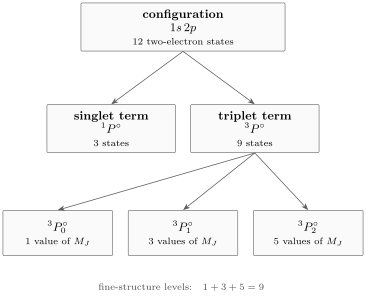
One configuration can contain several terms. The configuration has states: three in and nine in . The triplet term contains levels with magnetic states. The diagram groups states; its vertical positions do not specify energy ordering.
Atomic parity
Section titled “Atomic parity”The spatial parity of an electron configuration is
Closed subshells contribute even powers and therefore do not change the result. Common notations are:
| Parity | Formatted term | Other common forms |
|---|---|---|
| even | or when the convention is explicit | |
| odd | ; an ASCII database may use 3P*2 or separate the column |
The absence of a degree sign conventionally means even parity in many atomic tables. That convention should not be transferred blindly to nuclear, molecular, or condensed-matter notation.
Atomic examples
Section titled “Atomic examples”| Label | Reading |
|---|---|
| He | , , , even parity |
| He | , , , odd parity |
| Na | one valence electron, , , , odd parity |
| C | triplet P level, , even parity because is even |
| an alkali level | doublet S, , even parity |
Atomic jj and Intermediate Coupling
Section titled “Atomic jj and Intermediate Coupling”LS coupling forms total and before coupling them to . In jj coupling, each electron first forms ; these angular momenta, or the totals of groups of electrons, then couple to . The NIST coupling-notation guide illustrates the corresponding labels.
One-electron and subshell labels
Section titled “One-electron and subshell labels”For an electron with spin ,
except that has only . A relativistic subshell is written
so a shell splits into and subshells. An equivalent electron group can be written
The subscript on is a one-electron , whereas the final subscript outside a coupled configuration is the total . Their positions are part of the grammar.
Coupled-group labels
Section titled “Coupled-group labels”For two groups with angular momenta and ,
A schematic level label is
Authors omit brackets or redundant intermediate labels when the coupling order is clear. For example,
states that two equivalent electrons occupy the subshell and couple to total . The Pauli principle still restricts which total values are allowed; the triangle rule alone is not sufficient for equivalent electrons.
LS and jj labels are basis statements
Section titled “LS and jj labels are basis statements”The same exact field-free level can be expanded in either basis:
or
The basis changes; the exact , , and parity labels do not. A named LS or jj label is exact only in an ideal coupling limit. In intermediate coupling, it normally identifies the largest component or a historically assigned parent.
| Label in a rotationally invariant, parity-conserving atomic model | Typical status |
|---|---|
| and | exact in zero field, with basis-dependent inside a degenerate level |
| parity | exact if the Hamiltonian preserves spatial inversion |
| and | exact in the nonrelativistic electrostatic LS limit; approximate with spin-dependent relativistic terms |
| individual or subshell | exact only in the corresponding jj or group-coupling limit |
| configuration | approximate when configuration interaction is retained |
A mixed level can be described by its leading components,
while calling the level “predominantly .” The percentages are basis-dependent and should be accompanied by the basis and calculation.
Molecular Electronic-State Grammar
Section titled “Molecular Electronic-State Grammar”Brown and Carrington (2003) explain molecular coupling and electronic-state notation. For a molecule, the spatial part of an electronic state is classified by an irreducible representation of the molecular symmetry group appropriate to the geometry and model. The atomic letter is generally not a molecular quantum number because the nuclear framework is not spherically symmetric.
The two principal grammars are:
with applicable inversion and reflection labels, and
The empirical state label , the symmetry label, and the spin multiplicity answer different questions. A state may require all three.
Linear Molecules
Section titled “Linear Molecules”Choose the molecular axis as the body-fixed axis. Let and denote signed eigenvalues in the axial electronic basis. Then
The term letter uses the nonnegative magnitude . In a common Hund-case-(a) convention one selects the branch and writes the signed spin projection as , giving . The opposite branch has the corresponding opposite signed projections. This choice avoids adding an unsigned orbital magnitude to an unspecified spin projection.
These projections are distinct from the atomic magnitudes . The symbol for a spin projection is also distinct from the term letter meaning zero orbital projection; context tells them apart.
Projection letters
Section titled “Projection letters”| 0 | 1 | 2 | 3 | 4 | |
|---|---|---|---|---|---|
| electronic term | |||||
| one-electron orbital |
The uppercase letter labels the many-electron electronic state. A lowercase letter labels a molecular orbital. Thus is part of a configuration, whereas is a term symmetry.
Multiplicity and spin–orbit components
Section titled “Multiplicity and spin–orbit components”The left superscript remains
For a term,
so the case-(a) components are
They may be written
An subscript is most informative when the molecular-axis projection is nearly good. If rotation or other couplings strongly mix , the subscript becomes an approximate component label.
Empirical state letters
Section titled “Empirical state letters”The conventional electronic-state prefix is separate from the term symbol:
| Prefix | Conventional use |
|---|---|
| ground electronic state | |
| excited states of the same multiplicity as , in increasing energy order | |
| excited states of a different multiplicity |
For polyatomic molecules, a tilde is customarily added, , to distinguish empirical state names from point-group irreps. Historical literature contains exceptions and reassignments, so the prefix is an empirical identifier, not a theorem about the Hamiltonian.
Inversion labels g and u
Section titled “Inversion labels g and u”If the fixed-nuclei molecular Hamiltonian has a center of inversion, an electronic spatial eigenfunction may satisfy
The corresponding labels are
For a homonuclear diatomic, the electronic term may therefore be written
A heteronuclear diatomic such as CO has no inversion center that leaves the Hamiltonian invariant, so is not an allowed exact label. “Bonding” and “antibonding” are not replacements for and .
Reflection labels plus and minus
Section titled “Reflection labels plus and minus”For a electronic term, reflection through a plane containing the molecular axis gives the electronic spatial factor eigenvalue or :
This is denoted by a right superscript:
For , the degenerate and partners are interchanged by such a reflection, so a single electronic-term superscript is generally not used in the same way. Rotation and other interactions can later produce parity doublets, which are instead labeled .
Representative linear-molecule labels
Section titled “Representative linear-molecule labels”| Label | Decode |
|---|---|
| ground electronic state; ; ; gerade under inversion; even under a plane containing the axis | |
| ground state; singlet; ; reflection-even; no label | |
| ground state; doublet; ; the displayed spin–orbit component has | |
| ground state; triplet; ; gerade electronic inversion symmetry; reflection-odd electronic symmetry |
The minus sign in for oxygen is not a negative energy, not symmetry, and not by itself the total parity of every rotational level.
Nonlinear Molecules
Section titled “Nonlinear Molecules”For a nonlinear equilibrium geometry, the electronic spatial label is an irrep of a point group:
Examples include
and a schematic octahedral triplet
| Token | Meaning |
|---|---|
| empirical ground-state name | |
| spin multiplicity | |
| or | irrep in the declared point group |
| , prime/double-prime, or numeric subscripts | parts of the point-group irrep, when that group has the relevant operations |
The same letters can carry very different meanings in different point groups. in and in are not universal state types; each is defined by a particular character table and axis convention.
Geometry and model are part of the label
Section titled “Geometry and model are part of the label”A point-group label is attached to a geometry and a symmetry model. At a distorted geometry, a degenerate irrep can split into irreps of a subgroup. Isotopic substitution can also reduce the symmetry of the full nuclear Hamiltonian even when the clamped-nuclei electronic potential retains a visually symmetric geometry.
For large-amplitude motion, tunneling, or rovibronic coupling, the exact labels may belong to a molecular symmetry or permutation–inversion group rather than the equilibrium point group. A bare assignment is then insufficient unless its group is stated.
Orbital, configuration, and state labels
Section titled “Orbital, configuration, and state labels”For a nonlinear molecule, a one-electron orbital may transform as , , or , while a many-electron electronic state transforms as , , or . A configuration such as
does not by itself determine the total many-electron state symmetry when open shells are present. The occupied orbitals must be coupled, antisymmetrized, and decomposed into total spin and spatial irreps.
Parity and Symmetry Dictionary
Section titled “Parity and Symmetry Dictionary”The word “parity” is used at several layers. The operator, not the placement of the sign, determines the meaning.
| Printed label | Operator or transformation | Eigenvalue statement | Typical domain |
|---|---|---|---|
| atomic or odd degree sign | inversion of all electronic spatial coordinates through the nucleus | atom | |
| molecular | inversion through a molecular center | centrosymmetric molecule | |
| linear-molecule | reflection in a plane containing the molecular axis | electronic state | |
| total field-free parity correlated with | convention defined below | linear-molecule rovibronic level | |
| prime/double prime | reflection in the horizontal plane in groups such as | even/odd under | point-group irrep |
| explicit level parity | full spatial inversion of the specified total state | convention must identify included degrees of freedom | atomic, molecular, nuclear, or particle context |
These labels can coexist because they refer to different transformations. A centrosymmetric linear molecule can have both a electronic label and a total rovibronic parity.
The e/f convention
Section titled “The e/f convention”Field-free rotational levels of a linear molecule often occur in opposite-parity pairs. The Brown et al. convention labels the two parity classes independently of the Hund coupling case.
For integral ,
For half-integral ,
Here excludes nuclear spin. Consequently, does not universally mean even parity and does not universally mean odd parity. Their parity alternates with .
For example, at ,
The labels also do not mean “lower” and “upper” member of a doublet. Level ordering can change with , perturbations, and effective-Hamiltonian parameters while the assignment remains tied to parity.
Electronic symmetry versus total parity
Section titled “Electronic symmetry versus total parity”The electronic label acts on the clamped-nuclei electronic wavefunction. The parity of a rovibronic level also includes rotational and vibrational transformation properties. Therefore,
for an arbitrary total molecular level. Nuclear-spin permutation symmetry can add yet another independent classification.
Molecular Angular-Momentum Dictionary
Section titled “Molecular Angular-Momentum Dictionary”For the common definitions of and , use the molecular angular-momentum table. In particular, normally excludes nuclear spin, whereas includes it. Vibrational angular momentum can also contribute, so check the defining vector equation when moving between conventions.
Hund cases are regimes, not species
Section titled “Hund cases are regimes, not species”In a simplified Hund-case-(a) hierarchy, electronic orbital and spin projections are strongly tied to the molecular axis:
schematically, with and in the same units. This comparison is useful when spin–orbit coupling supplies the axial splitting, as in a state; it is not a universal criterion for states, where first-order orbital spin–orbit splitting can vanish. Compare the actual coupling matrix elements and splittings in that case. In a case-(b) hierarchy, remains tied to the axis but spin is more weakly coupled; first describes rotation excluding spin and then couples to :
Cases (c), (d), and (e) describe other limiting orders. Real states can move between cases with , vibrational excitation, electronic perturbations, or external fields. A Hund-case label says which basis organizes the spectrum; it does not create an exact symmetry.
Exactness Test
Section titled “Exactness Test”For a proposed label , the mathematical question is whether an operator exists such that
and
Three outcomes should be distinguished:
| Status | Meaning | Reporting language |
|---|---|---|
| exact | symmetry enforces the label for the declared Hamiltonian | “the level has and odd parity” |
| approximate | the label is nearly conserved because off-diagonal couplings are small | “predominantly in the stated LS basis” |
| empirical | a conventional name tracks a state through observations or calculations | “the state” |
Degeneracy is not required for exactness. Conversely, near-degeneracy does not prove that two levels share a symmetry.
What common interactions preserve
Section titled “What common interactions preserve”| Interaction or model change | Labels often preserved | Labels that can fail |
|---|---|---|
| atomic spin–orbit coupling in zero field | total , as a basis label, parity | separate and |
| spin-independent electrostatic configuration interaction | , parity | configuration and additional parent labels; it does not by itself mix different terms |
| static electric field | projection about the field axis when axial symmetry remains | field-free parity; often total |
| static magnetic field | projection about the field axis when axial symmetry remains | time-reversal degeneracy; often total |
| molecular rotation | total and full parity in zero field | exact body-fixed in intermediate cases |
| vibronic coupling | exact total symmetry of the coupled problem | separate electronic and vibrational irreps |
| isotopic substitution | angular momentum and symmetries retained by the isotopologue | exchange or point-group labels lost by mass asymmetry |
The Common Atomic Hamiltonians and Common Molecular Hamiltonians pages identify the operators behind these statements.
Common pitfalls
Section titled “Common pitfalls”One symbol, several different counts. The multiplicity counts spin projections. A field-free electronic level has magnetic states, while a whole LS term contains states.
A symmetry sign is not an energy sign. In oxygen’s , means electronic inversion-even and means spatial reflection-odd. Neither says that the energy is negative or gives the parity of every rotational level.
A conventional name need not be an exact quantum number. name electronic states; a dominant LS component names an approximate coupling description. Exact labels follow from the retained Hamiltonian, and an irrep such as needs its point group.
Exercises
Section titled “Exercises”Multiplicity and dimension
Section titled “Multiplicity and dimension”How many magnetic basis states belong to a pure term? Into which fine-structure levels do they organize?
Solution
For a quartet,
For a D term, . The uncoupled dimension is
The allowed total angular momenta are
Their dimensions sum to
LS label for a mixed level
Section titled “LS label for a mixed level”A calculated , even-parity atomic level has LS-basis weights in , in , and in other components. Assume a rotationally invariant electronic Hamiltonian without hyperfine coupling. Which labels are exact, how should the level be described, and could spin-independent electrostatic configuration interaction alone make the and components mix?
Solution
Total and even parity are exact under the stated symmetries. Neither pure nor pure describes the eigenvector. A defensible description is:
an even-parity level, predominantly with 54% weight and a substantial 41% component in the stated LS basis.
Calling it simply an exact level would hide the intermediate coupling. The basis and calculation should accompany the percentages. Electrostatic configuration interaction alone commutes with and , so it cannot mix these different terms. Spin-dependent interactions, such as spin–orbit coupling, are needed for that mixing.
Decode a linear-molecule symbol
Section titled “Decode a linear-molecule symbol”Decode
Which molecular class can carry every printed label, and which information is not supplied?
Solution
names the ground electronic state. The multiplicity gives . gives . The subscript means odd electronic behavior under inversion through the molecular center, and the superscript means even behavior under reflection in a plane containing the molecular axis.
All of these labels can apply to a centrosymmetric linear molecule, notably a homonuclear diatomic. The symbol does not supply a vibrational quantum number, rotational , total parity, component, nuclear spin, hyperfine , energy, or electronic configuration.
Compute e/f parity
Section titled “Compute e/f parity”For a linear-molecule level with , find the parity of its and components. Repeat for integral .
Solution
For half-integral ,
At ,
so
For integral ,
At ,
Thus neither letter has one fixed parity for all .
Classify molecular labels
Section titled “Classify molecular labels”For
classify , the left superscript, and as empirical, angular-momentum, or symmetry information. Explain why replacing by would be inappropriate.
Solution
is an empirical electronic-state name. The left superscript gives angular-momentum information:
is the spatial irrep of the electronic wavefunction in . Water is nonlinear, so it has no unique molecular axis supporting a linear molecule’s classification. would therefore use the wrong symmetry group and the wrong body-fixed projection grammar.
References
Section titled “References”- Brown, J. M., J. T. Hougen, K.-P. Huber, J. W. C. Johns, I. Kopp, H. Lefebvre-Brion, A. J. Merer, D. A. Ramsay, J. Rostas, and R. N. Zare. “The labeling of parity doublet levels in linear molecules.” Journal of Molecular Spectroscopy 55, 500–503 (1975). DOI; author-hosted article.
- Brown, J. M., and A. Carrington. Rotational Spectroscopy of Diatomic Molecules. Cambridge University Press, 2003. DOI.
- Martin, W. C., and W. L. Wiese. Atomic Spectroscopy: A Compendium of Basic Ideas, Notation, Data, and Formulas. National Institute of Standards and Technology. Online reference.
- National Institute of Standards and Technology. Atomic Spectra Database: Help and notation guide. Online documentation, accessed 14 October 2026.