

Conical Intersections
For an isolated pair of real, spin-free electronic states, a conical intersection is a nuclear geometry at which two adiabatic electronic energies are exactly degenerate and split linearly in two independent nuclear directions. In the two-dimensional plane that lifts the degeneracy, the local energy sheets have the topology of a double cone. In the full molecular coordinate space, the degeneracies usually form a high-dimensional intersection seam, not one isolated point.
Conical intersections are central because they unite three ideas that are easy to confuse:
- an exact degeneracy in an electronic eigenvalue problem;
- strong coupling of electronic and nuclear motion near that degeneracy;
- nontrivial phase acquired by adiabatic transport around the degeneracy.
These are related, but they are not identical. A wavepacket can pass through a coupling region and change electronic surface without completing a loop. A loop can acquire a geometric phase while remaining gapped and approximately adiabatic. An optimized crossing geometry can exist yet be dynamically inaccessible from a specified preparation.
Required background. Potential energy surfaces supplies the fixed-nucleus eigenvalue problem; nonadiabatic coupling and Born–Oppenheimer scale separation explain how nuclear motion couples its electronic channels.
Degeneracies in Molecular Potential Surfaces
Section titled “Degeneracies in Molecular Potential Surfaces”A two-state degeneracy requires two conditions
Section titled “A two-state degeneracy requires two conditions”Near an isolated pair of states, choose a real electronic basis and write the effective electronic Hamiltonian as
Its two eigenvalues are equal exactly when the traceless part vanishes:
When their nuclear gradients are independent at a solution, these are two independent scalar conditions. The implicit-function theorem then gives a smooth local seam. A generic double degeneracy of a real symmetric Hamiltonian therefore has codimension two. This is the molecular form of the von Neumann–Wigner counting rule.
The assumptions matter. The usual count applies to two states of the same spin in a spin-free, time-reversal-invariant problem for which a real representation can be chosen. A general complex Hermitian two-state Hamiltonian has a third Pauli-matrix component, so a generic degeneracy has codimension three. Spin–orbit coupling, magnetic fields, Kramers structure, and additional exact symmetries require their own count.
Why a seam is more common than a point
Section titled “Why a seam is more common than a point”Let be the number of independent internal nuclear coordinates. Imposing two degeneracy conditions leaves a seam of generic dimension
For a nonlinear molecule with nuclei,
Thus a nonlinear triatomic molecule has a one-dimensional seam in its complete three-dimensional internal coordinate space. A transverse two-coordinate slice through a seam point displays the familiar cone; an arbitrary slice can miss the seam. A larger polyatomic molecule can possess an extensive family of degenerate geometries with different energies, structures, and dynamical consequences.
A diatomic molecule has only one internal coordinate, so two same-symmetry states do not generically form an accidental conical intersection as the bond length alone changes. Curves of different exact symmetry can cross because symmetry forces their coupling to vanish, but that is a different counting problem.
Linear geometries also need special care. Their vibrational-coordinate count differs from the nonlinear count, and bending degeneracies can produce Renner–Teller structure. One should not insert mechanically at a linear configuration.
Accidental and symmetry-associated intersections
Section titled “Accidental and symmetry-associated intersections”“Accidental” does not mean physically unlikely. It means that no named point-group symmetry forces the equality. Because a polyatomic molecule supplies many coordinates, satisfying two independent conditions is generic enough to produce extended seams.
Symmetry can still organize an intersection:
- two states in different irreducible representations may cross within a symmetry-preserving subspace because their coupling vanishes there;
- a symmetry-breaking coordinate can become the coupling direction and open the gap;
- an electronically degenerate state at a high-symmetry geometry can undergo Jahn–Teller splitting;
- lowering symmetry can turn a protected crossing into an avoided crossing.
The labels “symmetry-allowed crossing,” “Jahn–Teller intersection,” and “accidental same-symmetry conical intersection” should not be treated as synonyms. Their local Hamiltonians may look similar after reduction, but their global seam structure and allowed perturbations differ.
Same spin is not different spin
Section titled “Same spin is not different spin”A conical intersection usually refers to two adiabatic states in the same spin manifold when spin–orbit coupling is neglected. A singlet and a triplet can cross on a codimension-one seam in that spin-free model because their electronic coupling is zero by spin symmetry. Once spin–orbit coupling is included, the relevant spin-mixed states can repel and the dynamics becomes an intersystem-crossing problem.
Thus the spin-free singlet–triplet crossing and a same-spin conical intersection have different numbers of gap-opening directions.
Geometry of Conical Intersections
Section titled “Geometry of Conical Intersections”The branching-plane vectors
Section titled “The branching-plane vectors”Let be a point on a two-state seam and let
denote a small displacement in local orthonormal nuclear coordinates, with a specified Euclidean or mass-weighted metric. At the degenerate point choose orthonormal real electronic vectors spanning the isolated pair. Define
all evaluated at . These are derivatives of the matrix in a smooth local two-state basis. The ordered adiabatic energies themselves have a cusp at the apex: their separate gradients there are not direction-independent objects. The name gradient-difference vector refers to this basis-dependent diagonal difference or to an explicitly chosen limiting adiabatic convention.
The two-dimensional subspace
is the branching plane, provided the two vectors are independent. A real rotation of the electronic basis mixes and but preserves their span and the quadratic form . Orthogonality here uses the declared nuclear metric. Displacements in this plane lift the degeneracy to first order. Directions orthogonal to both vectors are tangent, to first order, to the intersection seam.
The vector is finite in this smooth two-state representation; a globally strictly diabatic basis is not required. It should not be confused with the adiabatic derivative coupling
which away from degeneracy obeys
and is generically singular as the adiabatic gap closes. At the degeneracy itself, the individual adiabatic eigenvectors are not unique, so a reported derivative-coupling vector requires a limiting convention or a smooth electronic subspace construction.
Local two-state normal form
Section titled “Local two-state normal form”In the chosen smooth electronic basis, the first-order Hamiltonian is
The vector is the average-energy gradient at the seam point. It tilts both sheets together. The eigenvalues are
A singular-value decomposition of the two-row matrix with rows and , together with a real electronic basis rotation, gives orthogonal branching coordinates and positive slopes . Then
The gap is linear in radial displacement from the seam. If , the cone is elliptic rather than circular. Higher-order terms curve and warp both the cone and the seam.
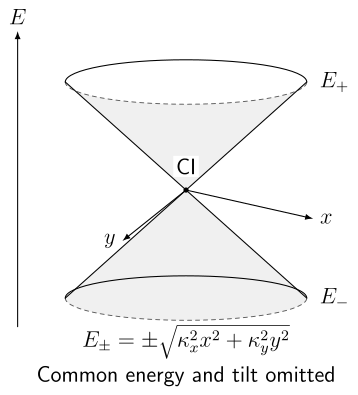
A transverse slice through one seam point shows the two local adiabatic sheets. The directions are orthogonal principal axes of the gap quadratic form; they need not coincide with the original basis-dependent . The remaining seam-tangent coordinates are not drawn.
A cone is a local statement
Section titled “A cone is a local statement”The double cone is the first-order energy splitting in the branching plane. It does not assert that the entire molecular surface is cone-shaped. Beyond a sufficiently small neighborhood:
- the seam bends through nuclear coordinate space;
- the average energy changes along the seam;
- branching directions rotate;
- other electronic states can enter;
- quadratic and higher vibronic couplings can change the topography;
- dissociation coordinates and environmental coordinates can alter accessibility.
The words peaked and sloped describe how the common tilt competes with the gap-opening slopes near an appropriate seam critical point. They are useful local classifications, not complete predictors of a quantum yield.
Minimum-energy conical intersections
Section titled “Minimum-energy conical intersections”A minimum-energy conical intersection (MECI) is a local minimum of a chosen seam energy subject to the degeneracy constraint. With
the idealized problem is
Although written as one gap equality, this constraint has codimension two. The gap is not differentiable at the apex; a smooth local constrained formulation uses and separately.
An MECI is analogous to a stationary landmark on the crossing seam, but it is not automatically a transition state and not necessarily the seam point reached by a wavepacket. A dynamically important point may instead minimize distance from a Franck–Condon geometry, lie on a constrained reaction coordinate, or occur where the incoming wavepacket has substantial amplitude and favorable momentum.
Different optimizations can find different local MECIs on the same connected seam or on disconnected seams. Reporting “the conical intersection” without a state pair, geometry, energy reference, optimization objective, and electronic-structure model is therefore incomplete.
Why a one-dimensional scan shows an avoided crossing
Section titled “Why a one-dimensional scan shows an avoided crossing”Take a straight cut through the local cone but miss the seam by a fixed offset in the second branching coordinate:
Along that cut,
Only the cut with reaches the exact degeneracy. This is why a one-dimensional reaction-coordinate plot often displays an avoided crossing even when the full multidimensional molecular problem contains a conical-intersection seam.
Nonadiabatic Transitions
Section titled “Nonadiabatic Transitions”The adiabatic basis fails at the apex
Section titled “The adiabatic basis fails at the apex”The adiabatic electronic eigenvectors are defined only up to phase away from degeneracy and up to an arbitrary unitary rotation inside a degenerate subspace at the seam. As the gap closes, trying to track two separate adiabatic states produces rapidly varying eigenvectors and singular derivative couplings.
That singularity is not an infinite physical force. It signals that the one-surface adiabatic representation has become a poor coordinate system for the coupled electron–nuclear state. A smooth diabatic or quasi-diabatic two-state subspace can keep the Hamiltonian matrix finite while moving the coupling into off-diagonal potential terms.
Passage creates branching, not a universal jump
Section titled “Passage creates branching, not a universal jump”An excited nuclear wavepacket approaching a conical-intersection region can:
- remain partly on the upper adiabatic sheet;
- transfer amplitude to the lower sheet;
- split into branches with different nuclear momenta;
- acquire relative phase and later interfere;
- miss the seam but still undergo substantial transfer in a small-gap region;
- encounter another state before the two-state event is complete.
There is no state-independent “transition probability of the conical intersection.” The result depends on the incoming nuclear wavepacket, its direction and momentum in the branching plane, the local tilt and anisotropy, seam-coordinate motion, electronic coherence, additional states, and the measured observable.
The same warning applies to the funnel metaphor. A low and accessible crossing region can support rapid internal conversion, but an intersection is not a drain that captures every trajectory or transfers all population.
Relation to Landau–Zener passage
Section titled “Relation to Landau–Zener passage”A prescribed one-dimensional path through or near the branching plane can sometimes be reduced locally to a Landau–Zener-like sweep. That model can illuminate gap and speed dependence. It does not represent the full multidimensional wavepacket automatically:
- the second branching coordinate controls whether the path hits or misses the seam;
- nuclear momentum can rotate and branch;
- repeated passages create interference;
- electronic character rotates around the cone, although the ordered energy labels return to themselves after a closed gapped loop;
- the wavepacket samples a distribution of paths rather than one classical sweep.
Landau–Zener Transition derives the exactly solvable sweep. Nonadiabatic Coupling compares wavepacket, spawning, mean-field, surface-hopping, and perturbative dynamics methods.
Berry Phase in Molecules
Section titled “Berry Phase in Molecules”Half-angle structure of a two-state eigenvector
Section titled “Half-angle structure of a two-state eigenvector”For a circularized branching plane, write
and omit the common energy and tilt. The local electronic Hamiltonian becomes
For and , one real normalized lower-state eigenvector is
After one circuit,
The sign of one eigenvector at one geometry is a gauge choice. The impossibility of choosing a globally single-valued real eigenvector around a loop that encloses the seam is the invariant content. In a complex gauge, the same holonomy appears as a Berry phase
The total molecular state remains single-valued
Section titled “The total molecular state remains single-valued”In a one-surface adiabatic product,
the electronic sign change must be compensated by the nuclear factor, or equivalently by including the Mead–Truhlar vector potential in the nuclear Hamiltonian. The geometric phase can then alter nodal structure, level patterns, interference between paths, and reaction amplitudes.
This phase is not an electronic transition. The loop used to define it stays in a region where the chosen electronic state is gapped. Dynamics through the seam and adiabatic transport around the seam are distinct limits of the same geometry-dependent electronic subspace.
When the simple π rule needs refinement
Section titled “When the simple π rule needs refinement”The elementary sign-change result assumes an isolated real two-state conical intersection and a loop linked once with the relevant seam. More generally:
- a loop can enclose several intersections whose phase factors combine;
- the electronic subspace can contain more than two important states;
- spin–orbit coupling can require a complex, possibly non-Abelian connection;
- the seam can curve and reconnect globally;
- exact electron–nuclear factorization changes how the phase is partitioned between factors.
The physical question is always about loop, subspace, gauge-covariant holonomy, and observable. Born–Oppenheimer Berry Phase develops that structure in full.
Photochemical Significance
Section titled “Photochemical Significance”A four-stage pathway
Section titled “A four-stage pathway”A common photochemical sequence is:
- Preparation. Absorption creates a nuclear wavepacket on one or more electronically excited states in a Franck–Condon region.
- Approach. Excited-state forces carry some amplitude toward an accessible small-gap or conical-intersection region.
- Transfer. Electronic and nuclear amplitudes mix, often producing internal conversion to a lower state.
- Branching. The outgoing lower-state wavepacket evolves toward reactants, isomers, fragments, or other products.
This sequence explains why excited-state chemistry cannot usually be inferred from a vertical excitation energy alone. The gradients and couplings between the preparation region and the seam, not only the MECI energy, control accessibility.
Product selectivity is dynamical
Section titled “Product selectivity is dynamical”In the chosen smooth basis, the diagonal-difference direction detunes its two basis states, while the off-diagonal direction mixes them. Their individual names depend on that basis; the gap-opening plane does not. Incoming momentum and the lower-surface slopes can steer different pieces of the wavepacket toward different products. Seam-coordinate motion adds many more approach and exit channels.
Consequently, a static conical-intersection geometry can suggest candidate coordinates but cannot by itself determine a branching ratio. Product yields are asymptotic observables requiring propagation, ensemble sampling, or an experimentally constrained kinetic model.
Internal conversion and photostability
Section titled “Internal conversion and photostability”Conical intersections can provide efficient radiationless return from an excited singlet to a lower singlet. Such pathways are implicated in photoisomerization and ring opening, and they can contribute to rapid deactivation of some nucleobases and amino-acid chromophores. The careful claim is can contribute: solvent, protonation, substitution, competing states, barriers, spin–orbit coupling, and initial excitation conditions can all redirect the dynamics.
Internal conversion should not be confused with fluorescence, phosphorescence, or intersystem crossing. A realistic photochemical model may require all of them, with rates or explicit dynamics matched to the relevant time and energy scales.
Conical intersections are not ordinary transition states
Section titled “Conical intersections are not ordinary transition states”A ground-state transition state is a saddle of one potential-energy surface used in a statistical reaction-rate construction. A conical intersection is a degeneracy between electronic surfaces. Both can organize reaction pathways, but their mathematics and dynamics differ:
- a transition state is characterized by curvature on one surface;
- a conical intersection is characterized by a seam and two gap-opening directions;
- passage near a conical intersection involves electronic-state mixing and coherence;
- recrossing, branching, and geometric phase may be essential.
Calling an MECI the “transition state of photochemistry” can be a useful analogy only when these differences remain explicit.
Computational Challenges
Section titled “Computational Challenges”Electronic states must be balanced
Section titled “Electronic states must be balanced”Near degeneracy, a method must describe both states with comparable orbital, correlation, and state-averaging errors. A small unbalanced error can move the seam, rotate the branching plane, change its energy, or open a spurious gap.
State-averaged CASSCF often gives the correct qualitative multireference topology and analytic derivative couplings, but its result depends on active space, orbital optimization, state weights, and omitted dynamic correlation. Multireference configuration interaction and multistate perturbation methods can add correlation at greater cost and with their own intruder-state and invariance issues.
Ordinary single-reference methods can become ill-conditioned as reference character changes. Conventional linear-response TDDFT does not generally provide the correct topology for a ground-state/excited-state conical intersection; spin-flip and ensemble approaches repair some cases but introduce method-specific assumptions. A method label is therefore not a validation argument.
Electronic Structure Overview explains the basis-set and correlation errors behind these limitations.
Locating a seam point
Section titled “Locating a seam point”A conical-intersection optimizer must reduce the energy gap while minimizing the average energy along the seam. If orthonormal vectors and span the branching plane, the first-order projector into the seam tangent space is
The vectors must be orthonormalized, not merely normalized separately: the original need not be perpendicular. Equivalently, for the full-rank matrix ,
The projected average-energy gradient
drives motion along the seam, while separate gap-closing components drive the geometry toward degeneracy. Direct gradient-projection algorithms, constrained optimization, sequential penalty methods, and branching-plane-update methods implement this logic in different ways.
When derivative couplings are unavailable, a penalty objective such as
can be used sequentially or combined with approximate branching-space information. A finite penalty alone does not prove that the final gap is zero or that the point is stationary along the true seam.
What distinguishes a seam from a small gap?
Section titled “What distinguishes a seam from a small gap?”A small gap alone does not establish a conical intersection. Follow the same two-state subspace by overlaps, check that two independent directions split it linearly, and sample the local energies. A claimed MECI also requires vanishing average-energy gradient along the seam and a local minimum there. Varying the active space, state averaging, and correlation model tests whether this geometry survives the electronic-structure approximation.
One MECI is not a dynamics calculation
Section titled “One MECI is not a dynamics calculation”Static optimization answers where a constrained seam landmark lies for a chosen electronic model. Dynamics additionally needs:
- an initial nuclear and electronic distribution;
- energies, gradients, and couplings over the visited region;
- a representation and phase-tracking convention;
- a nuclear propagation approximation;
- convergence in timestep, ensemble size, basis, and propagation time;
- operational observables such as spectra, lifetimes, or product probabilities.
The dynamically visited seam region can be far from the lowest MECI. Conversely, a low MECI can remain irrelevant if barriers, momentum, symmetry, or solvent coordinates prevent the prepared wavepacket from reaching it.
Molecular control frontiers discusses attempts to steer photochemical branching, while attosecond and ultrafast frontiers discusses time-resolved probes of the same regions.
Exercises
Section titled “Exercises”Exercise 1: Degeneracy conditions
Section titled “Exercise 1: Degeneracy conditions”For a real symmetric matrix
show that a double eigenvalue requires two independent conditions. Explain why this gives codimension two.
Solution
The eigenvalues are
They are equal only if the nonnegative square root vanishes. Hence
These are two independent scalar equations. In a parameter space of dimension , their generic common solution has dimension .
Exercise 2: Seam dimensions
Section titled “Exercise 2: Seam dimensions”Find the generic same-spin conical-intersection seam dimension for a nonlinear triatomic molecule and for a nonlinear six-atom molecule. Why does the same argument fail for a diatomic molecule?
Solution
For a nonlinear molecule,
For ,
For ,
A diatomic has only one internal coordinate. It cannot generically satisfy two independent same-symmetry degeneracy conditions by varying that coordinate alone. Crossings protected by different symmetry obey different counting.
Exercise 3: Diagonalize the local cone
Section titled “Exercise 3: Diagonalize the local cone”Diagonalize
and show that the gap is linear in radial distance after an anisotropic rescaling of the branching coordinates.
Solution
Because the Pauli matrices anticommute and square to the identity,
Therefore
With and , the gap is
It is linear in the rescaled radial distance and vanishes only at the seam point .
Exercise 4: An avoided crossing as a missed cone
Section titled “Exercise 4: An avoided crossing as a missed cone”For the local model in Exercise 3, follow the one-dimensional path , . Find the minimum gap and interpret .
Solution
Along the path,
The minimum occurs at :
The offset is the path’s miss distance in the second branching direction. If , the one-dimensional scan shows an avoided crossing even though the full two-dimensional branching plane contains an exact degeneracy at .
Exercise 5: Berry sign change
Section titled “Exercise 5: Berry sign change”Verify that
changes sign after one circuit. Why is this not removed by declaring the sign of a wavefunction unobservable?
Solution
Using
gives
At one geometry, a sign is arbitrary. Around the complete loop, however, no globally continuous single-valued real gauge removes the sign change. Relative phase between nuclear paths that encircle the seam differently can affect interference, so the loop holonomy is observable even though a local sign is not.
Exercise 6: Tangent directions to the seam
Section titled “Exercise 6: Tangent directions to the seam”Let satisfy
Show from the local Hamiltonian that displacement does not lift the degeneracy to first order. Does this prove the seam is straight?
Solution
The first-order splitting is
For , both scalar products vanish, so
Thus is tangent to the seam at the chosen point. Higher-order terms can curve the seam and rotate its tangent space, so the local result does not imply a globally straight seam.
Exercise 7: MECI versus mechanism
Section titled “Exercise 7: MECI versus mechanism”A calculation finds an MECI below the vertical excitation energy. List four additional pieces of evidence needed before claiming that it controls an observed photoproduct yield.
Solution
Suitable evidence includes:
- a dynamically accessible path from the prepared Franck–Condon ensemble to the seam region;
- balanced electronic states and a stable MECI energy, geometry, and branching plane across credible methods;
- nonadiabatic dynamics or another justified model showing population transfer in the visited region;
- outgoing lower-surface dynamics that reaches the measured product;
- convergence with respect to initial sampling, timestep, ensemble size, and propagation time;
- comparison with competing internal-conversion, fluorescence, intersystem-crossing, dissociation, or solvent-mediated pathways;
- agreement with an operational observable such as a lifetime, spectrum, or branching ratio.
The MECI energy alone establishes neither accessibility nor product selectivity.
Exercise 8: A seam projector with nonorthogonal branching vectors
Section titled “Exercise 8: A seam projector with nonorthogonal branching vectors”Let and . Find the seam-tangent projector. Why is subtracting the two normalized outer products incorrect?
Solution
Both vectors span the plane, so the answer is . With , the Gram-matrix formula gives this result. Separate normalization instead gives
This matrix does not annihilate and is not a projector. The failure comes from counting the shared direction twice.
References
Section titled “References”- M. J. Bearpark, M. A. Robb, and H. B. Schlegel, “A direct method for the location of the lowest energy point on a potential surface crossing,” Chemical Physics Letters 223, 269–274 (1994). doi:10.1016/0009-2614(94)00433-1
- W. Domcke, D. R. Yarkony, and H. Köppel, eds., Conical Intersections: Electronic Structure, Dynamics and Spectroscopy (World Scientific, 2004). doi:10.1142/5406
- M. Huix-Rotllant, A. Nikiforov, W. Thiel, and M. Filatov, “Description of conical intersections with density functional methods,” Topics in Current Chemistry 368, 445–476 (2016). doi:10.1007/128_2015_631
- B. G. Levine, J. D. Coe, and T. J. Martínez, “Optimizing conical intersections without derivative coupling vectors: Application to multistate multireference second-order perturbation theory,” Journal of Physical Chemistry B 112, 405–413 (2008). doi:10.1021/jp0761618
- B. G. Levine and T. J. Martínez, “Isomerization through conical intersections,” Annual Review of Physical Chemistry 58, 613–634 (2007). doi:10.1146/annurev.physchem.57.032905.104612
- H. C. Longuet-Higgins, U. Öpik, M. H. L. Pryce, and R. A. Sack, “Studies of the Jahn–Teller effect. II. The dynamical problem,” Proceedings of the Royal Society A 244, 1–16 (1958). doi:10.1098/rspa.1958.0022
- S. Maeda, K. Ohno, and K. Morokuma, “Updated branching plane for finding conical intersections without coupling derivative vectors,” Journal of Chemical Theory and Computation 6, 1538–1545 (2010). doi:10.1021/ct1000268
- S. Matsika and P. Krause, “Nonadiabatic events and conical intersections,” Annual Review of Physical Chemistry 62, 621–643 (2011). doi:10.1146/annurev-physchem-032210-103450
- C. A. Mead and D. G. Truhlar, “On the determination of Born–Oppenheimer nuclear motion wave functions including complications due to conical intersections and identical nuclei,” Journal of Chemical Physics 70, 2284–2296 (1979). doi:10.1063/1.437734
- M. S. Schuurman and A. Stolow, “Dynamics at conical intersections,” Annual Review of Physical Chemistry 69, 427–450 (2018). doi:10.1146/annurev-physchem-052516-050721
- G. A. Worth and L. S. Cederbaum, “Beyond Born–Oppenheimer: Molecular dynamics through a conical intersection,” Annual Review of Physical Chemistry 55, 127–158 (2004). doi:10.1146/annurev.physchem.55.091602.094335
- D. R. Yarkony, “Diabolical conical intersections,” Reviews of Modern Physics 68, 985–1013 (1996). doi:10.1103/RevModPhys.68.985