

Band Theory Overview
Band theory describes a periodic quantum system through energy eigenvalues and eigenstates labeled by crystal momentum and a band index. In its simplest form it solves an effective one-electron problem,
then fills the resulting Bloch states according to Fermi–Dirac statistics. The functions are the energy bands.
This compact construction explains why some crystals have a Fermi surface while others have a gap, why velocities and effective masses depend on band derivatives, and why atomic orbitals can become broad dispersive spectra in a solid. It does not mean that electrons in real materials cease to interact. The words band structure can refer to model eigenvalues, Hartree–Fock orbitals, Kohn–Sham eigenvalues, or interacting quasiparticle peaks. Those objects can resemble one another while answering different questions.
Required background. Bloch’s Theorem supplies the translation-sector eigenstates, reciprocal equivalence, and cell-periodic eigenproblem used to define bands.
Helpful background. The page assumes introductory reciprocal-space and fermion-filling language.
Start from the Many-Particle Crystal
Section titled “Start from the Many-Particle Crystal”A nonrelativistic crystal contains nuclei and electrons. Before approximation, its Hamiltonian includes nuclear kinetic energy, electron kinetic energy, electron–nuclear attraction, nuclear repulsion, and electron–electron repulsion:
The exact electronic state is therefore a many-fermion wavefunction, not a list of independently occupied orbitals.
Band theory begins with a controlled or declared reduction:
- Separate slow nuclear and fast electronic motion, usually within a Born–Oppenheimer or clamped-ion description.
- Use the periodic nuclear arrangement, possibly including a self-consistent electronic field, to define lattice translations.
- Replace or reorganize the interacting electronic problem by an effective one-particle or quasiparticle problem.
- Solve that periodic problem in crystal-momentum sectors.
- Fill or interpret the resulting states according to the approximation being used.
The first step is not exact at arbitrary nuclear velocity or near every degeneracy. The third step is where Hartree, Hartree–Fock, density-functional, model-Hamiltonian, and Green-function approaches diverge.
From Translation Symmetry to Bands
Section titled “From Translation Symmetry to Bands”Suppose the effective Hamiltonian commutes with every lattice translation:
Bloch’s theorem allows eigenstates of the form
Define the cell-periodic Hamiltonian
For each in a primitive Brillouin zone, solve
As varies continuously, each eigenvalue traces a band. Reciprocal periodicity implies
up to possible relabeling among degenerate or connected bands.
The band index is not a universal observable name. Near avoided crossings, orbital character can pass continuously from one energy branch to another. At exact degeneracies, any unitary basis inside the degenerate subspace is valid. Robust statements concern the whole subspace, its symmetry representation, its projector, or gauge-invariant observables rather than an arbitrary eigenvector label. Symmetry of Bloch States explains the representations and allowed crossings.
One Band Contains One State per Cell
Section titled “One Band Contains One State per Cell”Consider a crystal with primitive cells and periodic boundary conditions. There are allowed points in one Brillouin zone. A single nondegenerate band therefore contains
one-particle states, or one state per primitive cell.
If every displayed band is spin degenerate and spin is not included in , the capacity is
If spin–orbit coupling, magnetism, or an explicitly spinful basis is already included in the band index, no automatic factor of two may be added.
This counting is independent of whether the band is broad or flat. Bandwidth changes the energy distribution of states, not their total number.
Filling Bands with Fermions
Section titled “Filling Bands with Fermions”For independent-electron bands,
where
At zero temperature,
The electron count per primitive cell is
when includes all internal states. A full nondegenerate band contributes one to ; a partial band contributes its occupied fraction of the Brillouin zone. In an interacting system, the physical occupation instead comes from the full electron spectral function. A low-energy quasiparticle model does not generally count every electron by summing its coherent peaks alone.
The elementary filling criterion
Section titled “The elementary filling criterion”In a simple spin-degenerate independent-electron model:
- an even number of electrons per cell can fill an integer number of spin-degenerate bands;
- an odd number per cell leaves at least one band incompletely filled, so an ordinary full band gap is impossible. With smooth dispersive bands this generically gives a Fermi surface. A partially filled exactly flat band is a separate, highly degenerate case and need not carry ordinary band current.
This is a useful first check, not a theorem about every material. Magnetism can lift spin degeneracy. Translation-symmetry breaking can enlarge the cell and change the filling per new cell. Nonsymmorphic symmetries can force groups of bands to remain connected. Even filling is therefore not sufficient for a band insulator, as the filling constraints of Watanabe et al. illustrate. In two or three dimensions, a spin-degenerate nodal semimetal with only isolated point or line nodes and no finite-volume pockets has an integer number of occupied spin pairs almost everywhere; it has even filling. It is not a generic exception to the odd-filling argument. If spin degeneracy is absent, the counting changes. Strong correlations can produce a Mott insulator at a filling where ordinary band theory predicts a metal.
Filled Bands and Charge Transport
Section titled “Filled Bands and Charge Transport”For a nondegenerate band without Berry-curvature corrections, the group velocity is
The equilibrium current contribution of a completely filled band is proportional to
Because the band energy is periodic on the Brillouin torus, the boundary terms cancel:
Thus a full ordinary band has no net longitudinal group-velocity current. A partially filled band can respond because an electric field distorts its occupation near the Fermi surface.
Holes describes the current carried by a small number of missing electrons in an otherwise full band. Semiclassical Dynamics of Bloch Electrons develops the force equation and wave-packet motion.
This argument does not say that every filled band is physically inert. Filled bands determine polarization, orbital magnetization, and interband optical response, and topological filled bands can carry quantized transverse transport. Energies alone are insufficient for those effects; Bloch eigenvectors and their geometry matter.
Valence and Conduction Bands
Section titled “Valence and Conduction Bands”For a band insulator at zero temperature:
- valence bands are occupied bands below the gap;
- conduction bands are empty bands above the gap;
- the valence-band maximum is the highest occupied band energy;
- the conduction-band minimum is the lowest empty band energy.
Write
and
The independent-particle fundamental gap is
The labels valence and conduction refer primarily to occupation and energy position, not to immutable atomic orbitals. A band with mostly anion character in one part of the zone can hybridize and acquire other character elsewhere.
In a metal, a band that crosses the chemical potential is partly occupied, so the clean valence/conduction division is not generally available. In a semimetal, nominal valence and conduction bands touch or overlap.
Fermi Energy and Chemical Potential
Section titled “Fermi Energy and Chemical Potential”The chemical potential is the thermodynamic cost of changing particle number:
In a zero-temperature metal, the terms Fermi energy and chemical potential are commonly identified:
The Fermi surface is then the set . This page uses only that definition; the material-facing geometry belongs to Fermi Surface.
For an ideal band insulator at zero temperature, every value of inside the gap gives the same occupations. A plotted midgap “Fermi level” is often a convention, not a uniquely occupied one-particle state. At nonzero temperature, charge neutrality, dopants, defects, and contact reservoirs determine .
Do not confuse:
- the chemical potential measured relative to an internal energy zero;
- the vacuum-referenced work function;
- the highest occupied eigenvalue of a finite calculation;
- the Fermi energy of a free-electron gas;
- a spectrometer’s binding-energy zero.
These quantities can be related only after their energy references and approximations are stated.
Band-Gap Orientation
Section titled “Band-Gap Orientation”A direct separation compares a chosen lower and upper band group at the same crystal momentum; these groups need not be fully occupied and empty when their energies overlap globally. A global band gap allows the valence maximum and conduction minimum to occur at different momenta. The global gap can therefore be negative even when every same- separation is positive: the bands are locally separated but overlap in energy.
Use Band Gaps for the exact direct and full-zone definitions and for the distinction among band, charge, quasiparticle, Kohn–Sham, optical, transport, and mobility gaps. This overview needs only the material-level consequence: a local avoided crossing does not establish an insulating interval, and a conventional path plot cannot exclude an off-path extremum or another relevant band.
Material Classification at the Band Level
Section titled “Material Classification at the Band Level”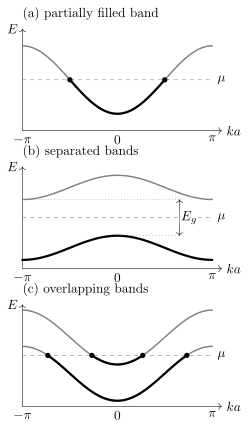
Independent-particle classification by filling and global energy separation. Black segments are occupied; gray segments are empty; dashed lines mark . The curves are explicit periodic dispersions, so the marked crossings lie on the bands. A metal has a Fermi-level crossing; a band insulator or intrinsic semiconductor has separated occupied and empty bands; a semimetal has touching or overlapping bands with reduced carrier phase space.
| Band-level state | Zero-temperature structure | Low-energy charged excitations |
|---|---|---|
| Metal | one or more bands cross | gapless states on a Fermi surface |
| Band insulator | occupied and empty bands separated by | gapped electron and hole excitations |
| Intrinsic semiconductor | a band insulator with a gap small enough for useful thermal, optical, or dopant control | thermally or optically activated carriers |
| Semimetal | bands touch or overlap weakly | point, line, or small-pocket carriers |
This is a band-theory classification, not an exhaustive taxonomy of insulating phases. Anderson localization can suppress dc transport without a clean band gap. Mott localization can produce an interaction-driven gap where a one-electron filling argument predicts a metal. Topological Insulators are bulk band insulators whose occupied eigenvectors carry nontrivial global structure and whose boundary claims require additional symmetry and evidence.
Two Complementary Pictures
Section titled “Two Complementary Pictures”Nearly free electrons
Section titled “Nearly free electrons”Begin with plane waves and turn on a weak periodic potential. Reciprocal Fourier components mix states whose momenta differ by a reciprocal vector. At a Bragg degeneracy, this mixing splits levels and opens a local gap. This picture is strongest when the ionic pseudopotential is weak for the states of interest.
Tight binding
Section titled “Tight binding”Begin with localized orbitals on separated atoms and turn on hopping. Each atomic level produces as many crystal states as there are cells, and hopping spreads them into a band. Multiple orbitals and basis sites produce multiple bands and hybridization gaps.
These are complementary basis choices and approximation regimes for Bloch states. A converged calculation can be expanded in plane waves or a localized basis without changing gauge-invariant observables. Wannier Functions explains the Fourier construction and conditions for a localized basis.
Worked Example: Two Hybridizing Bands
Section titled “Worked Example: Two Hybridizing Bands”Consider
The eigenvalues are
At a crossing of the uncoupled bands,
the direct splitting is
If symmetry forces , the crossing can remain exact. If , it is avoided. Whether the system becomes insulating still depends on filling and on every other band throughout the Brillouin zone.
What Kind of Band Structure?
Section titled “What Kind of Band Structure?”The source of must be stated.
Model bands
Section titled “Model bands”Nearly-free-electron, tight-binding, and models retain selected degrees of freedom and parameters. They are valuable because assumptions are visible and mechanisms can be isolated. Their accuracy is limited to the fitted orbitals, energies, momenta, and observables.
Hartree–Fock bands
Section titled “Hartree–Fock bands”Hartree–Fock minimizes the energy over single Slater determinants and produces a self-consistent nonlocal Fock operator. Its orbitals include direct and exchange fields but omit dynamical correlation. Orbital energies are not automatically exact electron-addition and removal energies.
Hartree–Fock Approximation derives the variational equations and their limitations.
Kohn–Sham bands
Section titled “Kohn–Sham bands”Kohn–Sham density-functional theory introduces a noninteracting auxiliary system constructed to reproduce the interacting ground-state density in exact DFT. In practical DFT, an approximate exchange-correlation functional determines the effective potential.
The Kohn–Sham framework is useful for total energies and forces, while its bands often provide useful trends and starting points for excitation calculations. The total energy is not simply the sum of occupied eigenvalues: interaction terms would be counted incorrectly. But the formal target is the ground-state density, not the complete charged-excitation spectrum. Treating every Kohn–Sham eigenvalue difference as a measured excitation energy is an additional approximation.
The exact multiplicative Kohn–Sham gap and the interacting charge gap differ by an exchange-correlation derivative discontinuity. Band Gaps explains that decomposition and the qualifications for generalized Kohn–Sham methods and approximate functionals.
Quasiparticle bands
Section titled “Quasiparticle bands”The interacting one-particle Green function satisfies a Dyson equation. Use the energy argument , rather than angular frequency, so that every term in the inverse propagator has units of energy. In matrix notation,
Peaks of the spectral function
define quasiparticle dispersions only when the peaks are sufficiently sharp. The self-energy shifts energies, changes velocities and masses, gives finite lifetimes, transfers weight into satellites, and can destroy a simple band picture.
Spectral Functions derives pole residues, lifetimes and incoherent weight.
Reading a Band Plot Correctly
Section titled “Reading a Band Plot Correctly”A conventional plot samples selected high-symmetry lines. It shows energies and crossings along those lines, but may miss a band extremum or Fermi pocket elsewhere. Even a complete set of energies does not supply all optical matrix elements, lifetimes or topological invariants. Band Structure Workflows explains numerical convergence and full-zone sampling.
A band approximation is useful over an energy range where its retained states describe the observable. Static mean fields can incorporate order; dynamical self-energies can incorporate screening, satellites and finite lifetimes. These are different levels of approximation. Agreement with an equilibrium structure or Fermi surface does not establish the accuracy of an optical threshold or satellite spectrum.
When the Simple Picture Fails
Section titled “When the Simple Picture Fails”Mott localization
Section titled “Mott localization”A partially filled band can be insulating when repulsion prevents charge motion. The gap is then interaction driven and cannot be obtained by merely filling a fixed noninteracting band.
Strongly incoherent metals
Section titled “Strongly incoherent metals”If spectral peaks are as broad as their energy, a long-lived is not a faithful low-energy degree of freedom. Spectral weight may still disperse, but calling it a conventional band can conceal the missing quasiparticle.
Fractionalization and topological order
Section titled “Fractionalization and topological order”The electron can cease to be the elementary low-energy excitation. Emergent gauge fields and fractional quasiparticles require a many-body description beyond occupied electron bands. Fractional Quantum Hall Effect gives the canonical case: interactions within a partially filled Landau level produce an incompressible fluid whose charge, statistics, edge, and ground sectors cannot be reconstructed from electron band energies alone.
Disorder and localization
Section titled “Disorder and localization”Strong disorder removes exact crystal momentum and can localize eigenstates. A large supercell always produces folded eigenvalues, but that does not restore a physically meaningful clean-crystal band picture.
Pairing
Section titled “Pairing”Superconductors are often described by Bogoliubov–de Gennes bands in an enlarged particle–hole space. These are coherent superpositions of electron addition and removal, not ordinary electron bands filled up to .
Hidden symmetry changes
Section titled “Hidden symmetry changes”Magnetic, structural, or charge order can enlarge the primitive cell and reconstruct the Brillouin zone. Using the high-symmetry phase’s bands below such a transition can give the wrong filling and wrong Fermi surface.
Exercises
Section titled “Exercises”Exercise 1: capacity of a band
Section titled “Exercise 1: capacity of a band”A three-dimensional crystal has primitive cells and a nonmagnetic calculation displays one spin-degenerate band. How many one-particle states does it contain? How many electrons are required to fill it?
Solution
Periodic boundary conditions produce allowed crystal momenta in one Brillouin zone. At each momentum the displayed band represents two spin states. It therefore contains
one-particle states and requires electrons for complete filling. Per primitive cell, its capacity is two electrons.
If spin were already explicit in the band index, each spin-resolved band would instead contain states.
Exercise 2: current of a filled one-dimensional band
Section titled “Exercise 2: current of a filled one-dimensional band”Show that the sum of group velocities in a completely filled one-dimensional band vanishes.
Solution
In the thermodynamic limit,
Choose the zone from to . Then
by reciprocal periodicity. Hence the equilibrium group-velocity current vanishes. The proof does not exclude Berry-curvature or interband responses of filled bands.
Exercise 3: Doubling the cell at one electron per site
Section titled “Exercise 3: Doubling the cell at one electron per site”A spin-independent chain has one orbital and one electron per original site. Alternating positive hoppings double the primitive period to . The two orbital bands in the new zone have energies
How many electrons occupy the new cell, and can a band gap now occur without breaking spin symmetry?
Solution
The new cell contains two sites and two electrons. Each of the displayed bands is spin degenerate and holds two electrons per new cell. The lower band can therefore be full. At its separation from the upper band is . The odd-filling argument for the original translation symmetry no longer applies because that translation is broken. At the smaller cell is restored and the folded bands touch. Tight-Binding Models gives the hopping construction.
Exercise 4: chemical potential inside a gap
Section titled “Exercise 4: chemical potential inside a gap”Why does moving the zero-temperature chemical potential within an ideal band gap not change the particle number?
Solution
At zero temperature,
Suppose no eigenvalue lies between and . For every
all valence states remain below and all conduction states remain above it. Every step function is unchanged, so is constant throughout the gap.
At nonzero temperature, exponentially small electron and hole populations and charge-neutrality constraints generally select a temperature-dependent value.
Exercise 5: diagnose the approximation
Section titled “Exercise 5: diagnose the approximation”For each case, state whether ordinary independent-electron bands are sufficient, useful but incomplete, or qualitatively unreliable: (a) a weakly interacting alkali metal with sharp ARPES peaks; (b) a half-filled narrow band with a large interaction-driven insulating gap; (c) a conventional semiconductor optical absorption edge dominated by a bound exciton; (d) a disordered sample whose states at the chemical potential are Anderson localized.
Solution
(a) Bands are highly useful, with interactions entering mainly through quasiparticle renormalization and lifetime. A nearly-free-electron or quasiparticle description can be quantitatively successful.
(b) A fixed independent-electron band is qualitatively unreliable for the insulating mechanism. A correlated many-body treatment is required, although orbital and lattice information from band theory remains useful input.
(c) Bands are useful but incomplete. They supply electron and hole dispersions, while electron–hole attraction and optical matrix elements are required for the absorption edge.
(d) Clean-crystal bands are useful as a reference, but they do not decide dc conduction. Localization and disorder statistics are essential because exact crystal momentum is absent and extended-state assumptions fail.
References
Section titled “References”- N. W. Ashcroft and N. D. Mermin, Solid State Physics (Holt, Rinehart and Winston, 1976), Chapters 7–12.
- W. Kohn and L. J. Sham, “Self-Consistent Equations Including Exchange and Correlation Effects,” Physical Review 140, A1133–A1138 (1965), doi:10.1103/PhysRev.140.A1133.
- R. M. Martin, Electronic Structure: Basic Theory and Practical Methods (Cambridge University Press, 2004), Chapters 1–5 and 12–13.
- J. P. Perdew, R. G. Parr, M. Levy, and J. L. Balduz, Jr., “Density-Functional Theory for Fractional Particle Number: Derivative Discontinuities of the Energy,” Physical Review Letters 49, 1691–1694 (1982), doi:10.1103/PhysRevLett.49.1691.
- H. Watanabe, H. C. Po, M. P. Zaletel, and A. Vishwanath, “Filling-Enforced Gaplessness in Band Structures of the 230 Space Groups,” Physical Review Letters 117, 096404 (2016), doi:10.1103/PhysRevLett.117.096404.