

Symmetry of Bloch States
A Bloch band acquires an exact symmetry label only when the relevant symmetry acts within the same crystal-momentum fiber. Most spatial operations instead send to another point in its star. At an invariant point or line, reciprocal sewing brings that action back to the chosen fiber, where little-group representations constrain degeneracy, hybridization, and connectivity.
This distinction prevents several common overclaims. Orbital weight is not automatically an irrep label. Time reversal pairs generic with rather than producing a same-momentum doublet everywhere. Two bands with different symmetry labels cannot mix on the invariant locus, but symmetry does not force their energies to meet. A list of high-symmetry eigenvalues can diagnose some obstructions, yet it does not by itself prove a full-zone gap, a topological invariant, or a material response.
Required background. Use the translation convention and Bloch fibers from Bloch’s Theorem, the reciprocal identifications from Brillouin Zones, and irreducible representations from Groups and Representations.
Helpful background. Crystalline Symmetry, Projective Representations, Degeneracy and Multiplets, and Kramers Degeneracy supply the general theorems that are specialized below.
Crystal symmetries and band labels
Section titled “Crystal symmetries and band labels”The symmetry is that of the Hamiltonian and state being studied. Magnetic order, a field or strain can reduce it below the symmetry of the parent crystal. A spin-independent electron Hamiltonian and one with spin–orbit coupling also require different representations: the latter must include the minus sign from a full spin rotation. Keep the orbital positions and Bloch phases explicit when constructing symmetry matrices.
The discussion concerns one-particle, quasiparticle or mean-field Bloch bands. Generic interacting many-body states have their own symmetry representations; individual band labels do not classify them.
Band index, orbital character, spin expectation, and valley name are useful annotations, but none is automatically an exact quantum number. At a degeneracy, energy-sorted band indices can swap under an arbitrarily small change of momentum. Projected orbital weights can exchange continuously through an avoided crossing. A physical spin component is conserved only when the Hamiltonian has the corresponding symmetry. A valley label is robust only to the accuracy with which intervalley mixing is absent.
Space-Group Actions Between Bloch Fibers
Section titled “Space-Group Actions Between Bloch Fibers”Write a unitary space-group operation as
where is a point operation and is a translation, possibly fractional. For , the multiplication rule is
With the active translation convention,
Because
the transformed state belongs to the fiber:
Choose orthonormal frames for a symmetry-invariant set of bands and collect their states as columns in . The sewing matrix is defined by
It intertwines the Bloch Hamiltonians:
This equation relates different fibers in general; it is not yet a same- commutator.
If the frame changes by a momentum-dependent unitary matrix,
then
Individual matrix entries and eigenvectors are gauge dependent. Eigenvalues on an invariant locus, irrep multiplicities, and compatibility data are meaningful only after the reciprocal sewing and representation convention have been fixed.
Antiunitary sewing
Section titled “Antiunitary sewing”An antiunitary symmetry sends momentum to . Define its sewing matrix by
Because conjugates scalar coefficients, its covariance and gauge laws are
The last complex conjugate is essential. At a fixed momentum, after reciprocal sewing, the square of the antiunitary action is represented by , not . For spin-half time reversal in a spin basis, gives . These are the matrix rules behind the magnetic-group corepresentations discussed by Bradley and Davies.
The star of a momentum
Section titled “The star of a momentum”The star of is the orbit
where is the crystal point group and is the reciprocal lattice. A symmetry makes spectra equal at star-related momenta. That is an equality between distinct fibers, not necessarily a degeneracy at one momentum.
For a square lattice with point group , a generic momentum has an eight-point star. At , the full point group leaves the momentum fixed. At , rotations by send to the distinct point , whereas a rotation and the appropriate mirrors return modulo a reciprocal vector. The star shrinks as the little group grows.
Little Groups and Exact Band Labels
Section titled “Little Groups and Exact Band Labels”The space-group little group of is
Here and means equality modulo a reciprocal vector. Translations form a normal subgroup. Quotienting them gives the little co-group. At a generic momentum it is often trivial; at high-symmetry points, lines, or planes it is larger.
When , the reciprocal-boundary sewing identifies the fiber with the chosen representative at . The resulting matrix acts inside one fiber and satisfies
Only at this stage may the Bloch eigenspace be decomposed into little-group irreps.
For the unitary little group,
where has irrep dimension and occurs times. Schur’s lemma gives
A -dimensional irrep therefore forces at least a -fold multiplet. Repeated copies of the same irrep can mix through the multiplicity-space matrix ; sharing an irrep does not protect a crossing.
For nonsymmorphic groups and spinful electrons, little-co-group matrices may be projective or double valued. Fractional translations contribute momentum-dependent phases, while a spin rotation contributes a minus sign for half-integer spin. A label such as , , or a glide eigenvalue is incomplete unless the space group, momentum, spin convention, and representation table are named.
Degeneracy Is a Conditional Statement
Section titled “Degeneracy Is a Conditional Statement”Several mechanisms produce doublets, with different responses to symmetry-breaking perturbations.
Unitary multiplet degeneracy. A multidimensional unitary little-group irrep forces degeneracy at the invariant momentum or locus. One-dimensional irreps label states but do not by themselves force a doublet.
Spin-rotation degeneracy. Without spin–orbit coupling, magnetism, or a spin-dependent field, an -invariant one-electron Hamiltonian has at least a spin doublet at every . This is not the same mechanism as Kramers degeneracy.
Time-reversal pairing. For spinful time reversal,
At a time-reversal-invariant momentum,
reciprocal sewing returns to the same fiber. Kramers theorem then forces an orthogonal partner at the same energy. Away from such momenta, time reversal generally relates states in different fibers; it does not require same- degeneracy.
Combined inversion and time reversal. Inversion sends to , so the antiunitary product leaves every momentum fixed. For spinful electrons, if , , and the two commute in the relevant representation, then
and every Bloch level is at least twofold degenerate. Inversion alone relates and but does not generically force a same-momentum doublet.
Magnetic or nonsymmorphic antiunitary degeneracy. More general antiunitary operations can leave a momentum fiber invariant only on selected loci. Their square need not be a scalar: it may be a unitary little-group operation. In the important special case
its restriction to the fiber is
A Kramers-like doublet follows where this scalar equals , subject to the full corepresentation algebra. The ordinary unitary-irrep argument is insufficient for magnetic little groups.
Valley degeneracy. In an ideal time-reversal-symmetric honeycomb crystal, the inequivalent corners and are exchanged by time reversal, so their spectra are equal. They are distinct crystal-momentum fibers rather than a same- doublet. Primitive translation symmetry forbids a matrix element between them unless the perturbation supplies their momentum difference modulo a reciprocal vector. An atomically sharp edge or defect can do so, and a commensurate superlattice can fold both valleys to the same reduced momentum and permit hybridization. Smooth perturbations can leave valley approximately conserved without making it an exact internal symmetry. Without time reversal or another symmetry relating the valleys, honeycomb momentum geometry alone does not enforce equal spectra. See Graphene and Dirac Materials for the honeycomb model and valley physics.
Accidental degeneracy. Equal energies can occur without protection. If an allowed arbitrarily small perturbation splits or gaps the equality, it is accidental relative to the declared symmetry class. Numerical equality alone never identifies the mechanism.
Protected Crossings and Allowed Avoided Crossings
Section titled “Protected Crossings and Allowed Avoided Crossings”Let two nondegenerate states on a symmetry-invariant locus have unitary symmetry eigenvalues and . For a symmetry-preserving perturbation ,
Inserting the symmetry gives
If , then . The two sectors cannot hybridize while the momentum remains on that locus and the symmetry remains exact. If their dispersions meet, the crossing is protected against symmetry-preserving mixing.
The converse needs care. Equal labels permit a coupling; they do not guarantee a visible avoided crossing, because the allowed matrix element can vanish for another reason or be numerically small. Different labels forbid mixing; they do not force the two energies to become equal.
A mirror-line model
Section titled “A mirror-line model”On a spinless mirror-invariant line, choose
Write a two-band Hamiltonian as
Mirror symmetry on the line requires
so . A zero of is then a crossing between opposite mirror sectors. Moving away from the mirror line or breaking the mirror permits and terms and generally opens a gap. For spinful reflection the eigenvalues are commonly rather than , but the selection-rule logic is the same after the double-group convention is declared.
Orbital weight through an avoided crossing
Section titled “Orbital weight through an avoided crossing”Consider instead
Its eigenvalues are
When , the levels avoid crossing and their orbital weights exchange continuously. Calling one energy-sorted branch “orbital 1” on both sides mislabels the state. Orbital character is a projected weight; the exact label is the symmetry representation, if one exists.
Compatibility and Nonsymmorphic Connectivity
Section titled “Compatibility and Nonsymmorphic Connectivity”An irrep at a high-symmetry point does not remain an irrep of that entire point group as momentum leaves the point. Restrict it to the smaller little group of the outgoing line:
These subduction rules are the compatibility relations. Bands leaving the endpoint must carry the allowed line irreps, and the same line irreps must recombine into allowed irreps at the other endpoint. Compatibility constrains which branches can connect. It does not determine their energy ordering, dispersion, filling, or whether a global gap exists away from these loci.
Fractional translations
Section titled “Fractional translations”Suppose a glide or screw operation leaves a momentum line invariant and obeys
up to a possible spin rotation. Its representation satisfies
so every symmetry eigenvalue obeys
For a spinless two-dimensional glide
one has on the glide-invariant lines. Hence
After , the two eigenvalue branches exchange. This enforces pairwise connectivity around the reciprocal loop; it does not mean that every momentum is degenerate. Additional symmetry and compatibility data determine where the required contact occurs. In the spinful case the mirror square changes the phase, commonly giving .
A concrete two-orbital representation on the invariant line is
Both matrices are reciprocal-periodic, , and . Following a fixed glide branch gives . The branches exchange after a reciprocal period, while the unordered energy spectrum returns to itself. Here they meet at ; the glide algebra alone does not pin that location in every allowed model.
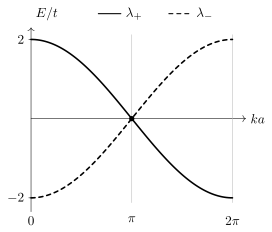
The continuous labels follow the solid and dashed branches. Energy sorting instead switches branch at the crossing. The spectrum at and is the same set.
Band Representations and Topological Quantum Chemistry
Section titled “Band Representations and Topological Quantum Chemistry”A localized orbital at a Wyckoff position transforms under its site-symmetry group. Inducing that local representation to the full space group produces a band representation. In momentum space it decomposes into little-group irreps that obey compatibility relations across the Brillouin zone.
An actual symmetry-respecting Wannier construction realizes such a localized description. Merely matching its tabulated high-symmetry irreps is weaker: distinct band subspaces can share those data. The Wannier centers can also lie at positions different from the ions.
Topological quantum chemistry organizes these band representations; disconnected subsets of an elementary band representation can have an obstruction. Symmetry indicators compress selected representation data. A nonzero indicator can diagnose topology under its stated assumptions, but zero does not establish triviality. Berry phases, Wilson loops or information at generic momenta can distinguish cases invisible to the indicator. These limitations are explicit in the frameworks of Bradlyn et al. and Po, Vishwanath and Watanabe.
See Wannier Functions for localization, Topological Insulators for class-AII invariants and Quantum Materials by Design for applications. Representation data alone do not establish an insulating filling, a full-zone gap or a measured response.
Checking a symmetry in a numerical model
Section titled “Checking a symmetry in a numerical model”A proposed unitary sewing matrix can be tested with the covariance residual
For antiunitary symmetry, conjugate the second Hamiltonian as above. Use a declared matrix norm and compare the residual, which has units of energy, with the gap or splitting being resolved. A large constant energy offset must not make a broken symmetry look accurate: for and the proposed mirror , the operator norm of is , independent of . Dividing by would conceal the error. A dimensionless residual can instead use a physically chosen bandwidth or target splitting, with a nonzero reference scale when needed.
At degenerate energies, analyze the whole eigenspace; arbitrary eigenvectors returned by a solver need not have definite symmetry labels. Follow compatibility relations between momenta, and test whether small symmetry-allowed perturbations move, split or remove an apparent crossing. A high-symmetry path alone cannot establish a full-zone gap. Small residuals test the implemented representation, not the adequacy of the model for a material. Band Structure Workflows and Wannierization Workflows discuss the numerical calculations in detail.
Exercises
Section titled “Exercises”Exercise 1: Fiber mapping and sewing-matrix gauge covariance
Section titled “Exercise 1: Fiber mapping and sewing-matrix gauge covariance”First use
and
to prove that belongs to . Then, starting from
derive the transformation of under . Which information is gauge covariant? Derive the corresponding rule for an antiunitary symmetry and explain why its square transforms covariantly.
Solution
The conjugation law implies
Therefore
This is the translation character of the fiber. Apply to the new frame. Because contains frame coefficients, . Substitute the sewing definition and , then compare with the primed sewing definition. The result is
At a little-group momentum, after reciprocal sewing, the matrices are related by a same-fiber similarity transformation. Their eigenvalue multiset and irrep multiplicities are invariant, while eigenvectors and individual matrix entries depend on the chosen frame.
For an antiunitary operation, , which produces . At a fixed fiber,
Thus the square has a basis-independent spectrum, including the Kramers value . Replacing by would generally destroy this property.
Exercise 2: Moving a protected crossing
Section titled “Exercise 2: Moving a protected crossing”On a mirror line, let and with . Compare perturbations and . Which preserves the mirror, and what happens to the crossing? Does a mirror symmetry require two arbitrary dispersions to cross?
Solution
The diagonal term preserves the mirror and moves the crossing to . It lifts the degeneracy at the old point without opening an avoided crossing nearby. The off-diagonal term breaks this mirror and gives , with minimum separation .
Mirror forbids mixing between opposite sectors, but does not require their energies to meet. A simple crossing persists locally under a sufficiently small diagonal perturbation; with larger changes, crossings can annihilate in pairs or move outside the region considered. For equal mirror labels, mixing is allowed. Away from the mirror-invariant line, the same-momentum selection rule no longer applies.
Exercise 3: Glide connectivity
Section titled “Exercise 3: Glide connectivity”For a spinless glide with , derive its two eigenvalues on a glide-invariant line. For the displayed two-orbital and , find the energies, the crossing and the fate of each glide branch after one reciprocal period.
Solution
The translation convention gives
Thus
After , becomes and conversely. A single isolated band cannot return to itself with the same glide branch around the reciprocal loop. Bands must connect in at least pairs, with a contact somewhere as required by continuity and the remaining symmetries. This does not imply degeneracy at every , nor does it locate the contact without further compatibility information.
Because is unitary, has energy on its eigenstate. Thus and the displayed model crosses at . The energy-sorted bands are periodic; the continuously followed glide branches exchange.
Exercise 4: Compatibility at two endpoints
Section titled “Exercise 4: Compatibility at two endpoints”A two-dimensional irrep at one endpoint subduces along a line as
At the other endpoint, every available isolated doublet subduces as . Can the original pair remain isolated along the entire line?
Solution
No. One branch leaving the first endpoint carries , but the proposed isolated endpoint pair offers no branch into which it can terminate. The connectivity graph is incomplete. Another band carrying the missing line irrep must join, or the assumed isolation fails through a crossing elsewhere. Compatibility determines this connection constraint, not the detailed energy ordering.
References
Section titled “References”- Aroyo, M. I., A. Kirov, C. Capillas, J. M. Perez-Mato, and H. Wondratschek. “Bilbao Crystallographic Server. II. Representations of Crystallographic Point Groups and Space Groups.” Acta Crystallographica A 62, 115–128 (2006). doi:10.1107/S0108767305040286.
- Bradley, C. J., and A. P. Cracknell. The Mathematical Theory of Symmetry in Solids. Clarendon Press, 1972.
- Bradley, C. J., and B. L. Davies. “Magnetic Groups and Their Corepresentations.” Reviews of Modern Physics 40, 359–379 (1968). doi:10.1103/RevModPhys.40.359.
- Bradlyn, B., L. Elcoro, J. Cano, M. G. Vergniory, Z. Wang, C. Felser, M. I. Aroyo, and B. A. Bernevig. “Topological Quantum Chemistry.” Nature 547, 298–305 (2017). doi:10.1038/nature23268.
- König, A., and N. D. Mermin. “Electronic Level Degeneracy in Nonsymmorphic Periodic or Aperiodic Crystals.” Physical Review B 56, 13607–13610 (1997). doi:10.1103/PhysRevB.56.13607.
- Po, H. C., A. Vishwanath, and H. Watanabe. “Symmetry-Based Indicators of Band Topology in the 230 Space Groups.” Nature Communications 8, 50 (2017). doi:10.1038/s41467-017-00133-2.
- Zak, J. “Band Representations of Space Groups.” Physical Review B 26, 3010–3023 (1982). doi:10.1103/PhysRevB.26.3010.