

Fermi Surfaces in Crystalline Bands
A crystalline Fermi surface is the zero-temperature constant-energy set at which one or more Bloch bands cross the chemical potential. For band energies ,
At regular crossings it separates occupied from unoccupied states. Its shape determines the normal directions of quasiparticle velocities and the extremal orbits seen in quantum oscillations. The velocity magnitudes require the energy dispersion as well: the same surface can support very different low-energy dynamics.
Required background. Brillouin Zones supplies the reciprocal-space torus and representative convention; the many-body Fermi Surface page supplies the generic occupation boundary and filling concepts specialized here to Bloch bands.
The zero-temperature Fermi surface
Section titled “The zero-temperature Fermi surface”At zero temperature, the occupation of a noninteracting Bloch state is
The occupied set in band is its Fermi sea,
and its boundary is the corresponding Fermi-surface sheet. A crystal may have several disconnected sheets, several bands crossing , or no Fermi surface at all.
We consider a bulk periodic normal state with sharp bands or quasiparticles and effectively continuous momenta. The statements about smooth sheets require a regular crossing. A level set can instead collapse to a point at a band edge or node; such a set is not a regular metallic sheet, and at an empty-band minimum it is not the boundary of a nonempty occupied sea.
At a regular point ,
The implicit-function theorem then makes the level set locally a smooth object of dimension in spatial dimensions. Critical points with vanishing gradient require separate treatment and can mark a change of Fermi-surface topology.
At nonzero temperature there is no exact occupation discontinuity: the Fermi–Dirac distribution rounds the boundary over an energy scale of order . One nevertheless speaks of the Fermi surface defined by the zero-temperature limit or by the normal-state quasiparticle crossing. The distinction matters near phase transitions and in systems without long-lived quasiparticles.
The Brillouin Zone Is a Torus
Section titled “The Brillouin Zone Is a Torus”Crystal momentum is periodic:
for every reciprocal-lattice vector . Opposite faces of a primitive Brillouin zone are therefore identified. Topologically, the momentum space of a -dimensional crystal is a -torus rather than a box with physical edges.
This changes how Fermi-surface plots must be read:
- a contour cut by the left and right edges of a plotted zone can be one closed curve on the torus;
- an apparently open sheet in an extended-zone plot may wrap nontrivially around the torus;
- translating a piece by a reciprocal vector does not create a second physical sheet;
- electron and hole character cannot be inferred merely from whether a contour surrounds the center of the chosen plotting window.
Reduced-zone, repeated-zone, and extended-zone drawings are different representations of the same periodic geometry. The Brillouin Zones page develops these conventions.
Filling and Fermi Volume
Section titled “Filling and Fermi Volume”Let be the primitive-cell volume in dimensions. If the band index enumerates every internal state already included in the model, the number of occupied one-particle states per primitive cell is
The Brillouin-zone volume is
Consequently, a completely filled nondegenerate band contributes exactly one state per primitive cell. If spin, valley, or another internal degeneracy is not included in , its factor must be inserted explicitly and only once.
For a single partially filled band,
where is the occupied -space volume inside the chosen primitive zone. Full bands contribute integers and do not produce Fermi-surface sheets.
This state-counting relation is exact for noninteracting bands. In an interacting Fermi liquid, Luttinger’s theorem relates the total Fermi volume to density under specific assumptions, but it is not permission to ignore symmetry breaking, topological order, zeros of the Green function, or the distinction between several reconstructed pockets.
Fermi Wavevector
Section titled “Fermi Wavevector”For an isotropic continuum band, the surface is the sphere , so one scalar describes it. In a crystal, the Fermi wavevector is generally a point, direction-dependent radius, or sheet label rather than one number.
If a sheet is star-shaped around a chosen origin, one may write
This notation fails for sheets with overhangs, multiple intersections along one ray, or nontrivial wrapping around the Brillouin torus. A safer general description is a parametrized sheet .
The magnitude is also origin dependent in a lattice. Observable statements should be phrased in terms of the sheet itself, momentum differences modulo reciprocal vectors, enclosed volume, or local derivatives of the band energy.
Fermi Velocity and Local Coordinates
Section titled “Fermi Velocity and Local Coordinates”The semiclassical group velocity in band is
At the Fermi surface,
Because a gradient is normal to a constant-energy surface, is normal to the local Fermi sheet. In a crystal it need not be parallel to .
Choose a unit normal
and decompose a small displacement as
For
the leading local dispersion is
Tangential displacements do not change the energy to first order. This separation between one energetic normal direction and tangential labels is the basic kinematics behind Fermi-surface patch theories.
The same geometry gives the density of states per primitive cell at a regular energy:
or, at the Fermi energy,
Large surface area and small Fermi velocity both enhance the density of low-energy states. Density of States derives this measure and treats critical points.
Electron and Hole Pockets
Section titled “Electron and Hole Pockets”A pocket is a closed Fermi sheet bounding a small region that fits within a reciprocal-space neighborhood without winding around the torus. Compactness alone does not distinguish a pocket: a winding curve on the torus is compact too.
Near a nondegenerate band minimum,
with and a positive-definite curvature tensor. If , states inside the resulting pocket are occupied. This is an electron pocket. Its electron velocity points from lower toward higher energy, locally outward from the minimum.
Near a nondegenerate band maximum,
where is positive definite. If , the small region inside the contour is unoccupied while nearby states outside it are occupied. This is a hole pocket. The electron group velocity points inward, toward increasing energy at the maximum.
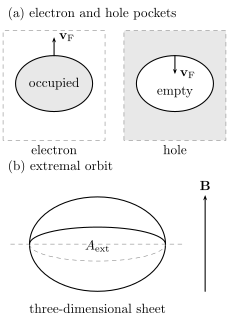
An electron pocket encloses occupied states and has outward electron velocity; a hole pocket encloses missing states and has inward electron velocity. Quantum oscillations measure an extremal cross-sectional area perpendicular to the magnetic field .
A hole describes a missing electron relative to a filled band, with positive carrier charge. Holes derives its momentum and current signs. Electron-like or hole-like curvature does not by itself fix a multiband Hall or thermoelectric sign; mobility and scattering matter too.
Compensated semimetals
Section titled “Compensated semimetals”Suppose small electron and hole pockets coexist. Relative to a reference with filled valence bands and empty conduction bands, the carrier imbalance per primitive cell is
where and count degeneracies omitted from the pocket labels. A compensated semimetal satisfies
Compensation is a state-counting statement. It does not imply zero conductivity, zero magnetoresistance, or a vanishing Hall coefficient.
Fermi-Surface Topology
Section titled “Fermi-Surface Topology”The geometry of a Fermi surface includes more than its volume. Important data include:
- the number of connected sheets;
- whether a sheet is contractible or wraps around the Brillouin torus;
- the genus and neck structure of a three-dimensional sheet;
- symmetry-related copies and protected degeneracies;
- electron-like and hole-like orientation;
- proximity to band critical points;
- nesting vectors that connect extended, nearly parallel regions.
A Lifshitz transition occurs when a continuous change of chemical potential, pressure, strain, or another control parameter changes the topology of the Fermi surface. For a smooth nondegenerate band undergoing an ordinary extremum or neck transition,
Common possibilities are:
- creation or annihilation of a pocket at a band extremum;
- opening or pinching off of a neck at a saddle point;
- reconnection of sheets across an identified Brillouin-zone boundary.
No broken symmetry is required. The nonanalyticity comes from the band critical point crossing the chemical potential. Multiband degeneracies can also change the level-set structure, but need a local matrix Hamiltonian instead of a differentiable single-band expansion. Thermodynamic derivatives and transport coefficients can show anomalies, while the associated van Hove singularity depends on dimension and local curvature.
This use of topology concerns the ordinary topology of constant-energy manifolds. It is distinct from topological-band invariants such as Chern numbers and indices.
Worked Example: An Ellipsoidal Pocket
Section titled “Worked Example: An Ellipsoidal Pocket”Consider
with and . The principal semiaxes are
The occupied pocket volume is
The velocity components are
Unless all three masses are equal, is not parallel to . For a magnetic field along , the largest cross section perpendicular to the field occurs at :
The associated cyclotron mass is
Thus rotating the field maps combinations of the principal masses and semiaxes.
Worked Example: Square-Lattice Topology Change
Section titled “Worked Example: Square-Lattice Topology Change”For a nearest-neighbor square lattice,
The band minimum lies at and the maximum at . The points
are saddles at zero energy.
For , the occupied region forms an electron-like sea around . At half filling,
and the Fermi contour passes through and . The Fermi velocity vanishes at those saddle points, the two-dimensional density of states diverges logarithmically in the ideal model, and the contour is at a Lifshitz transition.
For , it is more economical to describe the small unoccupied region around as a hole pocket. The occupied fraction changes continuously through . The occupied sea changes from a disk around to a torus with a disk removed around . On either side its boundary is a contractible loop; the singular contour at connects these distinct occupied-region topologies.
Semiclassical Orbits in a Magnetic Field
Section titled “Semiclassical Orbits in a Magnetic Field”In the ordinary one-band limit, omitting Berry-curvature and orbital-moment corrections, an electron of charge in a uniform magnetic field obeys
On a continuous repeated-zone lift , the band energy and are conserved. The lifted orbit is therefore the intersection of a periodically continued constant-energy surface with a plane perpendicular to , and the physical path is its projection to the Brillouin torus. Compact closed orbits of the lift enclose the area used in ordinary Onsager pocket quantization. A path that closes only modulo a reciprocal vector can have an open winding lift, so closure on the torus alone is insufficient. Open lifted orbits lead to qualitatively different magnetotransport and do not obey the simplest closed-orbit formulas. See Semiclassical Dynamics of Bloch Electrons for the equations and their range of validity.
Quantum Oscillations
Section titled “Quantum Oscillations”Landau quantization causes successive cyclotron orbits to pass through the chemical potential as changes. The magnetization then oscillates in the de Haas–van Alphen effect, while transport coefficients oscillate in the Shubnikov–de Haas effect.
For a closed orbit with cross-sectional area perpendicular to , semiclassical quantization has the form
where contains the usual turning-point contribution and can be modified by Berry phase, orbital moment, and other corrections. The leading oscillation frequency is the Onsager relation
is measured in tesla, and the signal is periodic in :
In three dimensions, contributions from neighboring planes generally dephase. Stationary-phase selection leaves extremal cross sections satisfying
A single field orientation therefore reveals extremal areas, not the entire three-dimensional surface. Rotating the field and tracking frequencies performs a form of Fermi-surface tomography.
Cyclotron mass
Section titled “Cyclotron mass”The temperature dependence of an oscillation amplitude measures the orbit’s cyclotron mass,
This is the positive damping mass of a regular orbit, as distinguished in Effective Mass from signed curvature or orbit-orientation conventions. A hole pocket can have ; that sign must not enter an amplitude-decay exponent. Here .
The temperature damping measures this positive mass; disorder damping measures a quantum lifetime that need not equal the transport lifetime. Quantum Oscillations develops the Lifshitz–Kosevich and Dingle factors. Spin splitting, magnetic breakdown, warping and chemical-potential oscillations can modify phases and amplitudes. A phase intercept alone is therefore not a secure Berry-phase measurement.
Two-dimensional pocket count
Section titled “Two-dimensional pocket count”For a two-dimensional pocket of area and omitted degeneracy ,
Combining this with the Onsager relation gives
The formula counts carriers per physical area for an isolated two-dimensional pocket. In a multiband material, each observed frequency must be assigned to an orbit before frequencies can be converted into a total carrier density.
What Experiments Actually Measure
Section titled “What Experiments Actually Measure”No single experiment returns an assumption-free picture of the Fermi surface.
| Probe | Primary information | Main cautions |
|---|---|---|
| ARPES | Occupied spectral function and band crossings | Surface sensitivity, matrix elements, finite resolution, and imperfect definition |
| Quantum oscillations | Extremal closed-orbit areas, cyclotron masses, and quantum lifetimes | Requires coherent high-mobility orbits; missing frequency does not prove a missing sheet |
| Hall and magnetotransport | Velocity-, curvature-, and lifetime-weighted carrier response | Multiband signs and densities are model dependent |
| STM/STS | Local density of states and, through interference, selected scattering vectors | Not a direct momentum-resolved occupation map |
| Compton scattering and positron annihilation | Bulk momentum-density information | Reconstruction is indirect and resolution limited |
Angle-Resolved Photoemission Spectroscopy explains how matrix elements, surface sensitivity and resolution affect a crossing map. Quantum Oscillations explains why heavy or short-lived orbits, spin zeros and limited field orientation can hide existing sheets. Comparing these probes with thermodynamics and band calculations gives stronger evidence than any one measurement.
Hall sign is not a pocket census
Section titled “Hall sign is not a pocket census”In the weak-field two-carrier Drude model,
where and are positive mobilities. Even at perfect compensation, , the Hall coefficient vanishes only if the mobilities are equal. Anisotropic bands and scattering make the relation still less direct.
Drude Theory derives this weak-field result from the full conductivity tensor and shows why Hall sign is mobility weighted rather than a direct pocket census.
Interactions and Reconstruction
Section titled “Interactions and Reconstruction”In a Fermi liquid, interactions renormalize the dispersion, velocity, residue and lifetime, and can change the surface’s shape. In a scalar band channel, a coherent pole at energy zero relative to requires , with vanishing decay rate in the zero-temperature limit.
For several orbitals, the inverse Green function is a matrix. Form its Hermitian part
A coherent Fermi sheet has a zero eigenvalue of ; the entire matrix need not vanish. Entrywise real parts are not a basis-covariant substitute for this Hermitian part. A zero of the Green function itself is also not a quasiparticle pole.
In a resolved quasiparticle channel the momentum-occupation jump is , rather than necessarily one. In a multiorbital representation the singular jump has the corresponding projector and orbital weights. Fermi-Liquid Theory explains these low-energy quantities.
Luttinger’s theorem constrains the total volume enclosed by the interacting Fermi surface for broad classes of translationally invariant fermion systems with conserved particle number and no relevant topological obstruction. Its application requires care:
- broken translational symmetry changes the primitive cell and folds the Brillouin zone;
- density waves hybridize folded bands and reconstruct large sheets into smaller pockets;
- spin polarization changes the spin-resolved volumes;
- topological order can modify the conventional volume relation;
- zeros of the Green function can matter in strongly correlated insulators and pseudogapped states.
In a superconductor, the ordinary electron Fermi surface is replaced by Bogoliubov excitations that are usually gapped except at nodes. Researchers may discuss an underlying normal-state Fermi surface, but that object is inferred from a model or from measurements above the transition. A non-Fermi liquid can retain a singular Fermi surface without quasiparticle poles. In that case, or in a Mott insulator, the appropriate definition must come from the spectral or many-body structure rather than an assumed coherent band crossing.
Why Low-Energy Metal Physics Lives Here
Section titled “Why Low-Energy Metal Physics Lives Here”Pauli exclusion blocks most low-energy rearrangements deep inside the occupied sea. For a process with energy scale
only states in a shell of local thickness
can readily change occupation. The enormous filled sea supplies the ground-state density, but the thin shell around its boundary supplies most low-temperature entropy, heat capacity, transport, and weak-coupling scattering phase space.
There are limits to this picture. First, filled bands can carry geometric and topological response even without a Fermi surface. Second, in incoherent or strongly correlated metals the relevant low-energy spectral weight may not be organized by long-lived quasiparticle sheets.
Patch description
Section titled “Patch description”Divide a smooth surface into patches labeled by . Within one patch,
The tangential coordinates label many low-energy channels while only controls the leading excitation energy. A low-energy integral therefore has the schematic form
This decomposition underlies Landau Fermi-liquid theory, patch renormalization groups, and many treatments of superconducting and density-wave instabilities.
Reconstructing a surface from computed bands
Section titled “Reconstructing a surface from computed bands”Determine the chemical potential from the electron count, then extract all band crossings on a sufficiently dense full-zone mesh. Join pieces across identified zone faces before counting pockets. The occupied volume must reproduce the filling, with spin or valley degeneracies included exactly once. A high-symmetry band path cannot determine a three-dimensional sheet.
Repeat the calculation with denser interpolation and slightly shifted chemical potential, especially near a saddle or a small pocket. For oscillations, compute extremal areas as the field is rotated; for photoemission, compare spectral intensity with the appropriate matrix elements and resolution. Band Structure Workflows explains convergence of the underlying calculation.
Exercises
Section titled “Exercises”Exercise 1: Same Fermi surface, different speed
Section titled “Exercise 1: Same Fermi surface, different speed”Let be a regular band crossing measured from , and let with . Compare the Fermi surface, filling, Fermi velocity, DOS at zero energy and cyclotron mass.
Solution
The zero set and occupied region are identical because multiplication by changes neither zeros nor signs. However, . The delta-function identity gives .
The area function obeys , so . Thus the oscillation frequency and filling agree while the mass, heat-capacity scale and velocities differ. A geometric drawing alone does not contain the energy scale.
Exercise 2: square-lattice Lifshitz point
Section titled “Exercise 2: square-lattice Lifshitz point”Verify that the points and are critical points of the nearest-neighbor square-lattice band and classify their local curvature.
Solution
The derivatives are
Both vanish at and . Near , write
Using
gives
The curvatures have opposite signs, so is a saddle; is equivalent by symmetry. When crosses zero, the Fermi contour passes through these saddles and changes from electron-like to hole-like topology.
Exercise 3: oscillation frequency and carrier density
Section titled “Exercise 3: oscillation frequency and carrier density”A spin-degenerate two-dimensional circular pocket produces a quantum-oscillation frequency . Find its area and carrier density per physical area.
Solution
The Onsager relation gives
For spin degeneracy ,
Substitution yields
This result assumes one isolated pocket and that the observed frequency is its fundamental extremal orbit rather than a harmonic or breakdown orbit.
Exercise 4: Rotating the field through an ellipsoid
Section titled “Exercise 4: Rotating the field through an ellipsoid”For the parabolic ellipsoid, show that a field direction gives
Solution
An ellipsoid with semiaxes has central section perpendicular to of area
One way to obtain it is to choose an orthonormal basis of the section plane: the section is the ellipse , whose area is . Substituting the semiaxes makes linear in , and gives the stated mass. For it reduces to .
Exercise 5: compensation does not fix the Hall sign
Section titled “Exercise 5: compensation does not fix the Hall sign”Use the weak-field two-carrier formula to determine the Hall coefficient of a compensated semimetal with . Under what condition does it vanish?
Solution
Set :
It vanishes only when . The sign is hole-like if and electron-like if , despite exact carrier compensation.
References
Section titled “References”- N. W. Ashcroft and N. D. Mermin, Solid State Physics (Holt, Rinehart and Winston, 1976), Chapters 2, 12, 13, and 14.
- I. M. Lifshitz, “Anomalies of Electron Characteristics of a Metal in the High Pressure Region,” Soviet Physics JETP 11, 1130–1135 (1960), JETP archive.
- J. M. Luttinger, “Fermi Surface and Some Simple Equilibrium Properties of a System of Interacting Fermions,” Physical Review 119, 1153–1163 (1960), doi:10.1103/PhysRev.119.1153.
- L. Onsager, “Interpretation of the de Haas–van Alphen effect,” The London, Edinburgh, and Dublin Philosophical Magazine and Journal of Science 43, 1006–1008 (1952), doi:10.1080/14786440908521019.
- D. Shoenberg, Magnetic Oscillations in Metals (Cambridge University Press, 1984), doi:10.1017/CBO9780511897870.
- J. A. Sobota, Y. He, and Z.-X. Shen, “Angle-resolved photoemission studies of quantum materials,” Reviews of Modern Physics 93, 025006 (2021), doi:10.1103/RevModPhys.93.025006.