

Topological Insulators
A time-reversal-invariant electronic topological insulator is a bulk-gapped, charge-conserving phase with spinful time reversal whose occupied states have a nontrivial obstruction to a symmetric atomic limit. In two dimensions this is the quantum spin Hall phase, with an odd number of helical Kramers pairs at an edge. In three dimensions a strong topological insulator has an odd surface Dirac-cone parity.
In broad taxonomy, a Chern insulator is also a topological band insulator. Here the shorter phrase topological insulator means the spinful, time-reversal-invariant class unless another symmetry setting is named. This keeps its structure separate from the broken-time-reversal integer Hall case.
The definition concerns the bulk phase, not whether a finite sample has infinite resistance. A real crystal can be topologically nontrivial yet conduct through doped bulk bands, surface accumulation layers, contacts, or sidewalls. Conversely, a trivial surface resonance can conduct without implying a nontrivial bulk invariant.
The occupied-projector formulas below apply directly to noninteracting systems and to materials with a controlled quasiparticle-band description. Interacting descendants can retain the same symmetry-protected distinction, but then a many-body flux-insertion, response or other appropriate diagnostic replaces a naive product of one-electron parity eigenvalues. Green-function shortcuts require their own nonsingularity and deformation assumptions; they are not general substitutes for the interacting state.
The central calculation is a parity: can the occupied Kramers pairs be connected throughout the Brillouin zone without a partner switch? We will compare symmetry eigenvalues and Wilson loops, work through a regularized band model, and separate its bulk prediction from the conductance of a finite sample. Edge and Surface States develops the boundary Hamiltonians and scattering mechanisms in detail.
Required background. Bloch’s Theorem supplies the band subspace, Time Reversal for Spin-1/2 Particles and Kramers Degeneracy supply the class-AII algebra, and Topology in Quantum Matter explains gap-preserving deformations and phase distinctions.
Helpful background. Spin–Orbit Coupling in Solids supplies the microscopic band mechanism, and Chern Numbers in Band Theory supplies the charge-Chern comparison.
Insulating Bulk, Conducting Boundary
Section titled “Insulating Bulk, Conducting Boundary”Consider a periodic one-electron or quasiparticle Hamiltonian with chemical potential . The clean bulk is spectrally insulating when
and lies in that indirect gap. A positive direct gap at every momentum is needed to define a smooth occupied projector,
but a material can have a direct gap while valence and conduction energies overlap indirectly. Such a system is not a bulk transport insulator at charge neutrality.
The topological question asks whether can be deformed to an atomic-insulator projector while preserving:
- the occupied–empty separation;
- charge conservation;
- spinful time reversal;
- locality and the lattice setting;
- any additional assumptions used by the chosen diagnostic.
For the nontrivial phase, a boundary with a trivial, symmetry-preserving vacuum cannot be everywhere featureless in the same low-energy description. In a clean noninteracting system it carries gapless states connecting valence and conduction bands. The boundary spectrum can move, bend, acquire extra trivial pairs, or merge into projected bulk continua. What cannot change without closing the bulk gap or relaxing the protection is the parity of the protected boundary structure.
A conducting boundary does not imply a universal three-dimensional surface conductivity. Its chemical potential, scattering, contacts, finite-size hybridization and parallel bulk channels still determine a measurement.
Time-Reversal Symmetry
Section titled “Time-Reversal Symmetry”For spinful electrons without magnetic order or external time-reversal breaking,
In a spin-only basis one may choose , but in a multiorbital crystal acts on the full Bloch spinor. The Pauli matrices used in an effective model need not equal the microscopic spin operator unless that identification is stated.
Time-reversal-invariant momenta
Section titled “Time-reversal-invariant momenta”A crystal momentum is time-reversal invariant when
for a reciprocal-lattice vector . Equivalently,
These points are called TRIM. A two-dimensional Brillouin torus has four TRIM, and a three-dimensional one has eight. At each TRIM, every spinful Bloch eigenstate has an orthogonal Kramers partner at the same energy.
Away from a TRIM, time reversal pairs a state at with one at . Spin–orbit coupling may split bands at a generic momentum when inversion is absent, but Kramers degeneracy remains at the TRIM. If both inversion and time reversal are present, every band is doubly degenerate at every .
Symmetry of Bloch States explains the little-group and combined inversion/time-reversal algebra.
Why the Chern number vanishes but topology survives
Section titled “Why the Chern number vanishes but topology survives”Time reversal sends the occupied trace Berry curvature to
Therefore the net occupied charge Chern number vanishes:
Time-reversal symmetry forbids the antisymmetric linear charge Hall response; the vanishing Chern number is its insulating-band expression. For an analytic isolated band projector, it removes the Chern obstruction to some exponentially localized Wannier basis, but it does not construct a globally time-reversal-compatible basis for each Kramers pair. In the nontrivial phase, the obstruction is specifically to a time-reversal-covariant, Kramers-paired Wannier frame, not to exponential localization after that gauge condition is relaxed. Wannier Functions explains this distinction and the construction. The remaining obstruction has only two values, trivial or nontrivial, and is measured by a invariant.
The Z₂ Invariant
Section titled “The Z₂ Invariant”Partner switching
Section titled “Partner switching”Imagine following the occupied-subspace Wilson eigenphases over half of the transverse Brillouin zone, with Kramers pairing at its ends. These are phases of parallel transport, not simply the energy eigenvalues of individual bands. In a trivial insulator, partners can be chosen so that they reconnect without an odd exchange. In a quantum spin Hall insulator, the pairing switches an odd number of times. Adding two identical nontrivial copies permits the switches to recombine, which is the physical origin of
The invariant is thus a parity, not a small Chern number. It remains meaningful when spin is not conserved and “spin-up band” is not globally defined.
Sewing-matrix formulation
Section titled “Sewing-matrix formulation”Choose a smooth occupied frame locally and define the sewing matrix
At a TRIM, is antisymmetric:
Its Pfaffian is therefore defined. Using a globally smooth periodic occupied frame, not necessarily a time-reversal-covariant one, and continuous square-root choices, set
For a two-dimensional insulator,
Individual values in this gauge-general formula are not arbitrary observables. The branch-consistent product is the invariant. A calculation that independently chooses square-root signs at each TRIM can manufacture a false answer.
Inversion-symmetry shortcut
Section titled “Inversion-symmetry shortcut”If inversion is also a symmetry and commutes with , the two states in each occupied Kramers pair share one parity eigenvalue
For occupied Kramers pairs, define
The same two-dimensional product gives . This is the Fu–Kane parity criterion. It is powerful because it uses only symmetry eigenvalues at the TRIM, but it is valid only while inversion symmetry is present. “Band inversion” at one momentum is suggestive, not a substitute for the complete parity product or another gauge-invariant diagnostic.
Wilson-loop formulation
Section titled “Wilson-loop formulation”For numerical work without inversion, use dimensionless momenta with period and form an occupied-subspace Wilson loop, schematically
Include reciprocal-boundary sewing when the orbital frame is not periodic. For the physical cell-periodic connection, its eigenphases divided by give hybrid-Wannier centers modulo a lattice period. Time reversal constrains them into Kramers pairs at and . An odd partner switch gives . Equivalently, count crossings of a generic fixed phase line over , avoiding endpoint degeneracies and tangencies; only the parity matters. Follow continuous branches or a gap-based algorithm rather than independently sorting principal phases at each sample (Soluyanov and Vanderbilt, 2011). The spectrum of is gauge invariant even though the chosen occupied frame is not.
The invariant can change only if the occupied subspace ceases to be well defined, usually through a bulk gap closing, or if time reversal is broken so that the classifying problem changes. A surface gap closing alone does not necessarily change the three-dimensional bulk index. Topological Phase Transitions explains direct-gap closings, parity switches and their interacting or disordered counterparts.
Quantum Spin Hall Effect
Section titled “Quantum Spin Hall Effect”Two opposite Chern sectors
Section titled “Two opposite Chern sectors”In the artificial limit where is conserved, a quantum spin Hall state can be pictured as two Chern insulators related by time reversal:
The charge Chern number cancels,
while
This picture is excellent intuition, but it is not the general definition. Rashba coupling mixes spin sectors, physical spin is not conserved, and spin Hall conductivity need not remain exactly quantized. The invariant and helical edge anomaly survive as long as the bulk gap and time reversal survive.
The Bernevig–Hughes–Zhang model
Section titled “The Bernevig–Hughes–Zhang model”A continuum model for HgTe/CdTe quantum wells uses an electron-like and hole-like orbital doublet in two time-reversed blocks:
with
The orbital Pauli matrices are ; the block label is exchanged by time reversal. For and in the regularized continuum model, the mass near has sign , while the large- mass has sign . The nontrivial regime has opposite signs:
At the gap closes and the index can change. In HgTe/CdTe wells, changing the well thickness reverses the order of the electron-like and heavy-hole-like subbands. The experimentally important critical thickness is about in the original structures (König et al., 2007), with a structure-dependent precise value.
The condition belongs to this regularized model and convention. The sign of one fitted “mass” without the ultraviolet completion, orbital basis, and convention is not a universal invariant.
What a lattice completion changes
Section titled “What a lattice completion changes”To see the role of large momentum explicitly, set the lattice spacing to one and take a square-lattice block with no scalar energy shift:
The full Hamiltonian remains . Take , and half filling. Inversion acts as in each block. At the four TRIM the masses are
The occupied orbital at each TRIM has parity . Their product gives for and , and outside that range. At the bulk gap closes, so the invariant is undefined there. The simultaneous inversions at leave the Z₂ parity unchanged. The inversion at makes the lattice model trivial, despite : the continuum criterion cannot be extrapolated beyond its completion.
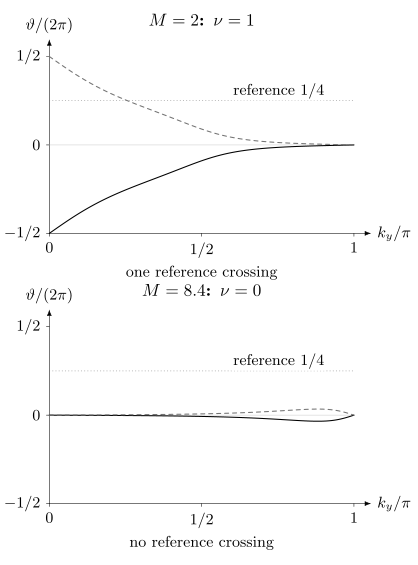
Occupied Wilson phases for the stated lattice model with , computed with 800 points around each loop and 161 values of . The pair switches partners and crosses the dotted reference line once; the pair does not cross it. Phases at and are identified. Both examples have , but their lattice Z₂ indices differ. These curves describe occupied-state geometry, not a surface energy spectrum.
Helical edge states
Section titled “Helical edge states”Across an interface between topological and trivial masses, the effective mass changes sign and a Kramers pair localizes at the boundary. Time reversal exchanges its counterpropagating branches and enforces Kramers degeneracy at edge TRIM. The anomalous connectivity crosses the bulk gap, but the energy of the Kramers crossing itself can be buried in a projected bulk band. Edge and Surface States derives the minimal Hamiltonian, the elastic Kramers-backscattering restriction, and the effects of interactions and finite width.
The phase-specific statement here is parity: ordinary boundary bands can add or remove an even number of helical pairs, but one anomalous pair remains while the two-dimensional bulk and time reversal remain intact.
Conductance and interactions
Section titled “Conductance and interactions”An ideal ballistic strip with two uncoupled edges and ideal reservoirs has two source-to-drain channels, giving . One edge contributes , not twice that value: its left mover is the return channel from the drain. The measured value depends on geometry, equilibration, contacts, edge length, and bulk leakage, so it is supporting evidence rather than the invariant itself. Interactions can enable multiparticle processes or boundary symmetry breaking without invalidating the bulk phase label.
Three-Dimensional Topological Insulators
Section titled “Three-Dimensional Topological Insulators”Four bulk indices
Section titled “Four bulk indices”Let be primitive reciprocal vectors. For each choice , one of the eight TRIM is
For an inversion-symmetric system, compute the parity product at each TRIM. The strong index is
and the three weak indices obey
The phase label is conventionally written
A strong topological insulator has . In a clean noninteracting boundary description it has an odd number of surface Dirac cones, independent of surface orientation. Time-reversal-preserving disorder cannot remove the strong parity while a mobility gap and the bulk phase survive.
A weak topological insulator has but at least one nonzero weak index. It can be viewed heuristically as stacked quantum spin Hall layers. Its clean side surfaces can carry an even number of Dirac cones, while other surfaces may be gapped. The weak vector depends on lattice translation structure and is more vulnerable to translation-breaking disorder, although dislocations and selected surfaces can retain characteristic modes.
Magnetoelectric angle
Section titled “Magnetoelectric angle”The strong index also appears in the bulk electromagnetic response through an angle defined modulo . Time reversal sends to , so a time-reversal-invariant insulator permits
The strong phase has . For an ordinary charge-conserving surface with no intrinsic fractional topological order, a time-reversal-breaking gap with chemical potential inside it gives a Hall response that is half-integer modulo an added integer quantum Hall layer:
The half-integer sign is fixed by the oriented surface mass, while the integer reflects an attached quantum Hall layer or equivalent boundary convention. This is not the dc Hall conductivity of an ordinary gapless surface. Measuring the topological magnetoelectric response requires control of all surfaces, magnetic domains, side conduction, and the chemical potential.
Surface Dirac Cones
Section titled “Surface Dirac Cones”The strong index requires odd surface-cone parity in a clean noninteracting description. Edge and Surface States derives the Dirac Hamiltonian and explains magnetic masses, warping, thin-film hybridization and the difference between effective pseudospin and measured physical spin.
For the bulk phase, three qualifications matter. Opposite surfaces of a finite film can pair and gap while preserving time reversal. Rashba-split accumulation layers and dangling-bond states can coexist with the anomalous cone. Strong interactions can replace a gapless cone by symmetry-preserving intrinsic surface topological order. None of these options turns one isolated anomalous surface into an ordinary, unique, symmetry-preserving band insulator.
Material Examples
Section titled “Material Examples”What the probes tell you
Section titled “What the probes tell you”A trustworthy identification combines bulk, boundary, symmetry, and transport information.
| Question | Useful observations | Insufficient by itself |
|---|---|---|
| Bulk topology | Bulk gap and invariant | One inverted level |
| Helical edge | Localized edge current | One conductance value |
| Surface cone | Localization and connectivity | One linear band |
| Surface transport | Gating and thickness dependence | Weak antilocalization |
| Symmetry protection | Magnetic/nonmagnetic comparison | One missing scattering peak |
Angle-resolved photoemission maps dispersion and photon-energy dependence: negligible dispersion supports surface localization, while odd surface-state connectivity must agree with the bulk invariant. Spin texture adds a separate check. Scanning tunneling spectroscopy resolves local gaps, standing waves and edge localization; neither a linear band nor one absent scattering wavevector is sufficient to establish protection.
For transport, combine bulk insulation with nonlocal lead geometries, length and contact dependence, and a controlled magnetic-field response. Gating, thickness, Hall density and quantum oscillations help separate bulk and surface currents. First-principles calculations must describe the relevant occupied subspace; band bending, disorder and the actual chemical potential remain experimental inputs.
Three instructive material examples
Section titled “Three instructive material examples”HgTe/CdTe quantum wells. Changing thickness reverses the E1/H1 ordering. König et al. (2007) connected this change to short-device conductance near and a magnetic-field response. The comparison is powerful because it relates a controllable bulk change to boundary transport; a long edge can still have resistance from puddles, inelastic processes and contacts.
Bismuth selenide. Xia et al. (2009) observed the single-cone surface dispersion predicted for the strong-TI phase. That identifies a boundary band structure; it does not guarantee surface-only current. Defects and band bending can add bulk carriers or trivial accumulation layers. Kim et al. (2012) studied transport in bulk-insulating samples to address that distinct question.
Monolayer tungsten ditelluride. Wu et al. (2018) reported quantum spin Hall conductance in short edges up to about in their devices. This reported operating regime is not a universal temperature bound or a promise that arbitrary edge lengths remain ballistic. Spectroscopy, length dependence and contact control complement the conductance measurement.
Magnetic, crystalline and strongly correlated topological insulators require their corresponding symmetry and many-body assumptions. The nonmagnetic band formulas above cannot simply be reused for all of them.
Exercises
Section titled “Exercises”1. Two helical pairs can acquire a symmetric gap
Section titled “1. Two helical pairs can acquire a symmetric gap”Let act on right/left partners and on two copies of a helical edge. With , consider
Check time reversal and find the energies. Why is there no analogous charge-conserving constant mass for a single pair?
Solution
Time reversal changes to and complex conjugation changes to , so their product is even. The kinetic term transforms as . The two terms anticommute, hence
each twice degenerate. The gap is . For one pair, the possible masses are both time-reversal odd. Two copies can therefore gap each other while one cannot in this noninteracting setting: modulo two.
2. All four lattice masses matter
Section titled “2. All four lattice masses matter”Classify the lattice model at and . Does its gap closing at change the Z₂ index?
Solution
The ordered mass lists at are
Multiplying the occupied parities, each opposite to the mass sign, gives . Thus the indices are . Two parity changes occur at , so its closing does not change the Z₂ value. In the spin-conserving model the individual block Chern numbers change, but their parity does not.
3. Break inversion without breaking the phase
Section titled “3. Break inversion without breaking the phase”Start with a gapped inversion-symmetric model with . Add a time-reversal-preserving polar perturbation continuously, keeping the bulk gap open. Can the final parity eigenvalues still be used? What can be concluded without recomputing the invariant?
Solution
Once inversion is broken, its eigenvalues are not good quantum numbers and the Fu–Kane shortcut no longer applies. The gap-preserving, time-reversal-preserving path nevertheless fixes the final index to one. An independent calculation can use the complete occupied-subspace Wilson flow, including orbital sewing, without assuming spin conservation.
4. Identify a weak index
Section titled “4. Identify a weak index”Suppose the only negative three-dimensional parity products are . Find the four indices and interpret a stack of quantum spin Hall layers normal to the third primitive direction.
Solution
The product of all eight signs is positive, so . The plane contains one negative sign; the and planes contain none. Thus
Side faces expose edges of the stacked layers; a face parallel to the layers can be gapped. The weak labels refer to the chosen reciprocal primitive basis. Translation-breaking couplings can mix the even number of side-surface cones, so these are not the orientation-independent odd cones of a strong topological insulator.
5. Channel counting and parallel bulk conduction
Section titled “5. Channel counting and parallel bulk conduction”A short strip has one perfectly transmitting helical pair on each edge, plus a bulk conductance in parallel. What is the total two-terminal conductance? Would this value or a value below determine the Z₂ index by itself?
Solution
Each edge supplies one incoming channel from the source. Under the stated independent-channel assumptions,
The excess comes from the bulk, not an extra topological edge pair. Backscattering or nonideal contacts can instead lower measured edge conductance. Neither number alone determines the bulk index; transport must be interpreted together with the bulk gap, geometry and symmetry.
Further Reading
Section titled “Further Reading”- B. A. Bernevig and T. L. Hughes, Topological Insulators and Topological Superconductors, Princeton University Press, 2013.
- M. Z. Hasan and C. L. Kane, “Colloquium: Topological Insulators,” Reviews of Modern Physics 82, 3045–3067 (2010), doi:10.1103/RevModPhys.82.3045.
- X.-L. Qi and S.-C. Zhang, “Topological Insulators and Superconductors,” Reviews of Modern Physics 83, 1057–1110 (2011), doi:10.1103/RevModPhys.83.1057.
References
Section titled “References”- B. A. Bernevig, T. L. Hughes, and S.-C. Zhang, “Quantum Spin Hall Effect and Topological Phase Transition in HgTe Quantum Wells,” Science 314, 1757–1761 (2006), doi:10.1126/science.1133734.
- L. Fu, C. L. Kane, and E. J. Mele, “Topological Insulators in Three Dimensions,” Physical Review Letters 98, 106803 (2007), doi:10.1103/PhysRevLett.98.106803.
- L. Fu and C. L. Kane, “Topological Insulators with Inversion Symmetry,” Physical Review B 76, 045302 (2007), doi:10.1103/PhysRevB.76.045302.
- C. L. Kane and E. J. Mele, “Quantum Spin Hall Effect in Graphene,” Physical Review Letters 95, 226801 (2005), doi:10.1103/PhysRevLett.95.226801.
- C. L. Kane and E. J. Mele, “ Topological Order and the Quantum Spin Hall Effect,” Physical Review Letters 95, 146802 (2005), doi:10.1103/PhysRevLett.95.146802.
- D. Kim et al., “Surface Conduction of Topological Dirac Electrons in Bulk Insulating ,” Nature Physics 8, 459–463 (2012), doi:10.1038/nphys2286.
- M. König et al., “Quantum Spin Hall Insulator State in HgTe Quantum Wells,” Science 318, 766–770 (2007), doi:10.1126/science.1148047.
- J. E. Moore and L. Balents, “Topological Invariants of Time-Reversal-Invariant Band Structures,” Physical Review B 75, 121306(R) (2007), doi:10.1103/PhysRevB.75.121306.
- X.-L. Qi, T. L. Hughes, and S.-C. Zhang, “Topological Field Theory of Time-Reversal Invariant Insulators,” Physical Review B 78, 195424 (2008), doi:10.1103/PhysRevB.78.195424.
- A. A. Soluyanov and D. Vanderbilt, “Computing Topological Invariants without Inversion Symmetry,” Physical Review B 83, 235401 (2011), doi:10.1103/PhysRevB.83.235401.
- C. Wu, B. A. Bernevig, and S.-C. Zhang, “Helical Liquid and the Edge of Quantum Spin Hall Systems,” Physical Review Letters 96, 106401 (2006), doi:10.1103/PhysRevLett.96.106401.
- S. Wu et al., “Observation of the Quantum Spin Hall Effect up to 100 Kelvin in a Monolayer Crystal,” Science 359, 76–79 (2018), doi:10.1126/science.aan6003.
- Y. Xia et al., “Observation of a Large-Gap Topological-Insulator Class with a Single Dirac Cone on the Surface,” Nature Physics 5, 398–402 (2009), doi:10.1038/nphys1274.
- C. Xu and J. E. Moore, “Stability of the Quantum Spin Hall Effect: Effects of Interactions, Disorder, and Topology,” Physical Review B 73, 045322 (2006), doi:10.1103/PhysRevB.73.045322.
- H. Zhang et al., “Topological Insulators in , and with a Single Dirac Cone on the Surface,” Nature Physics 5, 438–442 (2009), doi:10.1038/nphys1270.