

Topology in Quantum Matter
A topological distinction is an obstruction to smoothly connecting quantum states while preserving specified physical conditions. In a gapped system, those conditions include locality, a nonzero bulk gap and any protecting symmetry. The distinguishing information may be in occupied Bloch states, a quantized response or fractional excitations, rather than an ordinary local order parameter.
This page develops that common idea. It does not identify every topological phase with a Chern number or promise a gapless boundary for every nontrivial bulk. The chapter guide connects the general reasoning to particular phases and measurements.
Required background. Phases of Matter supplies the ground-state and thermodynamic-limit framework. Helpful background. Bloch’s Theorem and Berry Phase prepare the band examples; Topological Invariants develops the mathematical deformation idea.
Gapped phases and allowed deformations
Section titled “Gapped phases and allowed deformations”Consider local Hamiltonians on a system of linear size , with . Local means finite-range interactions, or sufficiently rapid decay for the continuation arguments being used. Two states belong to the same gapped phase if a path connects their Hamiltonians while preserving the required symmetries and a uniformly isolated ground-state sector.
For low-energy states, number energies from and distinguish
For a topological ground sector, its internal splitting tends to zero with size, while the gap above it has a positive lower bound, uniform along the path. One finite sample’s level spacing is not that thermodynamic statement. For a unique ground state, and .
Under suitable smoothness and locality assumptions, quasi-adiabatic continuation relates the ground projectors by a quasi-local unitary,
Here is a quasi-local generator. This connects phase equivalence to the way entanglement can be changed locally (Hastings and Wen, 2005; Chen et al., 2010). It assumes the gapped path exists; it does not prove that every arbitrary perturbation preserves a gap.
If an integer invariant is continuous along such paths, it cannot change: a continuous map from a connected interval to the integers is constant. Different invariant values therefore require leaving the allowed space, for example by closing a bulk gap or breaking protection. Microscopic energies and velocities can still vary continuously within a phase.
What a local order parameter misses
Section titled “What a local order parameter misses”A ferromagnet is distinguished by broken spin symmetry and a local magnetization. Two insulators can instead have the same unbroken symmetries and no conventional local order parameter distinguishing their phases, yet differ in the global structure of occupied states. Their local correlations need not be numerically identical.
Topology and symmetry breaking can also coexist. In a Chern magnet, magnetization describes broken symmetry; a band invariant describes a separate global property. “Topological” does not simply refer to holes in the physical sample, although spatial topology matters for flux insertion and ground-state sectors.
A dimerized chain makes protection concrete
Section titled “A dimerized chain makes protection concrete”Use a spinless, two-orbital chain at half filling. Measure energy in a positive hopping unit and set the cell length to one. In a fixed unit-cell basis,
The alternating hoppings are and ; is a staggered on-site energy. Take . At , the Hamiltonian anticommutes with , the sublattice or chiral symmetry. Its upper-right entry is
As increases through a Brillouin zone, this complex number traces a clockwise circle centered at . The winding
is for and for . The sign depends on the stated basis and orientation; the distinction uses a fixed cell and symmetry representation. Reassigning orbitals between cells also changes how a physical termination is described. See the SSH model for the chain and its end states.
The energies are . Since both hoppings are positive, the minimum is at , giving the exact band gap
Now compare two paths between and . Let . The symmetry-preserving path uses and closes its gap at . The alternative uses and keeps the gap exactly . It succeeds because the staggered energy breaks chiral symmetry along the interior of the path (Asbóth et al., 2016).
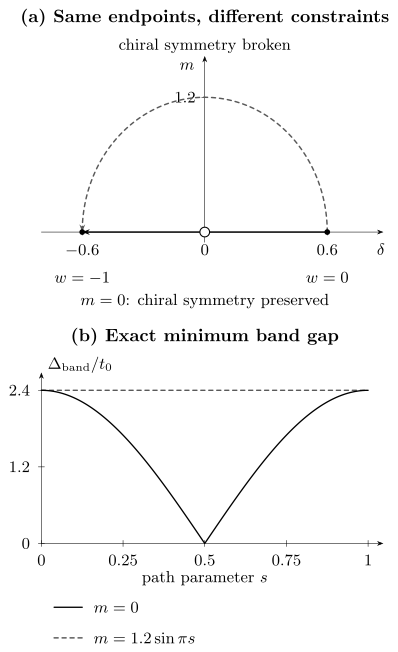
The upper panel shows the two paths in ; the lower shows their exact minimum band gaps. Both share the same endpoints. The curved path does not refute the protected distinction, because it leaves the symmetry class in which the winding was defined. Energies are in units of .
Breaking chiral symmetry removes this particular winding classification; it does not automatically remove every possible crystalline distinction. The conclusion always depends on which other symmetries the path must preserve.
Occupied states and global band structure
Section titled “Occupied states and global band structure”For a gapped, noninteracting insulator, the occupied projector is
Changing the phases or mixing the occupied basis vectors leaves unchanged. The topological object is the subspace, not a preferred eigenvector gauge (Chiu et al., 2016). Spectral flattening replaces the Hamiltonian, measured relative to the chemical potential, by
The occupied states now have energy , empty states , and the original projector survives. For a local gapped band model this flattening retains suitable spatial decay, though it need not retain strictly finite-range hopping.
For , the lower-band projector is . With Berry connection and orientation , its Chern number is
This measures how the unit vector wraps the sphere. It requires everywhere; the upper band has the opposite Chern number. A nonzero curvature at one point is not a nonzero integral. The scalar changes energies but not these eigenvectors, so it can even create indirect band overlap without changing the isolated-band invariant. A quantized insulating response then no longer follows from that invariant alone.
Chern Numbers in Band Theory derives projector and mesh formulas. Wannier Functions connects global obstructions to localized orbitals.
Which extra orbitals may be added?
Section titled “Which extra orbitals may be added?”Stable band classification allows specified trivial filled or empty degrees of freedom to be added. In crystalline problems, their positions and symmetry representations must be stated: adding an arbitrary atomic band is not the same operation in every classification.
A fragile Wannier obstruction can disappear after adding suitable atomic bands; a stable Chern obstruction cannot. An obstructed atomic limit already has symmetric localized Wannier functions, but their centers differ from the chosen atomic reference. These distinctions cannot be settled by a blanket declaration that all atomic projectors are equivalent (Po et al., 2018).
Boundaries and quantized response
Section titled “Boundaries and quantized response”A nontrivial bulk often constrains its boundary, but the constraint depends on the phase and adjoining material. For two-dimensional noninteracting Chern insulators sharing a bulk gap, put the left bulk at and the right at . Count positive group velocity along as right-moving. With the preceding Berry convention,
Termination can create extra counterpropagating pairs; it cannot change the protected net while the hypotheses remain valid. This is a spectral-flow statement across the gap, not a test on one localized eigenstate (Hatsugai, 1993). Bulk–Boundary Correspondence supplies the domain-wall and lattice derivations.
The corresponding filled-band Hall response, for electrons of charge , , is
A reversal of Berry sign or coordinate orientation changes the written invariant and must be accompanied by the corresponding sign change in this relation. The Integer Quantum Hall Effect explains disorder, localization and measured conductance.
These examples do not imply that every topological boundary is gapless or every phase has quantized charge response. A symmetry-protected boundary can break symmetry. Suitable interacting surfaces of a three-dimensional topological insulator can remain symmetric and gapped by developing intrinsic topological order (Metlitski et al., 2015). Some intrinsically ordered two-dimensional phases also admit gapped boundaries. Which boundary types are possible is part of the phase-specific physics.
For a filled one-dimensional insulating pump, a closed adiabatic cycle defines a Chern number on the oriented torus. With the same convention and charge , the electronic charge transported along the positive chain direction is . This is an integrated cyclic response; generic static polarization is not quantized (Thouless, 1983). Polarization and Pumping explains branch choice and ionic contributions.
Finite temperature, finite size, finite driving rate and contacts alter measurements in different ways. Thermally activated bulk carriers may give exponential corrections in a fully gapped regime; metallic parallel channels need not. There is no universal sum of exponential, frequency and broadening terms applicable to every topological response.
Interacting phases and ground-state families
Section titled “Interacting phases and ground-state families”Strong interactions may invalidate a band description, reduce a free-particle classification or produce new phases. For a charge-conserving system on a torus, a useful replacement for crystal momentum is a boundary twist:
If a unique ground state is isolated for every pair , its Berry connection and Chern number are
The twist-averaged zero-temperature Hall response is related to this integer. At a fixed twist in a finite system the response need not itself be an exact integer; the thermodynamic/locality assumptions matter in relating the average to an actual large sample (Niu et al., 1985).
A separated -dimensional topological ground sector requires the non-Abelian curvature of the whole sector. Its traced Chern number is integer, while the response averaged equally over the sector and over twists is proportional to . Fractional Hall response therefore does not contradict integer quantization of the bundle invariant. Identifying that average with the response of a physical ground sector uses local indistinguishability and the appropriate limits.
| Structure | Defining distinction |
|---|---|
| Symmetry-protected phase | becomes trivial when its protecting symmetry is relaxed |
| Invertible chiral phase | cancels on stacking with an inverse; can have chiral response without fractional bulk excitations |
| Intrinsic topological order | has nonlocal structure and fractionalized sectors that survive removal of optional symmetries |
These descriptions are not an exhaustive partition. Symmetry can act nontrivially on intrinsic order, and conventional order can coexist with it. In two dimensions, anyon fusion and braiding give detailed information beyond a charge response. Topological Order and Symmetry-Protected Topological Phases develop the distinctions.
Local indistinguishability is a statement about all matrix elements of local operators in a ground sector:
with corrections vanishing appropriately with size and fixed operator support. Equal diagonal expectations in one selected basis are weaker: symmetry-broken states can be combined into cat states with identical diagonal magnetization, while off-diagonal matrix elements still reveal the order.
Topological transitions and material tests
Section titled “Topological transitions and material tests”A changing invariant requires a failure of the assumptions that kept it fixed. A local Dirac model closes its direct gap at , but one continuum cone does not define an integer lattice invariant. Other cones and the ultraviolet completion can add or cancel its contribution.
Disorder can close a mobility gap without a clean band touching. An interacting transition can leave a one-electron gap open while a neutral many-body gap closes; a first-order change involves a ground-state crossing. A zero of a Green function can change an invariant built from that Green function, but does not by itself prove a change of the many-body phase. The relation between the diagnostic and the physical state must still hold. See Topological Phase Transitions.
In a material, compare three questions: does the model have the stated invariant, does it describe the prepared bulk state, and do the measurements test the predicted consequence? A band inversion suggests a calculation; a surface peak suggests a boundary study. Neither alone fixes the invariant, actual filling or competing explanation. Data Interpretation and Pitfalls discusses complementary tests.
Exercises
Section titled “Exercises”1. Compare the two dimerization paths
Section titled “1. Compare the two dimerization paths”Derive the minimum gap of the chain, and verify both curves in the figure. Why is the curved path compatible with a protected distinction at its endpoints?
Solution
The squared positive energy is
Positive puts the minimum at , so the band separation is . Since , the straight path gives . The curved path gives from . Its term violates , so it is excluded when chiral symmetry must be preserved. Restoring a gap by relaxing a condition is not a path within the original class.
2. Count an oriented boundary
Section titled “2. Count an oriented boundary”Stack Chern insulators with and at , next to vacuum at . Find the net edge direction. Could three right-moving and four left-moving branches occur?
Solution
Direct-sum Chern numbers add, so and . The signed count is , one net left-moving branch. Three right-moving and four left-moving branches have this same net count; the three counterpropagating pairs need not be protected individually. A single pair of opposite crossings has zero net count and alone does not establish Chern topology. Other symmetries, if imposed, can protect additional structure beyond this Chern count.
3. Change gauge on the twist torus
Section titled “3. Change gauge on the twist torus”Let . Show that the Chern number is unchanged.
Solution
The connection becomes . Its curl is unchanged because mixed derivatives commute within each smooth patch. On patch overlaps, the gauge-transition functions account for a globally nontrivial bundle; a nonzero Chern number need not admit one smooth periodic state vector everywhere. Gauge invariance does not remove that obstruction.
4. Test local indistinguishability in cat states
Section titled “4. Test local indistinguishability in cat states”For Ising spins, consider . Both have zero mean . Are they locally indistinguishable as a two-state ground sector?
Solution
No. In the basis,
which is not a scalar multiple of the identity. Its eigenvectors are the two magnetized product states, distinguished by a local measurement. Equal diagonal expectations in the cat basis concealed an off-diagonal order parameter; the projected-operator criterion is basis independent.
References
Section titled “References”- J. K. Asbóth, L. Oroszlány, and A. Pályi, A Short Course on Topological Insulators: Band Structure and Edge States in One and Two Dimensions, Lecture Notes in Physics 919, Springer (2016), doi:10.1007/978-3-319-25607-8.
- X. Chen, Z.-C. Gu, and X.-G. Wen, “Local Unitary Transformation, Long-Range Quantum Entanglement, Wave Function Renormalization, and Topological Order,” Physical Review B 82, 155138 (2010), doi:10.1103/PhysRevB.82.155138.
- C.-K. Chiu, J. C. Y. Teo, A. P. Schnyder, and S. Ryu, “Classification of Topological Quantum Matter with Symmetries,” Reviews of Modern Physics 88, 035005 (2016), doi:10.1103/RevModPhys.88.035005.
- M. B. Hastings and X.-G. Wen, “Quasi-Adiabatic Continuation of Quantum States: The Stability of Topological Ground-State Degeneracy and Emergent Gauge Invariance,” Physical Review B 72, 045141 (2005), doi:10.1103/PhysRevB.72.045141.
- Y. Hatsugai, “Chern Number and Edge States in the Integer Quantum Hall Effect,” Physical Review Letters 71, 3697–3700 (1993), doi:10.1103/PhysRevLett.71.3697.
- M. A. Metlitski, C. L. Kane, and M. P. A. Fisher, “Symmetry-Respecting Topologically Ordered Surface Phase of Three-Dimensional Electron Topological Insulators,” Physical Review B 92, 125111 (2015), doi:10.1103/PhysRevB.92.125111.
- Q. Niu, D. J. Thouless, and Y.-S. Wu, “Quantized Hall Conductance as a Topological Invariant,” Physical Review B 31, 3372–3377 (1985), doi:10.1103/PhysRevB.31.3372.
- H. C. Po, H. Watanabe, and A. Vishwanath, “Fragile Topology and Wannier Obstructions,” Physical Review Letters 121, 126402 (2018), doi:10.1103/PhysRevLett.121.126402.
- D. J. Thouless, “Quantization of Particle Transport,” Physical Review B 27, 6083–6087 (1983), doi:10.1103/PhysRevB.27.6083.