

Weyl and Dirac Semimetals
A Weyl semimetal is a three-dimensional crystal whose bulk bands contain isolated, generically twofold crossings with nonzero Berry-flux charge. A Dirac semimetal contains fourfold crossings that can be viewed locally as opposite-chirality Weyl nodes superposed and stabilized by additional symmetry. Weyl nodes are momentum-space sources or sinks of Berry curvature; surface Fermi arcs and chiral magnetic-field Landau levels are consequences of that charge.
These are gapless phases. Their topology is not an invariant of a completely filled set of bands over the entire Brillouin zone, as in an insulator. Instead, it is attached to a band crossing or to a gapped two-dimensional momentum slice that avoids the crossing. The node is stable because a small perturbation can move it but cannot remove its quantized charge except by bringing it together with nodes whose total charge cancels.
The words Weyl and Dirac describe low-energy quasiparticle Hamiltonians. They do not claim that the crystal is Lorentz invariant or that its Bloch states are elementary relativistic particles. The effective spinor can combine orbitals, sublattices, Kramers partners, or physical spin; velocities are anisotropic; the spectrum has a finite bandwidth; and lattice regularization requires additional nodes.
Required background. Band Theory Overview supplies the crystal-band setting, Berry Curvature supplies the enclosing-surface flux, and Chern Numbers in Band Theory supplies the gapped-slice invariant.
Helpful background. Fermi Surface supplies the node, pocket, and chemical-potential geometry, while Symmetry Classification Preview supplies the constraints that distinguish Weyl from Dirac crossings.
Band Crossings as Quasiparticles
Section titled “Band Crossings as Quasiparticles”Near an isolated crossing of two nondegenerate bands at crystal momentum , any smooth Hermitian Hamiltonian can be expanded as
Here is a wavevector measured from the node, and have velocity units, and is the node energy. The identity term tilts the spectrum, while the Pauli-vector term opens a splitting away from the crossing. If the real velocity matrix is nonsingular, the eigenvalues are
Three independent Pauli coefficients must vanish to produce a degeneracy. In three momentum dimensions, the three components of can satisfy those three conditions at isolated points without fine tuning. This codimension argument is why a two-band Weyl point is stable in three dimensions.
The same crossing in two dimensions would normally require tuning an extra parameter or imposing a symmetry. A fourfold three-dimensional Dirac point is also not generic: more matrices can gap or split it, so a crystalline or antiunitary symmetry must forbid the dangerous terms.
Type-I and type-II cones
Section titled “Type-I and type-II cones”For every direction , compare the tilt speed with the cone speed:
A type-I node satisfies
for every direction. At the node energy, its ideal Fermi surface shrinks to a point. A type-II node has at least one direction for which
so the crossing occurs where electron and hole pockets touch. The tilt changes the Fermi-surface geometry and magnetic response but not the node’s quantized Berry charge as long as the two-band crossing remains isolated.
An efficient test avoids scanning all directions. Define
Maximizing the squared tilt-to-cone ratio gives : type I has , type II has , and equality is the boundary. In a type-II cone, the two bands remain directly separated on a small sphere around the node, so their eigenvector flux is still defined even though the lower band is not the occupied band at every point on that sphere (Soluyanov and colleagues).
Density of states
Section titled “Density of states”For one untilted anisotropic node with principal velocities , the positive-energy density of states per volume is
The law follows from three-dimensional phase space and linear dispersion. Here is measured from . At zero temperature it implies vanishing excess electron or hole density at an ideal isolated type-I node when the chemical potential equals the node energy; the filled valence bands still contain electrons. Real materials usually have:
- a chemical potential displaced from the nodes;
- several symmetry-related nodes at different energies;
- additional trivial electron or hole pockets;
- disorder broadening and interactions;
- nonlinear dispersion outside a limited momentum window.
Consequently, observing an approximately quadratic low-energy density of states is compatible with a Weyl cone but does not determine its topological charge.
Weyl Nodes and Chirality
Section titled “Weyl Nodes and Chirality”For a nondegenerate band , define Berry curvature using the convention
Take a small outward-oriented closed surface enclosing one Weyl point and no other degeneracy. The Chern number of the lower band on that surface is
For a simple linear node, . Multiple-Weyl nodes with can occur when crystal rotation symmetry forces higher-order dispersion in transverse directions.
For the untilted linear model above, this Berry convention and the outward surface orientation give
The commonly used handedness therefore agrees with the lower-band charge in this convention; the upper band has the opposite charge. A source using the opposite Berry-connection convention, an inward surface normal, or the upper-band flux reverses the reported Chern sign. Here the node charge is ; any right- or left-handed label must be compared using its stated definition.
In isotropic coordinates the lower-band curvature has the monopole form
Its flux is
The singularity belongs to momentum-space band geometry. It is not a magnetic monopole in real space and does not violate for the electromagnetic field.
Stability of the node
Section titled “Stability of the node”Let remain gapped between the two bands while the Hamiltonian changes smoothly. Its integer cannot vary continuously. A weak perturbation can:
- shift the node in momentum and energy;
- tilt or anisotropically reshape the cone;
- change the surrounding Fermi pocket;
- mix the eigenvectors smoothly.
It cannot gap an isolated unit-charge node by itself. Removal requires one of the following:
- collision and annihilation with nodes whose total charge is ;
- loss of translation structure so severe that the momentum-space description must be replaced;
- transfer of charge through another degeneracy crossing the enclosing surface;
- interaction-driven physics outside the quasiparticle-band description.
Lattice charge neutrality
Section titled “Lattice charge neutrality”The Brillouin zone is a compact three-torus with no boundary. Applying the divergence theorem away from all degeneracies gives
This is the band-geometric form of fermion doubling. A strictly three-dimensional lattice cannot contain one unpaired Weyl node. Surface states do not evade the rule; they encode how bulk nodes of opposite net charge are connected.
Symmetry further constrains the multiplicity:
- With inversion symmetry but broken time reversal, a node at is paired with one at of opposite charge. The minimal number is two.
- With time reversal but broken inversion, a node at a generic is paired with one at of the same charge. Another same-charge pair of opposite total charge is required, so the minimal number is four.
- With both inversion and spinful time reversal, bands are Kramers degenerate at every momentum under their product. An isolated nondegenerate Weyl node is forbidden unless another symmetry is broken.
The pair-counting argument assumes nodes at generic momenta, with and distinct modulo a reciprocal vector. Crossings at time-reversal-invariant momenta and nonsymmorphic degeneracies require their own little-group analysis; do not apply the generic counting mechanically.
Chern Slices and Fermi Arcs
Section titled “Chern Slices and Fermi Arcs”Suppose two simple Weyl nodes lie at different values of . First assume a fixed set of lower bands is directly separated from the remaining bands on every slice that avoids a node. This defines the band-subspace Chern number
Here is the sum of curvatures of the selected lower bands; for a degenerate group, use the trace of its non-Abelian curvature.
As passes through a Weyl node, the slice Chern number jumps by that node’s charge:
A Chern-insulator slice at the Fermi energy requires more: that energy must lie in a full gap across the slice, with precisely those lower bands occupied. Indirect overlap, tilt or additional pockets can spoil this condition without removing the node charge. Under the stronger insulating-slice assumption, the slices between a pair of opposite-charge nodes can be Chern insulators. At a physical surface, each nontrivial slice contributes a chiral boundary state. At a fixed surface energy, the collection of these states over the interval of forms an open contour: a Fermi arc.
This construction is the cleanest explanation of bulk–boundary correspondence in a Weyl semimetal. The arc must terminate where the surface state merges into the projected bulk continuum. When both nodes lie at the chosen energy and their projections are distinct, its endpoints are those projected nodes. Away from the node energies it generally merges into projected bulk pockets instead.
One lattice model from bulk nodes to a surface arc
Section titled “One lattice model from bulk nodes to a surface arc”Take lattice spacing , dimensionless momenta , energy scale , and . A periodic two-band model is
Only are gapless. Their velocity determinants have signs at . On a fixed slice, the four Dirac masses at are , , , , where . The lower-band invariant is
It is undefined at the nodes. Thus the jumps agree with the enclosing-surface charges. A side surface normal to keeps the two projections distinct. For a termination into vacuum at larger , the surface branch has in its allowed range. At zero energy its arc is , .
Number layers inward from that surface, . The zero-energy surface amplitude is proportional to , with
The state exists only when . Its normalized probability on the outermost layer is . As a node is approached, : the state penetrates the bulk and its outer-layer weight vanishes. A surface arc is not a line of equally localized states.
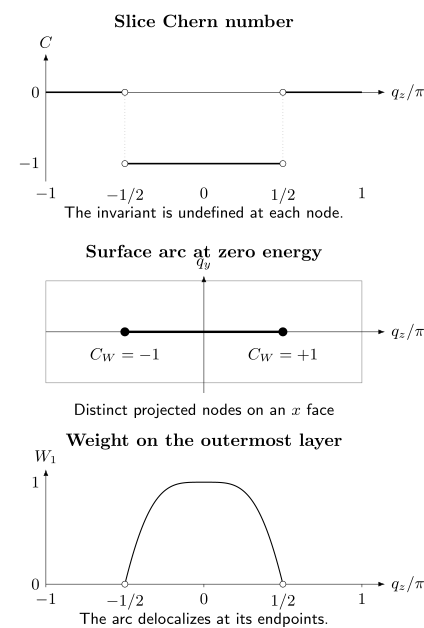
The lattice example at . Top: the lower-band slice invariant jumps by and at the two nodes. Middle: their projections bound the zero-energy arc on an face. Bottom: the calculated weight on the outermost layer tends to zero at the endpoints. On a face the two nodes project onto the same momentum, so this arc argument does not require a protected open contour.
What is protected
Section titled “What is protected”The exact shape of a Fermi arc is not universal. Surface potentials can bend it, reconnect arcs among several projected nodes, or mix it with trivial surface bands. Topology constrains:
- the net number of chiral surface crossings along a closed momentum-space loop;
- the change of that count when the loop encloses projected Weyl charge;
- termination in the projected bulk continuum;
- the impossibility of realizing an isolated open Fermi contour in a strictly two-dimensional band structure.
If opposite-charge nodes project to the same surface momentum, their net projected charge is zero and an arc need not be visible on that face. If the chemical potential is far from the node energy, surface arcs can join bulk electron and hole pockets and appear as parts of closed contours. Calling every surface feature that looks open a Fermi arc is therefore unsafe.
Spectroscopic identification
Section titled “Spectroscopic identification”Angle-Resolved Photoemission Spectroscopy can distinguish surface-localized states from bulk states by varying photon energy and thus the sampled out-of-plane momentum, subject to final-state and escape-depth limits. A strong arc diagnosis combines:
- bulk crossings at the predicted three-dimensional momenta;
- a validated crystal structure and chemical potential;
- surface contours with negligible bulk dispersion;
- endpoint consistency with projected bulk nodes;
- a signed crossing count consistent with the enclosed projected charge;
- slab calculations that include the actual surface termination.
The closed-loop crossing count is more robust than tracing one visually appealing contour through regions where surface and bulk intensity overlap.
Dirac Semimetals and Symmetry
Section titled “Dirac Semimetals and Symmetry”A three-dimensional Dirac point contains two Weyl sectors of opposite charge at the same momentum and energy. A schematic low-energy Hamiltonian is
where
The total Berry charge through a surface enclosing the fourfold point is zero. Unlike a single Weyl node, topology alone therefore does not prevent the two sectors from mixing and gapping. A stable Dirac semimetal requires symmetry that forbids the mixing mass.
Rotation-protected crossings
Section titled “Rotation-protected crossings”In and -type models, band inversion occurs along a crystal rotation axis. Conduction and valence Kramers doublets with different rotation eigenvalues cannot hybridize on that axis. Their crossing produces a pair of symmetry-protected bulk Dirac points.
For these rotation-protected models, the relevant conditions are:
- spinful time reversal;
- inversion, giving double degeneracy at each momentum;
- a crystal rotation or nonsymmorphic symmetry distinguishing the crossing bands;
- translation symmetry and a momentum location where those labels apply.
Breaking the protecting rotation while preserving inversion and time reversal generally allows a mass and gaps the node. Depending on the mass sign and band inversion, the resulting phase can be a topological or trivial insulator. Breaking inversion or time reversal can split a Dirac point into separated Weyl nodes if the remaining terms do not simply gap it.
This makes a Dirac semimetal a useful parent phase at the boundary among several gapped and Weyl phases. It also makes it less generic than a Weyl semimetal: the fourfold node has no nonzero total Chern charge once its crystalline protection is removed. Topological Phase Transitions uses codimension to explain when a direct critical point expands into an intervening Weyl interval.
Stable phase versus critical point
Section titled “Stable phase versus critical point”Not every three-dimensional Dirac crossing defines an extended semimetal phase. At a topological-insulator transition, tuning a mass through zero can produce a Dirac point only at one critical parameter value:
The spectrum
is gapless only at . A symmetry-protected Dirac semimetal instead forbids the relevant mass over a finite parameter region and pins crossings along a symmetry line. Experimental language should distinguish a stable phase from a tuned critical point.
Magnetic Field and the Chiral Anomaly
Section titled “Magnetic Field and the Chiral Anomaly”Use electrons of charge , with , SI electromagnetic fields, and the untilted isotropic Hamiltonian , where , , and . Momentum is measured from the corresponding node. For , transverse motion forms Landau levels. For ,
The zeroth level has only one direction per node:
For example, when , is proportional to a lowering operator. The spinor therefore has energy . This fixes the sign instead of leaving it implicit. Opposite-chirality nodes propagate oppositely.
Each Landau branch has transverse degeneracy per area and one longitudinal state per of wavevector per length. An electric field changes wavevector at rate . Counting states crossing the occupied-state boundary gives
This is the Nielsen–Ninomiya spectral-flow picture. The two signs cancel in , so total charge is conserved. They add in the imbalance . With a phenomenological relaxation time defined for this imbalance,
Different definitions of a single-valley scattering time can introduce factors of two; the equation above defines unambiguously. It describes separately identifiable valleys with fast equilibration within each valley and slower transfer between them. Strong intervalley mixing or a pocket enclosing both opposite charges can invalidate that simple two-population description.
For uniform steady fields, . Define and the positive valley susceptibility . The induced nonequilibrium current is . Consequently the ideal weak-field contribution is
The pumping coefficient is universal for a simple pair; the conductivity is not, because susceptibility and relaxation depend on filling, temperature and disorder. The semiclassical result assumes many occupied Landau levels and small field corrections (Son and Spivak). The quantum limit and overtilted cones need a different transport analysis. No generic persistent bulk equilibrium current proportional to static follows: the current here requires a driven valley imbalance.
Why negative magnetoresistance is not enough
Section titled “Why negative magnetoresistance is not enough”A decrease of longitudinal resistance for nominally parallel current and magnetic field is compatible with anomaly transport, but several effects can imitate it:
- current jetting: large transverse magnetoresistance focuses current through an inhomogeneous path, making a four-probe voltage geometry appear less resistive;
- weak localization, magnetic scattering, or field-dependent mobility;
- conductivity from trivial pockets;
- contact placement and sample-shape errors;
- small angular misalignment mixed with a large transverse response;
- field-induced changes of magnetic order or band structure;
- entry into the quantum limit with mechanisms unrelated to a clean semiclassical anomaly.
The TaP case is especially instructive: negative longitudinal magnetoresistance was observed even when the Fermi surface enclosed opposite-chirality nodes together, so chirality was not separately well defined, and modeled current redistribution strongly affected the signal. A credible anomaly experiment needs multiple voltage-contact configurations, homogeneous current injection, angular maps, sample-shape scaling, independent Fermi-surface characterization, and evidence that intervalley pumping is meaningful.
Transport and Optical Signatures
Section titled “Transport and Optical Signatures”Anomalous Hall response
Section titled “Anomalous Hall response”The signed component follows directly from insulating slices. With the Berry convention above and ,
For our lattice model at chemical potential zero, the nontrivial interval has width and , giving
This is a three-dimensional conductivity, with units of conductance per length. It changes continuously as the nodes separate. Burkov and Balents give a related layer construction connecting a Weyl phase to a three-dimensional quantum Hall phase. Adding filled Chern bands can shift the slice background by an integer; node separation alone therefore does not fix the complete Hall response. Once additional pockets are occupied, integrate their Berry curvature too. A large anomalous Hall signal is not a node count.
Optical conductivity
Section titled “Optical conductivity”For a clean, neutral, type-I three-dimensional Weyl cone, interband phase space gives a low-frequency optical conductivity linear in frequency:
Finite chemical potential Pauli-blocks low-frequency interband absorption and adds a Drude response. Anisotropy, tilt, several nodes, phonons, disorder, interactions, and trivial bands modify the slope and threshold. Linear optical conductivity supports a linearly dispersing three-dimensional spectrum but does not by itself measure .
Quantum oscillations and Weyl orbits
Section titled “Quantum oscillations and Weyl orbits”Bulk quantum oscillations determine extremal Fermi-surface areas through
A phase offset influenced by Berry phase can be suggestive, but extracting a topological phase from a Landau fan requires care with:
- whether conductivity or resistivity extrema are indexed;
- three-dimensional curvature corrections;
- Zeeman splitting;
- multiple frequencies;
- chemical-potential motion in field;
- the quantum-limit regime.
In a thin slab, a proposed Weyl orbit combines a surface arc on one face, a chiral bulk Landau level, the opposite surface arc, and a return bulk channel. Thickness-dependent oscillation phase can test this picture, but surface and bulk paths, magnetic breakdown, and ordinary closed orbits must be modeled together.
Combining complementary measurements
Section titled “Combining complementary measurements”| Probe | Main information | Principal limitation |
|---|---|---|
| Bulk photoemission | Node positions and velocities | Resolution and momentum coverage |
| Surface photoemission | Arc connectivity | Bulk overlap and termination |
| Quantum oscillations | Fermi-pocket geometry | Nonunique phase offsets |
| Longitudinal transport | Valley-pumping response | Current redistribution |
| Hall transport | Integrated Berry curvature | Other occupied bands |
| Optical response | Dispersion and thresholds | Several carrier types |
Band calculations connect these measurements by supplying eigenvectors, node charges and symmetry labels. They must use the appropriate crystal structure, magnetic state and chemical potential. Agreement with one dispersion plot does not by itself verify a predicted charge.
Two historical comparisons are useful. In TaAs, bulk and surface spectroscopy together with band calculations established Weyl cones and arc connectivity (Lv and colleagues; Xu and colleagues). In and , three-dimensional Dirac dispersions accompany rotation-protected band-crossing models (Liu and colleagues; Borisenko and colleagues; Wang and colleagues). Their Dirac surface contours are less robust: the opposite charges coincide, and a surface can break the rotation symmetry and mix them. High mobility or an arc-like image alone does not distinguish these situations.
Common pitfalls
Section titled “Common pitfalls”Calling every linear crossing a Weyl node. Determine an enclosing-surface charge and a three-dimensional isolated degeneracy. A nodal line and a tuned Dirac point are different objects.
Replacing band geometry with Fermi-level occupation. A type-II node can retain its band charge while electron and hole pockets destroy the insulating-slice picture at that energy. State which subspace is being integrated.
Inferring chirality from resistance alone. Current jetting and ordinary scattering mechanisms can mimic a decreasing longitudinal resistance. Establish the pockets and test the measurement geometry before assigning valley pumping.
Exercises
Section titled “Exercises”1. Classify a tilted anisotropic cone
Section titled “1. Classify a tilted anisotropic cone”Take and . Find its charge and the boundary between type I and type II. Does increasing reverse the charge?
Solution
The determinant is , so for the lower-band charge is . The tilt parameter is , giving the boundary at . Tilt multiplies the identity and leaves the eigenvectors unchanged, so the charge remains across this change of Fermi-surface geometry.
2. Derive the quadratic density of states
Section titled “2. Derive the quadratic density of states”For an isotropic untilted node with , derive the number of positive-energy states per volume below and hence for one nondegenerate cone.
Solution
The occupied momentum volume inside radius
is . One state per real-space volume occupies momentum volume , so
Differentiating gives
Node, spin, and valley multiplicities must be inserted explicitly rather than hidden in this one-cone result.
3. Count symmetry-related nodes
Section titled “3. Count symmetry-related nodes”Assume all nodes are at generic momenta. Explain why a time-reversal-invariant, inversion-breaking Weyl semimetal needs at least four simple nodes, whereas an inversion-symmetric, time-reversal-breaking one can have two.
Solution
Under time reversal,
The orientation of a small sphere also reverses when is mapped to . The two sign reversals cancel, so time reversal maps a node to one of the same charge. Charge neutrality then requires another time-reversal-related pair with the opposite charge. The minimum is four.
Under inversion,
because Berry curvature is an axial vector. The enclosing-surface orientation still reverses, so the node at has the opposite charge. One inversion-related pair can satisfy
giving a minimum of two when time reversal is broken.
4. Count lattice slices and compute the Hall response
Section titled “4. Count lattice slices and compute the Hall response”For the lattice model above, set . Find the charges of both nodes, the interval with nonzero slice Chern number, and at zero chemical potential. What happens to this response as ?
Solution
The velocity determinant has the sign of , so the nodes at have charges . Starting from the trivial outside slice, the first jump gives for and the second restores zero. Thus
As , the nodes approach and annihilate, the interval shrinks, and this contribution tends to zero. At the collision the linear velocity along vanishes, so the isolated linear-node formula must not be applied right at .
5. From valley pumping to conductivity
Section titled “5. From valley pumping to conductivity”Consider two identical, untilted nodes at a common positive Fermi energy , at zero temperature. Each has density of states . Apply constant uniform parallel fields to an initially equilibrated sample. Find , , and the steady conductivity correction. Explain why its apparent divergence at is not a prediction of infinite conductivity.
Solution
Integrating the imbalance equation gives
At fixed total density, the small chemical-potential shifts are and . Hence and . Substitution yields
The assumed weak-field, degenerate-metal regime fails when becomes comparable with temperature, disorder broadening, or the Landau-level scale. The susceptibility and relaxation also change. Taking in this formula extrapolates beyond its derivation. The sum remains unchanged throughout the pumping process.
Continue studying
Section titled “Continue studying”Graphene and Dirac Materials gives the two-dimensional comparison. Edge and Surface States examines boundary spectra, and Bulk–Boundary Correspondence explains the slice-by-slice argument. Hall Effect places the intrinsic response among other Hall mechanisms. For the relativistic analogy and its limits, see Angular Momentum to Helicity.
References
Section titled “References”- F. Arnold et al., “Negative Magnetoresistance without Well-Defined Chirality in the Weyl Semimetal TaP,” Nature Communications 7, 11615 (2016), doi:10.1038/ncomms11615.
- S. Borisenko et al., “Experimental Realization of a Three-Dimensional Dirac Semimetal,” Physical Review Letters 113, 027603 (2014), doi:10.1103/PhysRevLett.113.027603.
- A. A. Burkov and L. Balents, “Weyl Semimetal in a Topological Insulator Multilayer,” Physical Review Letters 107, 127205 (2011), doi:10.1103/PhysRevLett.107.127205.
- C. Herring, “Accidental Degeneracy in the Energy Bands of Crystals,” Physical Review 52, 365–373 (1937), doi:10.1103/PhysRev.52.365.
- Z. K. Liu et al., “Discovery of a Three-Dimensional Topological Dirac Semimetal, ,” Science 343, 864–867 (2014), doi:10.1126/science.1245085.
- B. Q. Lv et al., “Experimental Discovery of Weyl Semimetal TaAs,” Physical Review X 5, 031013 (2015), doi:10.1103/PhysRevX.5.031013.
- H. B. Nielsen and M. Ninomiya, “Absence of Neutrinos on a Lattice: (I). Proof by Homotopy Theory,” Nuclear Physics B 185, 20–40 (1981), doi:10.1016/0550-3213(81)90361-8.
- H. B. Nielsen and M. Ninomiya, “The Adler–Bell–Jackiw Anomaly and Weyl Fermions in a Crystal,” Physics Letters B 130, 389–396 (1983), doi:10.1016/0370-2693(83)91529-0.
- A. A. Soluyanov et al., “Type-II Weyl Semimetals,” Nature 527, 495–498 (2015), doi:10.1038/nature15768.
- D. T. Son and B. Z. Spivak, “Chiral Anomaly and Classical Negative Magnetoresistance of Weyl Metals,” Physical Review B 88, 104412 (2013), doi:10.1103/PhysRevB.88.104412.
- X. Wan, A. M. Turner, A. Vishwanath, and S. Y. Savrasov, “Topological Semimetal and Fermi-Arc Surface States in the Electronic Structure of Pyrochlore Iridates,” Physical Review B 83, 205101 (2011), doi:10.1103/PhysRevB.83.205101.
- Z. Wang et al., “Dirac Semimetal and Topological Phase Transitions in (),” Physical Review B 85, 195320 (2012), doi:10.1103/PhysRevB.85.195320.
- Z. Wang, H. Weng, Q. Wu, X. Dai, and Z. Fang, “Three-Dimensional Dirac Semimetal and Quantum Transport in ,” Physical Review B 88, 125427 (2013), doi:10.1103/PhysRevB.88.125427.
- S.-Y. Xu et al., “Discovery of a Weyl Fermion Semimetal and Topological Fermi Arcs,” Science 349, 613–617 (2015), doi:10.1126/science.aaa9297.
Further reading
Section titled “Further reading”- N. P. Armitage, E. J. Mele, and A. Vishwanath, “Weyl and Dirac Semimetals in Three-Dimensional Solids,” Reviews of Modern Physics 90, 015001 (2018), doi:10.1103/RevModPhys.90.015001.
- A. A. Burkov, “Weyl Metals,” Annual Review of Condensed Matter Physics 9, 359–378 (2018), doi:10.1146/annurev-conmatphys-033117-054129.
- B. Q. Lv, T. Qian, and H. Ding, “Experimental Perspective on Three-Dimensional Topological Semimetals,” Reviews of Modern Physics 93, 025002 (2021), doi:10.1103/RevModPhys.93.025002.