

Topological Quantum Computation Bridge
Topological quantum matter can protect information by storing it in a nonlocal degree of freedom that small local perturbations cannot readily distinguish. The computational opportunity comes from combining that separation with controlled braiding or charge measurements. A protecting phase, an encoded state and a reliable operation are related achievements, but each requires its own physics.
This bridge concentrates on the material contribution: why separation suppresses overlap, why a short-chain zero mode is not a length-scaling result, and why thermal excitations and finite operation times remain important. Topological Quantum Computation develops the fusion-space gates and their universality; Topological Qubits develops complete devices, readout and logical-error metrics. Research discussions of non-Abelian anyons and quantum hardware scaling compare experiments and open questions within their stated review horizons.
Required background. Anyons and Braiding supplies fusion channels and exchange operations. Topological Order explains the gapped phase and its nonlocal state space.
Helpful background. Topological Superconductors and Fractional Quantum Hall Effect explain the principal material settings.
What local protection means in a material
Section titled “What local protection means in a material”Let project onto an intended low-energy fusion or code space. For a sufficiently small, bounded allowed physical operator , local indistinguishability means
The first term acts identically on all logical states. Only the small remainder can distinguish or mix them. In a suitable gapped geometry its norm can be exponentially suppressed with separation relative to a correlation length; exact commuting-projector models can instead have an exactly vanishing remainder on correctable regions. These statements depend on the phase, geometry and perturbation class (Kitaev; Nayak and colleagues).
For Majorana devices, isolated-system observables preserve total fermion parity. A single Majorana operator is parity odd and is not an allowed isolated-system perturbation. Coupling to a fermionic environment can exchange parity with the device; it changes the noise problem rather than obeying the same protection assumption.
Even when is scalar, may connect the low-energy space to excited states. A weak static perturbation can produce virtual corrections; a time-dependent or thermal perturbation can cause actual leakage. Ground-space indistinguishability therefore does not assert immunity to excitation creation. The gap suppresses some processes, while cooling and control must address others.
There is also a distinction between one local term and a sum of many terms. Small contributions can accumulate with device size, and higher-order processes can connect distant defects. The benefit of separation must be checked for the full Hamiltonian and noise model, not inferred from a single vanishing matrix element.
A short-chain zero and a protected interval
Section titled “A short-chain zero and a protected interval”An explicit Kitaev-chain calculation shows why a zero-energy point and robust separation are different tests. Let be Majorana operators at site , normalized so that each squares to one and distinct operators anticommute. At equal real hopping and pairing, , take an open chain of sites:
At , the interior Majoranas pair across adjacent sites; and do not appear in . They are exact zero modes for a two-site chain as well as for a long chain. Observing that one point does not tell us how strongly the modes respond away from it.
Write
Orthogonal rotations of the two Majorana sets reduce this real matrix to singular values. Each singular value is a positive Bogoliubov excitation energy. The smallest one, , is the end-mode splitting; occupation of that mode changes the chain’s fermion parity. This convention gives an effective pair Hamiltonian , whose two many-body energies differ by .
For two sites, direct diagonalization gives
For a fixed number of sites and small , a coupling between the ends requires a process through the whole chain:
Thus a third site raises the leading order from quadratic to cubic, while longer chains can suppress the splitting over an interval of parameters. In the uniform gapped phase, put . At large and fixed ,
The corresponding amplitude localization length, in sites, is . Near , the infinite-chain quasiparticle gap closes, diverges and a given finite chain no longer separates its ends effectively. The small- expansion at fixed and the large- expression at fixed are different approximations, although they agree where both apply.
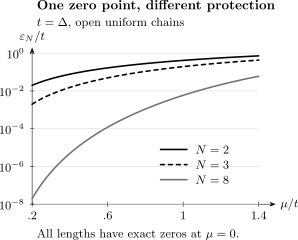
Exact singular-value calculations at , shown for positive within the infinite-chain topological regime. All three lengths have exact zero modes at , outside this logarithmic plot. Away from that point, longer chains suppress the splitting over a wider parameter range. The graph tests overlap in an ideal model; it does not include poisoning, readout or control errors.
For example, at , the exact splittings are approximately , and for . The bulk model and gap are the same; the separation is different. A very small measured splitting at one tuned parameter could also result from an accidental zero or oscillatory cancellation. A length comparison over a controlled parameter interval is more informative than the best point of each device.
This ideal chain isolates one material mechanism. Real wires can have additional modes, disorder, nonuniform pairing, smooth confinement and oscillatory overlaps. Their gap and wavefunctions must be established independently. The general Kitaev phase and Majorana profiles are developed in Topological Superconductors and the Kitaev-chain reference.
A pair of end modes is not yet a qubit
Section titled “A pair of end modes is not yet a qubit”The two occupations of one end-mode fermion have opposite chain parity. Arbitrary coherent superpositions of different total fermion parity are not an ordinary isolated-device qubit. A standard encoding uses four Majoranas with fixed total parity, leaving two states. Their logical variable is a joint parity or fusion channel, not the occupation of one local endpoint.
The measured splitting of one chain contributes to relative logical energies when such chains are combined into a fixed-parity device. Other chains and couplings also contribute; the single-chain should not automatically be identified with the complete device’s qubit splitting. Topological Qubits gives the explicit parity constraints and Pauli operators.
Protection must survive during an operation
Section titled “Protection must survive during an operation”Moving or coupling defects changes the Hamiltonian. The smallest relevant gap along the entire path, rather than the initial gap, controls excitation risk. For a path traversed with , define the largest relevant transition matrix element
Here is in the computational manifold and is an unwanted excited state. A useful adiabatic scale is
It makes explicit what the rough estimate omits: the size of the Hamiltonian change. Pulse smoothness, endpoints, resonances and accumulated amplitudes affect the actual leakage, so this is a diagnostic scale, not a universal error bound (Knapp and colleagues).
An operation that is too slow has other costs. An uncompensated logical energy splitting produces a relative phase
Random splitting produces dephasing; a reproducible known phase may be calibrated or compensated, but then its control accuracy must be included. Quasiparticle entry can change the device’s parity, and other environmental couplings can dephase it without any parity change. The useful regime therefore compares adiabaticity, splitting, parity lifetime and coherence separately. A long parity-switching time is not a measured coherent-qubit lifetime.
Separation helps overlap, but may require longer paths. In a simple illustration, let , and . Then
For a size-independent Poisson poisoning rate , the probability of at least one event is
Increasing beyond one reduces this overlap phase but increases exposure to poisoning. These are illustrative assumptions, not a device optimization formula. They show why a decrease in one error mechanism is not automatically a decrease in total logical error.
What the different physical platforms supply
Section titled “What the different physical platforms supply”| Physical setting | Source of nonlocal states | Control to establish |
|---|---|---|
| Fractional Hall fluid | Intrinsic many-body order | Quasiparticle placement and fusion readout |
| Topological superconductor | Gapped BdG phase and defects | Parity control and defect manipulation |
| Prepared topological state | Engineered quantum state | Encoded operations under native noise |
| Active topological code | Repeated local checks | Reliable syndrome extraction and decoding |
Fractional Hall fluids support deconfined fractional quasiparticles; their charged edges provide interferometric access. Computational use requires manipulating the relevant bulk quasiparticles while controlling edge reconstruction, charging phases and neutral-mode coherence. Fractional charge or an Abelian statistical phase does not itself identify a multidimensional non-Abelian fusion space. For fixed Abelian charges and total charge on a simply connected region, braiding contributes scalar phases; other encodings using holes, global sectors or codes require a separate construction.
Majorana defects provide a different setting: the superconductor and device constraints supply the parity structure. Wire networks, vortices and controlled couplings can implement exchange protocols in appropriate models (Alicea and colleagues; Aasen and colleagues). A low-energy end resonance is only a spectral observation until the phase, nonlocal state space and operation are connected. Short chains are especially useful for controlled model tests, but their zero-mode sweet spots do not by themselves establish asymptotic protection.
A programmable processor can prepare and manipulate a topological wavefunction without its microscopic hardware being a topological material. The resulting excitations and fusion operations can be valid quantum simulations. Their error suppression depends on how the state is maintained and how physical noise maps into the encoded degrees of freedom. Reproducing the ideal braid matrix does not by itself supply a protecting Hamiltonian gap.
An actively stabilized topological code instead repeatedly measures local checks and decodes errors. Its logical information is nonlocal even when the physical qubits are conventional. The surface code explains this operating principle. A material gap and an active code can be complementary resources; neither should be assumed to replace the other automatically.
Braids, measurements and universal gates
Section titled “Braids, measurements and universal gates”For well-separated non-Abelian anyons, ideal adiabatic exchange acts on their fusion space. Its projective action depends on the braid class rather than small smooth changes of the path, provided the gap, charges, separation and relevant symmetry assumptions remain intact. An unintended anyon, collision, changed boundary or leakage event changes the physical problem.
The mathematical details belong in Anyons and Braiding and Topological Quantum Computation. For a material comparison, the essential distinction is that Ising/Majorana braids give a restricted, nonuniversal set of Clifford operations on standard encodings. Suitable Fibonacci encodings admit approximate braid universality, with gate accuracy traded against braid length (Freedman, Larsen and Wang). A non-Abelian exchange is therefore not synonymous with a universal processor.
Ising architectures need an additional non-Clifford resource, such as prepared magic states or calibrated phase operations; ordinary Ising fusion and parity measurements with stabilizer resources do not remove this restriction by themselves (Bravyi and Kitaev). Other anyon models and additional physical primitives can give different computational capabilities. The resources must be specified rather than grouped together as “measurement.”
Sequences of topological-charge measurements can reproduce braid transformations without moving the anyons (Bonderson, Freedman and Nayak). This changes the physical challenge to ancilla preparation, measurement backaction, adaptive control and readout. A detector needs the correct conditional quantum action as well as a low bit-assignment error; see Quantum Instruments.
Thermal motion and the need to detect errors
Section titled “Thermal motion and the need to detect errors”At low temperature, the equilibrium density of a dilute excitation with energy is often suppressed by a Boltzmann factor . A pair-creation rate instead depends on its activation barrier and bath dynamics; it should not be identified with that density without a model. A gap suppresses thermal occupation but does not forbid events over arbitrarily long times.
In familiar two-dimensional models with freely mobile anyons, a created pair can separate at essentially fixed excitation energy. Its worldline may connect defects or wind around a nontrivial cycle before the pair annihilates. The final state can then contain a logical error even though no anyons remain. An energy gap alone does not give a growing memory barrier with system size (Kitaev; Dennis and colleagues).
Detection, correction, faster operation or an additional physical mechanism is needed to control these processes. The geometry of logical strings explains which errors matter; the actual event rate depends on the environment and protocol. That is the point at which material physics connects to the repeated measurements, decoding and fault-tolerant design developed in the information volume.
Exercises
Section titled “Exercises”1. The two-site splitting
Section titled “1. The two-site splitting”For , compute its smallest singular value and expand at small . Compare the result with the leading three-site splitting.
Solution
The eigenvalues of are
They are , so
For three sites the leading result is . Both vanish at , but the extra site suppresses the leading sensitivity to small uniform detuning by another power.
2. A perturbation at only one end
Section titled “2. A perturbation at only one end”For a two-site chain with separate onsite parameters, replace the diagonal of by . Show that setting either parameter to zero leaves an exact zero singular value. For both parameters small compared with , find the leading splitting.
Solution
The determinant is , equal in magnitude to the product of the two singular values. If either onsite parameter vanishes, one singular value is exactly zero. The other is in that case.
When both are small, the larger singular value approaches , so
This special model requires both onsite couplings to connect the two ends. It illustrates a higher-order virtual process, not immunity to every possible perturbation of a two-site device.
3. A pulse scale larger than the inverse gap
Section titled “3. A pulse scale larger than the inverse gap”Suppose and the largest relevant path matrix element is . Compare with . Does either number alone certify a desired gate error?
Solution
Using ,
The second scale is fifty times larger because the path changes the Hamiltonian by a scale much larger than the minimum gap. Neither certifies an error tolerance: the pulse profile, other levels and actual leakage must still be calculated or measured. Slow operation must also be compared with logical splitting and environmental events.
4. Longer separation and longer exposure
Section titled “4. Longer separation and longer exposure”In the illustrative path model, take and . Compare the overlap phase and poisoning-event probability at and . What conclusion about total error is justified?
Solution
The phases are and radians. The event probabilities are and .
Separation strongly reduces overlap while the longer duration approximately doubles exposure to poisoning. Phase and event probability are different quantities and should not be added directly. To compare total logical error, specify the input states, compensation, leakage handling and the conditional effect of an event. The calculation establishes a competing trend, not an optimal length.
References
Section titled “References”- D. Aasen et al., “Milestones toward Majorana-Based Quantum Computing,” Physical Review X 6, 031016 (2016), doi:10.1103/PhysRevX.6.031016.
- J. Alicea, Y. Oreg, G. Refael, F. von Oppen, and M. P. A. Fisher, “Non-Abelian Statistics and Topological Quantum Information Processing in 1D Wire Networks,” Nature Physics 7, 412–417 (2011), doi:10.1038/nphys1915.
- P. Bonderson, M. Freedman, and C. Nayak, “Measurement-Only Topological Quantum Computation,” Physical Review Letters 101, 010501 (2008), doi:10.1103/PhysRevLett.101.010501.
- S. Bravyi and A. Kitaev, “Universal Quantum Computation with Ideal Clifford Gates and Noisy Ancillas,” Physical Review A 71, 022316 (2005), doi:10.1103/PhysRevA.71.022316.
- E. Dennis, A. Kitaev, A. Landahl, and J. Preskill, “Topological Quantum Memory,” Journal of Mathematical Physics 43, 4452–4505 (2002), doi:10.1063/1.1499754.
- M. H. Freedman, M. Larsen, and Z. Wang, “A Modular Functor Which Is Universal for Quantum Computation,” Communications in Mathematical Physics 227, 605–622 (2002), doi:10.1007/s002200200645.
- A. Y. Kitaev, “Fault-Tolerant Quantum Computation by Anyons,” Annals of Physics 303, 2–30 (2003), doi:10.1016/S0003-4916(02)00018-0.
- A. Y. Kitaev, “Unpaired Majorana Fermions in Quantum Wires,” Physics-Uspekhi 44, 131–136 (2001), doi:10.1070/1063-7869/44/10S/S29.
- C. Knapp, M. Zaletel, D. E. Liu, M. Cheng, P. Bonderson, and C. Nayak, “The Nature and Correction of Diabatic Errors in Anyon Braiding,” Physical Review X 6, 041003 (2016), doi:10.1103/PhysRevX.6.041003.
- C. Nayak, S. H. Simon, A. Stern, M. Freedman, and S. Das Sarma, “Non-Abelian Anyons and Topological Quantum Computation,” Reviews of Modern Physics 80, 1083–1159 (2008), doi:10.1103/RevModPhys.80.1083.