

Topological Quantum Computation
Topological quantum computation stores information in the fusion degrees of freedom of anyons. Braiding or suitable sequences of charge measurements transform that information. The attraction is that an ideal braid depends on its topological class rather than small details of the path, but a computational gate still needs a specified encoding, preparation, readout and error model. Non-Abelian braiding alone does not guarantee universality or physical fault tolerance.
This page develops finite logical examples using ideal anyon data. Anyons and braiding explains those data and their physical origin; the topological-computation bridge discusses protection and material realizations.
Helpful background. Anyons and braiding supplies fusion spaces and and moves. Universal gate sets explains exact versus approximate universality and gate-error metrics.
Encoding information in fusion channels
Section titled “Encoding information in fusion channels”For charges , vacuum and fusion multiplicities ,
A fusion tree describes how several charges combine. Intermediate charges, together with any multiplicity indices, label a basis of , the fusion space for ordered anyons and fixed total charge . For , set and . A left-associated tree gives
An move changes the association and coordinates used to describe that same space. It need not be a physical gate. A fixed total charge does not itself identify a tensor product of qubits, nor does a large fusion-space dimension specify how logical gates avoid unused states.
For an example, four Ising anyons have fusion rule . Fix their total charge to vacuum. If the first pair fuses to , the second pair must fuse to the same , because . This gives the two logical states
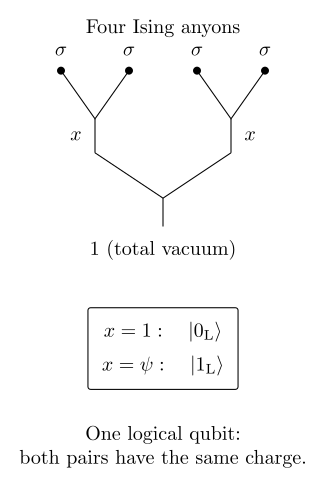
Fixing total vacuum ties the two pair charges together. There are two fusion basis states, not two independent pair qubits. Superpositions of these two states remain in the same total-charge sector.
Vacuum pair creation can initialize the state, under ideal preparation assumptions. Superpositions of different total charges require a physical reference or enlarged system that makes them meaningful; the fixed-sector encoding does not assume such a reference.
Let project onto a chosen logical subspace and within the full sector. Preserving total charge does not necessarily preserve . A braid can therefore leak from a code even while remaining in the same anyon sector.
Braid matrices and operation order
Section titled “Braid matrices and operation order”For identical anyons in a fixed sector, adjacent exchanges represent the braid group:
For different charge types, an exchange can instead map to a differently ordered fusion space. One must track those charge labels, restrict to label-preserving braids, or work in the appropriate direct sum of sectors before writing one fixed-space representation.
We take positive exchanges counterclockwise and apply matrix products rightmost first. For
the rightmost exchange occurs first, and . An inverse word reverses the factor order and inverts every generator.
When the exchanged pair’s fusion channel is a basis label, its action is given by . For an adjacent pair, change to a suitable fusion tree, apply , then change back:
The two factors evaluate one exchange. They do not count as two additional physical operations. A protocol that actually measures or fuses charges must include those physical operations separately.
A fusion-basis gauge change transforms all coordinates together:
Transforming a braid matrix but leaving its target and measurement unchanged generally compares different protocols.
An exact Ising Hadamard
Section titled “An exact Ising Hadamard”In the four-anyon basis above, use
These are the standard Ising data in the stated orientation and gauge. Let and . Multiplication gives
Thus three exchanges implement a Hadamard on the whole logical qubit, up to one common phase. On , a final measurement of the first pair’s fusion charge gives or with probability each. The relative minus sign in the second column of matters for other inputs; equal probabilities for this one input would not alone prove the gate identity.
The ideal calculation uses four anyons, three sequential exchanges and one final fusion measurement. Its two-dimensional representation has no internal leakage space. Leakage to physical states outside this model has not been evaluated.
Ising braiding acts within the Clifford group on standard qubit encodings; the accessible subgroup can depend on the encoding. Braids alone do not supply arbitrary quantum gates. An Ising architecture needs an additional non-Clifford resource, such as an injected state or a suitable non-topological operation, whose preparation, accuracy and protection must be assessed separately.
A Fibonacci word close to Hadamard
Section titled “A Fibonacci word close to Hadamard”For Fibonacci charges , three anyons with total charge give a two-dimensional space, labeled by the first pair’s charge or . Take
Here . With and , the same three-exchange word satisfies the exact identity
This is close to the Hadamard matrix but is not equal to it. Its first-column probabilities are and .
For two unitaries acting on the same -dimensional logical space, compare
and . Common phase is irrelevant to an isolated logical channel, but relative phases in a coherently controlled implementation remain relevant.
For ,
Using gives
The phase minimizing the distance is . These numbers compare a specific word with a specific target; neither one successful compilation nor a large fidelity proves universality.
Fibonacci braids are dense on suitable encoded spaces. Approximating a chosen gate nevertheless requires a compilation method, inverse access, a target tolerance and an explicit treatment of leakage. If a code is not invariant under every generator, the compressed matrices need not be unitary or form a representation. One must analyze full-space braid sequences and their leakage rather than apply a finite-dimensional gate-synthesis theorem to those compressions.
Fusion measurements and logical frames
Section titled “Fusion measurements and logical frames”A general outcome-resolved instrument has operators , where is the recorded outcome and an unobserved Kraus label. Its probability is
With corrections , the unnormalized map for accepted outcomes is
Its trace is the acceptance probability. Normalizing produces a conditional state and generally makes the rule nonlinear when acceptance depends on the input. A special map that always prepares the same state can have an input-dependent probability yet a constant normalized output; even then the probability cannot be discarded. A code projector inserted into this formula would represent an additional code-survival measurement unless that measurement was already part of the instrument. Mathematically examining does not perform that measurement for free.
A known byproduct may be corrected physically or tracked as a logical frame, provided subsequent operations and final decoding use it. Measurement-based qubit computation is related in spirit, but anyonic measurement-only protocols require their own charge instruments, ancillas and branch analysis. Bonderson, Freedman and Nayak show how suitable charge measurements can reproduce braid transformations without moving the computational anyons. Feedforward and any required repetitions remain part of the process.
Leakage, physical protection and cost
Section titled “Leakage, physical protection and cost”For a full-space unitary and a logical input ,
The second equality maximizes over normalized states supported in the code. Conditional fidelity after projecting back can be one even when survival probability is small. The unitary fidelity formulas above apply to unitaries on a common logical space, not directly to trace-decreasing or leaking maps.
Ideal topological invariance means that continuously deforming a braid within its topological class preserves its projective action. A physical implementation additionally requires separated excitations, an appropriate gap, controlled paths, no unintended enclosed charge and a suitable operating-time window. Initialization errors, thermal excitations, poisoning, residual splitting and fusion-readout errors can remain. An exact braid matrix does not establish a fault-tolerance threshold.
An actively corrected surface code is also distinct from a material supporting intrinsic anyons. Topological qubits discusses implementations; fault-tolerant gates explains fault containment and overhead.
Braid word length counts exchanges, while disjoint exchanges may share a parallel layer. Preparation pairs, ancillas, fusion measurements, repetitions, routing and non-braid resources add costs. A synthesis theorem controls word length under its hypotheses; it does not set physical braid speed or prove computational advantage.
Exercises
Section titled “Exercises”Decode a Braid Word and Its Inverse
Section titled “Decode a Braid Word and Its Inverse”In the Ising gauge of the Ising example, take
Identify the execution order, derive and , verify the inverse, and find the first-pair fusion probabilities on . Count the word length and sequential depth.
Solution
The rightmost factor executes first: perform the counterclockwise , followed by the clockwise . Therefore
The group inverse reverses the factor order and inverts both generators:
Hence
and direct multiplication gives
The first column of gives
Both squared amplitudes are , so the two fusion outcomes are equally likely. The word and its inverse each have length two and sequential depth two because the two exchanges share an anyon. Reversing the written symbols without inverting them, or applying the matrices leftmost first, produces a different operation.
Rephase a Fusion-Tree Basis
Section titled “Rephase a Fusion-Tree Basis”Let
Transform the Ising generators, states, target, logical projector, and fusion projectors into the rephased basis. Prove that a complete protocol has the same fusion probabilities, leakage, and projective gate error.
Solution
Use one coordinate transformation everywhere:
For any word,
because adjacent factors cancel. The first Ising generator is diagonal, so . If
then
The matrix entries changed, but a complete measurement amplitude did not:
Similarly, makes the leakage trace invariant. Unitary invariance of the operator norm gives
Rephasing only while leaving the target or readout unchanged compares different protocols, not different gauges for one protocol.
Count a Fibonacci Encoding Sector
Section titled “Count a Fibonacci Encoding Sector”Starting from one anyon and , count the fusion-space dimensions for six anyons in total sectors and . Also give the dimension when the total charge is not fixed, and explain what the count does not establish about a qubit encoding.
Solution
Let
For one anyon, . Adding one and using the fusion rule gives
Thus
with . For six anyons,
Without a fixed total sector the direct-sum dimension is
A five-dimensional sector does not itself select a two-qubit tensor factor, choose the unused state, or prove that a proposed braid preserves a chosen four-dimensional code. Those are encoding and leakage questions beyond the dimension count.
Use an adaptive fusion outcome
Section titled “Use an adaptive fusion outcome”Consider the abstract two-outcome instrument
with corrections and . Verify completeness, compute the corrected channel, and find the channel and target fidelity on if the classical record is forgotten before correction.
Solution
Completeness follows from
The outcome probabilities are state independent:
After applying the outcome-dependent correction,
If the record is discarded before correction, the channel is instead
For input this yields
whose fidelity with is . This example specifies an abstract instrument with a known byproduct. It is not a claim that a particular device implements a fusion measurement with these Kraus operators.
Compare Three Logical-Gate Metrics
Section titled “Compare Three Logical-Gate Metrics”Suppose is a two-dimensional unitary whose eigenvalues are , with principal eigenphase spread . Compute the projective operator distance, process fidelity, and average gate fidelity. Explain why these values are not interchangeable.
Solution
The optimal common phase removes . The two residual eigenphases are , so
The trace magnitude is , giving
For ,
The operator distance is a worst-direction norm after optimizing global phase; the process fidelity is a normalized trace overlap; and the average gate fidelity averages state fidelity. Their numerical values and operational uses differ. This example assumes two unitaries on one code space, so these formulas do not evaluate leakage or rejected measurement branches.
Separate Leakage from Conditional Fidelity
Section titled “Separate Leakage from Conditional Fidelity”In a Hilbert space containing a code state and an orthogonal leakage state , analyze
Find the leakage, code acceptance probability, conditional code-state fidelity, and unconditioned overlap with the target .
Solution
Let project onto the code and onto the leakage sector. Orthogonality gives
The code acceptance probability is
Conditioned on code acceptance, the normalized state is exactly , so its conditional fidelity is . Without conditioning, the squared target overlap is
Quoting only the unit conditional fidelity would hide the leakage. Even the full calculation concerns one input; it does not certify a deterministic or worst-case logical gate.
Schedule an Eight-Anyon Braid Word
Section titled “Schedule an Eight-Anyon Braid Word”On eight ordered anyons, execute the commuting layer
first and then the commuting layer
Count anyons, elementary exchanges, word length, and ideal parallel depth. Explain why the exchange schedule alone does not specify a logical gate.
Solution
The first layer exchanges disjoint pairs , , , and . Because the generator indices differ by at least two, all four commute and can run in one ideal layer. The second layer exchanges , , and clockwise; those three generators also commute.
The counts are:
- eight anyons;
- seven elementary exchanges;
- signed word length seven;
- ideal parallel braid depth two.
Fusion-basis changes used to evaluate the word are coordinate operations, not extra exchanges. Physical routing or unequal braid durations could make the implementation depth larger and are not included in this ideal count. Without an anyon model, total sector, encoding, input, target, and final measurement, this schedule does not specify a logical gate or a fidelity.
Abelian braiding without a fusion qubit
Section titled “Abelian braiding without a fusion qubit”Use semion charges with and . Prepare four semions with total charge . Execute and in parallel, followed by . Find the fusion-space dimension, braid action and exchange depth. Does this encode a qubit?
Solution
There is a unique fusion path, so the fixed-sector space is one-dimensional. Each positive exchange acts by , and a negative exchange by . With rightmost-first products,
The word contains three exchanges in two ideal parallel layers. The output fusion charge is deterministic, and is a common phase on this one-dimensional space. There is no fusion-space qubit or nontrivial projective logical gate. An external interferometer could make a relative path phase observable, but that would add a different degree of freedom to this encoding.
References
Section titled “References”- P. Bonderson, M. Freedman, and C. Nayak, “Measurement-Only Topological Quantum Computation,” Physical Review Letters 101, 010501 (2008), doi:10.1103/PhysRevLett.101.010501.
- S. Bravyi, “Universal Quantum Computation with the Fractional Quantum Hall State,” Physical Review A 73, 042313 (2006), doi:10.1103/PhysRevA.73.042313.
- M. H. Freedman, M. Larsen, and Z. Wang, “A Modular Functor Which Is Universal for Quantum Computation,” Communications in Mathematical Physics 227, 605–622 (2002), doi:10.1007/s002200200645.
- L. Hormozi, G. Zikos, N. E. Bonesteel, and S. H. Simon, “Topological Quantum Compiling,” Physical Review B 75, 165310 (2007), doi:10.1103/PhysRevB.75.165310.
- A. Yu. Kitaev, “Fault-Tolerant Quantum Computation by Anyons,” Annals of Physics 303, 2–30 (2003), doi:10.1016/S0003-4916(02)00018-0.
- C. Nayak, S. H. Simon, A. Stern, M. Freedman, and S. Das Sarma, “Non-Abelian Anyons and Topological Quantum Computation,” Reviews of Modern Physics 80, 1083–1159 (2008), doi:10.1103/RevModPhys.80.1083.