

Topological Phase Transitions
A topological phase transition changes the topological distinction between bulk phases within a specified class of Hamiltonians. In clean band theory, occupied and unoccupied bands must touch somewhere before their invariant can change. The converse is not true: a gap can close without changing that invariant. With interactions or disorder, one must examine many-body ground states or localization, rather than infer the transition from an electron band gap alone.
Two questions organize this page: which gap is relevant, and what distinguishes the phases on either side? We answer them with Dirac curvature transfer, a lattice Chern transition and a band-overlap counterexample. Finite systems, interactions and experiments then show why the distinction matters in practice.
Required background. Topology in Quantum Matter explains phase-preserving deformations and protecting symmetries. Quantum Phase Transitions explains thermodynamic limits and critical scaling.
Helpful background. Chern Numbers in Band Theory supplies occupied-band geometry and invariant calculations. Bulk–Boundary Correspondence relates the endpoint phases to interface modes.
Changing a topological phase
Section titled “Changing a topological phase”Let be a smooth path of local Hamiltonians, with . If the occupied band subspace stays isolated at every momentum, its projector changes continuously. A discrete invariant cannot change continuously, so
For interacting ground-state phases, the analogous statement requires the appropriate bulk gap, ground-state structure and protecting symmetries to persist uniformly in the thermodynamic limit. Locality and the allowed degrees of freedom are also part of the phase definition. A small gap in every member of a finite sequence is insufficient if that gap vanishes as size increases.
Consequently, distinct endpoints require a failure of some phase-preserving condition along the path. Several physically different possibilities occur:
| Mechanism | What must be examined |
|---|---|
| Direct band touching | Occupied–unoccupied separation and invariant change |
| Gapless intermediate phase | Nodes or extended states over a parameter interval |
| First-order transition | Competing ground-state branches |
| Disorder-driven transition | Localization and mobility gap |
| Interaction-driven transition | Collective excitations and many-body ground states |
| Symmetry-breaking detour | Whether the original distinction still applies |
At a first-order transition, two extensive ground-state energies exchange order. Their thermodynamic branches become degenerate, although excitations above either locally stable branch can remain massive. The transition need not contain a massless Dirac quasiparticle or a diverging correlation length. Phase coexistence and hysteresis concern this mechanism, rather than establishing topology by themselves.
A detour that explicitly breaks a protecting symmetry has a different meaning: the endpoints may be connected without a phase transition in the larger class. Likewise, interactions can identify phases that free-band theory distinguished. For example, the free one-dimensional BDI integer reduces to a modulo-eight distinction when suitable interactions are allowed (Fidkowski and Kitaev). Before searching for a critical point, check that the two endpoints remain distinct under the allowed deformations.
Which gap is closing?
Section titled “Which gap is closing?”Direct separation and indirect band overlap
Section titled “Direct separation and indirect band overlap”Order the Bloch energies and consider the lowest bands. Define
For the indirect gap, first locate the conduction minimum and valence maximum , possibly at different momenta. Then
A positive direct gap isolates a rank- band subspace. A positive indirect gap additionally allows one chemical potential to separate those bands throughout the Brillouin zone. If the indirect gap becomes negative, the fixed-rank band bundle can retain its invariant while the actual fixed-density ground state develops electron and hole pockets. Calling its projector the “occupied projector” then confuses band selection with physical occupation. Quantized insulating response generally no longer follows.
Thus a band invariant can change only if the direct separation closes. An indirect overlap alone can create a metal without changing the eigenvectors at all. Conversely, a touching between unoccupied bands does not change the invariant of an isolated occupied subspace.
A lattice transition and a counterexample
Section titled “A lattice transition and a counterexample”Use the Qi–Wu–Zhang model, with lattice spacing and hopping energy set to one:
where .
For the lower band, Berry convention and orientation give
The direct and indirect gaps agree because the energies are symmetric about zero. Their value is
At , the selected band becomes singular and is undefined. The jump at is , because two Dirac points close together. Counting a single gap minimum would miss the multiplicity. Chern Numbers in Band Theory gives the full lattice derivation (Qi, Wu and Zhang).
Now hold and add a scalar dispersion with :
The scalar term changes both energies by the same amount and leaves every eigenvector unchanged. Writing , one finds
so . The conduction minimum is , reached at ; the valence maximum is , reached at . Therefore
At , the insulating gap closes indirectly; for , the bands overlap. Yet the lower-band Chern number remains for all . This is a change in metallic occupation, not a change of that band bundle’s topology. Its experimentally measured Hall response in the metallic regime involves the actual partially filled states, not the integer of the whole lower band.
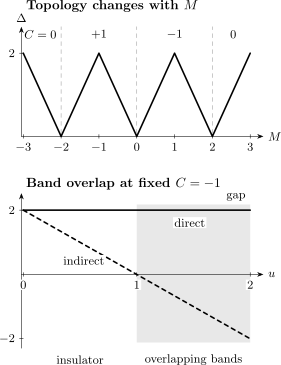
Two changes with different meanings. Top: varying in closes the direct gap and changes ; labels give the invariant only in the open gapped intervals. Bottom: adding at closes the indirect gap while preserving the direct gap and all eigenvectors. Beyond the negative indirect gap denotes overlap, not a negative excitation energy. The full lower-band bundle still has .
Spectral, mobility and many-body gaps
Section titled “Spectral, mobility and many-body gaps”A spectral gap contains no energy eigenvalues. A mobility gap instead permits localized states near the Fermi energy while excluding extended transport states under the localization hypotheses of the Hall theorem. Disorder can fill a clean spectral gap without destroying the quantized Hall phase. Density of states alone cannot decide whether the phase survived (Bellissard, van Elst and Schulz-Baldes).
For interacting systems, use periodic boundaries when studying the bulk, and separate any low-energy ground-state multiplet from excitations. If states have splittings that vanish with size, label them and examine
The first level spacing is inappropriate for a topologically ordered phase with a nearly degenerate torus multiplet: it can vanish throughout a gapped phase. Conversely, restricting the calculation to one symmetry sector can hide a critical excitation in another sector. Specify charge/parity constraints physically, and inspect all sectors relevant to the proposed instability.
Electron addition and removal gaps probe only charged excitations. A neutral collective mode or an emergent anyon can soften while those gaps remain finite. First-order ground-state competition must also be checked rather than inferred from a quasiparticle gap alone.
Dirac masses transfer Berry curvature
Section titled “Dirac masses transfer Berry curvature”Near an isolated two-band touching, let be a wavevector measured from the critical momentum and signed velocities. Define , so that
Its energies are , where
The direct gap is , and the characteristic real-space lengths are
All units now agree: and are energies. If the mass is linear in control-parameter detuning and the clean free-Dirac theory applies, and the correlation-length exponent is . Interactions, disorder, multiple relevant variables or a nonlinear relation between laboratory control and mass can change the observed scaling.
For our lower-band Berry convention, the curvature in wavevector coordinates is
As decreases, the curvature becomes concentrated in a narrower momentum region. Its signed integral over the continuum plane is
This half-integer is not an isolated lattice-band invariant: the continuum plane lacks the high-momentum completion of the Brillouin torus. The meaningful local result is its change. If increases through zero, the contribution changes by . For a general control with nonzero mass slope,
Sum over every critical cone. Two simultaneous closings can reinforce or cancel one another. A gap closing alone is therefore not sufficient to demonstrate a change of Chern number.
Why the jump is an integer
Section titled “Why the jump is an integer”Treat as three coordinates near the touching. A small sphere around it carries an integer Berry flux, like a monopole in this extended parameter space. The flux leaving through the upper and lower parameter slices gives
where is the oriented charge enclosed between the slices. The mass-slope formula is the linear two-band version of this relation.
Away from a touching, the projector onto the selected bands is smooth. Locally it can be written using a resolvent contour around that group of eigenvalues. Its Chern number is integer-valued and continuous, hence constant. At a touching the spectral separation fails, and this continuity argument no longer applies. This is why one evaluates invariants on either gapped side, rather than rounding a numerical integral at the critical point.
Opposite valleys and symmetry constraints
Section titled “Opposite valleys and symmetry constraints”For two valleys , use
Their opposite velocity orientations give the regulated two-valley result
when no additional filled bands contribute. Equal-sign masses cancel; opposite signs give an integer. The Haldane model realizes this competition between sublattice asymmetry and time-reversal-breaking hopping (Haldane). Exercise 2 makes the phase boundaries explicit.
For a time-reversal-invariant insulator, the relevant change can instead be parity. With inversion, exchanging opposite-parity Kramers pairs at one invariant momentum flips the parity product; two such exchanges can cancel. Without inversion, those parity labels are unavailable and one must use a valid alternative such as Wilson-loop flow. See Topological Insulators.
Similarly, a class-D Pfaffian sign change identifies a zero-energy closing at an invariant momentum, but the superconducting phase label applies only if the full bulk quasiparticle spectrum is gapped on each side. A zero-momentum condition alone does not exclude other nodes. The nanowire example and its spin–orbit, pairing and field assumptions are developed in Topological Superconductors.
A transition point or a gapless interval?
Section titled “A transition point or a gapless interval?”A generic Hermitian two-band matrix is . A degeneracy imposes three real conditions, . With momentum coordinates and one tuning parameter, the generic local solution set has dimension
In one dimension a crossing therefore requires extra tuning or symmetry. In two dimensions it can occur at isolated points of . In three dimensions the solutions generically form curves in the four-dimensional extended space. Fixed- sections can then contain Weyl nodes over a finite interval, with creation and annihilation at its ends.
This counting assumes independent constraints and a two-band crossing. Kramers degeneracy, inversion and crystalline symmetries can change the problem. In particular, three-dimensional time-reversal-invariant insulators without inversion generically admit a gapless intermediate phase, while inversion can allow a direct symmetry-pinned transition (Murakami). This statement concerns crossings between the relevant band subspaces; their node energies and indirect overlap must still be considered when deciding whether the actual system is a semimetal or a more general metal.
Finite systems can miss—or hit—the critical momentum
Section titled “Finite systems can miss—or hit—the critical momentum”A finite periodic sample only samples a discrete momentum grid. Its minimum band gap can remain nonzero at the thermodynamic critical parameter if the touching momentum is absent. It can also close exactly if that momentum is present. Finite size does not universally forbid a closing.
The critical SSH chain provides an elementary example. With equal hopping , its Bloch energies are
For a ring of unit cells with twist ,
At periodic boundary conditions, an even includes and has zero band gap. Odd misses it by , giving
A twist makes the odd ring include the critical momentum and closes the gap exactly. The same thermodynamic critical point therefore looks different on different finite grids. Neither one nonzero gap nor one exact crossing settles the bulk phase diagram.
Use multiple sizes and twists, check all symmetry-related momenta, and keep edge levels separate from bulk excitations. For interacting models, track the ground-state multiplet and competing sectors as well. Finite-Size Scaling in Numerical Many-Body Physics gives the general analysis; the distinctive issue here is whether a finite calculation resolves the singularity that changes the invariant.
Disorder and interactions require different diagnostics
Section titled “Disorder and interactions require different diagnostics”Localization and disorder-induced topology
Section titled “Localization and disorder-induced topology”In a Hall phase, localized states can populate an energy interval without carrying macroscopic longitudinal transport. A plateau transition requires failure of the relevant localization protection; a finite density of states by itself is not enough. Real-space or scattering invariants, localization-length scaling and transport provide complementary checks. A local Chern marker must be evaluated in an appropriate bulk region, not averaged over the entire finite open sample; see the finite-trace example.
Disorder can also induce a topological regime. In models with quadratic Dirac corrections, an effective-medium calculation can shift the band parameters into an inverted regime (Li and colleagues; Groth and colleagues). This weak-disorder explanation is not a complete account of localization at all disorder strengths. One should check the invariant and spatial character of states rather than identify a disorder-averaged mass sign with the entire phase diagram. Strong disorder can ultimately destroy the protected regime; the path depends on symmetry, filling and model.
Twisted many-body ground states
Section titled “Twisted many-body ground states”On a torus, a boundary twist multiplies the many-body wavefunction by when a particle is moved once around direction . If a unique ground state is isolated throughout the twist torus, its Berry curvature defines
Here the derivatives in are with respect to the twist angles, not momentum. A change requires failure of the smooth isolated ground-state bundle somewhere on this torus. In a small sample the singularity need not occur at periodic twists (Niu, Thouless and Wu).
For a topologically ordered phase with a nearly degenerate ground-state multiplet, use its non-Abelian Berry connection and trace curvature, with a gap to states outside the multiplet. An arbitrary single finite-size member need not remain isolated as twists permute the states. The relation between the multiplet Chern number and fractional Hall response requires this ground-state structure; see Fractional Quantum Hall Effect.
Green-function zeros are not phase transitions by definition
Section titled “Green-function zeros are not phase transitions by definition”Some interacting invariants are expressed through . Their formulas can become singular through a zero of as well as through a pole. A zero can therefore change a Green-function index without closing the electron spectral gap. It does not by itself prove that the physical many-body phase or quantized response changed (Gurarie; Essin and Gurarie).
Under the necessary nonsingularity and phase assumptions, the auxiliary matrix
can simplify the invariant calculation (Wang and Zhang). Its eigenvalues are not excitation energies. A Green-function shortcut must be tied to the relevant many-body invariant; near zeros, fractionalization or ground-state degeneracy, inspect that connection directly. Conversely, the absence of an electron gap closure does not exclude a neutral or first-order transition.
Anyon condensation and temperature
Section titled “Anyon condensation and temperature”An intrinsically topologically ordered phase can change when an appropriate bosonic anyon softens and condenses. Sectors with incompatible mutual statistics become confined, and remaining sectors can be identified or split (Bais and Slingerland). Such transitions need not be band inversions or visible in electron spectroscopy. They can also be first order or pass through a gapless phase. Topological Order gives the quasiparticle and boundary structure.
The quantum phase classification used here concerns zero-temperature ground states. Finite temperature introduces thermal carriers and broadening; it can also drive a symmetry-breaking transition that changes the effective band structure. A temperature-dependent gap minimum or transport crossover should therefore be distinguished from the underlying zero-temperature topological boundary. Mixed-state classifications require their own definitions.
Connecting a tuning experiment to the phase diagram
Section titled “Connecting a tuning experiment to the phase diagram”A laboratory control usually changes several model parameters. Thickness changes confinement and disorder; a gate changes density and electrostatics; pressure changes hopping and possibly crystal symmetry. Determine the Hamiltonian change before interpreting a measured minimum as a Dirac mass reversal.
Two historical examples illustrate complementary approaches. For HgTe/CdTe quantum wells, the Bernevig–Hughes–Zhang model related thickness to the ordering of electron-like and hole-like subbands and a change; König and colleagues measured edge-dominated transport in the inverted regime. The critical thickness is specific to the heterostructure, not a universal constant. In the cold-atom Haldane realization, Jotzu and colleagues independently controlled sublattice offset and time-reversal-breaking tunneling, mapped interband-transfer features near the valley closings, and measured transverse drift sensitive to Berry curvature. Finite-force transitions and Floquet occupations still affect the response.
For a new measurement or calculation, connect each conclusion to a quantity that actually distinguishes it:
| Question | Useful comparison |
|---|---|
| Which terms changed? | Calibrated parameters and symmetry |
| Which gap closed? | Momentum, twist, sector or localization |
| Are the endpoints distinct? | Same invariant on both gapped sides |
| Is a finite grid misleading? | Sizes, twists and refined momenta |
| Does the physical consequence agree? | Boundary flow or appropriate response |
| Could ordinary band overlap explain it? | Filling, chemical potential and indirect gap |
A zero-bias peak, optical threshold or resistance minimum can have several causes. It becomes informative when combined with a model of the tuning path and an independent distinction between the phases. Detailed platform measurements belong with Topological Insulators, Topological Superconductors and Weyl and Dirac Semimetals.
Exercises
Section titled “Exercises”1. Curvature transfer at an anisotropic cone
Section titled “1. Curvature transfer at an anisotropic cone”Integrate the lower-band curvature of the anisotropic Dirac model above over the continuum plane. Which signs enter its change as a control parameter passes through a simple zero of ?
Solution
Set and use polar coordinates in the plane. Define the radial integral
Then . The radial integral is , giving . As increases, the jump is . The continuum half-values require lattice completion; the local jump is an integer.
2. Two valleys can cancel
Section titled “2. Two valleys can cancel”Take the opposite valley orientations used above and masses , , with . Find the Chern numbers as increases. What changes if both masses instead equal ?
Solution
For , both masses are negative and . For , their signs are negative and positive, giving . For , both are positive and . The critical values are , where one cone closes.
If both masses equal , both cones close at zero, but their opposite orientation charges cancel. The Chern number is zero on both sides. Other symmetry-dependent distinctions would need separate analysis; the observed closing alone does not establish a Chern transition.
3. A metal with an unchanged band bundle
Section titled “3. A metal with an unchanged band bundle”For , prove the stated direct and indirect gaps. Explain why the Chern number of the whole lower band cannot be used as a quantized Hall response at half filling when .
Solution
Since , the direct separation is at least two and reaches two. For ,
Both bounds are attained at the momenta given in the text, so . The scalar term leaves eigenvectors and unchanged. After overlap, the lowest-energy half-filled state occupies some upper-band states and leaves some lower-band states empty. Its Berry-curvature integral is occupation weighted and need not be an integer.
4. A finite ring at the critical point
Section titled “4. A finite ring at the critical point”For the critical SSH ring, compute the minimum direct band gap for periodic even and odd . Show how an antiperiodic twist changes the odd case. For , estimate the periodic gap in units of .
Solution
Even includes , giving zero gap. Odd has nearest momenta , so
For , this is approximately . With , choose in to obtain and zero gap. The nonzero periodic result was a momentum-sampling effect, not a shifted bulk critical point.
5. Which low-energy gap matters?
Section titled “5. Which low-energy gap matters?”A torus calculation has four lowest states with splittings of order and a fifth state separated by an energy approaching . Electron addition/removal remains costly as a tuning parameter changes. Does the vanishing first level spacing show a critical phase? Does the electron gap rule out a transition?
Solution
Neither conclusion follows. The four-state manifold can be the nearly degenerate ground-state space of a gapped topologically ordered phase. Its bulk excitation gap is measured above the manifold, here approaching , rather than by .
The electron gap probes only charged states accessible by electron insertion. A neutral collective mode or anyon can soften, or competing ground-state phases can cross, while that gap stays nonzero. Track the whole low-energy manifold, its separation from other relevant sectors and an appropriate many-body invariant. A Green-function zero alone would not settle the phase question either.
References
Section titled “References”- F. A. Bais and J. K. Slingerland, “Condensate-Induced Transitions between Topologically Ordered Phases,” Physical Review B 79, 045316 (2009), doi:10.1103/PhysRevB.79.045316.
- J. Bellissard, A. van Elst, and H. Schulz-Baldes, “The Noncommutative Geometry of the Quantum Hall Effect,” Journal of Mathematical Physics 35, 5373–5451 (1994), doi:10.1063/1.530758.
- B. A. Bernevig, T. L. Hughes, and S.-C. Zhang, “Quantum Spin Hall Effect and Topological Phase Transition in HgTe Quantum Wells,” Science 314, 1757–1761 (2006), doi:10.1126/science.1133734.
- A. M. Essin and V. Gurarie, “Bulk–Boundary Correspondence of Topological Insulators from Their Respective Green’s Functions,” Physical Review B 84, 125132 (2011), doi:10.1103/PhysRevB.84.125132.
- L. Fidkowski and A. Kitaev, “Effects of Interactions on the Topological Classification of Free Fermion Systems,” Physical Review B 81, 134509 (2010), doi:10.1103/PhysRevB.81.134509.
- C. W. Groth, M. Wimmer, A. R. Akhmerov, J. Tworzydło, and C. W. J. Beenakker, “Theory of the Topological Anderson Insulator,” Physical Review Letters 103, 196805 (2009), doi:10.1103/PhysRevLett.103.196805.
- V. Gurarie, “Single-Particle Green’s Functions and Interacting Topological Insulators,” Physical Review B 83, 085426 (2011), doi:10.1103/PhysRevB.83.085426.
- F. D. M. Haldane, “Model for a Quantum Hall Effect without Landau Levels: Condensed-Matter Realization of the ‘Parity Anomaly’,” Physical Review Letters 61, 2015–2018 (1988), doi:10.1103/PhysRevLett.61.2015.
- G. Jotzu et al., “Experimental Realization of the Topological Haldane Model with Ultracold Fermions,” Nature 515, 237–240 (2014), doi:10.1038/nature13915.
- M. König et al., “Quantum Spin Hall Insulator State in HgTe Quantum Wells,” Science 318, 766–770 (2007), doi:10.1126/science.1148047.
- J. Li, R.-L. Chu, J. K. Jain, and S.-Q. Shen, “Topological Anderson Insulator,” Physical Review Letters 102, 136806 (2009), doi:10.1103/PhysRevLett.102.136806.
- S. Murakami, “Phase Transition between the Quantum Spin Hall and Insulator Phases in 3D: Emergence of a Topological Gapless Phase,” New Journal of Physics 9, 356 (2007), doi:10.1088/1367-2630/9/9/356.
- Q. Niu, D. J. Thouless, and Y.-S. Wu, “Quantized Hall Conductance as a Topological Invariant,” Physical Review B 31, 3372–3377 (1985), doi:10.1103/PhysRevB.31.3372.
- X.-L. Qi, Y.-S. Wu, and S.-C. Zhang, “Topological Quantization of the Spin Hall Effect in Two-Dimensional Paramagnetic Semiconductors,” Physical Review B 74, 085308 (2006), doi:10.1103/PhysRevB.74.085308.
- Z. Wang and S.-C. Zhang, “Simplified Topological Invariants for Interacting Insulators,” Physical Review X 2, 031008 (2012), doi:10.1103/PhysRevX.2.031008.
Further reading
Section titled “Further reading”- M. Z. Hasan and C. L. Kane, “Colloquium: Topological Insulators,” Reviews of Modern Physics 82, 3045–3067 (2010), doi:10.1103/RevModPhys.82.3045.
- C. L. Kane and E. J. Mele, “ Topological Order and the Quantum Spin Hall Effect,” Physical Review Letters 95, 146802 (2005), doi:10.1103/PhysRevLett.95.146802.
- X.-L. Qi and S.-C. Zhang, “Topological Insulators and Superconductors,” Reviews of Modern Physics 83, 1057–1110 (2011), doi:10.1103/RevModPhys.83.1057.