

Quantum Phase Transitions
A quantum phase transition is a qualitative change in the ground-state phase of a many-body system at zero temperature as a nonthermal parameter in its Hamiltonian is varied. For a family
the control parameter may represent a magnetic field, pressure-dependent coupling, interaction-to-hopping ratio, density, or another quantity that changes the competition among terms in .
The sharp transition is a bulk statement. If is the ground-state energy of a system with linear size , then the ground-state energy density is
A transition occurs at when the thermodynamic-limit ground state cannot be continued through without a nonanalytic change in an appropriate bulk observable, response, correlation structure, excitation spectrum, or phase invariant.
Noncommuting terms often produce the competing quantum fluctuations, but noncommutation is not required by the definition: two ground states of a commuting Hamiltonian can also exchange stability in a first-order transition. Temperature is set to zero in the definition, but a zero-temperature critical point can organize a broad finite-temperature crossover regime. A finite-temperature crossover is not itself the quantum phase transition.
Helpful background. Phases of matter explains which deformations preserve a phase, and the thermodynamic limit distinguishes bulk behavior from a finite spectrum.
Ground-state phases and their boundaries
Section titled “Ground-state phases and their boundaries”Two parameter intervals represent distinct phases when no admissible smooth deformation connects their bulk ground states while preserving the properties used to define the phase. The relevant obstruction may involve:
- spontaneous breaking of a symmetry;
- a closing of the bulk excitation gap;
- a change in long-distance correlation behavior;
- a change in stiffness, compressibility, or quantized response;
- topological order or a symmetry-protected invariant;
- a change from a gapped phase to a stable gapless phase.
No single item is universal. A local order parameter works for many symmetry-breaking transitions but not for every topological transition. A gap can close along an entire phase rather than only at one point. First-order transitions can be controlled by competing ground states rather than a diverging correlation length.
The phase definition must therefore state:
- the Hamiltonian family and control parameter;
- the thermodynamic sequence and boundary conditions;
- the symmetries or constraints held fixed;
- the bulk observables or invariants used to distinguish phases;
- the order of zero-temperature, source, and volume limits.
Why Finite Systems Usually Look Smooth
Section titled “Why Finite Systems Usually Look Smooth”Suppose depends analytically on and has an isolated, nondegenerate ground state in a finite-dimensional Hilbert space. In a neighborhood where the gap remains open, standard spectral perturbation theory makes the ground-state energy and projector analytic functions of .
Consequently, a generic finite system exhibits a crossover rather than a sharp continuous transition. Levels with the same exact quantum numbers usually avoid crossing. An exact finite-size crossing can occur when symmetry places the states in different sectors or when additional integrability prevents hybridization, but an isolated crossing alone does not establish a bulk phase transition.
Define the finite-size spectral gap
For a finite-size sequence without exact ground-state degeneracies, the low-energy gap near a continuous critical point commonly decreases with and approaches zero in the thermodynamic limit. Exact crossings can instead make vanish already at finite size: a half-filled noninteracting critical SSH ring has this property when its allowed momenta include the band touching. Near a first-order transition, competing macroscopic states can produce an exponentially small avoided-crossing gap. The size dependence, boundary conditions, symmetry sector, and identity of the excitation matter as much as the numerical value of .
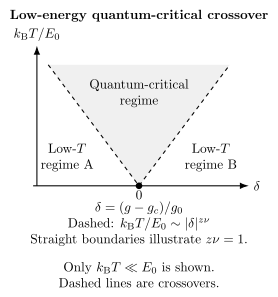
The dimensionless detuning is , where sets its scale; is a microscopic energy. Dashed lines show , drawn for . They are crossovers within the low-energy range , not universal phase boundaries. Finite-temperature ordering, disorder, or other relevant couplings can alter this picture.
First-Order and Continuous Transitions
Section titled “First-Order and Continuous Transitions”The distinction is made from bulk singularities, not from whether a finite numerical curve looks steep.
First-order quantum transitions
Section titled “First-order quantum transitions”Let
For a nondegenerate finite-system ground state, the Hellmann–Feynman theorem gives
After division by volume and passage to the bulk limit,
where the derivative exists. A discontinuity in this quantity signals a first-order transition. Physically, two macroscopically distinct ground states exchange stability.
At a first-order quantum transition:
- the order parameter or another first derivative can jump;
- the correlation length need not diverge;
- a finite system can show an exact or avoided level crossing;
- the minimum gap can be exponentially small in volume;
- hysteresis in a protocol may occur but is not the equilibrium definition.
Continuous quantum transitions
Section titled “Continuous quantum transitions”At a conventional continuous transition, the ground-state energy remains differentiable to lower orders while long-distance scales become singular. A correlation length commonly diverges as
where and are microscopic scales and is the correlation-length exponent.
The characteristic low-energy scale vanishes as
and the corresponding correlation time diverges:
The exponent is the dynamical critical exponent. It states how time and space rescale near criticality:
Power laws are common but not universal. Berezinskii–Kosterlitz–Thouless transitions have an essential rather than algebraic divergence of . Infinite-randomness critical points can have activated rather than power-law dynamical scaling. A scaling form must be justified for the universality class under study.
Gap Closing: Important but Not a Standalone Definition
Section titled “Gap Closing: Important but Not a Standalone Definition”For a conventional continuous transition between two gapped phases, the bulk gap closes at . This produces long correlation times and makes low-energy states sensitive to large distances.
Three qualifications are essential.
First, define which gap is being measured. In a symmetry-broken phase, the splitting between finite-size symmetry partners can vanish exponentially throughout the ordered phase, while the gap to a local bulk excitation remains nonzero away from criticality.
Second, a gapless phase can occupy a finite interval of . The transition into that phase is not identified merely by observing one small gap.
Third, first-order transitions and level crossings can close a ground-state gap without producing scale-invariant fluctuations. Gap closing must be interpreted together with correlations, matrix elements, symmetry sectors, and size scaling.
Scaling Near a Continuous Critical Point
Section titled “Scaling Near a Continuous Critical Point”Near a scale-invariant critical point, an observable’s singular part can often be organized by a homogeneity relation. Measuring lengths in microscopic units, write
Here:
- is the scaling dimension associated with ;
- are additional scaling fields;
- denotes a relevant perturbation;
- denotes an irrelevant perturbation;
- requires a separate marginal-flow analysis.
At and infinite volume, choosing
reduces the long-distance behavior to powers of multiplied by scaling functions. For an order parameter on the ordered side,
where is a critical exponent, not the inverse temperature.
When hyperscaling is valid, the singular ground-state energy density obeys
This relation can fail above an upper critical dimension or in the presence of dangerously irrelevant variables. Critical-exponent identities should not be applied without checking those assumptions.
Quantum Criticality at Nonzero Temperature
Section titled “Quantum Criticality at Nonzero Temperature”Temperature introduces a thermal time scale
Away from , the ground-state phase controls low-temperature behavior when
Near criticality, the thermal scale exceeds the detuning gap when
Using gives the crossover scale
Within the low-energy window , the region is often called quantum critical because neither adjacent zero-temperature phase supplies the only relevant low-energy description. Observables can show scaling governed by the nearby quantum critical fixed point.
This does not mean the system is in its ground state at finite temperature. Its equilibrium state is a thermal density operator, and the imaginary-time extent is finite. Nor is every line drawn around a quantum-critical fan a phase boundary. Many are crossovers, and a system may also contain genuine finite-temperature transition lines. Their thermodynamic definition, order, critical temperature, and finite-size diagnostics belong to Finite-Temperature Phase Transitions.
Imaginary Time and Effective Dimension
Section titled “Imaginary Time and Effective Dimension”The equilibrium partition function is
In an imaginary-time path integral, fields live on
At , the interval becomes infinitely long. A path-integral representation therefore has spatial coordinates plus one imaginary-time coordinate. Its weight need not be a positive classical probability: fermionic signs and Berry-phase factors can obstruct that interpretation.
The phrase “effective dimension ” is a scaling statement, not generally a literal count of coordinates. Under critical rescaling,
When and the long-distance action can be made isotropic, the mapping resembles a classical model in Euclidean dimensions. For , space and imaginary time scale anisotropically even though there is still only one time coordinate.
The transverse-field Ising model provides a precise benchmark: a -dimensional quantum Ising model maps through a Trotter construction to an anisotropic classical Ising model in dimensions. More general quantum-to-classical mappings can be modified by Berry phases, fermionic signs, long-range temporal interactions, dissipation, quenched disorder, constraints, or topological terms. “Add one dimension” is useful intuition, not a universal theorem about all quantum critical points.
Benchmark I: Transverse-Field Ising Chain
Section titled “Benchmark I: Transverse-Field Ising Chain”The transverse-field Ising chain makes these scaling concepts concrete. Its exact solution and parity sectors are developed there; here we use the resulting spectrum.
Consider
Take and measure wavevector in inverse lattice spacings, so below is dimensionless. The field competes with the Ising exchange. The Hamiltonian has a global symmetry generated by
because
Two simple limits
Section titled “Two simple limits”At , the exchange favors the two -polarized configurations
At , the field favors the -polarized product state
The first regime is ferromagnetically ordered in the thermodynamic limit; the second is a quantum paramagnet. The transition occurs at
for the Hamiltonian convention stated above.
Exact bulk spectrum
Section titled “Exact bulk spectrum”Jordan–Wigner and Bogoliubov transformations give a free-fermion quasiparticle dispersion
The bulk quasiparticle gap is
At criticality,
for small . Thus
The infinite-chain longitudinal magnetization is
Hence the order-parameter exponent is . These exponents agree with the two-dimensional classical Ising universality class.
Finite-size subtlety
Section titled “Finite-size subtlety”For , a finite periodic chain can have a unique parity eigenstate even though the thermodynamic phase is symmetry broken. Its even and odd symmetry partners become exponentially close with increasing . This near-degeneracy is different from the bulk domain-wall or quasiparticle gap. In a periodic spin chain, parity and boundary conditions can require domain walls to occur in pairs; the single-quasiparticle energy is not automatically the lowest excitation accessible to every local probe.
A numerical statement such as “the gap is nearly zero” is incomplete until it specifies:
- boundary conditions;
- parity sector;
- whether the symmetry-partner splitting is included;
- whether the target is a bulk excitation or the globally lowest level;
- how the quantity scales with .
Benchmark II: Bose–Hubbard Transition
Section titled “Benchmark II: Bose–Hubbard Transition”The Hamiltonian conventions, atomic gaps, and general-lattice phase-boundary approximations are developed in Bose–Hubbard Model. The Bose–Hubbard chain explains the additional one-dimensional qualifications.
The clean Bose–Hubbard Hamiltonian is
Hopping favors phase coherence and number fluctuations. Repulsive onsite interaction favors localized integer occupation. The chemical potential selects the density.
Atomic limit
Section titled “Atomic limit”At , sites decouple. A site with bosons has energy
Occupation minimizes the onsite energy when
Adding or removing one particle costs finite energy inside this interval. The state is incompressible and forms the atomic limit of a Mott lobe.
At nonzero , the lobes shrink. Crossing a lobe boundary produces a zero-temperature superfluid–Mott transition. The Mott phase has integer density, vanishing compressibility within a lobe, and a particle–hole gap. The superfluid has nonzero stiffness and a gapless phase mode; the precise long-range-order statement depends on spatial dimension.
More than one critical scaling form
Section titled “More than one critical scaling form”The lobe geometry already shows why a model need not have one universality class for every boundary point; Universality gives the corresponding classification logic.
- At a generic density-driven side of a clean Mott lobe, particle or hole excitations become dilute and one commonly finds .
- At a commensurate lobe tip, emergent particle–hole symmetry gives in the standard clean problem.
- In one spatial dimension, the commensurate tip is a Berezinskii–Kosterlitz–Thouless transition, so the correlation length has an essential singularity rather than a finite power-law exponent .
- Disorder can replace the direct clean transition by Bose-glass physics and change the critical structure.
Quoting “the Bose–Hubbard critical exponent” without specifying dimension, filling, trajectory through parameter space, and disorder is therefore not meaningful.
Response and Correlation Diagnostics
Section titled “Response and Correlation Diagnostics”A continuous critical point reorganizes correlation functions over all long scales. If is an order-parameter density, its connected equal-time correlator often has the critical form
under a conventional hyperscaling description, where is an anomalous dimension. Away from criticality, a gapped phase commonly restores exponential decay at large distance:
up to algebraic prefactors.
Susceptibilities can grow or diverge because the probe couples coherently to fluctuations on scales up to . Their interpretation still depends on source sign, operator normalization, contact terms, and the order of static and uniform limits. Those conventions are developed in the Kubo Formula.
Conservation laws can also force noncommuting limits:
A divergent equilibrium susceptibility is not automatically the same as a transport singularity.
Entanglement and Fidelity Diagnostics
Section titled “Entanglement and Fidelity Diagnostics”Ground-state entanglement often changes character near a continuous quantum critical point. In one-dimensional conformal critical systems, interval entropy can grow logarithmically with interval size, while gapped phases commonly saturate for a fixed number of boundary cuts. The assumptions, finite-size formulas, and boundary-condition dependence are developed in Entanglement Entropy in Many-Body Systems.
The ground-state fidelity compares nearby parameters:
For a smooth nondegenerate ground state,
with fidelity susceptibility
Small gaps can make large, so it is a useful finite-size locator. It is not a universal phase definition. A peak can arise from an avoided crossing, boundary rearrangement, or crossover, and its scaling must be tested. Perturbation Theory in Many-Body Systems compares its squared denominators with the less infrared-sensitive second-order energy denominator.
Finite-Size Scaling at a Quantum Critical Point
Section titled “Finite-Size Scaling at a Quantum Critical Point”For a continuous transition with power-law scaling, a finite system replaces the divergent correlation length by . At , a common ansatz is
For a low-energy branch with a nonzero finite-size scaling amplitude, at criticality,
A dimensionless quantity , such as a Binder ratio or correlation-length ratio, often obeys
where is a correction-to-scaling exponent. Curves for different sizes can cross near , but the crossing drifts when corrections are appreciable.
A defensible finite-size analysis should:
- resolve exact symmetry and conserved-quantity sectors;
- compare more than two sizes;
- state boundary conditions and aspect ratios;
- fit corrections or vary the fitting window;
- test more than one observable;
- distinguish algebraic from exponential gap closing;
- report uncertainty in , , and ;
- check alternative first-order or crossover explanations.
Data collapse is a consistency test, not proof by appearance. Flexible exponents, narrow size ranges, and unreported corrections can make incorrect hypotheses look convincing.
Ground-State Preparation and Critical Slowing Down
Section titled “Ground-State Preparation and Critical Slowing Down”Suppose is varied in time. A schematic adiabatic condition for transitions out of the instantaneous ground state is
for every relevant excited state .
As the many-body gap shrinks, maintaining adiabaticity becomes increasingly difficult. If the finite-system path retains a nonzero gap, sufficiently slow preparation is possible under the usual smoothness assumptions, but its time can grow rapidly with . At an exact crossing protected by a conserved sector, slowing the same Hamiltonian path cannot transfer the state to a different sector; a coupling that opens the crossing would be needed. In the thermodynamic limit, a ramp through a continuous critical point generates excitations and a nonequilibrium length scale.
That dynamical problem motivates Kibble–Zurek scaling and counterdiabatic protocols, but it is not part of the equilibrium definition of a quantum phase transition. A protocol-dependent excitation density should not be confused with the equilibrium order parameter.
Boundaries of the Concept
Section titled “Boundaries of the Concept”Several nearby phenomena require separate language:
- A finite-size crossover is smooth unless an exact level crossing is protected.
- A thermal phase transition is a nonanalyticity at driven by free-energy competition.
- A quantum-critical crossover at is controlled by a zero-temperature critical point but is often not a phase boundary.
- A dynamical phase transition concerns singular structures in time-evolved states or trajectory ensembles, not necessarily the ground-state phase diagram. Loschmidt Echo and Dynamical Phase Transitions Preview develops the return-rate definition and explains why crossing an equilibrium critical point is neither necessary nor sufficient in general.
- An excited-state quantum phase transition concerns singularities in excited-state spectra and is not the standard ground-state definition used here.
- A topological transition may lack a local order parameter and requires the relevant invariant, edge structure, or long-range entanglement diagnostic. Topological Phase Transitions develops the gap taxonomy, invariant-transfer mechanisms, disorder and interaction qualifications, and experimental diagnostics.
Exercises
Section titled “Exercises”Hellmann–Feynman signature of a first-order transition
Section titled “Hellmann–Feynman signature of a first-order transition”Let
Show that a discontinuity in the bulk density produces a discontinuity in the first derivative of the ground-state energy density.
Solution
For a finite nondegenerate ground state, the Hellmann–Feynman theorem gives
Divide by volume:
If the two one-sided thermodynamic limits satisfy
then jumps at . This is the ground-state analogue of a first-order thermodynamic singularity. Finite-size rounding can hide the jump, so the order of limits matters.
Ising-chain exponents from the exact dispersion
Section titled “Ising-chain exponents from the exact dispersion”For
show that the critical point has and infer from the bulk gap.
Solution
At ,
The critical energy scales linearly with momentum, so
gives .
At away from criticality,
The scaling relation therefore gives
Since , one obtains .
Crossing of a dimensionless finite-size ratio
Section titled “Crossing of a dimensionless finite-size ratio”Suppose
with no corrections to scaling. Show why all sizes cross at , and find the size dependence of the slope there.
Solution
At , the scaling argument vanishes for every :
Thus every curve passes through the same point. Differentiating,
If , the slope grows as ; a symmetry can instead make this leading slope vanish. In real data, irrelevant operators add corrections, so pairwise crossings drift and the slope need not follow a pure power over small sizes.
Width of the quantum-critical regime
Section titled “Width of the quantum-critical regime”Assume
At fixed temperature, estimate the detuning at which the thermal and gap scales become comparable.
Solution
The crossover occurs when
Solving gives
The quantum-critical window in control-parameter space narrows toward as . The estimate locates a crossover, not necessarily a thermodynamic phase boundary.
Atomic-limit Mott intervals
Section titled “Atomic-limit Mott intervals”For one Bose–Hubbard site,
derive the chemical-potential interval in which occupation minimizes the energy.
Solution
Stability against removing one particle requires
so
Stability against adding one particle requires
so
Combining the inequalities,
Because , the onsite energies are discretely convex: successive differences increase with . The two neighboring inequalities therefore guarantee the global minimum over all occupations, rather than only a local minimum. At the endpoints, particle or hole addition becomes gapless in the atomic limit.
Why the scaling dimension is d + z
Section titled “Why the scaling dimension is d + z”Explain why a quantum critical theory has one imaginary-time coordinate but a spacetime measure that scales with exponent .
Solution
There are spatial coordinates and one imaginary-time coordinate. Under critical rescaling,
Therefore
and
The combined measure scales as
Thus controls hyperscaling dimensions. Only when and anisotropies can be removed does this coincide with an isotropic classical theory in a literal -dimensional Euclidean space.
Further reading
Section titled “Further reading”Entanglement and criticality discusses central-charge inference and finite-entanglement effects. Quantum criticality in matter connects these ideas to pressure, field, and composition tuning in materials.
References
Section titled “References”- A. Altland and B. Simons, Condensed Matter Field Theory, 2nd ed., Cambridge University Press (2010).
- P. Coleman, Introduction to Many-Body Physics, Cambridge University Press (2015).
- M. P. A. Fisher, P. B. Weichman, G. Grinstein, and D. S. Fisher, “Boson Localization and the Superfluid-Insulator Transition”, Physical Review B 40, 546–570 (1989).
- E. Fradkin, Field Theories of Condensed Matter Physics, 2nd ed., Cambridge University Press (2013).
- J. A. Hertz, “Quantum Critical Phenomena”, Physical Review B 14, 1165–1184 (1976).
- P. Pfeuty, “The One-Dimensional Ising Model with a Transverse Field”, Annals of Physics 57, 79–90 (1970).
- V. Privman and M. E. Fisher, “Universal Critical Amplitudes in Finite-Size Scaling”, Physical Review B 30, 322–327 (1984).
- S. Sachdev, Quantum Phase Transitions, 2nd ed., Cambridge University Press (2011).
- S. L. Sondhi, S. M. Girvin, J. P. Carini, and D. Shahar, “Continuous Quantum Phase Transitions”, Reviews of Modern Physics 69, 315–333 (1997).
- M. Suzuki, “Relationship between d-Dimensional Quantal Spin Systems and (d+1)-Dimensional Ising Systems: Equivalence, Critical Exponents and Systematic Approximants of the Partition Function and Spin Correlations”, Progress of Theoretical Physics 56, 1454–1469 (1976).