

Goldstone Modes in Many-Body Systems
A Nambu–Goldstone mode, usually shortened to Goldstone mode, is a gapless collective excitation forced by spontaneous breaking of an exact continuous global symmetry under appropriate locality, stability, and thermodynamic-limit assumptions.
The useful implication is
This statement is not the relativistic slogan “one broken generator, one massless particle.” A generic many-body system has no Lorentz symmetry. Two broken generators can form one canonically conjugate pair and produce a single mode, often with quadratic rather than linear dispersion.
For broken internal symmetries, the modern counting rule is
where is the number of broken generators and is the thermodynamic density of their commutators. The rule explains, in one line, why a collinear antiferromagnet has two linearly dispersing transverse modes while an isotropic ferromagnet breaks the same two spin-rotation generators but has one quadratically dispersing magnon.
Goldstone modes are collective infrared degrees of freedom. They are not synonymous with every gapless quasiparticle, every low finite-size level, or every soft feature at a phase transition.
Helpful background. Spontaneous Symmetry Breaking explains selected thermodynamic states; Generators supplies the charge algebra. Collective Modes describes modes more generally, including those whose gaplessness does not come from broken symmetry.
Broken symmetry and soft collective motion
Section titled “Broken symmetry and soft collective motion”Unless a subsection says otherwise, assume:
- a closed equilibrium quantum many-body system, initially at zero temperature for the nondissipative effective actions below;
- a sequence of volumes approaching a thermodynamic limit;
- short-range or sufficiently local interactions;
- an exact continuous global symmetry of the Hamiltonian;
- a selected thermodynamic state that preserves only a subgroup;
- stable homogeneous order;
- conserved internal charges when applying the internal-symmetry counting rule.
A branch is gapless at an ordering momentum when
For a uniform condensate or ferromagnet, . For an antiferromagnet or another modulated phase, the natural soft point may be nonzero in the full Brillouin zone.
The order of limits matters:
with the thermodynamic phase selected before the continuum of momenta is inferred. A finite box has discrete momenta and no literal sequence at fixed .
From a Broken Manifold to a Field
Section titled “From a Broken Manifold to a Field”Let an exact continuous group be spontaneously broken to the subgroup :
The symmetry-related ordered states form, locally,
Coordinates
on describe slow spatial and temporal variations of the order-parameter orientation. A constant moves the entire state along an exactly degenerate symmetry orbit. A symmetry-invariant potential is constant on that orbit, so it gives no quadratic restoring force along a broken direction. For a general non-Abelian coset, the symmetry acts nonlinearly on : a constant coordinate shift is only a linearized description near the chosen orientation, not an exact invariance of the full spatially varying field energy.
The leading static cost is therefore usually a stiffness term,
For a plane wave, this energy vanishes with wave number. That explains why a soft branch is plausible, but static flatness does not determine the number of dynamical modes or whether their dispersion is linear or quadratic. The time-derivative structure supplies that information.
Angular and radial fluctuations
Section titled “Angular and radial fluctuations”If an order parameter is written schematically as
then moves along the symmetry orbit, whereas changes the amplitude away from the minimum. The Goldstone theorem constrains the angular direction. The amplitude mode is generally gapped and is not made gapless merely by sharing the same order parameter.
This phase–amplitude language is illustrative, not universal. A non-Abelian order parameter can have several tangent directions, constraints, or type-B pairings that are not captured by one complex scalar.
Broken Generators
Section titled “Broken Generators”For an internal symmetry, let be conserved charges. A generator is broken in the selected thermodynamic state if some local operator has
If breaks to , the number of broken generators is
for a regular internal-symmetry pattern. This counts tangent directions of , not yet independent propagating modes.
The finite-volume charge may be perfectly well defined even when every exact finite-volume state is symmetric. The broken expectation value and charge-density limits belong to a source-selected or extremal thermodynamic state, as developed in Spontaneous Symmetry Breaking.
The Nonrelativistic Counting Rule
Section titled “The Nonrelativistic Counting Rule”Charge-commutator density
Section titled “Charge-commutator density”For the broken charges, define the real antisymmetric matrix
If the charge algebra is
then
Thus a nonzero density of an unbroken or broken charge can pair two broken directions.
Because a real antisymmetric matrix has even rank,
Counting formulas
Section titled “Counting formulas”Under the standard assumptions for broken internal symmetries,
The modern type-A and type-B counts are
Therefore
and
Each type-A mode uses one unpaired broken direction. Each type-B mode uses two broken directions that become canonically conjugate.
Representative count
Section titled “Representative count”| Ordered system | Symmetry pattern | Modes | ||
|---|---|---|---|---|
| neutral scalar superfluid | 1 | 0 | one type A | |
| collinear antiferromagnet | 2 | 0 | two type A | |
| isotropic ferromagnet | 2 | 2 | one type B | |
| ordinary continuum crystal | translations and rotations | spacetime symmetry | internal rule not sufficient | acoustic phonons |
The crystal row is deliberately not assigned a naive rank count. Broken spacetime symmetries can generate redundant local transformations and require additional relations.
Type-A Dynamics
Section titled “Type-A Dynamics”For one unpaired broken coordinate, the leading quadratic effective Lagrangian is often
Here is a kinetic susceptibility and is a stiffness. The equation of motion is
For
one obtains
with
The second-order time derivative supplies an independent coordinate and momentum for each field. One broken direction therefore gives one propagating mode.
Linear dispersion is generic when the displayed terms are the leading allowed derivatives. It is not a definition of type A. Fine tuning, anisotropy, long-range forces, subsystem symmetries, or vanishing stiffness can change the leading power.
Type-B Dynamics
Section titled “Type-B Dynamics”For two broken coordinates with nonzero commutator density, the leading time derivative can be first order:
With angular-momentum charges as defined above, is the relevant commutator-density coefficient; for a simple ferromagnet its magnitude is the spin angular-momentum density. The signed convention fixes the sense of precession. The first-order term makes and a canonical pair rather than two independent oscillators.
The equations of motion can be written
Their positive-frequency branch has
Two broken directions have produced one quadratic mode. Second-order time derivatives may also be present, but they are subleading in the generic low-frequency type-B regime or supply a separate gapped partner outside the strict Goldstone sector.
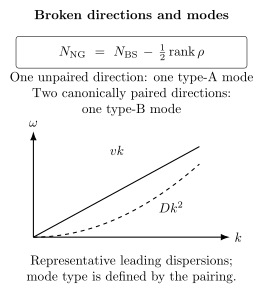
An unpaired broken direction gives one type-A mode, while two directions paired by a nonzero commutator density give one type-B mode. The curves illustrate the usual leading dispersions. The counting depends on the charge algebra, not on the power of momentum alone; tuned cases can have different leading derivatives.
Type A and Type B Versus Type I and Type II
Section titled “Type A and Type B Versus Type I and Type II”The older Nielsen–Chadha classification labels modes by their low-momentum dispersion:
- type I for an odd leading power of ;
- type II for an even leading power of .
The modern A/B classification labels the canonical structure:
- type A for an unpaired broken direction;
- type B for a canonically paired pair of broken directions.
In ordinary rotationally invariant local systems,
and
are the generic outcomes. The classifications should not be identified without qualifications because accidental zeros or unusual derivative structures can alter the leading dispersion.
Neutral Superfluid Phonon
Section titled “Neutral Superfluid Phonon”Symmetry and count
Section titled “Symmetry and count”A simple neutral bosonic condensate breaks global particle-number phase symmetry:
There is one broken generator,
using angular-momentum units for generators in the preceding algebra. A one-dimensional antisymmetric commutator matrix is necessarily zero. A neutral paired-fermion condensate leaves a discrete subgroup, but still breaks one continuous direction. Therefore
The Goldstone field is the slowly varying condensate phase .
Density is conjugate to phase
Section titled “Density is conjugate to phase”Let be a density fluctuation. For an annihilation field with phase , a minimal hydrodynamic Lagrangian density is
where
is the zero-temperature number compressibility and is the phase stiffness. Stability requires . The Berry-term sign follows from up to the amplitude total derivative; choosing the opposite phase convention reverses both that sign and the density–phase relation.
The algebraic equation for density gives
Eliminating yields
Hence
The density and phase oscillate together. Calling the mode “a phase wave” should not hide its measurable density response.
Bogoliubov benchmark
Section titled “Bogoliubov benchmark”For a dilute repulsive Bose gas, microscopic Bogoliubov theory gives
where
At low momentum,
Bogoliubov Theory derives that diagonalization and its stability conditions. Weakly Interacting Bose Gas Preview explains the dilute-gas scales and crossover to particle-like excitations.
The ideal Bose gas is singular: its compressibility diverges in the condensed idealization and its excitation spectrum is quadratic. Its kinetic phase-twist stiffness need not vanish. At in a box, a small uniform phase gradient costs , giving , while the Landau critical velocity is zero because . Condensation, twist stiffness, and a robust acoustic superfluid mode are therefore distinct statements.
Ferromagnetic Magnon
Section titled “Ferromagnetic Magnon”An isotropic ferromagnet selects a magnetization direction, for example :
The broken generators are and . Their commutator is
In a magnetized state,
Therefore
and the broken-sector matrix has rank two. The count is
The two transverse tilts are canonically conjugate components of one magnon mode. Its long-wavelength dispersion is generically
For the nearest-neighbor Heisenberg ferromagnetic chain, the exact one-magnon result indeed approaches . The Heisenberg Model gives the exchange-sign convention and exact lattice formula.
The lowering operator moves within the maximal-spin ground multiplet. The dispersing spin wave is the spatially varying Goldstone excitation. Magnons derives its Holstein–Primakoff quantization and contrasts it with the squeezed, two-sublattice antiferromagnetic construction.
Antiferromagnetic Magnons
Section titled “Antiferromagnetic Magnons”A collinear antiferromagnet also has
so it breaks two generators. The crucial difference is that the selected Néel state has zero uniform spin density:
Consequently,
and
Let be the unit Néel vector. Its leading effective Lagrangian is
There are two transverse polarizations, both generically linear:
Depending on Brillouin-zone and sublattice conventions, these may be described as two polarizations of a degenerate branch or as branches associated with symmetry-related soft wavevectors.
The symmetry argument assumes an ordered antiferromagnetic thermodynamic phase. The spin- Heisenberg chain has no Néel long-range order in its ground state; its gapless spinon continuum is not a Goldstone magnon branch. Agreement on a linear low-energy scale does not establish the same quasiparticle content.
Acoustic Phonons in a Crystal
Section titled “Acoustic Phonons in a Crystal”Broken translations
Section titled “Broken translations”An isolated continuum crystal spontaneously breaks continuous translations to a discrete lattice. A displacement field
labels slow local shifts of the ordered density pattern. A uniform displacement costs no bulk energy, so the elastic energy depends on strain:
The harmonic elastic Lagrangian is
In an isotropic three-dimensional solid,
There is one longitudinal and two transverse acoustic branches. In dimensions, an ordinary crystal has displacement components and hence acoustic phonon polarizations under the usual assumptions.
Why broken rotations add no ordinary branches
Section titled “Why broken rotations add no ordinary branches”A crystal also breaks continuous rotations, yet it does not acquire an independent Goldstone field for every broken rotation. A slowly varying local rotation is already contained in spatial derivatives of . The local actions of broken translations and rotations are therefore redundant.
This is a spacetime-symmetry phenomenon. The internal formula based only on must not be applied blindly.
What is not an acoustic Goldstone phonon
Section titled “What is not an acoustic Goldstone phonon”Optical phonons involve relative motion inside a unit cell and generally remain gapped at . A crystal placed on a rigid substrate has continuous translation explicitly broken and can acquire a pinning gap. An electronic density wave on an imposed lattice may break only a discrete translation symmetry and does not automatically have a Goldstone mode.
An incommensurate density wave can possess an approximate sliding phase called a phason. Lattice commensurability, disorder, or Coulomb effects can pin or modify it. The exact symmetry of the physical Hamiltonian decides whether the phason is an exact Goldstone mode or a pseudo-Goldstone mode.
Three Kinds of Sound
Section titled “Three Kinds of Sound”Similar linear dispersions can have different origins:
| Mode called “sound” | Infrared origin | Broken symmetry required? |
|---|---|---|
| normal-fluid first sound | hydrodynamic mass, momentum, and energy conservation | no |
| neutral-superfluid phonon | broken global mixed with density | yes |
| crystal acoustic phonon | broken continuous translations | yes in a self-organized continuum crystal |
A normal fluid preserves translations and particle-number phase symmetry, yet it supports hydrodynamic sound. Conservation laws and local equilibrium can produce a gapless collective mode without spontaneous symmetry breaking.
Conversely, a Goldstone mode can mix strongly with conserved densities. Classifying its origin requires the symmetry, state, and operator content, not only a plot of versus .
Finite Systems
Section titled “Finite Systems”Momentum quantization
Section titled “Momentum quantization”In a periodic box,
For a generic type-A branch,
whereas a generic type-B branch gives
Boundary conditions, aspect ratio, ordering wavevector, and anisotropic velocities must be held under control when fitting these powers.
Goldstone branch versus Anderson tower
Section titled “Goldstone branch versus Anderson tower”The Anderson tower describes the nearly uniform quantum rotor of the entire order parameter. In a conventional antiferromagnet,
The type-A spin wave instead has
They are parametrically distinct for . The tower consists of symmetry representations at momenta determined by the ordered state; the Goldstone branch consists of spatially varying excitations at nonzero wavevector.
The ferromagnet is exceptional: it can have an exactly degenerate maximal-spin multiplet at finite size and a type-B branch with dispersion. Not every continuous broken phase exhibits the same rotor spectrum.
The zero mode
Section titled “The zero mode”At exactly , a uniform symmetry rotation may move within a degenerate ground-state manifold or become the finite-size rotor coordinate. It should not be double counted as an additional propagating quantum on top of the small nonzero-momentum branch.
Response and Spectral Signatures
Section titled “Response and Spectral Signatures”Retarded response
Section titled “Retarded response”For a Hermitian real-space channel, . With source coupling (including the conjugate momentum term when needed), the physical susceptibility is
A stable Goldstone mode appears as a pole approaching zero frequency with momentum. In a scattering spectrum one may write schematically
Interactions, finite temperature, disorder, and instrumental resolution broaden the line. A mode can also decay into other gapless excitations, so Goldstone status does not guarantee an infinitely sharp peak at every momentum.
Operator overlap
Section titled “Operator overlap”The residue
depends on the probe. A transverse spin operator sees a magnon that a scalar density probe may miss. Neutron polarization, Bragg coupling, Raman tensor, and crystal form factors select different channels.
Failure to see a peak in one operator does not disprove the mode if symmetry forces that matrix element to vanish. Conversely, one soft peak does not establish Goldstone origin without establishing the broken thermodynamic symmetry.
Representative probes
Section titled “Representative probes”- neutron scattering measures spin-wave and magnon spectral weight;
- Brillouin, Raman, neutron, and inelastic x-ray scattering resolve phonons in different momentum and symmetry windows;
- Bragg spectroscopy probes density and spin modes in quantum gases;
- microwave and resonance experiments probe magnetic gaps and anisotropies;
- numerical analytic continuation and real-time evolution estimate dynamic correlators with resolution-dependent uncertainty.
Structure Factors explains normalization, detailed balance, and sum rules. Spectral Functions explains poles, continua, widths, and experimental convolution.
Pseudo-Goldstone Modes
Section titled “Pseudo-Goldstone Modes”If an approximate continuous symmetry is weakly broken explicitly, the effective Lagrangian can acquire a restoring term:
The dispersion becomes
Here is a frequency, and is the energy gap produced by explicit breaking in this type-A example. Type-B modes generally have a different small-breaking dependence. Examples include:
- magnetic anisotropy or an applied field gapping a spin wave;
- a substrate pinning a translational phonon;
- commensurability or disorder pinning a sliding phase;
- weak microscopic terms breaking an emergent continuous symmetry.
Not every small gap is pseudo-Goldstone. The claim requires an identifiable larger symmetry recovered as the explicit-breaking parameter is removed.
Gauge Fields and Long-Range Forces
Section titled “Gauge Fields and Long-Range Forces”Gauge redundancy is not a broken global symmetry
Section titled “Gauge redundancy is not a broken global symmetry”A local gauge transformation is a redundancy, not an operation relating distinct physical states. Its “broken generators” must not be inserted into the global counting rule.
In a charged condensate coupled to a dynamical electromagnetic field, the phase mode and gauge field reorganize. In three dimensions, long-range Coulomb interactions produce a nonzero plasma frequency in the longitudinal sector. This Anderson–Higgs physics does not contradict the neutral global-symmetry result because the degrees of freedom and assumptions have changed.
Charged versus neutral limit
Section titled “Charged versus neutral limit”Turning off the gauge coupling or screening the long-range interaction can recover a neutral sound-like phase mode. The order of limits
can matter. A statement about one limit should not be silently transferred to another.
Other long-range interactions
Section titled “Other long-range interactions”Dipolar forces, unscreened Coulomb interactions, and power-law couplings can change dispersion relations and the locality assumptions used in standard proofs. The symmetry pattern remains useful, but the short-range counting and derivative expansion require rechecking.
Spacetime-Symmetry Caveats
Section titled “Spacetime-Symmetry Caveats”The internal counting rule assumes independent conserved internal charges in a translation-invariant setting. Broken spacetime symmetries require more care because:
- charge densities contain explicit coordinates;
- different broken transformations can generate the same local deformation;
- translations may themselves be broken;
- momentum and angular-momentum currents obey relations;
- background fields and boundaries can explicitly remove the symmetry.
Crystals are the canonical example: broken translations generate the displacement field, while broken rotations do not add independent ordinary branches. Superfluids similarly do not acquire an extra mode merely because a chosen rest frame fails to display Galilean boosts.
Temperature, Dimension, and Damping
Section titled “Temperature, Dimension, and Damping”The premise can fail
Section titled “The premise can fail”For short-range systems at nonzero temperature, continuous internal symmetry breaking is forbidden in sufficiently low dimensions under the Mermin–Wagner–Hohenberg assumptions. If there is no broken thermodynamic phase, the corresponding Goldstone theorem premise is absent.
Two-dimensional Berezinskii–Kosterlitz–Thouless phases have algebraic order and a sound-like phase mode, but no nonzero local condensate order parameter in the strict thermodynamic limit. Their infrared description should not be compressed into an ordinary three-dimensional broken-symmetry slogan.
Finite-temperature modes
Section titled “Finite-temperature modes”At nonzero temperature, Goldstone variables couple to entropy, momentum, and other hydrodynamic densities. Modes can mix, split into first and second sound, or acquire damping. The static count of broken directions does not by itself determine every finite-temperature pole.
Superfluidity in Condensed Matter applies that finite-temperature mode splitting to neutral-material two-fluid and sound measurements.
Open and driven systems
Section titled “Open and driven systems”Dissipation can make frequencies complex and produce diffusive Goldstone modes. The equilibrium Hermitian counting rule is not automatically a theorem for Lindblad, active, Floquet, or driven steady states. State the dynamical framework before importing type-A/type-B conclusions.
Goldstone Modes Versus Other Gapless Excitations
Section titled “Goldstone Modes Versus Other Gapless Excitations”| Gapless structure | Goldstone mode? | Reason |
|---|---|---|
| ferromagnetic quadratic magnon | yes | broken spin rotations with nonzero commutator density |
| antiferromagnetic transverse magnon | yes in an ordered phase | broken spin rotations with zero commutator density |
| acoustic phonon of a self-organized crystal | yes, with spacetime caveats | broken translations |
| normal-fluid first sound | not by itself | hydrodynamic conservation laws |
| photon in vacuum | no | gauge field excitation, not a broken-global-symmetry mode |
| particle–hole continuum near a Fermi surface | no | kinematic gaplessness of an extended momentum-space manifold |
| soft mode exactly at a quantum critical point | not necessarily | criticality can occur without an ordered phase on either side |
| topological boundary mode | no in general | topology and anomaly constraints, not ordinary symmetry breaking |
| Ising domain wall | no | broken symmetry is discrete |
Origins can mix. In a superfluid, the Goldstone phase couples to conserved density. In a supersolid, superfluid and elastic sectors can hybridize. Classification should identify the symmetry constraint and the dynamical mixture.
Connection to relativistic field theory
Section titled “Connection to relativistic field theory”From Symmetry Breaking to Goldstone Theorem develops currents, broken charges, and massless poles. A Lorentz-invariant vacuum imposes stronger constraints: for ordinary broken internal symmetries the charge-commutator density vanishes, and each broken generator gives a linearly dispersing mode. A medium with nonzero density does not generally satisfy these vacuum assumptions.
Common pitfalls
Section titled “Common pitfalls”Dispersion alone does not identify a Goldstone mode. A quadratic free-particle band is not automatically type B; establish the broken symmetry and the commutator matrix. The A/B labels refer to canonical pairing, not simply to linear or quadratic dispersion.
A tower is not another propagating branch. The finite-size rotor describes global orientation. Nonzero-momentum waves describe spatial distortions.
The assumptions can change. Pinning, gauge dynamics, long-range forces, low dimensionality, and dissipation can alter or remove the stated mode. Counting broken internal generators is insufficient for spatial symmetries or a thermal hydrodynamic spectrum.
Exercises
Section titled “Exercises”Exercise 1: Ferromagnet and antiferromagnet counting
Section titled “Exercise 1: Ferromagnet and antiferromagnet counting”Both a collinear isotropic ferromagnet and a collinear isotropic antiferromagnet break
Use
to count type-A and type-B modes in each case.
Solution
There are two broken generators in both systems:
In a ferromagnet selected along ,
Hence the broken-sector commutator matrix is
which has rank two. Therefore
The two transverse tilts form one type-B magnon.
In a collinear antiferromagnet, the staggered moment is nonzero but the uniform spin density vanishes:
Thus and
The two transverse Néel-vector fluctuations are type-A modes.
Exercise 2: Type-A dispersion
Section titled “Exercise 2: Type-A dispersion”Starting from
derive the dispersion and the lowest finite-size energy in a periodic box of length .
Solution
The Euler–Lagrange equation is
For a plane wave,
Therefore
The smallest nonzero periodic momentum is
so
Exercise 3: One mode from two type-B fields
Section titled “Exercise 3: One mode from two type-B fields”For
derive the dispersion and explain why there is one positive-frequency mode rather than two.
Solution
The equations are
Define
Up to the orientation convention for , the two real equations combine into a first-order Schrödinger-type equation. Taking another time derivative gives
The positive-energy branch is
Because the Lagrangian is first order in time, and are a coordinate–momentum pair. They describe one oscillator per momentum, not two independent oscillators.
Exercise 4: Tower and wave scaling
Section titled “Exercise 4: Tower and wave scaling”In a -dimensional antiferromagnet, suppose tower levels scale as and type-A magnons scale as . For which are the two scales parametrically distinct? Why is equality of exponents in insufficient to establish Néel order?
Solution
For ,
at large , so tower states collapse parametrically faster than the first nonzero-momentum magnon.
For , both powers are . Exponents alone cannot distinguish the structures. One must inspect symmetry representations, momenta, matrix elements, and long-range-order scaling.
Moreover, the spin- Heisenberg antiferromagnetic chain does not have Néel long-range order. Its low-energy conformal tower and spinon excitations arise from a critical phase, not from an Anderson tower plus Goldstone magnons.
Exercise 5: Longitudinal and transverse phonons
Section titled “Exercise 5: Longitudinal and transverse phonons”For an isotropic elastic medium with mass density and Lamé coefficients , show that a plane-wave displacement separates into one longitudinal and transverse polarizations with
Solution
The isotropic elastic equation is
For a longitudinal wave,
both terms contribute, giving
For a transverse wave,
the divergence term vanishes:
There is one longitudinal direction and a -dimensional transverse subspace.
Exercise 6: Pseudo-Goldstone gap
Section titled “Exercise 6: Pseudo-Goldstone gap”Add
to the type-A Lagrangian. Derive the dispersion and identify the limits that recover an exact Goldstone mode.
Solution
The equation becomes
For a plane wave,
At , the excitation gap is . The exact Goldstone limit is recovered by removing the explicit-breaking parameter so that
after the thermodynamic phase has been defined.
Exercise 7: Classifying gapless excitations
Section titled “Exercise 7: Classifying gapless excitations”Classify each excitation as Goldstone, non-Goldstone, or assumption dependent:
- a photon in vacuum;
- first sound in a normal fluid;
- a quadratic magnon in an isotropic ferromagnet;
- an Ising domain wall;
- an acoustic phonon in an isolated continuum crystal;
- a soft order-parameter mode exactly at a quantum critical point.
Solution
- A photon is not a Goldstone mode of broken global symmetry; it is a gauge-field excitation.
- Normal-fluid first sound is hydrodynamic and follows from conservation laws and local equilibrium, not necessarily broken symmetry.
- The ferromagnetic magnon is a type-B Goldstone mode.
- An Ising domain wall belongs to broken discrete symmetry and is not a Goldstone mode.
- An acoustic phonon is a spacetime Goldstone mode of broken translations, with rotational redundancy caveats.
- A critical soft mode is not automatically Goldstone. At the critical point the ordered phase may not yet exist, and critical scaling rather than motion along a broken manifold controls the gaplessness.
Exercise 8: Charged condensate
Section titled “Exercise 8: Charged condensate”A neutral superfluid has a linear phase mode. Explain why replacing its particles by charged particles and coupling them to dynamical electromagnetism can produce a plasma gap without contradicting Goldstone reasoning.
Solution
The neutral derivation assumes a physical global phase degree of freedom with short-range interactions. Dynamical electromagnetism introduces a gauge redundancy, a gauge field, and a long-range Coulomb interaction.
The phase fluctuation and longitudinal electromagnetic field are no longer independent neutral variables. They hybridize, and in three dimensions the longitudinal collective mode approaches a nonzero plasma frequency:
The assumptions and physical degrees of freedom have changed, so the neutral theorem has not been violated. Gauge-invariant electromagnetic response must be analyzed in the charged system.
Further connections
Section titled “Further connections”Phonons as Many-Body Excitations derives the dynamical matrix and mode quantization. Magnons develops spin-wave quantization; Plasmons explains dimension-dependent charge modes.
References
Section titled “References”- P. W. Anderson, “Plasmons, Gauge Invariance, and Mass”, Physical Review 130, 439–442 (1963).
- J. Goldstone, “Field Theories with Superconductor Solutions”, Il Nuovo Cimento 19, 154–164 (1961).
- J. Goldstone, A. Salam, and S. Weinberg, “Broken Symmetries”, Physical Review 127, 965–970 (1962).
- Y. Hidaka, “Counting Rule for Nambu–Goldstone Modes in Nonrelativistic Systems”, Physical Review Letters 110, 091601 (2013).
- P. C. Hohenberg, “Existence of Long-Range Order in One and Two Dimensions”, Physical Review 158, 383–386 (1967).
- T. Holstein and H. Primakoff, “Field Dependence of the Intrinsic Domain Magnetization of a Ferromagnet”, Physical Review 58, 1098–1113 (1940).
- H. Leutwyler, “Nonrelativistic Effective Lagrangians”, Physical Review D 49, 3033–3043 (1994).
- N. D. Mermin and H. Wagner, “Absence of Ferromagnetism or Antiferromagnetism in One- or Two-Dimensional Isotropic Heisenberg Models”, Physical Review Letters 17, 1133–1136 (1966).
- Y. Nambu, “Quasi-Particles and Gauge Invariance in the Theory of Superconductivity”, Physical Review 117, 648–663 (1960).
- H. B. Nielsen and S. Chadha, “On How to Count Goldstone Bosons”, Nuclear Physics B 105, 445–453 (1976).
- H. Watanabe and T. Brauner, “Number of Nambu–Goldstone Bosons and Its Relation to Charge Densities”, Physical Review D 84, 125013 (2011).
- H. Watanabe and H. Murayama, “Unified Description of Nambu–Goldstone Bosons without Lorentz Invariance”, Physical Review Letters 108, 251602 (2012).
- H. Watanabe and H. Murayama, “Redundancies in Nambu–Goldstone Bosons”, Physical Review Letters 110, 181601 (2013).
- H. Watanabe and H. Murayama, “Effective Lagrangian for Nonrelativistic Systems”, Physical Review X 4, 031057 (2014).
- H. Watanabe, “Counting Rules of Nambu–Goldstone Modes”, Annual Review of Condensed Matter Physics 11, 169–187 (2020).