

Magnons
A magnon is one quantum of a spin-wave normal mode about an ordered magnetic reference state. The microscopic variables are fixed-length quantum spins, but the low-amplitude transverse deviations of an ordered texture behave as coupled bosonic coordinates. Diagonalizing their quadratic dynamics gives spin-wave modes; quantizing those modes gives magnons.
This separates three related objects:
- a spin-wave mode is an allowed normal pattern of transverse motion;
- a magnon is one quantum occupying a spin-wave mode;
- a classical precessing spin wave is usually represented by a coherent state with an indefinite, often large, magnon occupation.
A localized spin flip is not generally an energy eigenstate. Exchange transports and phase-locks spin deviations, so a one-magnon eigenstate is usually spread over many sites. Conversely, a single magnon number state has no classical transverse magnetization expectation value. It is detected through its energy, momentum, angular-momentum transfer, fluctuations, and transition matrix elements.
Magnons are bosonic quasiparticles even though a spin has only local states. The bosonic representation is exact only after restricting each auxiliary oscillator to a finite physical subspace. Linear spin-wave theory then replaces that constrained problem by a dilute, approximately unconstrained boson theory. Its reliability depends on the ordered reference, the spin-deviation density, dimensionality, interactions, and the observable being computed.
Helpful background. Spin algebra supplies the finite-spin ladder; the Heisenberg model gives the exchange Hamiltonian and exact one-magnon benchmark. Bosonic Bogoliubov theory explains the commutator-preserving diagonalization used for antiferromagnets.
Spin Operators and Local Deviations
Section titled “Spin Operators and Local Deviations”Dimensionless spin operators
Section titled “Dimensionless spin operators”At site , use dimensionless spin operators :
Physical angular momentum is
The ladder operators are
and obey
An energy denoted corresponds to angular frequency
Keeping energy and angular frequency distinct prevents missing factors of in response functions and equations of motion.
Lattice Fourier transform
Section titled “Lattice Fourier transform”For a Bravais lattice with sites and positions , use
Then
For a bipartite antiferromagnet, separate transforms on the and sublattices are more transparent. Momentum may then be restricted to a magnetic Brillouin zone. A full-zone convention can display the same degrees of freedom as symmetry-related soft points instead. Branch counts must therefore be stated together with the zone convention.
Ordered Reference States
Section titled “Ordered Reference States”Why a reference is needed
Section titled “Why a reference is needed”Spin-wave theory is an expansion around an ordered texture
The classical reference moment is
This reference may be:
- a uniform ferromagnet;
- a two-sublattice collinear antiferromagnet;
- a ferrimagnet with unequal sublattices;
- a spiral or other noncollinear order;
- a field-polarized state;
- a texture that varies slowly compared with the lattice spacing.
The existence of a classical stationary point is not enough. The ordered phase must survive quantum and thermal fluctuations on the scales of interest, and the quadratic fluctuation spectrum must be dynamically stable.
Local axes
Section titled “Local axes”Choose an orthonormal triad at every site:
Resolve the physical spin into local components:
The local longitudinal component points along the ordered moment even when physical moments on different sublattices point in opposite directions. For down-pointing spins one must either make this local rotation or use the corresponding down-spin Holstein–Primakoff map. Applying the up-spin formulas unchanged to both sublattices expands about the wrong reference.
For a general spin Hamiltonian,
the expansion has the schematic large- hierarchy
Here contains bosonic fluctuation operators after expanding square roots. A correctly chosen stationary reference makes
Nonzero linear terms are not harmless: they mean the proposed reference is not stationary under the Hamiltonian and constraints being used.
The Exact Holstein–Primakoff Map
Section titled “The Exact Holstein–Primakoff Map”One spin as a constrained oscillator
Section titled “One spin as a constrained oscillator”For a spin locally aligned with , introduce a boson with
The exact Holstein–Primakoff representation is
The physical subspace is
It has dimension , exactly matching the spin Hilbert space. The identification is
The square roots produce the correct finite-spin matrix elements:
At , the lowering matrix element vanishes. The oscillator state is unphysical and must not be reached by the exact spin operators. The square root is defined on the physical subspace; it is not a real self-adjoint square root of on the entire unrestricted Fock space.
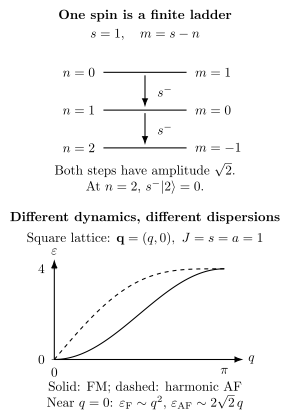
The local spin-one ladder contains exactly three states; the spin-lowering operator stops at . These lines label spin states, rather than an energy spectrum. Below, nearest-neighbor square-lattice models with and give and . The ferromagnetic one-magnon result is exact; the antiferromagnetic curve is linear spin-wave theory about Néel order at zero temperature.
Why the ordering matters
Section titled “Why the ordering matters”Because and do not commute, the square-root placement is part of the definition. For example,
Changing the order shifts the number inside the square root and gives the wrong ladder matrix elements. The exact representation should be checked by its action on , not by treating as an ordinary number too early.
Low-density expansion
Section titled “Low-density expansion”For
and negligible weight near the upper occupancy boundary, expand
At leading order,
Equivalently,
The longitudinal deviation is quadratic in bosons while transverse deviations are linear. This is why transverse spin correlations couple directly to one-magnon states, whereas longitudinal correlations begin with two-magnon or density-like processes in a collinear magnet.
What is exact and what is approximate
Section titled “What is exact and what is approximate”Three logically separate steps are often called “the Holstein–Primakoff approximation”:
- The map itself is exact on the constrained physical subspace.
- Expanding the square root is a low-density or large- approximation whose control requires small higher occupation moments as well as a small mean. A small mean alone can hide rare occupations near .
- Keeping only is linear spin-wave theory.
Diagonalizing exactly does not restore , , or the local occupancy constraint. A stable quadratic spectrum is necessary but not sufficient for quantitative accuracy.
Linear Spin-Wave Theory
Section titled “Linear Spin-Wave Theory”Harmonic truncation
Section titled “Harmonic truncation”After local rotations and the Holstein–Primakoff expansion, linear spin-wave theory retains
The generic translation-invariant quadratic Hamiltonian is
Here is a column when there are several spins in the magnetic unit cell; and . Normal terms conserve auxiliary boson number. Anomalous terms create or annihilate boson pairs and require a bosonic Bogoliubov transformation.
The calculation is trustworthy only after checking:
- all classical torque equations, so ;
- Hermiticity and the bosonic symmetry of the anomalous block;
- positive-norm, real-frequency modes of the bosonic dynamical matrix;
- correct treatment of exact zero modes;
- convergence of zero-point and thermal spin-deviation densities;
- small occupation relative to ;
- robustness under system size and momentum resolution.
Ferromagnetic Magnons
Section titled “Ferromagnetic Magnons”Exchange convention
Section titled “Exchange convention”To isolate the ferromagnetic structure without colliding with other sign conventions, define
where
and the relevant couplings favor parallel alignment. The factor compensates for summing each unordered pair twice. The Zeeman energy is positive when the field favors .
For a translation-invariant Bravais lattice, write
and define
The real symmetric scalar exchange used here implies , so is real.
Quadratic Hamiltonian
Section titled “Quadratic Hamiltonian”With all moments aligned along ,
To quadratic order,
Fourier transformation gives
with
There are no anomalous terms. Axial spin conservation makes a spin deviation a number-conserving excitation in this collinear reference.
Nearest-neighbor chain
Section titled “Nearest-neighbor chain”For a chain with spacing and ferromagnetic coupling to the two nearest neighbors,
Therefore
At and small ,
This agrees with the exact one-magnon result in the isotropic ferromagnetic chain. The Heisenberg Model gives that exact lattice derivation in its own exchange convention.
Long-wavelength stiffness
Section titled “Long-wavelength stiffness”If and the second moment exists,
Hence
where
For an isotropic medium,
At zero field, the quadratic dispersion is the characteristic type-B Goldstone behavior of an isotropic ferromagnet. The two transverse components are canonically conjugate and form one propagating magnon mode, rather than two independent linearly dispersing polarizations.
One-magnon states
Section titled “One-magnon states”The fully polarized state is the Holstein–Primakoff vacuum:
A momentum eigenstate is
It is a coherent spatial superposition of one local spin deviation. In an isotropic Heisenberg ferromagnet, the one-deviation sector is closed, so this one-magnon dispersion is exact even though interactions matter in sectors with two or more magnons.
At ,
This state lies in the same maximal-spin ground multiplet and is generated by the global spin-lowering operator. It is a collective change of orientation within that multiplet, rather than the first nonuniform propagating wave. The lowest dispersing mode has nonzero momentum and, for a box of size , typically scales as .
Bipartite Antiferromagnetic Magnons
Section titled “Bipartite Antiferromagnetic Magnons”Néel reference and local rotation
Section titled “Néel reference and local rotation”Consider the nearest-neighbor model
The classical Néel reference points along on and on . Rotate each -sublattice spin by about its local axis:
Both local reference moments now point along local . For one – bond,
Introduce on and on . To quadratic order,
The pair terms are the central difference from the ferromagnet. A local deviation on each sublattice changes the physical uniform spin in opposite directions, so creating one boson and one boson can preserve the conserved total .
Magnetic-zone Hamiltonian
Section titled “Magnetic-zone Hamiltonian”Let be the coordination number and
where runs from an site to its neighboring sites. First take a centrosymmetric neighbor set, so is real. Redefining every boson by changes the negative pair coefficient derived above to the following positive convention; physical spin operators must be transformed by the same sign. Then
For a complex structure factor, the annihilation and creation coefficients must be complex conjugates; a single complex cannot multiply both terms as written above. A momentum-dependent sublattice phase makes the coefficient real locally in momentum space, and the energy depends on . Probe matrix elements retain that phase information.
The classical energy for sites is
Bosonic Bogoliubov transformation
Section titled “Bosonic Bogoliubov transformation”For real , define
with
Bosonic commutators require
Choosing
removes the anomalous terms in this phase convention. The two degenerate transverse modes have energy
The same physical modes may appear as one branch at multiple soft wavevectors in a full Brillouin zone or as two polarizations in a magnetic Brillouin zone. Neither description doubles the physical degrees of freedom when counting is done consistently.
The coefficients obey
These coherence factors control the zero-point sublattice reduction and the intensity seen by different spin probes.
Linear long-wavelength dispersion
Section titled “Linear long-wavelength dispersion”For a -dimensional hypercubic lattice,
Near the reduced-zone origin,
Therefore
where the energy-velocity coefficient is
The angular-frequency velocity is
The linear behavior reflects two type-A Goldstone polarizations for
when the ordered state has zero uniform spin density. The symmetry argument and its assumptions are developed in Goldstone Modes in Many-Body Systems.
A squeezed spin-wave vacuum
Section titled “A squeezed spin-wave vacuum”The classical Néel product state is the vacuum of and , but it is not the vacuum of the diagonal modes. Because
the Bogoliubov vacuum satisfies
The zero-point reduction of the local ordered moment is
so linear spin-wave theory predicts
before interaction corrections. The ferromagnetic product vacuum has no analogous zero-point reduction in the isotropic collinear model: its polarized product state is already an exact eigenstate.
The divergence of at an exact Goldstone point is not by itself a pathology. It reflects a collective zero coordinate and requires finite-volume or symmetry-breaking-field care. Physical integrated quantities, not an isolated coherence factor, determine whether the expansion is infrared controlled.
Ferromagnet and Antiferromagnet Compared
Section titled “Ferromagnet and Antiferromagnet Compared”| Feature | FM | Bipartite AF |
|---|---|---|
| Classical reference | All moments parallel | Two sublattices antiparallel |
| Reference-state status in the isotropic model | Fully polarized product state is exact | Néel product state is generally not exact |
| Quadratic bosons | Number-conserving hopping | Normal and anomalous pair terms |
| Harmonic vacuum | Polarized product vacuum | Squeezed vacuum with zero-point pairs |
| Soft dispersion | ||
| Goldstone organization | One type-B mode | Two type-A polarizations |
| Uniform spin density | Nonzero | Zero in the ideal compensated case |
| Zero-point ordered-moment reduction | Absent in the ideal isotropic product state | Present already at harmonic order |
| Natural zone | Structural Brillouin zone | Magnetic or full zone, if declared |
The contrast is structural, not merely a different coefficient in the same formula. A ferromagnet’s transverse components form one canonical pair with first-order precession dynamics. An antiferromagnet’s staggered orientation has an inertial, second-order low-energy dynamics and two transverse polarizations.
These statements assume collinear, isotropic, stable order. Ferrimagnets, noncollinear magnets, anisotropic exchange, dipolar forces, and external fields can mix these patterns.
Magnon Quantum Numbers
Section titled “Magnon Quantum Numbers”Crystal momentum
Section titled “Crystal momentum”In a periodic magnet, a magnon carries crystal momentum , defined modulo a reciprocal-lattice vector:
If magnetic order enlarges the unit cell, the natural reciprocal lattice is reduced. The same excitation can then be labeled either by reduced momentum plus a branch index or by momentum in the structural Brillouin zone. Statements such as “the antiferromagnetic magnon is soft at ” are incomplete unless the zone convention is given.
Crystal momentum is the conserved translation label. It is not automatically the literal mechanical momentum of a localized spinning object.
Spin in a collinear ferromagnet
Section titled “Spin in a collinear ferromagnet”For an axially symmetric ferromagnet polarized along ,
Therefore
One magnon lowers physical angular momentum along the order axis by :
This statement is exact when the global Holstein–Primakoff representation applies and the Hamiltonian conserves .
Spin in a collinear antiferromagnet
Section titled “Spin in a collinear antiferromagnet”For the local axes used above and equal and sublattice sizes, the classical contributions cancel and
An -sublattice boson lowers uniform , while a -sublattice boson raises it. The anomalous pair
has zero net uniform , so it is compatible with axial symmetry.
The diagonal modes may be chosen as circularly polarized magnons carrying opposite when a conserved axial component and the required degeneracy are present. Real linear combinations are linearly polarized and need not be eigenstates of that spin projection. Anisotropy, field, noncollinearity, and spin–orbit coupling can split or mix the polarizations.
It is therefore unsafe to say that every magnon universally carries spin . The answer depends on the ordered state, symmetry, branch basis, and the component of angular momentum being measured.
Branch and polarization
Section titled “Branch and polarization”With spins in a magnetic unit cell, the quadratic bosonic problem has positive-frequency bands after correct paraunitary diagonalization. Degeneracy can make several polarizations share one dispersion curve. Conversely, unfolding into a larger Brillouin zone can make one reduced-zone band appear at several momenta.
A complete label is therefore
where may encode:
- sublattice content;
- circular or linear polarization;
- acoustic or optical character;
- parity under a magnetic-space-group operation;
- hybridization with another excitation.
Is Magnon Number Conserved?
Section titled “Is Magnon Number Conserved?”Ferromagnetic case
Section titled “Ferromagnetic case”For a collinear ferromagnet with exact axial symmetry,
is exactly conserved within the physical Holstein–Primakoff subspace. The full Hamiltonian may contain magnon–magnon interactions, but those interactions preserve .
If the Hamiltonian does not conserve the chosen spin component, terms such as
can appear and the simple number interpretation changes.
Antiferromagnetic case
Section titled “Antiferromagnetic case”In a bipartite antiferromagnet, the total local deviation count
is not the conserved uniform spin. Pair terms change it by two. The conserved axial quantity is instead proportional to
After Bogoliubov diagonalization, the occupation numbers
are conserved by the quadratic Hamiltonian. Higher-order interactions generally scatter those quasiparticles and can change individual branch occupations even when total energy, crystal momentum, and an exact spin component remain conserved.
“Magnon number” can thus mean three different things:
- local Holstein–Primakoff boson count;
- diagonal quadratic-quasiparticle count;
- an exact conserved spin deficit.
They coincide only in special cases.
One Magnon and a Classical Spin Wave
Section titled “One Magnon and a Classical Spin Wave”A number state has no transverse mean
Section titled “A number state has no transverse mean”In a ferromagnet,
Because this state has definite boson number (and definite total ),
Therefore, exactly by the spin-projection selection rule,
and similarly for . A one-magnon state does not look like a classical arrow field precessing at each site.
It nevertheless has nonzero transverse fluctuations and the exact one-deviation matrix element from the fully polarized state:
Coherent spin wave
Section titled “Coherent spin wave”Define the coherent state
It satisfies
The leading transverse expectation is
Under the harmonic Hamiltonian,
This oscillator coherent state is a harmonic approximation: its Poisson tails extend beyond the exact local spin constraint. It represents a small-angle spin wave when the mean local occupation and its relevant fluctuations are small compared with . For this oscillator state, the mean magnon number is
with Poissonian number fluctuations.
An exact spin coherent state remains in the finite spin Hilbert space. For one spin tilted by an angle from , the local spin deficit has a binomial distribution on , with :
Thus its number variance is smaller than its mean except at the zero-occupation endpoint. The Poisson statistics emerge in the large-, small-angle limit with fixed. This finite-spin comparison explains which constraint the harmonic oscillator approximation has relaxed.
In an antiferromagnet, a coherent state should be built from the diagonal or modes. Its physical sublattice motion then contains the Bogoliubov coherence factors and the relative phase required by the Néel dynamics.
How Magnons Appear in Response
Section titled “How Magnons Appear in Response”Spin structure factor
Section titled “Spin structure factor”Define a normalized Fourier component
One zero-temperature spectral convention is
where
Fourier signs, factors of , factors of , and the order of vary across communities. The Structure Factors page gives a normalization-first treatment.
Ferromagnetic one-magnon weight
Section titled “Ferromagnetic one-magnon weight”Use the creation-compatible component
At leading order,
Thus
The ideal harmonic response contains a delta-function one-magnon line at
Interactions, disorder, boundaries, and coupling to other degrees of freedom can shift the line, broaden it, transfer weight to continua, or split it into hybrid branches.
Antiferromagnetic coherence factors
Section titled “Antiferromagnetic coherence factors”In an antiferromagnet, physical transverse spin operators contain both sublattice bosons. After the Bogoliubov transformation, their one-magnon amplitudes involve combinations such as
Which sign appears depends on:
- the physical momentum relative to the ordering vector;
- the sublattice phase convention;
- the spin component and circular polarization;
- the magnetic basis positions;
- whether the zone is folded or unfolded.
The energy eigenvalue alone therefore does not determine scattering intensity. Two symmetry-related branches can have very different visibility in a given Brillouin zone.
Neutron-scattering projection
Section titled “Neutron-scattering projection”For unpolarized magnetic neutron scattering, the spin response is projected perpendicular to the momentum transfer :
Schematically,
Here is a wavevector transfer (physical momentum ), and is the magnetic form factor. Basis interference, polarization, detailed balance, instrumental resolution, and domain populations all matter. A missing peak need not mean a missing mode.
Longitudinal response
Section titled “Longitudinal response”For a collinear reference,
contains no term linear in bosons. Consequently, longitudinal inelastic response begins with two-magnon or density-like contributions in linear spin-wave language. A broad longitudinal continuum can therefore coexist with sharp transverse one-magnon quasiparticles. At zero temperature in the fully polarized isotropic ferromagnet, the connected longitudinal inelastic response actually vanishes: the density operator cannot create a magnon from its vacuum. Antiferromagnetic Bogoliubov mixing permits pair creation.
Zero-Point and Thermal Spin Reduction
Section titled “Zero-Point and Thermal Spin Reduction”Ferromagnetic thermal magnons
Section titled “Ferromagnetic thermal magnons”For the ideal collinear ferromagnet,
where
Take the thermodynamic limit at a small aligning field before removing that field; the isolated uniform rotation is not a thermal oscillator. In three dimensions, use
For one spin per primitive-cell volume , the low-temperature reduction is
This is the harmonic origin of the Bloch law. Interactions, anisotropy gaps, multiple branches, and the finite Brillouin zone give corrections.
For an exactly gapless quadratic branch, the thermal occupation integral behaves at small as
It diverges for , consistent with the absence of finite-temperature continuous-symmetry long-range order in short-range isotropic one- and two-dimensional magnets.
Antiferromagnetic zero-point reduction
Section titled “Antiferromagnetic zero-point reduction”For a linear antiferromagnetic mode,
near the Goldstone point. The zero-point reduction behaves as
It is infrared finite for and divergent for . The divergence in one dimension warns that expansion around rigid Néel order is not self-consistent.
At nonzero temperature,
Because
and
the thermal contribution behaves as
It diverges for , again matching the Mermin–Wagner constraint under its assumptions.
What an infrared divergence means
Section titled “What an infrared divergence means”An infrared divergence is a diagnostic, not a license to discard the theorem or the approximation selectively. It may indicate:
- no true long-range order in the thermodynamic limit;
- algebraic or very long but finite correlations;
- a need to retain finite size, anisotropy, field, or interlayer coupling;
- a crossover scale below which the nominal reference fails;
- a different low-energy description.
A small ordered moment can coexist with a well-defined spin-wave regime over intermediate energies. Conversely, a finite harmonic correction does not prove that all interaction corrections are small.
Magnon Interactions
Section titled “Magnon Interactions”Origin in the spin constraint
Section titled “Origin in the spin constraint”The square-root expansion generates cubic, quartic, and higher vertices. Schematically,
These terms encode:
- magnon–magnon scattering;
- energy and velocity renormalization;
- ordered-moment corrections;
- bound states;
- decay and source processes when allowed;
- temperature-dependent shifts and linewidths.
The bosons are not freely occupiable microscopic particles. Their interactions remember both exchange and the finite local spin length.
Which vertices appear
Section titled “Which vertices appear”In a collinear isotropic ferromagnet with axial spin conservation, odd-number terms are absent and magnon number is conserved. Quartic terms generate two-magnon scattering.
In a simple collinear bipartite antiferromagnet, symmetries commonly eliminate cubic vertices in the natural expansion, leaving quartic interactions as the leading correction. After Bogoliubov transformation, those quartic terms contain several quasiparticle scattering and number-changing channels compatible with exact symmetries.
Noncollinear order can permit cubic vertices already at leading interaction order. Then a one-magnon state may couple directly to a two-magnon continuum and decay spontaneously even at zero temperature.
These are common patterns, not substitutes for deriving the vertices of the actual Hamiltonian.
Kinematic and symmetry tests for decay
Section titled “Kinematic and symmetry tests for decay”A proposed process
requires crystal-momentum conservation:
and on-shell energy conservation:
It also requires a nonzero interaction matrix element after all spin, lattice, polarization, and magnetic-space-group selection rules. Phase space without a vertex gives no decay; a vertex without on-shell phase space gives virtual renormalization rather than an on-shell lifetime.
Self-energy language
Section titled “Self-energy language”For a weakly interacting magnon branch, a retarded propagator may be written
The real part of shifts the energy. The imaginary part produces damping when evaluated near the renormalized pole. If
an isolated quasiparticle peak is meaningful. When the width is comparable to the energy or overlaps strongly with continua, “the magnon dispersion” alone no longer captures the response.
Here must be an energy width. For an isolated weakly damped pole, its FWHM is evaluated on shell. It gives amplitude decay ; the population lifetime is only when additional pure dephasing is absent. See Lifetime and Spectral Weight.
Fields, Anisotropy, and Hybridization
Section titled “Fields, Anisotropy, and Hybridization”Zeeman field
Section titled “Zeeman field”For the ferromagnetic convention above, a field along the ordered axis gives
The field explicitly breaks the degeneracy among orientations and gaps the uniform precession relative to the laboratory frame. Calling every gapped spin wave a Goldstone mode would therefore be incorrect.
Easy-axis anisotropy
Section titled “Easy-axis anisotropy”A single-ion term
has an especially useful finite-spin check. Since ,
The exact one-deviation energy shift is therefore . Keeping only the leading large- coefficient gives the familiar , but this is an additional approximation, not the complete normally ordered quadratic term. For , is a constant and this single-ion term cannot open any gap. This limiting case is a useful test of a proposed anisotropy Hamiltonian.
An easy-plane anisotropy leaves a continuous in-plane symmetry and can retain one gapless phase mode while gapping the orthogonal fluctuation. The answer follows from the symmetry actually left by the Hamiltonian and state.
Other interactions
Section titled “Other interactions”Additional terms can qualitatively reshape the modes:
- Dzyaloshinskii–Moriya exchange can shift minima, select chirality, and make propagation nonreciprocal;
- dipolar interactions can produce direction-dependent gaps and mix spin precession with electromagnetic fields;
- ferrimagnets can host acoustic and optical magnon branches;
- noncollinear order can generate cubic interactions and complex polarization textures;
- magnon–phonon coupling produces avoided crossings and hybrid magnetoelastic modes;
- itinerant magnets can mix collective spin waves with particle–hole continua.
At an avoided crossing, labeling one branch “the magnon” by continuity is useful only if its spectral weight and polarization content are also reported.
Finite Volume and Broken Symmetry
Section titled “Finite Volume and Broken Symmetry”An exact finite-system eigenstate of a symmetry-invariant Hamiltonian need not choose a magnetization direction. A spin-wave calculation instead selects one ordered reference and quantizes fluctuations around it. The connection to the exact finite system involves:
- a small symmetry-breaking field or boundary condition;
- a thermodynamic limit;
- a low-lying tower of collective rotations;
- separation of global zero modes from nonuniform spin waves.
The order of limits matters. A standard construction is
not necessarily the reverse.
Treating the exact Goldstone coordinate as an ordinary positive-frequency oscillator can generate divergent Bogoliubov coefficients or spurious normalization. The global orientation belongs to collective-coordinate physics; nonzero-momentum modes describe local waves around that orientation.
When the Magnon Picture Works
Section titled “When the Magnon Picture Works”Linear spin-wave theory is strongest when:
- the Hamiltonian has a stable ordered phase;
- the chosen reference solves the classical torque equations;
- the local spin-deviation density is small compared with ;
- zero-point and thermal corrections converge;
- the quadratic bosonic spectrum has real, nonnegative frequencies;
- interactions shift energies modestly and produce narrow peaks;
- the probe couples to an isolated one-magnon pole;
- finite-size and infrared scales are under control.
A useful local diagnostic is
The condition is necessary for the square-root expansion, but it is not the only criterion. A mode can be weakly occupied yet strongly hybridized or strongly damped.
Large often improves the expansion because
while interaction corrections are organized in powers of . Still, accidental degeneracies, frustration, soft manifolds, and noncollinearity can make nominally subleading effects important.
Breakdown and Alternative Excitations
Section titled “Breakdown and Alternative Excitations”One-dimensional spin- antiferromagnet
Section titled “One-dimensional spin-1/21/21/2 antiferromagnet”The uniform spin- Heisenberg antiferromagnetic chain has no Néel long-range order in its ground state. Its elementary fractional excitations are spinons, and the dynamical structure factor contains a continuum rather than a single exact magnon branch.
Linear spin-wave theory predicts a gapless linear scale, but it gives neither the exact velocity nor the correct quasiparticle content. Agreement on gaplessness alone does not identify the correct elementary excitations.
Quantum-disordered magnets
Section titled “Quantum-disordered magnets”In a dimerized paramagnet, the natural elementary excitation can be a gapped triplet or triplon above a singlet reference. In a spin liquid, fractional spinons and emergent gauge fields may be more appropriate. In a field-polarized phase, magnons may again become controlled even if the zero-field phase is not ordered.
Choose the excitation description from the reference state and the measured or calculated spectrum, including its matrix elements.
Strong damping and continua
Section titled “Strong damping and continua”Even in an ordered magnet, a sharp one-magnon pole can lose weight through:
- decay into multi-magnon states;
- coupling to particle–hole excitations;
- disorder and domain scattering;
- thermal collisions;
- proximity to a critical point;
- overlap with phonons or other collective modes.
The correct observable may then be a broad spectral function with a resonance and continuum, not a dispersion relation assigned to an infinitely lived particle.
Magnon bound states
Section titled “Magnon bound states”Attractive interactions can bind two or more spin deviations. A bound state appears below the relevant multi-magnon continuum and has its own symmetry and probe selection rules. It should not be confused with a harmonic branch obtained by enlarging the magnetic unit cell.
Continuum Field-Theory Bridge
Section titled “Continuum Field-Theory Bridge”Ferromagnetic precession
Section titled “Ferromagnetic precession”Let and be small transverse components of a unit magnetization direction. The long-wavelength ferromagnetic Lagrangian has the schematic form
Here is the ordered dimensionless spin per volume along . This sign of the first-order term gives , consistent with . In particular, evolves as . The transverse components are one canonical pair. The resulting dispersion is
Antiferromagnetic inertia
Section titled “Antiferromagnetic inertia”For the transverse components of a Néel vector, the leading Lagrangian is
Each transverse component has
Here is the transverse dimensionless spin-density response to a Zeeman energy , so its units are inverse energy per volume. The lattice spin-wave calculation supplies microscopic estimates of , , velocities, and ultraviolet structure. The continuum theory organizes symmetry, long wavelengths, topology, and renormalization. Matching them requires a declared normalization and cutoff.
Exercises
Section titled “Exercises”Exercise 1: Verify the constrained ladder
Section titled “Exercise 1: Verify the constrained ladder”Starting from
derive the action of on . Show that the physical subspace has dimension and that lowering stops at .
Solution
Because operators act from right to left,
For the lowering operator,
The allowed occupations
give states. At ,
so the spin ladder terminates. The state belongs to the auxiliary oscillator but not to the physical spin Hilbert space.
Exercise 2: Ferromagnetic chain dispersion
Section titled “Exercise 2: Ferromagnetic chain dispersion”Use
and the leading Holstein–Primakoff expansion to derive the quadratic magnon dispersion on a periodic chain.
Solution
For one bond,
Therefore
Fourier transformation gives
Hence
near .
Exercise 3: Number state versus coherent wave
Section titled “Exercise 3: Number state versus coherent wave”For one harmonic magnon mode, compare
with a coherent state . Evaluate , , and the number variance in both states. Which state has a classical transverse spin expectation?
Solution
For the number state,
For a coherent state,
so
Since the leading transverse spin is linear in and , the coherent state has a classical precessing transverse expectation. The one-magnon number state has zero transverse mean but nonzero transition matrix elements and fluctuations.
Exercise 4: Two-sublattice Bogoliubov mode
Section titled “Exercise 4: Two-sublattice Bogoliubov mode”Consider
where and is real with . Use a two-mode squeeze transformation to find the excitation energy and the original-boson occupation in the quasiparticle vacuum.
Solution
Take
with
The commutator is preserved because
The anomalous coefficient vanishes when
The positive excitation energy is
In the vacuum,
This nonzero occupation is the harmonic zero-point reduction of the classical sublattice moment.
Exercise 5: Infrared convergence
Section titled “Exercise 5: Infrared convergence”Assume an antiferromagnetic Goldstone mode has
Determine the spatial dimensions in which the zero-temperature and nonzero-temperature spin reductions are infrared finite.
Solution
At zero temperature,
This converges at when
At nonzero temperature,
Because , the thermal term behaves as
It converges only for
Thus harmonic infrared counting is compatible with zero-temperature order in two and three dimensions, but cannot establish that it occurs. Its finite-temperature divergence in one and two dimensions agrees with the Mermin–Wagner theorem for short-range isotropic magnets.
Exercise 6: Which spin component does a pair conserve?
Section titled “Exercise 6: Which spin component does a pair conserve?”For a Néel state with spins along and spins along , show that
where and are local Holstein–Primakoff boson numbers. Explain why an anomalous pair is compatible with conservation of .
Solution
On sublattice ,
On sublattice , the physical axis is opposite to the local axis:
For equal sublattice sizes, the classical contributions cancel. Therefore
Here
Creating increases both and by one, leaving unchanged. The pair term does not conserve total local deviation number, but it does conserve the physical uniform spin component.
Exercise 7: One-magnon spectral weight
Section titled “Exercise 7: One-magnon spectral weight”Use
and the leading ferromagnetic Holstein–Primakoff map to find its matrix element between the polarized ground state and a normalized one-magnon state.
Solution
At leading order,
Therefore
For
the matrix element is
The squared matrix element is . For the spectral convention above, the integrated one-magnon weight is ; omitting the in that integral would give .
Exercise 8: When can a magnon decay?
Section titled “Exercise 8: When can a magnon decay?”A calculation reports that a magnon at decays into two magnons. List the minimum checks needed before interpreting the result as a physical lifetime.
Solution
At minimum, verify:
- Reference stability: the ordered state is stationary and the external modes have real, positive-norm frequencies.
- Interaction order: the retained Hamiltonian actually contains a one-to-two vertex; a purely quartic theory does not generate that process at first order.
- Crystal momentum: in one declared zone convention.
- Energy: the renormalized on-shell energies satisfy .
- Symmetry: spin, polarization, lattice, and magnetic-space-group selection rules permit a nonzero matrix element.
- Phase space: the energy-delta-function-weighted phase-space integral is nonzero after dimensionality, curvature, thresholds, and the matrix element are included. The on-shell surface itself generally has zero measure in the unconstrained momentum space.
- Thermal factors: spontaneous, stimulated, absorption, and inverse processes are treated at the stated temperature.
- Normalization: paraunitary mode norms, branch counting, zone volume, and reciprocal-lattice factors are consistent.
- Other channels: phonons, particle–hole excitations, disorder, and boundaries are not silently assigned to the magnon–magnon rate.
- Lifetime convention: half width, full width, amplitude decay, and population decay are distinguished.
- Quasiparticle test: the resulting linewidth is small enough for an isolated pole to remain meaningful.
Energy and momentum conservation alone do not establish a decay rate.
References
Section titled “References”- P. W. Anderson, “An approximate quantum theory of the antiferromagnetic ground state,” Physical Review 86, 694–701 (1952), doi:10.1103/PhysRev.86.694. Foundational antiferromagnetic spin-wave analysis and zero-point reduction.
- A. Auerbach, Interacting Electrons and Quantum Magnetism (Springer, 1994), doi:10.1007/978-1-4612-0869-3. Standard graduate treatment of spin coherent states, boson representations, antiferromagnets, and continuum theories.
- S. O. Bayrakci, T. Keller, K. Habicht, and B. Keimer, “Spin-wave lifetimes throughout the Brillouin zone,” Science 312, 1926–1929 (2006), doi:10.1126/science.1127756. Momentum-resolved measurement of magnon linewidths and lifetimes.
- S. P. Bayrakci, D. A. Tennant, Ph. Leininger, T. Keller, M. C. R. Gibson, S. D. Wilson, R. J. Birgeneau, and B. Keimer, “Lifetimes of antiferromagnetic magnons in two and three dimensions: experiment, theory, and numerics,” Physical Review Letters 111, 017204 (2013), doi:10.1103/PhysRevLett.111.017204. Quantitative dimensional comparison of magnon damping.
- F. Bloch, “Zur Theorie des Ferromagnetismus,” Zeitschrift für Physik 61, 206–219 (1930), doi:10.1007/BF01339661. Early quantum spin-wave treatment of the low-temperature ferromagnet.
- F. J. Dyson, “General theory of spin-wave interactions,” Physical Review 102, 1217–1230 (1956), doi:10.1103/PhysRev.102.1217. Controlled organization of interacting ferromagnetic spin waves.
- F. J. Dyson, “Thermodynamic behavior of an ideal ferromagnet,” Physical Review 102, 1230–1244 (1956), doi:10.1103/PhysRev.102.1230. Low-temperature thermodynamics and interaction corrections.
- P. A. Fleury and R. Loudon, “Scattering of light by one- and two-magnon excitations,” Physical Review 166, 514–530 (1968), doi:10.1103/PhysRev.166.514. Canonical derivation of magnetic light-scattering operators and multi-magnon response.
- C. Herring and C. Kittel, “On the theory of spin waves in ferromagnetic media,” Physical Review 81, 869–880 (1951), doi:10.1103/PhysRev.81.869. Continuum and exchange contributions to ferromagnetic spin waves.
- P. C. Hohenberg and W. F. Brinkman, “Sum rules for the frequency spectrum of linear magnetic chains,” Physical Review B 10, 128–131 (1974), doi:10.1103/PhysRevB.10.128. Exact spectral-moment constraints for magnetic response.
- T. Holstein and H. Primakoff, “Field dependence of the intrinsic domain magnetization of a ferromagnet,” Physical Review 58, 1098–1113 (1940), doi:10.1103/PhysRev.58.1098. Original constrained-boson representation and spin-wave expansion.
- R. Kubo, “The spin-wave theory of antiferromagnetics,” Physical Review 87, 568–580 (1952), doi:10.1103/PhysRev.87.568. Systematic quantum theory of antiferromagnetic spin waves.
- E. Manousakis, “The spin- Heisenberg antiferromagnet on a square lattice and its application to the cuprous oxides,” Reviews of Modern Physics 63, 1–62 (1991), doi:10.1103/RevModPhys.63.1. Detailed comparison of spin-wave, numerical, and experimental results in two dimensions.
- D. C. Mattis, The Theory of Magnetism Made Simple (World Scientific, 2006), doi:10.1142/5372. Broad reference on lattice magnetism and spin-wave methods.
- N. D. Mermin and H. Wagner, “Absence of ferromagnetism or antiferromagnetism in one- or two-dimensional isotropic Heisenberg models,” Physical Review Letters 17, 1133–1136 (1966), doi:10.1103/PhysRevLett.17.1133. The finite-temperature continuous-symmetry constraint underlying the infrared divergence tests.
- H. J. Mikeska and A. K. Kolezhuk, “One-dimensional magnetism,” in Quantum Magnetism, edited by U. Schollwöck, J. Richter, D. J. J. Farnell, and R. F. Bishop, Lecture Notes in Physics 645 (Springer, 2004), pp. 1–83, doi:10.1007/BFb0119591. Ordered spin-wave limits, one-dimensional breakdown, and alternative excitations.
- G. L. Squires, Introduction to the Theory of Thermal Neutron Scattering, 3rd ed. (Cambridge University Press, 2012), doi:10.1017/CBO9781139107808. Standard probe conventions for magnetic structure factors, polarization factors, and detailed balance.
- D. A. Tennant, R. A. Cowley, S. E. Nagler, and A. M. Tsvelik, “Measurement of the spin-excitation continuum in one-dimensional KCuF using neutron scattering,” Physical Review B 52, 13368–13380 (1995), doi:10.1103/PhysRevB.52.13368. Experimental evidence for a spinon continuum beyond a simple one-magnon description.
- M. E. Zhitomirsky and A. L. Chernyshev, “Colloquium: Spontaneous magnon decays,” Reviews of Modern Physics 85, 219–242 (2013), doi:10.1103/RevModPhys.85.219. Symmetry, kinematics, singularities, and experimental signatures of magnon decay.