

Phases of Matter in Many-Body QM
A phase of matter is a robust pattern of macroscopic organization shared by many microscopic states and Hamiltonians.
The word robust is essential. Small admissible changes to couplings, lattice details, or local basis choices should not erase the qualitative structure used to identify the phase. The word admissible is equally essential: the spatial dimension, locality class, symmetries, conservation laws, equilibrium setting, and spectral assumptions must be stated.
There is no single scalar test that classifies every many-body phase. A useful phase fingerprint can involve:
- thermodynamic potentials and their analyticity;
- symmetry and order parameters;
- long-distance correlation functions;
- spectral gaps and low-energy excitations;
- stiffnesses, susceptibilities, and quantized responses;
- topology, boundary structure, and defects;
- many-body entanglement.
Different phases require different subsets of this information. A ferromagnet is naturally described by broken symmetry and magnetic order. A Chern insulator can have no local symmetry-breaking order parameter but a quantized topological response. A Luttinger liquid is a stable gapless phase characterized by its low-energy theory and algebraic correlations rather than by a nonzero local order parameter.
Helpful background. Thermodynamic Limit explains why the size and source limits matter; Correlation Functions supplies the language for comparing long-distance behavior.
This page compares equilibrium thermal and ground-state phases. Quantum Phase Transitions and Finite-Temperature Phase Transitions develop the boundaries between them.
Phase Is a Coarse-Grained Concept
Section titled “Phase Is a Coarse-Grained Concept”A microscopic state is specified by a vector, density operator, or positive functional. A phase is an equivalence class or stable region containing many such states.
For a family of local Hamiltonians
the parameters can include couplings, fields, pressure proxies, density, chemical potential, or interaction-to-hopping ratios. A phase occupies a region in this parameter space where a declared collection of bulk properties changes smoothly and remains qualitatively stable.
The phase concept deliberately forgets microscopic detail. Two samples can differ in lattice constants, short-range interactions, disorder realization, or quasiparticle velocities and still realize the same phase. Conversely, two Hamiltonians with identical microscopic symmetries can realize distinct phases if their long-distance structure cannot be connected under the allowed deformations.
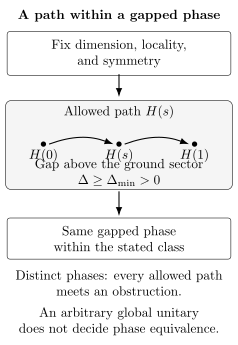
The gapped-path definition keeps locality, symmetry, and a fixed ground-sector structure throughout the interpolation. The gap is above the whole ground sector, including any asymptotically degenerate states within it.
State, Pure Phase, and Phase of Matter
Section titled “State, Pure Phase, and Phase of Matter”The word phase is used at several levels.
Microscopic state
Section titled “Microscopic state”A finite-system density operator is one state. It can be changed continuously without defining a new phase every time an expectation value changes.
Infinite-volume equilibrium phase
Section titled “Infinite-volume equilibrium phase”In algebraic statistical mechanics, a pure thermodynamic phase is often represented by an extremal infinite-volume equilibrium state. A ferromagnet below its ordering temperature can have two symmetry-related extremal states with opposite magnetization. A convex mixture of them is also an equilibrium state but is not extremal.
Broad phase-of-matter label
Section titled “Broad phase-of-matter label”In condensed-matter language, the symmetry-related positive- and negative-magnetization states are often called two broken-symmetry states within the same ferromagnetic phase of matter. Other authors call them distinct pure phases. Both usages occur.
The ambiguity is manageable if the object is named:
- state: one density operator or infinite-volume functional;
- pure thermodynamic phase: one extremal equilibrium state;
- phase of matter: a robust organizational class, often containing symmetry-related states.
Thermal Phases
Section titled “Thermal Phases”For a finite region with Hamiltonian , define
The finite-volume free-energy density is
For a finite-dimensional Hamiltonian analytic in its parameters and , is positive and analytic in regular real coupling parameters. For unbounded local Hilbert spaces, trace-class and analytic-dependence assumptions are also needed; finite volume alone is insufficient. Under these regularity assumptions, a sharp equilibrium transition requires a bulk limit:
A conventional thermal phase is a connected region where the bulk thermodynamic functions and relevant local equilibrium properties are analytic, while phase boundaries are associated with nonanalytic behavior in the limit.
What analyticity captures
Section titled “What analyticity captures”This language naturally captures:
- first-order coexistence surfaces;
- continuous ordering transitions;
- critical endpoints;
- singular response coefficients;
- latent heat and discontinuous densities;
- diverging correlation lengths.
What analyticity does not classify by itself
Section titled “What analyticity does not classify by itself”Knowing that is analytic inside a region does not tell the reader:
- which symmetry is broken;
- which quasiparticles exist;
- whether a response is quantized;
- whether boundary modes are protected;
- whether two zero-temperature gapped states are topologically distinct;
- how a stable gapless phase is organized.
Thermodynamics identifies sharp boundaries. The phase fingerprint supplies the physical content on either side.
Zero-Temperature Gapped Phases
Section titled “Zero-Temperature Gapped Phases”At zero temperature, a powerful definition applies to local gapped Hamiltonians.
Consider a continuous path
with local or sufficiently rapidly decaying interactions. Suppose the relevant ground-state sector is separated from all higher excitations by a size-independent bulk gap:
for sufficiently large and all .
If the path also preserves the declared symmetries, dimensionality, locality class, and other defining constraints, then and are said to lie in the same gapped phase.
Ground-state manifolds
Section titled “Ground-state manifolds”The phrase the gap remains open must specify the sector. A symmetry-breaking phase or intrinsically topological phase can have a ground-state manifold whose internal splitting vanishes with system size. The relevant gap is then the gap above that entire low-energy manifold, not necessarily
for one finite sample.
Let project onto a low-energy sector of constant rank along the path, for the chosen finite-size geometry. Its internal energy spread must vanish in the ground-state limit; one cannot enlarge the sector arbitrarily to hide a transition. A uniform spectral separation means that states outside the range of remain at least higher in energy in the bulk limit.
Quasi-adiabatic continuation
Section titled “Quasi-adiabatic continuation”Under locality and gap assumptions, quasi-adiabatic continuation constructs a quasi-local unitary that transports the ground-state sector:
The generator is built so that distant degrees of freedom are affected only through rapidly decaying tails. This makes the phase relation local in physical space rather than an arbitrary unitary equivalence of Hilbert spaces.
Every two normalized pure states in the same finite-dimensional Hilbert space are related by some global unitary. That statement is too weak to define a phase. The unitary must be local or quasi-local in a controlled sense.
Local-unitary viewpoint
Section titled “Local-unitary viewpoint”For broad classes of gapped lattice states, the same-phase relation can also be expressed through finite-depth local circuits, possibly up to controlled approximation, stable ancillas, and symmetry constraints. Short-range entanglement can be rearranged locally; long-range entanglement cannot be removed by a finite-depth local circuit.
The exact equivalence among gapped paths, quasi-local evolutions, and circuit definitions depends on the setting. Gauge constraints, fermionic parity, crystalline structure, long-range interactions, and fracton geometry require additional care.
What Must Be Held Fixed?
Section titled “What Must Be Held Fixed?”A phase statement is incomplete until its admissible deformations are defined.
Spatial dimension
Section titled “Spatial dimension”A one-dimensional chain and a two-dimensional layer are not normally compared as points in one phase space. Topological classifications and fluctuation effects depend strongly on dimension.
Locality class
Section titled “Locality class”For
the interaction norm and spatial decay matter. Stability theorems for short-range local Hamiltonians do not automatically apply to arbitrary all-to-all couplings.
Symmetry
Section titled “Symmetry”Two states can be connected if symmetry breaking is allowed but remain distinct when a symmetry must be preserved. A symmetry-protected topological phase is defined only relative to its protecting symmetry and its action on the Hilbert space.
Conserved quantities and superselection
Section titled “Conserved quantities and superselection”Particle-number conservation, fermion parity, gauge constraints, and charge sectors change the allowed paths. A superconducting mean-field Hamiltonian and an exactly number-conserving Hamiltonian require an explicit dictionary before their phases are compared.
Microscopic degrees of freedom
Section titled “Microscopic degrees of freedom”Adding a completely decoupled trivial ancilla should not usually create a new phase. This motivates stable equivalence. Adding a nontrivial topological layer, changing on-site symmetry representation, or changing filling can alter the classification.
Equilibrium or dynamical setting
Section titled “Equilibrium or dynamical setting”An equilibrium phase, a metastable regime, a prethermal plateau, and a periodically driven phase are not interchangeable. This page concerns equilibrium thermal phases and ground-state phases unless stated otherwise.
Robustness Is Conditional
Section titled “Robustness Is Conditional”Let
If is an allowed local perturbation and a defining bulk gap remains open for
then the perturbed Hamiltonian stays in the same gapped phase.
This statement does not mean:
- every observable is unchanged;
- the gap has the same numerical value;
- quasiparticle masses and velocities are fixed;
- boundary spectra are independent of termination;
- disorder of arbitrary strength is harmless;
- a protecting symmetry may be broken freely.
Within one phase, nonuniversal quantities can vary substantially. Robustness means that the qualitative phase fingerprint and the stated obstruction do not disappear under allowed small changes.
Energy-scale criterion
Section titled “Energy-scale criterion”For a gapped phase, a rough operational hierarchy is
where denotes a suitable local interaction scale rather than the extensive operator norm of the full perturbation. An extensive perturbation can have norm proportional to volume while still being weak per site.
The inequality is intuition, not a universal theorem. Rigorous stability depends on locality, interaction norms, ground-space structure, and additional hypotheses.
Gapless Phases
Section titled “Gapless Phases”A gap-preserving definition cannot classify a phase whose bulk spectrum is gapless throughout a finite parameter region.
Examples include:
- a Fermi liquid with a stable Fermi surface;
- a one-dimensional Luttinger liquid;
- a superfluid with a Goldstone mode;
- a Coulomb phase with an emergent gauge mode;
- a critical phase with algebraic correlations.
For a gapless phase, stability is instead encoded by low-energy structure. Relevant descriptors can include:
- symmetry and conserved charges;
- the dimension and topology of a gapless manifold;
- central charge or other universal data;
- emergent gauge constraints;
- quasiparticle statistics;
- anomaly or Lieb–Schultz–Mattis-type obstructions;
- scaling exponents and operator content;
- the set of perturbations that are relevant, marginal, or irrelevant.
Same phase with varying exponents
Section titled “Same phase with varying exponents”In a Luttinger liquid, a continuous parameter can change correlation exponents while the system remains in the same broad gapless phase:
The velocity and exponents vary, but the low-energy structure remains a compact bosonic mode with central charge over the stable region.
Boundaries inside gapless matter
Section titled “Boundaries inside gapless matter”A change in Fermi-surface topology, number of gapless modes, central charge, or allowed low-energy operator content can mark a phase transition even when both sides are gapless. The absence of a gap does not imply the absence of distinct phases.
There is no universal gapless classification comparable in simplicity to the gapped-path definition. The admissible low-energy theory must be stated.
The Phase Fingerprint
Section titled “The Phase Fingerprint”No single diagnostic should be promoted beyond its domain.
Thermodynamic structure
Section titled “Thermodynamic structure”Useful quantities include:
and derivatives with respect to fields, pressure, or chemical potential.
Discontinuities or divergences can locate a boundary. Smooth values inside a phase characterize it but rarely classify it alone.
Symmetry and order
Section titled “Symmetry and order”Let be a symmetry group of the Hamiltonian. A symmetry-breaking phase preserves only a subgroup
An order parameter transforms nontrivially under and may satisfy
The source selects one broken-symmetry state. Reversing the limits can return the symmetric finite-volume result.
Order parameters are powerful but not universal. Two phases can preserve the same symmetry and still differ topologically, in their excitation content, or in their pattern of entanglement.
Correlations
Section titled “Correlations”For a local observable , define the connected equal-time correlation
Common long-distance patterns include:
for an ordinary short-range-correlated gapped phase,
for a scale-invariant or stable algebraic phase, and
for long-range order in the relevant channel.
These forms require qualifications for long-range interactions, disorder, finite temperature, conserved hydrodynamic modes, and operators with vanishing overlap on the slow sector.
Excitation spectrum
Section titled “Excitation spectrum”The spectral gap is
where the excitation sector must be declared.
Phase identity can also involve:
- Goldstone modes;
- magnons, phonons, or quasiparticles;
- particle and hole gaps;
- Fermi surfaces or nodal points;
- anyonic excitations and braiding;
- confined versus deconfined charges;
- protected boundary or defect modes.
Two phases can have the same ground-state symmetry but different elementary excitations.
Response
Section titled “Response”Response coefficients connect phase structure to probes. Examples include the compressibility
the helicity modulus (phase stiffness)
where is the total dimensionless phase twist across length and is the volume. Equivalently, . Differentiating with respect to the phase gradient instead would remove the factor. Converting to a superfluid mass or number density requires the appropriate mass and factors. Another response is a Hall conductance
for an appropriate integer quantum Hall or Chern-insulator setting.
A response can vanish, remain finite, diverge, or become quantized. The relevant boundary conditions, order of limits, and units must be stated.
Topology
Section titled “Topology”A topological invariant can distinguish phases that share local symmetry and bulk energy-gap properties. A change in an integer invariant cannot occur continuously while all assumptions defining it remain valid.
The safe inference is:
along every interpolation.
The converse is not automatic. Equal values of one invariant do not prove that two interacting many-body states are in the same phase.
Entanglement
Section titled “Entanglement”Entanglement can reveal organization invisible to local expectation values.
For a spatial region ,
Broad one-dimensional gapped phases obey an area law, while critical one-dimensional phases often show logarithmic growth. Intrinsic topological order can contribute a universal subleading term in suitable geometries.
But:
- an area law alone does not classify a phase;
- two distinct gapped phases can have the same leading entropy scaling;
- finite-size entanglement spectra depend on the cut and symmetry sector;
- mixed-state and finite-temperature entanglement require different diagnostics.
Symmetry Is Central but Not Complete
Section titled “Symmetry Is Central but Not Complete”Landau’s organizing principle classifies many phases by symmetry breaking.
Suppose
for , while an ordered state is invariant only under . Then the pattern
organizes order-parameter components, degeneracy, defects, and low-energy modes.
This framework explains magnets, crystals, superfluids, density waves, and many superconducting states. It does not exhaust quantum phases.
Same symmetry, distinct phase
Section titled “Same symmetry, distinct phase”Two charge-conserving two-dimensional insulators can preserve the same microscopic symmetries while having different Chern number. They cannot be connected while preserving the bulk gap and the assumptions behind that invariant.
Different symmetry does not specify everything
Section titled “Different symmetry does not specify everything”Knowing that spin rotation is broken does not by itself identify:
- whether the order is ferromagnetic or antiferromagnetic;
- the ordering wavevector;
- whether excitations are confined;
- whether another topological sector coexists;
- the transport and boundary response.
The full phase fingerprint remains necessary.
Topology and Long-Range Entanglement
Section titled “Topology and Long-Range Entanglement”Intrinsic topological order describes gapped many-body phases not reducible to local symmetry breaking. Depending on dimension and setting, signatures can include:
- topology-dependent ground-state degeneracy;
- anyonic quasiparticles;
- nontrivial braiding and fusion;
- long-range entanglement;
- topological entanglement entropy;
- robust boundary or defect structure.
Symmetry-protected topological phases are different. Their nontriviality requires specified symmetry protection. By definition, the usual SPT phases become trivial once their protecting symmetry may be broken. Invertible chiral phases, whose obstruction persists without that symmetry, should not be included in this statement.
This page uses these distinctions only to show why local order parameters are not universal classifiers. Topological Order Preview develops the diagnostic package; detailed classifications and realizations belong to Quantum Matter.
Low-Energy Excitations Are Part of the Phase
Section titled “Low-Energy Excitations Are Part of the Phase”A phase is not merely its ground-state expectation values.
Ordered magnets
Section titled “Ordered magnets”A ferromagnet and antiferromagnet can both break spin-rotation symmetry but have different ordering wavevectors and low-energy spin dynamics. Continuous symmetry breaking produces gapless collective modes under the appropriate assumptions.
Superfluids
Section titled “Superfluids”A neutral superfluid has phase stiffness and a gapless sound mode. A charged superconductor couples the phase mode to electromagnetism. In a three-dimensional bulk this produces a plasma gap; a two-dimensional charged film with a three-dimensional Coulomb field can instead have a gapless, non-acoustic plasmon. Geometry matters.
Insulators
Section titled “Insulators”Two insulators can both have vanishing zero-temperature compressibility and a bulk charge gap while differing in spin excitations, topology, polarization, or boundary states.
Fractionalized phases
Section titled “Fractionalized phases”The low-energy excitations can carry quantum numbers or statistics unavailable to microscopic particles. Fractionalization is then part of the emergent phase structure, not merely a small correction to a product state.
Example: Ising Ferromagnet and Paramagnet
Section titled “Example: Ising Ferromagnet and Paramagnet”At zero temperature, consider the one-dimensional ferromagnetic transverse-field Ising family with and
It has a global spin-flip symmetry generated in a finite chain by
The infinite clean chain is ordered for and paramagnetic for ; is critical. The two broad regimes are:
| Diagnostic | Ferromagnetic regime | Paramagnetic regime |
|---|---|---|
| symmetry | broken in the thermodynamic pure states | preserved |
| order | long-range correlations | no long-range order |
| excitations | domain-wall-like sector | spin-flip-like sector |
| finite chain | symmetric parity eigenstates possible | symmetric ground state |
A finite periodic chain can have
even when its correlation function and near-degenerate low-energy sector approach the ordered phase. One finite-size expectation value is therefore not a phase classifier.
The exact model, its finite-size spectrum, and its critical boundary are developed in Transverse-Field Ising Model and Quantum Phase Transitions.
Example: Mott Insulator and Superfluid
Section titled “Example: Mott Insulator and Superfluid”The Bose–Hubbard Hamiltonian is
At appropriate integer filling, two phases can be distinguished by several linked diagnostics.
Mott phase
Section titled “Mott phase”In an idealized bulk Mott region:
at zero temperature, particle and hole excitations are gapped, and the one-body density matrix has no off-diagonal long-range order.
Superfluid phase
Section titled “Superfluid phase”The superfluid has nonzero stiffness,
long-range or dimension-dependent quasi-long-range phase coherence, and a gapless collective phase mode in the thermodynamic limit.
The order parameter, compressibility, stiffness, gap, and correlation structure tell a consistent story. No one of them should be transplanted without its dimensional and finite-temperature qualifications.
Bose–Hubbard Model develops the model-specific phase diagram and conventions.
Example: Trivial and Chern Insulators
Section titled “Example: Trivial and Chern Insulators”Two two-dimensional band insulators can share:
- charge conservation;
- a unique bulk ground state on a simple finite geometry;
- a nonzero bulk single-particle gap;
- exponentially decaying bulk correlations.
They can nevertheless differ by a Chern number
when a noninteracting isolated-band description applies.
If
there is no interpolation between the two band structures that keeps the relevant band gap open everywhere in the Brillouin zone while preserving the defining assumptions.
This is the cleanest reason symmetry labels alone do not classify all phases. The Berry-curvature and bundle construction belongs to Chern Numbers; interacting topological phases require broader many-body diagnostics.
Example: A Stable Gapless Liquid
Section titled “Example: A Stable Gapless Liquid”The XXZ and spinless-fermion chains contain parameter regimes described at low energy by a Luttinger liquid.
Characteristic features include:
algebraic correlations,
linear low-energy dispersion,
and one compact gapless mode with
The exponents and velocity vary continuously with interactions. This does not force a new phase at every value. A phase boundary appears when a relevant perturbation changes the stable low-energy structure, opens a gap, changes the number of modes, or produces a distinct ordered state.
See XXZ Spin Chain and Spinless-Fermion Chains for model-specific conventions and finite-size checks.
Phase, Transition, and Crossover
Section titled “Phase, Transition, and Crossover”These terms answer different questions.
A phase is a stable region with one declared qualitative organization.
Phase transition
Section titled “Phase transition”A transition is the boundary or obstruction separating phases. It may be:
- first order;
- continuous;
- topological;
- a gap-opening transition;
- a transition between two gapless phases;
- driven by temperature, field, pressure, density, or a quantum coupling.
Crossover
Section titled “Crossover”A crossover is a smooth change in behavior with no sharp bulk singularity or protected obstruction in the stated parameter space.
For example, gas-like and liquid-like regimes above a liquid–gas critical endpoint can be connected without crossing a phase boundary. Their local structure changes substantially, but they belong to one analytic supercritical region.
Regime
Section titled “Regime”A regime is a useful scale-dependent description. Terms such as quantum critical, hydrodynamic, collisionless, prethermal, or incoherent can describe behavior over a window without naming a distinct equilibrium phase.
Phase Diagrams Need Declared Axes
Section titled “Phase Diagrams Need Declared Axes”A phase diagram is a map only after its coordinates and ensemble are specified.
Common axes include:
Changing ensemble can change which variable is controlled and which thermodynamic potential is appropriate.
Lines, surfaces, and points
Section titled “Lines, surfaces, and points”In a two-dimensional parameter plot:
- a phase boundary is commonly a line;
- a first-order line can end at a critical endpoint;
- several boundaries can meet at a multicritical point;
- a coexistence region can appear when an extensive density rather than its conjugate field is controlled;
- dashed lines often denote crossovers rather than transitions.
Graphical style is not physics. The caption must say which curves are singular boundaries, stability limits, or crossover estimates.
Finite Systems Do Not Contain Sharp Bulk Singularities
Section titled “Finite Systems Do Not Contain Sharp Bulk Singularities”Every experiment and numerical calculation has finite size, finite resolution, finite time, and nonzero noise. The thermodynamic phase is inferred from systematic scaling.
Finite-temperature analyticity
Section titled “Finite-temperature analyticity”For finite Hilbert space and ,
The real-axis free energy is analytic under ordinary parameter dependence. A sharp nonanalyticity appears only after a limiting sequence.
Finite zero-temperature smoothness
Section titled “Finite zero-temperature smoothness”If a finite Hamiltonian depends analytically on and has an isolated nondegenerate ground state with nonzero gap, its ground-state projector varies analytically near that point.
An avoided crossing can become increasingly sharp with size, but one narrow avoided crossing is not by itself a phase transition.
Useful finite-size tests
Section titled “Useful finite-size tests”Tests can include:
- order-parameter scaling;
- Binder ratios;
- correlation-length ratios;
- gap scaling by symmetry sector;
- stiffness or compressibility scaling;
- entanglement scaling;
- topological response under twisted boundaries;
- collapse onto a controlled scaling form;
- stability under boundary-condition and truncation changes.
The relevant test depends on the proposed phase.
Common pitfalls
Section titled “Common pitfalls”One finite-size gap can be misleading. A collapsing splitting inside a ground-state manifold differs from a bulk excitation gap. Resolve the low-energy states by symmetry and repeat the calculation at increasing sizes.
A response is not a universal phase label. Stiffness, condensation, compressibility, and topology answer different questions. Their definitions and dimensional assumptions must match the proposed phase.
Symmetry constrains a path. A connection that breaks the protecting symmetry does not establish equivalence within the symmetry-preserving class.
Exercises
Section titled “Exercises”Exercise 1: Product states and local equivalence
Section titled “Exercise 1: Product states and local equivalence”Consider spin- product states
and
Show that a depth-one local unitary connects them. Construct a gapped on-site Hamiltonian path with these states as unique ground states.
Solution
Define
All gates act on different sites, so they form a depth-one circuit. Directly,
Start from
whose unique ground state is . Let
and define
Every is a sum of on-site terms and has the same spectrum as . The many-body gap is therefore constant:
in the units used here. The endpoint ground state is . The states differ microscopically but lie in the same trivial gapped phase when no symmetry restriction forbids the rotation.
Exercise 2: Symmetry changes the answer
Section titled “Exercise 2: Symmetry changes the answer”Suppose the path in Exercise 1 must preserve
For generic , does the rotation preserve this symmetry? What lesson follows for phase classification?
Solution
For one site,
which differs from the original rotation for generic . Thus
in general.
The depth-one circuit proves equivalence only when arbitrary local basis rotations are allowed. If must be preserved, this particular path is inadmissible. Phase equivalence depends on the symmetry class and its on-site action, not only on the endpoint vectors.
Exercise 3: Why finite temperature is smooth at finite size
Section titled “Exercise 3: Why finite temperature is smooth at finite size”Let a finite Hamiltonian have eigenvalues that are analytic near . Show why
cannot vanish for real and . What does this imply for the finite-system free energy?
Solution
For real energies and positive ,
Therefore their finite sum satisfies
Each term is analytic, so is analytic. Because it stays positive on the real axis, one can choose the ordinary real logarithm smoothly:
Thus the finite-system free energy has no real-axis thermodynamic singularity under these assumptions. Sharp phase transitions arise when a thermodynamic sequence converges nonuniformly and zeros or singular structures approach the physical axis in the limit.
Exercise 4: The correct gap in a broken-symmetry phase
Section titled “Exercise 4: The correct gap in a broken-symmetry phase”A finite Ising-like chain has two lowest states with splitting
while the next excitation lies an energy higher with
as . Which scale diagnoses the gap above the ordered ground-state manifold?
Solution
The two lowest states become the symmetry-related ground-state sector in the thermodynamic limit. Their internal splitting
does not mean that the ordered phase lacks a bulk excitation gap.
Let project onto those two low-energy states. The relevant phase-protecting bulk gap is the separation from the range of to the rest of the spectrum:
Using only would confuse the collapsing ground-state manifold with a gapless bulk mode.
Exercise 5: Same symmetry, different topology
Section titled “Exercise 5: Same symmetry, different topology”Two two-dimensional noninteracting insulators preserve charge conservation and have Chern numbers
Why can they not be connected through a path of isolated occupied bands that remains gapped everywhere in the Brillouin zone?
Solution
For an isolated occupied bundle, the Chern number is integer-valued and continuous under smooth deformations. A continuous integer-valued function is constant.
If a path connected to while the occupied subspace remained isolated and smooth for every , then would have to change continuously between two integers, which is impossible.
Therefore some defining hypothesis must fail. Typically the occupied and unoccupied bands touch at some momentum, closing the band gap. The two insulators preserve the same listed symmetry but belong to distinct gapped phases within this noninteracting class.
Exercise 6: Identify the Bose–Hubbard phase
Section titled “Exercise 6: Identify the Bose–Hubbard phase”A sequence of zero-temperature calculations gives
and nonzero extrapolated particle-addition and particle-removal gaps at the chosen chemical potential. Does this support a superfluid or a Mott insulator at integer filling? What additional check is useful?
Solution
The vanishing compressibility, vanishing stiffness, and nonzero charge gap support a Mott-insulating phase rather than a superfluid.
A useful independent check is the one-body density matrix:
It should decay without off-diagonal long-range order in an ordinary Mott phase. One should also verify integer density, size convergence, and that the apparent gap is not a boundary or truncation artifact.
Exercise 7: Varying exponents inside one gapless phase
Section titled “Exercise 7: Varying exponents inside one gapless phase”Suppose a one-dimensional model has, over an interval of coupling ,
with continuously varying , one linearly dispersing mode, and central charge . Must every value of define a distinct phase?
Solution
No. A gapless phase can contain continuously varying nonuniversal or marginally controlled parameters. In a Luttinger liquid, the Luttinger parameter changes correlation exponents while the stable low-energy structure remains one compact gapless bosonic mode with .
A distinct phase requires a qualitative obstruction or change in the declared low-energy data, such as:
- opening a gap;
- changing the number of gapless modes;
- changing symmetry or an anomaly constraint;
- developing long-range order;
- changing Fermi or nodal topology;
- entering a different stable fixed-point family.
Continuous variation of alone does not force a phase boundary.
Exercise 8: Phase transition or crossover?
Section titled “Exercise 8: Phase transition or crossover?”A finite system shows a rapidly changing density near , but:
- the curve remains smooth;
- the peak susceptibility saturates with size;
- the correlation length remains much shorter than the system;
- no protected invariant or level-sector change is found.
What is the conservative interpretation?
Solution
The conservative interpretation is a crossover over the sizes and scales studied. A steep finite-size change can result from competing energy scales without converging to a bulk singularity.
A transition would require size-dependent behavior such as:
- susceptibility growth with a controlled scaling law;
- correlation length approaching the system size;
- latent-quantity or coexistence scaling;
- a sector-resolved gap closing;
- a topological invariant change under valid assumptions;
- a stable nonanalytic limit.
These finite observations do not prove analyticity at all scales; they also do not establish a transition.
Further connections
Section titled “Further connections”Symmetry-Protected Topological Phases develops symmetry-restricted paths and boundaries. Topological Order treats anyons and long-range entanglement; Entanglement Entropy explains the associated scaling tests. The Condensed-Matter Roadmap connects these ideas to concrete models.
References
Section titled “References”- P. W. Anderson, “More Is Different”, Science 177, 393–396 (1972).
- O. Bratteli and D. W. Robinson, Operator Algebras and Quantum Statistical Mechanics 2, 2nd ed., Springer (1997).
- X. Chen, Z.-C. Gu, and X.-G. Wen, “Local Unitary Transformation, Long-Range Quantum Entanglement, Wave Function Renormalization, and Topological Order”, Physical Review B 82, 155138 (2010).
- M. P. A. Fisher, P. B. Weichman, G. Grinstein, and D. S. Fisher, “Boson Localization and the Superfluid–Insulator Transition”, Physical Review B 40, 546–570 (1989).
- N. Goldenfeld, Lectures on Phase Transitions and the Renormalization Group, CRC Press (2018).
- M. Z. Hasan and C. L. Kane, “Colloquium: Topological Insulators”, Reviews of Modern Physics 82, 3045–3067 (2010).
- M. B. Hastings and X.-G. Wen, “Quasiadiabatic Continuation of Quantum States: The Stability of Topological Ground-State Degeneracy and Emergent Gauge Invariance”, Physical Review B 72, 045141 (2005).
- L. P. Kadanoff, “Scaling Laws for Ising Models Near ”, Physics Physique Fizika 2, 263–272 (1966).
- L. D. Landau and E. M. Lifshitz, Statistical Physics, Part 1, 3rd ed., Butterworth–Heinemann (1980).
- X.-L. Qi and S.-C. Zhang, “Topological Insulators and Superconductors”, Reviews of Modern Physics 83, 1057–1110 (2011).
- D. Ruelle, Statistical Mechanics: Rigorous Results, World Scientific (1999).
- S. Sachdev, Quantum Phase Transitions, 2nd ed., Cambridge University Press (2011).
- X.-G. Wen, “Colloquium: Zoo of Quantum-Topological Phases of Matter”, Reviews of Modern Physics 89, 041004 (2017).
- C. N. Yang, “Concept of Off-Diagonal Long-Range Order and the Quantum Phases of Liquid He and of Superconductors”, Reviews of Modern Physics 34, 694–704 (1962).