

Transverse-Field Ising Model
The transverse-field Ising model is the simplest quantum spin model in which a local tendency to align competes with a noncommuting field. In one dimension it is exactly solvable, yet it already exhibits a zero-temperature ordered phase, a quantum paramagnet, a continuous quantum critical point, domain-wall quasiparticles, finite-size symmetry cats, and universal entanglement scaling.
Its standard ferromagnetic chain Hamiltonian is
with . The exchange favors alignment along , while the transverse field favors polarization along . Because and do not commute on the same site, no product basis diagonalizes both terms.
Helpful background. Pauli matrices supplies the local operator algebra; tensor-product spaces explains the chain state space.
Competing exchange and transverse field
Section titled “Competing exchange and transverse field”Each of the sites carries a spin one half, so has dimension . The dimensionless Pauli matrices have eigenvalues . Operators at different sites commute, while .
The exchange lowers the energy of aligned neighbors when . The field instead favors the positive eigenstate, a superposition of the two states. Their preferred local states differ, and the competing terms do not commute.
Coupling conventions matter: with dimensionless spin , the same Hamiltonian has exchange coefficient and field coefficient . Physical angular momentum is . All formulas below use the Pauli convention and lattice spacing ; counts sites, and the ring circumference is .
Hamiltonian and Boundaries
Section titled “Hamiltonian and Boundaries”For an open chain,
For a periodic chain,
with
The open chain has exchange bonds; a ring with has distinct bonds. The two-site example below is open and contains just one bond. This distinction changes finite-size energies, translation symmetry, domain-wall parity, and the Jordan–Wigner boundary term.
Parameters and Dimensionless Coupling
Section titled “Parameters and Dimensionless Coupling”Both and have units of energy. For the ferromagnetic chain take
and define
The two simple limits are
For the convention on this page, the infinite one-dimensional chain is critical at
Other texts may call the field , exchange the and axes, or use spin operators instead of Pauli matrices. Those changes alter the displayed formula but not the underlying model.
Sign of the Field
Section titled “Sign of the Field”The unitary operator
leaves every Ising bond unchanged and sends
Therefore
The spectra at and are identical. It is sufficient to analyze unless additional terms break this equivalence.
Ferromagnetic and Antiferromagnetic Exchange
Section titled “Ferromagnetic and Antiferromagnetic Exchange”For , an exchange bond is minimized by parallel spins. For , it is minimized by antiparallel spins.
On an open chain, or an even periodic chain, a staggered rotation
changes the sign of every nearest-neighbor Ising bond while leaving the transverse field unchanged. The antiferromagnetic chain is then unitarily related to the ferromagnetic chain, with uniform magnetization replaced by staggered magnetization.
An odd periodic ring is not bipartite. One bond remains frustrated, and the sign of cannot be removed from every bond simultaneously.
Classical Ising Energy
Section titled “Classical Ising Energy”At , the Hamiltonian is diagonal in the simultaneous basis. Label a basis configuration by
where
Its energy is
This is the same algebraic energy function as a classical Ising chain. It does not make every use of the quantum Hamiltonian a classical statistical problem: the state space, observables, dynamics, and transverse perturbation remain quantum.
Why the Transverse Field Is Quantum
Section titled “Why the Transverse Field Is Quantum”The bond and field terms fail to commute when they share a site. For example,
Similarly,
Thus
for a nontrivial chain. The field flips -basis spins and mixes classical configurations.
Domain Walls
Section titled “Domain Walls”For a ferromagnetic bond, define the domain-wall occupation
Its eigenvalues are zero for an aligned bond and one for an antialigned bond. At ,
Therefore each domain wall costs
For an open chain, a configuration can contain one domain wall. On a periodic ferromagnetic ring, the number of domain walls is even because every change from up to down must eventually be followed by a change back.
What a Spin Flip Does
Section titled “What a Spin Flip Does”Acting with reverses . At an interior site it changes the status of the two adjacent bonds:
Depending on the configuration, a spin flip can:
- create two domain walls;
- annihilate two domain walls;
- move one domain wall by one site.
At an open endpoint there is only one adjacent bond, so a flip can create or remove a single wall. The transverse field therefore supplies domain-wall dynamics. The ordered-to-paramagnetic transition can be understood as the point where quantum domain-wall fluctuations proliferate strongly enough to destroy long-range order.
Ordered Limit
Section titled “Ordered Limit”At and , the two ferromagnetic product states are
and
For an open chain their energy is
For a periodic chain it is
The two states are exactly degenerate at . At weak field, connecting them requires sequences that flip every spin. More generally, at fixed the lowest parity partners split exponentially for , where is the physical correlation length. This asymptotic statement does not describe a joint limit approaching with fixed.
Paramagnetic Limit
Section titled “Paramagnetic Limit”At and , each site independently minimizes
The ground state is
where
Its energy is
Flipping one site to costs
For large but finite , exchange dresses these local excitations and entangles the ground state, but the phase remains a quantum paramagnet with no spontaneous magnetization.
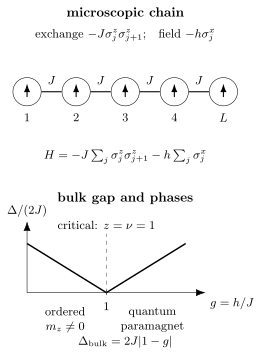
The ferromagnetic one-dimensional chain balances -axis exchange against an -directed field. In the infinite chain with and , the bulk quasiparticle gap closes at and reopens in the quantum paramagnet.
Global Spin-Flip Symmetry
Section titled “Global Spin-Flip Symmetry”Define
Because operators on different sites commute,
Conjugation gives
and
Every Ising bond contains two factors, so
The eigenvalues
label two exact parity sectors.
Reality versus physical time reversal
Section titled “Reality versus physical time reversal”In the computational basis, is a real symmetric matrix, so complex conjugation is an antiunitary symmetry of that matrix representation. This should not be confused with physical spin time reversal. For literal angular momentum, physical time reversal sends every spin component to its negative; therefore a nonzero transverse field changes sign under it. The exchange-only model is time-reversal invariant, whereas the field selects an oriented external magnetic field. For an effective two-level pseudospin, determine time reversal from the underlying physical states; it need not act like literal angular momentum.
Order Parameter
Section titled “Order Parameter”The longitudinal magnetization per site is
It is odd under the symmetry:
If a finite-chain eigenstate has definite parity,
then
This exact zero does not rule out an ordered thermodynamic phase.
Finite Symmetry Cats
Section titled “Finite Symmetry Cats”At , parity eigenstates can be formed as
They satisfy
Each has
but
Long-range two-point correlations and magnetization fluctuations reveal order that the one-point function hides. Their pointwise, squared-order, and finite-size peak criteria are developed in Long-Range Order.
Spontaneous Symmetry Breaking
Section titled “Spontaneous Symmetry Breaking”In the infinite ordered phase, one may select a branch with an infinitesimal longitudinal source. Schematically,
For fixed , reversing the limits returns the unique parity-even finite-chain ground state and gives zero magnetization. The endpoint has an exactly degenerate ground space: at , any positive longitudinal source selects the all-up state even at finite , so its limit has magnetization one. A parity cat or the symmetric mixture at exactly zero source instead has zero magnetization. This finite-system degeneracy must be distinguished from the asymptotic degeneracy at nonzero transverse field (Pfeuty, 1970, p. 89).
For the infinite chain,
The formula refers to a selected symmetry-broken ground state. It is not the expectation value in a finite parity eigenstate.
Ordered and Paramagnetic Regimes
Section titled “Ordered and Paramagnetic Regimes”For the infinite ferromagnetic chain:
| Regime | Ground-state structure | Long-distance behavior |
|---|---|---|
| ordered, two thermodynamic branches | and long-range correlations | |
| scale invariant | gapless with algebraic correlations | |
| quantum paramagnet | unique symmetric bulk phase with exponentially decaying correlations |
The words ordered and paramagnetic describe thermodynamic regimes. A finite chain has discrete levels and analytic ground-state data away from exact crossings; it does not literally contain two infinite-volume phases.
Correlation Diagnostics
Section titled “Correlation Diagnostics”Define
In a selected ordered ground state,
In the paramagnet,
up to algebraic prefactors; counts lattice separations and is a length. At criticality,
where is nonuniversal while the exponent is universal for the one-dimensional quantum Ising critical point.
Transverse Magnetization
Section titled “Transverse Magnetization”The transverse magnetization is
For a nondegenerate finite-size ground state, Hellmann–Feynman gives
Thus
Unlike , the transverse magnetization is even under and can be nonzero in both phases. It approaches one as .
Longitudinal Field
Section titled “Longitudinal Field”Adding
explicitly breaks the global spin-flip symmetry:
The longitudinal field selects one magnetization direction and generally destroys the free-fermion integrability of the nearest-neighbor chain. Results for should not be transferred to without a new analysis.
Dual Variables
Section titled “Dual Variables”For an open chain, introduce operators on dual links:
and
Then neighboring dual strings give
The bulk Hamiltonian becomes
up to boundary terms and edge degrees of freedom.
Self-Dual Point
Section titled “Self-Dual Point”The dual Hamiltonian has the same form with field and exchange interchanged:
Equivalently,
The self-dual value is
Duality exchanges the ordered and disordered descriptions. It strongly identifies the candidate transition point, but self-duality alone does not prove that every self-dual model has one unique continuous transition. The exact solution supplies that additional information here.
Exact Solution Strategy
Section titled “Exact Solution Strategy”The one-dimensional nearest-neighbor model at zero longitudinal field is integrable. A standard route is:
- rotate spin axes so the Ising coupling lies along and the field along ;
- apply a Jordan–Wigner transformation from spins to fermions;
- separate fermion-parity sectors and impose the corresponding boundary conditions;
- for the uniform ring, Fourier transform within the allowed boundary sector;
- perform a Bogoliubov rotation that diagonalizes its pairing terms.
The result is a set of independent fermionic quasiparticles. The mapping is nonlocal, and the periodic spin chain does not become a single periodic fermion problem without parity qualifications.
Open or nonuniform chains instead require a real-space quadratic-fermion diagonalization. The Jordan–Wigner transformation derives the strings and boundary-sector constraints. Adding a generic longitudinal field destroys this free-fermion integrability. The mixed-field chain is therefore a standard finite-size testbed for the eigenstate thermalization hypothesis, provided exact reflection and other symmetries are resolved before comparing eigenstates.
Exact Bulk Dispersion
Section titled “Exact Bulk Dispersion”Let be dimensionless crystal momentum, with lattice spacing . In the thermodynamic limit,
Equivalent forms include
The dispersion is nonnegative and periodic in .
The exact finite-chain set of allowed momenta depends on spin boundary conditions and fermion parity. The continuous function above is the bulk result, not a complete finite-size spectrum by itself.
Bulk Gap
Section titled “Bulk Gap”For , the minimum occurs at . Therefore
The bulk gap is nonzero for
and closes at
This gap is the quasiparticle mass scale in the infinite system. In the ordered phase it must be distinguished from the exponentially small splitting between finite-size parity partners.
Critical Dispersion
Section titled “Critical Dispersion”At ,
Using
gives
For ,
Restoring , the low-energy velocity is
The linear dispersion implies dynamical exponent
Correlation-Length Exponent
Section titled “Correlation-Length Exponent”Near the transition,
Relativistic scaling with gives
Hence
so
The model-specific values agree with the two-dimensional classical Ising universality class. The general meaning and extraction of these exponents belong to Critical Exponents and Scaling.
Exact Ground-State Energy Density
Section titled “Exact Ground-State Energy Density”In the thermodynamic limit, the ground-state energy per site is
Equivalently,
The limiting checks are
and
The energy itself remains continuous at , while higher derivatives reveal the critical nonanalyticity.
Exact Critical Data
Section titled “Exact Critical Data”For the infinite chain in the convention used here:
| Quantity | Exact critical behavior |
|---|---|
| critical coupling | |
| bulk gap | |
| dynamical exponent | |
| correlation-length exponent | |
| order-parameter exponent | |
| critical exponent | |
| conformal central charge |
These values characterize the clean nearest-neighbor chain. Disorder, long-range interactions, dissipation, or additional fields can change the universality class or remove integrability.
Quasiparticles and Physical Excitations
Section titled “Quasiparticles and Physical Excitations”At , the bulk formula gives
This is the energy assigned to one fermionic domain-wall quasiparticle in the infinite-chain description. On a periodic spin ring, domain walls occur in pairs, so a physical excitation within a fixed boundary and parity sector can cost at .
The distinction between a quasiparticle dispersion and the lowest allowed finite-size many-body excitation is essential. Boundary conditions and global constraints decide which quasiparticle occupations represent physical spin states.
Finite-Size Parity Sectors
Section titled “Finite-Size Parity Sectors”Because
the Hilbert space splits as
For ,
Exact diagonalization can work in either parity block. For a periodic uniform chain, translation and reflection provide further symmetry structure, but generic momentum and reflection cannot be diagonalized simultaneously: reflection sends to . Use compatible quantum numbers or the appropriate two-momentum representation.
The Jordan–Wigner transform ties fermion boundary conditions to . For a periodic spin chain, diagonalize the correct momentum grid in each sector and then impose its fermion-parity constraint. The partition function must include these physical parity projections; one unrestricted mode product does not give the finite-ring spin partition function. Ignoring the constraint can produce incorrect finite-size spectra or an unphysical ground-state sector.
Three different gaps
Section titled “Three different gaps”Finite-chain calculations contain several distinct energy scales:
- Symmetry-partner splitting: the difference between the lowest even and odd states. At fixed it is exponentially small once ; at it vanishes exactly.
- Bulk quasiparticle mass: , finite away from criticality. A kink is not created by an arbitrary local spin operator, and periodic physical states can require quasiparticle pairs. A measured spectral threshold need not equal this single-quasiparticle mass.
- Finite-size critical gaps: at , low levels scale as , with coefficients determined by boundaries and symmetry sectors.
When comparing numerical gaps, state which levels and sectors enter the difference. The ordered phase has a nonzero bulk mass despite its degenerate thermodynamic ground states.
Scaling of the Finite Critical Gap
Section titled “Scaling of the Finite Critical Gap”At , the dispersion is linear:
Finite length quantizes momenta in steps of order
Therefore a low critical excitation scales as
The proportionality constant depends on open versus periodic boundaries and on the parity or conformal sector. The robust statement is the power
consistent with .
MB-B009 uses the critical open chain . Its exact global gap is
For example,
Writing gives
and hence
This sequence tests the dynamical exponent and the leading boundary-aware correction. It is a global gap, not a gap restricted to one parity sector.
Exact Two-Site Open Chain
Section titled “Exact Two-Site Open Chain”For with one exchange bond,
Define parity-even states
and
The even block is
Its energies are
Odd Two-Site States
Section titled “Odd Two-Site States”The parity-odd states are
and
The transverse-field sum annihilates both states, so
For , the ground state is even with energy
This dimer is a finite analytic crossover, not a phase transition.
At , the sorted dimensionless energies are
At these parameters, the global gap is
The lowest excitation within the ground state’s sector instead costs . A parity-even probe cannot connect the ground state to the lowest odd state, whereas a parity-odd probe can have such a matrix element. Thus a spectral gap and a particular probe’s threshold need not coincide.
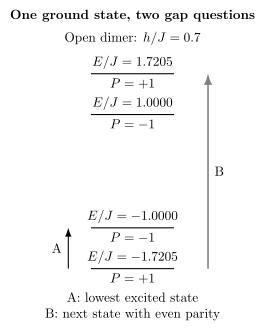
The open Ising dimer at . Left arrow: global gap . Right arrow: gap within even parity . Both begin at the same ground state; the allowed transition depends on the probe’s parity.
Two-Site Ground State
Section titled “Two-Site Ground State”Write
The normalized ground state is
At , this is the even ferromagnetic cat . As ,
The dimer makes the finite-size interpolation explicit: the exact symmetric ground state evolves smoothly between two limits.
Two-Site Entanglement
Section titled “Two-Site Entanglement”Tracing out either spin gives two eigenvalues
where
The one-spin entanglement entropy is
At , the even cat has
At , the product paramagnet has
The entropy at belongs to the finite parity cat. Either selected broken product state has zero bipartite entanglement.
Entanglement Away from Criticality
Section titled “Entanglement Away from Criticality”Both phases have a nonzero gap above their thermodynamic ground-state manifold away from . In one dimension, a ground-state interval entropy approaches a size-independent constant once the interval is much larger than the correlation length, subject to boundary and cat-state contributions.
Near criticality, the saturation value grows logarithmically with the correlation length. For a single cut in an infinite gapped chain,
for the standard conformal scaling geometry, with
The microscopic cutoff and additive constant are nonuniversal.
Critical Entanglement
Section titled “Critical Entanglement”For a periodic critical chain with sites and circumference , the ground-state entropy of an interval of consecutive sites has the conformal form
with
For an interval adjacent to an open boundary, the logarithmic coefficient becomes , with boundary-dependent constants. The general entropy definitions and area-law context live in Entanglement Entropy in Many-Body Systems. Geometry-correct estimators and the finite-entanglement benchmark are developed in Entanglement and Criticality.
For a parity-definite fermionic Gaussian state, the spin entropy of a single contiguous block can be computed from its fermionic correlation matrix. A finite periodic thermal spin state includes parity projections and is not generally one Gaussian fermionic density operator; apply the appropriate spin-state construction rather than an unrestricted covariance formula.
Critical Continuum Theory
Section titled “Critical Continuum Theory”At , the low-energy theory is described by a massless Majorana field with central charge
Detuning generates a mass whose magnitude is proportional to the bulk gap. The relativistic continuum description is emergent: the microscopic spin chain has a lattice, a preferred time coordinate, and no fundamental Lorentz symmetry.
The broader operator-to-field and scaling bridge is developed in Why Many-Body QM Leads to QFT.
Quantum-to-Classical Mapping
Section titled “Quantum-to-Classical Mapping”A Trotter decomposition represents the -dimensional quantum Ising partition function as an anisotropic classical Ising model in Euclidean dimensions. For the chain, the zero-temperature critical exponents match those of the two-dimensional classical Ising model.
This correspondence explains the exponent values, but it is not a statement that a finite quantum chain is literally a two-dimensional magnet. Imaginary time, anisotropic couplings, limits, and observable dictionaries must be handled explicitly. The correspondence uses the imaginary-time Trotter limit; the zero-temperature critical point also requires . Quantum phase transitions, universality, and critical scaling explain these limits and their finite-size tests.
Finite Temperature in One Dimension
Section titled “Finite Temperature in One Dimension”The ordered and paramagnetic regimes above are zero-temperature phases. For finite-range interactions in one spatial dimension, the clean chain has no nonzero-temperature Ising ordering transition. Any gives a finite density of thermally excited domain walls and a finite longitudinal correlation length.
There can still be broad low-temperature crossover regimes controlled by the nearby zero-temperature critical point. A crossover is not a finite-temperature phase boundary. Finite-Temperature Phase Transitions states the thermodynamic and finite-size criteria behind that distinction.
Sparse-Matrix Representation
Section titled “Sparse-Matrix Representation”In the product basis, the exchange energy is diagonal:
The field connects a configuration only to the configurations obtained by flipping one bit:
Thus each matrix row has at most one diagonal contribution and one-spin-flip entries before symmetry reduction. The matrix dimension is , but the number of nonzero entries per row grows only linearly with .
This structure makes the chain a standard benchmark for Sparse Matrices, Krylov methods, and matrix-free Hamiltonian actions.
Finite-matrix checks
Section titled “Finite-matrix checks”MB-B001 gives the complete small-chain spectrum. Its ring example uses , periodic boundaries, and . Useful comparison values include
The benchmark page includes all levels and degeneracies. A code should pass the open-chain test before the periodic test, because a wrong two-site ring can accidentally conceal double-counted bonds.
The second moment follows without diagonalization. Distinct nonidentity Pauli strings are orthogonal under the Hilbert–Schmidt inner product, so for a ring with distinct bonds,
This trace identity checks a sum over all matrix entries. It can reveal normalization errors but cannot uniquely identify the Hamiltonian; verify selected matrix elements and symmetry relations as well.
Experimental and Effective Uses
Section titled “Experimental and Effective Uses”The model can describe actual magnetic moments only when the physical anisotropy and field coupling justify the pseudospin Hamiltonian. It can also describe effective two-level variables in atomic, molecular, optical, superconducting, or programmable systems.
The symbol may represent a true spin, a crystal-field doublet, two charge configurations, or another qubit-like degree of freedom. The operation and measured magnetization must be interpreted in that physical encoding.
Agreement with an Ising Hamiltonian over one energy range does not prove that longer-range couplings, longitudinal fields, decoherence, or leakage are absent.
Which extensions remain free fermions?
Section titled “Which extensions remain free fermions?”Nearest-neighbor couplings and transverse fields can vary in space and still map to a quadratic fermion Hamiltonian. They can also vary in time. A fermionic Gaussian initial state remains Gaussian, with evolution determined by a time-dependent one-particle Bogoliubov equation. For a non-Gaussian initial state, the operator evolution remains linear but covariance data alone do not determine the full state or all its correlations. On a ring, retain the physical parity constraints. Translation symmetry and the simple bulk dispersion are lost, but quadratic solvability remains. Disorder can change the critical behavior even within this free-fermion class (Dutta et al., 2015).
Generic longitudinal fields, longer-range Ising exchange, additional incompatible spin interactions, baths, and higher-dimensional lattices require other methods. A special solvable limit must be established for its specific Hamiltonian. For uniform quenches, the quadratic chain supplies an exact example of Loschmidt-rate dynamical transitions; a nonanalytic return rate is a different question from an equilibrium phase boundary.
Exercises
Section titled “Exercises”Duality
Section titled “Duality”Using
and
show that the bulk Hamiltonian exchanges and under duality.
Solution
The Ising bond is directly
Neighboring strings cancel except at site :
Hence the bulk terms become
This has the same structure with field and exchange exchanged, up to boundary terms. Therefore maps to , and the self-dual value is .
Cat-state entanglement
Section titled “Cat-state entanglement”Partition a nontrivial chain into regions and . Compare the entanglement entropy of , , and .
Solution
Both product states factor across the cut:
and
Their entanglement entropies are zero.
For the cat state,
The two branch states are orthogonal in both nonempty regions. The reduced density matrix has eigenvalues and , so
This is global cat entanglement, not the same as the scale-dependent critical entanglement at .
Sparse connectivity and symmetry blocks
Section titled “Sparse connectivity and symmetry blocks”In the basis for sites, how many configurations can the transverse field connect to a given basis configuration? What are the parity-block dimensions?
Solution
Each term flips exactly one site. There are choices, so the field connects a basis configuration to distinct one-bit-flipped configurations.
The exchange term is diagonal. Thus a row has one diagonal entry and at most off-diagonal field entries.
The parity operator has eigenvalues . Multiplying any configuration by the global spin flip pairs it with a distinct reversed configuration. Symmetric and antisymmetric combinations give one state in each sector per pair. Since there are configurations,
Critical energy and transverse magnetization
Section titled “Critical energy and transverse magnetization”Use the bulk energy integral to show and . Why does the nonzero transverse magnetization not distinguish the two phases?
Solution
At , for . Its integral is four, giving . Differentiating with respect to at fixed gives
At the integrand is , so . The transverse field explicitly favors this component on either side of the transition. It is the longitudinal magnetization selected by an infinitesimal longitudinal source, or the long-distance longitudinal correlation, that detects broken spin-flip symmetry.
Translate the normalization
Section titled “Translate the normalization”An article writes
with . Express and in terms of the present and . At what ratio does the critical point occur?
Solution
Using
gives
The baseline critical point is , so
The apparent factor-of-two shift is entirely a normalization change.
Count domain walls on a ring
Section titled “Count domain walls on a ring”Prove that every computational-basis configuration on a periodic ring has an even number of domain walls. Why does this constrain the excitation energy?
Solution
Assign to site . A domain wall occurs when . Around a ring,
If bonds have product , the same product is . Hence is even. Each wall changes one bond energy from to and costs , so the lowest domain-wall excitation of the periodic spin chain contains two walls and costs .
Extract the critical finite-size exponent
Section titled “Extract the critical finite-size exponent”Starting from
derive its leading large- behavior and identify .
Solution
Let . Then
Using gives
At a quantum critical point, a characteristic gap scales as . Therefore .
References
Section titled “References”- E. Barouch and B. M. McCoy, “Statistical Mechanics of the XY Model. II. Spin-Correlation Functions”, Physical Review A 3, 786–804, 1971.
- P. Calabrese and J. Cardy, “Entanglement Entropy and Quantum Field Theory”, Journal of Statistical Mechanics P06002, 2004.
- B. K. Chakrabarti, A. Dutta, and P. Sen, Quantum Ising Phases and Transitions in Transverse Ising Models, Springer, 1996.
- A. Dutta, G. Aeppli, B. K. Chakrabarti, U. Divakaran, T. F. Rosenbaum, and D. Sen, Quantum Phase Transitions in Transverse Field Spin Models: From Statistical Physics to Quantum Information, Cambridge University Press, 2015.
- J. B. Kogut, “An Introduction to Lattice Gauge Theory and Spin Systems”, Reviews of Modern Physics 51, 659–713, 1979.
- E. Lieb, T. Schultz, and D. Mattis, “Two Soluble Models of an Antiferromagnetic Chain”, Annals of Physics 16, 407–466, 1961.
- P. Pfeuty, “The One-Dimensional Ising Model with a Transverse Field”, Annals of Physics 57, 79–90, 1970.
- S. Sachdev, Quantum Phase Transitions, 2nd ed., Cambridge University Press, 2011.
- S. Suzuki, J.-i. Inoue, and B. K. Chakrabarti, Quantum Ising Phases and Transitions in Transverse Ising Models, 2nd ed., Springer, 2013.
- G. Vidal, J. I. Latorre, E. Rico, and A. Kitaev, “Entanglement in Quantum Critical Phenomena”, Physical Review Letters 90, 227902, 2003.