

Jordan–Wigner Transformation
The Jordan–Wigner transformation is an exact representation of an ordered chain of spin- operators by canonical fermionic operators. Its defining ingredient is a parity string extending from the beginning of the chain to the transformed site. That string converts commuting spin operators on distinct sites into anticommuting fermion operators.
The map is especially powerful in one dimension because strings cancel in many nearest-neighbor even operators. The transverse-field Ising and anisotropic XY chains then become quadratic fermion Hamiltonians. The transformation does not make every spin model free, does not preserve locality for arbitrary geometries or observables, and does not allow periodic boundaries to be handled without a parity-sector choice.
Helpful background. Pauli matrices supplies local ladders, and fermion anticommutation states the target algebra.
Ordered spins and fermion occupations
Section titled “Ordered spins and fermion occupations”Take two-state sites with a declared order
Let be Pauli matrices on site . Operators on different spin sites commute:
Introduce the local Pauli ladder operators
This page uses the qubit-standard occupation convention
Thus the state is empty and the state is occupied:
With this choice, annihilates the occupied state and creates it. Some spin-chain references choose the opposite identification. The convention translation is given explicitly below.
Why Bare Local Ladders Fail
Section titled “Why Bare Local Ladders Fail”It is tempting to identify
On one site this has the desired nilpotency. On distinct sites, however,
whereas fermions require
Commuting hard-core ladder operators and anticommuting fermion operators share the local occupation rule , but they differ in exchange signs. The missing information is the parity of all occupied modes that an operator must pass in the chosen ordering.
The Left-Parity String
Section titled “The Left-Parity String”Define the parity to the left of site by
The empty product is the identity, so
Because ,
On an occupation basis state,
The string is Hermitian and unitary:
It commutes with every operator on site , but it contains a factor for every earlier site . Since anticommutes with , that one factor supplies the sign needed when two transformed operators are exchanged.
Forward Jordan–Wigner Map
Section titled “Forward Jordan–Wigner Map”Define
and
Since commutes with site , it may be written on either side of . The operator removes an occupation at site , while adds one with the sign determined by all earlier occupations.
Inverse Map
Section titled “Inverse Map”The local density is
so
The transverse Pauli operators are
and
Equivalently,
This is an exact operator dictionary on a finite ordered chain. Both the spin Hilbert space and the fermionic Fock space have dimension , and the occupation product basis identifies their vectors one to one. What changes is the locality and grading of the operator representation.
Proof of the Fermion Algebra
Section titled “Proof of the Fermion Algebra”The transformed operators must satisfy
Same-Site Relations
Section titled “Same-Site Relations”Because and commutes with ,
Similarly,
The mixed anticommutator is
Thus Pauli exclusion is already present locally.
Different-Site Relations
Section titled “Different-Site Relations”Let and write
where
All factors in commute with operators on sites and . The crucial one-site identities are
Therefore
whereas
Hence
Replacing by gives
The full canonical anticommutation relations follow. Only one parity factor, , is responsible for the sign; the rest of the string records where that factor must appear for every ordered pair.
Action on Occupation States
Section titled “Action on Occupation States”The operator action is
and
For example,
because one occupied mode lies to the left of site three. A bare local spin ladder would remove the third occupation but miss this minus sign.
This basis action is often the fastest way to debug a matrix implementation. It must agree with both the bit-order convention and the Pauli-string formula.
Convention Crosswalk
Section titled “Convention Crosswalk”The dictionary above uses
The XXZ Spin Chain and Spinless Fermion Chains pages use the opposite spin-axis convention,
A rotation by about the axis gives
Consequently,
Both conventions are correct. They differ in which spin orientation is called occupied and in the sign assigned to a longitudinal field or chemical potential. Mixing formulas from the two conventions without this rotation creates spurious sign disagreements.
Local and Nearest-Neighbor Operators
Section titled “Local and Nearest-Neighbor Operators”The usefulness of the transformation comes from string cancellation in parity-even local combinations.
Density and Longitudinal Spin
Section titled “Density and Longitudinal Spin”The local relation is string free:
Therefore
A longitudinal spin interaction becomes a density interaction rather than a quadratic term.
Adjacent Transverse Product
Section titled “Adjacent Transverse Product”Since
the common part of the two strings squares to the identity. Direct substitution gives
The result is local and quadratic. It contains both hopping and pairing:
Similarly,
while
The isotropic combination preserves fermion number. Anisotropy introduces pair creation and annihilation, preserving only fermion parity.
Separated Transverse Operators
Section titled “Separated Transverse Operators”For , the strings do not disappear completely:
Thus a local spin correlation can become a fermionic string correlation. Conversely, a single local fermion operator is a spin ladder multiplied by a long Pauli string. Spectral equivalence does not imply that locality or correlation complexity is unchanged.
Why One Dimension Is Special
Section titled “Why One Dimension Is Special”The algebraic map needs only a total ordering, so a finite set of modes can always be linearized. The one-dimensional advantage is stronger: geometric nearest neighbors can also be consecutive in the ordering. Their strings then cancel to a bounded local operator.
In more than one spatial dimension, choose any snake-like ordering. Some geometric nearest neighbors will be far apart in that order. A local hopping or spin-exchange term can then acquire a string crossing many intervening modes. The representation remains exact, but geometric locality is generally lost.
This is the precise limitation:
- Jordan–Wigner is not algebraically forbidden beyond one dimension;
- a naive single ordering does not preserve locality for all higher-dimensional nearest-neighbor bonds;
- higher-dimensional fermionization can introduce gauge fields or more elaborate auxiliary structure to recover a local description;
- the choice of ordering affects computational string lengths but not the underlying fermionic spectrum.
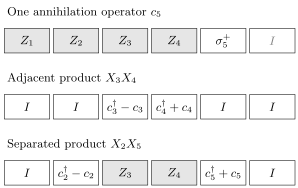
The operator at site carries the parity of every earlier occupation. Adjacent even products cancel their common strings, but separated operators retain the parity of intervening sites. The shaded factors are operators, not occupied sites. For an actual state, each contributes its eigenvalue .
Global Fermion Parity
Section titled “Global Fermion Parity”The total fermion number is
Its parity is
An operator with an even number of and factors commutes with . An odd operator anticommutes with it. Number-nonconserving quadratic spin chains therefore often retain exact parity even when they do not retain exact fermion number.
For the rotated transverse-field Ising chain below, is exactly the global spin-flip symmetry of the original spin convention.
Open Chains
Section titled “Open Chains”For an open chain, every nearest-neighbor bond lies inside the chosen order. No interaction closes from site back to site , so no full-chain string appears.
The map is then a direct equality between the complete -dimensional spin Hilbert space and the complete -dimensional fermion Fock space. One may still block diagonalize by parity when the Hamiltonian preserves it, but no parity-dependent boundary condition is needed to define the transformed open Hamiltonian.
Open chains are therefore the cleanest setting for a first derivation. They also expose edge Majorana operators in the Ising example without the extra ring closure term.
Periodic Spin Chains
Section titled “Periodic Spin Chains”Suppose the spin Hamiltonian contains a boundary bond between sites and . The local cancellation used for no longer applies in the same way because the chosen order has a cut between those sites.
For the transverse product,
The minus sign follows from moving the total parity operator past one odd local fermion factor. Therefore a periodic spin coupling becomes
The transformed Hamiltonian is still quadratic within a fixed parity sector, because can then be replaced by its eigenvalue . It is not one unrestricted quadratic Hamiltonian with one universal boundary condition.
Effective Fermion Boundary Condition
Section titled “Effective Fermion Boundary Condition”The bulk expression can be extended uniformly through the boundary by imposing
Hence
| Fixed parity | Effective fermion boundary | Allowed wave numbers |
|---|---|---|
| (even ) | antiperiodic, | |
| (odd ) | periodic, |
This table uses the convention of this page and an untwisted periodic spin ring. A staggered gauge change can shift signs and momenta, but it cannot remove the need to correlate the fermion boundary with parity.
Projection Is Still Required
Section titled “Projection Is Still Required”Fixing determines the boundary condition used to diagonalize the quadratic Hamiltonian. One must also retain only many-body states with the same physical parity:
Pair rotations generated by even quadratic operators preserve physical parity, but the quasiparticle vacuum need not have even original-fermion parity. Filling an unpaired mode, or relabeling it by a particle–hole exchange, changes that reference parity. If the diagonalization gives vacuum parity , a state with quasiparticles has
Keep only states satisfying this equation with the chosen . Ignoring the vacuum parity can select an unphysical candidate ground state; retaining both full quadratic Fock spaces doubles the spin Hilbert space.
The self-inverse wave numbers satisfy modulo : they are and . Their presence depends on both grid and length. For even , both occur in the periodic sector and neither in the antiperiodic sector. For odd , is periodic but is antiperiodic. Treat them as single unpaired modes rather than double-counted blocks.
The Anisotropic XY Chain
Section titled “The Anisotropic XY Chain”Before specializing to Ising, consider
For an open chain, Jordan–Wigner gives
At , the pairing vanishes and total fermion number is conserved. At , only parity is conserved. At , the exchange is , the rotated transverse-field Ising chain.
The map makes the distinction between integrability and number conservation explicit. A quadratic Bogoliubov Hamiltonian can be exactly solvable even when it creates and annihilates fermion pairs.
Transverse-Field Ising Example
Section titled “Transverse-Field Ising Example”Take and and start from the convention used on the model page:
The symbols here denote the original physical axes. Rotate the spin coordinates by defining
These operators satisfy the same Pauli algebra, and
Open-Chain Fermion Hamiltonian
Section titled “Open-Chain Fermion Hamiltonian”For an open chain,
This is the case of the expanded XY Hamiltonian above. The field contributes , including the constant needed when comparing energies.
This is quadratic but not number conserving. Its exact symmetry is
Thus the original global Ising spin flip becomes fermion parity.
Majorana Form
Section titled “Majorana Form”Define two Majorana operators per site,
They obey
and
Since
the open Hamiltonian becomes
The field couples the two Majoranas on the same site; exchange couples Majoranas across neighboring sites. At , every site is paired internally. At , and are absent from the Hamiltonian. The Ising model explains their finite-size splitting; the Kitaev chain interprets the edge operators in a fermionic system.
Periodic Chain and Fourier Transform
Section titled “Periodic Chain and Fourier Transform”For a periodic spin ring, first choose and impose
Then use
with the momentum grid appropriate to . Pair with and introduce
Writing the paired part as plus its constant (or summing once over each pair), the Bogoliubov–de Gennes matrix is
Its eigenvalues are , where
with
The Jordan–Wigner step produced a quadratic paired-fermion problem. Fourier and Bogoliubov transformations finish the diagonalization. The bulk gap and finite-size interpretation are developed in Transverse-Field Ising Model.
XXZ Crosswalk
Section titled “XXZ Crosswalk”For the spin operators associated with the Pauli axes of this page, define
In the primary occupation convention,
An open XXZ chain maps to
After the spin-axis rotation used by the XXZ page, the final field term changes sign. The density interaction remains for , so Jordan–Wigner does not make the generic XXZ chain free. It changes a spin interaction into an interacting spinless-fermion Hamiltonian.
Computational Use
Section titled “Computational Use”In qubit simulation, the direct encoding is
A hopping term between modes becomes Pauli strings with operators between the endpoints. Mode ordering therefore affects Pauli weight and circuit cost even though it does not change the target fermionic Hamiltonian.
For exact diagonalization, the same signs are often implemented directly in occupation bits:
These are two implementations of the same parity rule. The state ordering in the matrix must agree with the bit ordering; for example, the minus sign in tests more than the local empty/occupied rule.
Exercises
Section titled “Exercises”Momentum grids on eight sites
Section titled “Momentum grids on eight sites”List the dimensionless momenta for an eight-site ring in the even- and odd-parity sectors. Which sector contains self-inverse modes?
Solution
Even fermion parity uses antiperiodic boundaries:
Equivalently, representatives in are
Odd parity uses periodic boundaries:
Representatives are
The periodic sector contains the self-inverse modes and .
Ordering in two dimensions
Section titled “Ordering in two dimensions”Order a square lattice row by row. Compare the Jordan–Wigner string length for a horizontal nearest-neighbor bond and a vertical nearest-neighbor bond.
Solution
Horizontal neighbors inside one row are consecutive in the ordering. Their common parity strings cancel, leaving a bounded local fermion operator.
Vertical neighbors in adjacent rows differ by three positions in the row-major order. Their transformed bilinear retains parity factors for the modes lying between them. On a square lattice of width , a vertical bond generally spans order modes.
The map remains exact, but the Pauli or fermion representation of a geometrically local vertical bond becomes increasingly nonlocal as the width grows. A different snake ordering moves which bonds are long; it cannot make every two-dimensional nearest-neighbor bond consecutive simultaneously.
Odd length and an unpaired mode
Section titled “Odd length and an unpaired mode”For a five-site periodic spin ring, identify the self-inverse momentum in each parity sector. Why does the even-length rule fail?
Solution
The odd-parity periodic grid is and contains , but not . The even-parity antiperiodic grid is and contains at , but not . Each grid has an odd number of modes, so one mode remains after all distinct pairs are formed.
Parity of a quasiparticle vacuum
Section titled “Parity of a quasiparticle vacuum”For a single unpaired mode with and , define a positive-energy quasiparticle annihilator. What is its vacuum parity?
Solution
Choose . Then
Its vacuum obeys and is the occupied original mode . It has odd original parity despite zero quasiparticles. This is why counting quasiparticles alone cannot enforce the spin-ring parity constraint.
References
Section titled “References”- E. Barouch and B. M. McCoy, “Statistical Mechanics of the XY Model. II. Spin-Correlation Functions”, Physical Review A 3, 786–804 (1971).
- S. B. Bravyi and A. Yu. Kitaev, “Fermionic Quantum Computation”, Annals of Physics 298, 210–226 (2002).
- E. Fradkin, “Jordan–Wigner Transformation for Quantum-Spin Systems in Two Dimensions and Fractional Statistics”, Physical Review Letters 63, 322–325 (1989).
- F. Franchini, An Introduction to Integrable Techniques for One-Dimensional Quantum Systems, Springer (2017).
- P. Jordan and E. Wigner, “Über das Paulische Äquivalenzverbot”, Zeitschrift für Physik 47, 631–651 (1928).
- E. Lieb, T. Schultz, and D. Mattis, “Two Soluble Models of an Antiferromagnetic Chain”, Annals of Physics 16, 407–466 (1961).
- P. Pfeuty, “The One-Dimensional Ising Model with a Transverse Field”, Annals of Physics 57, 79–90 (1970).
- S. Sachdev, Quantum Phase Transitions, 2nd ed., Cambridge University Press (2011).
- T. D. Schultz, D. C. Mattis, and E. H. Lieb, “Two-Dimensional Ising Model as a Soluble Problem of Many Fermions”, Reviews of Modern Physics 36, 856–871 (1964).