

Tight-Binding Model
The tight-binding model describes coherent motion among a retained set of localized orbitals. Instead of resolving the continuous wavefunction between neighboring orbital centers, it records that motion through Hamiltonian matrix elements called hopping amplitudes. Translation-invariant hopping turns localized site states into extended crystal-momentum eigenstates and, on a periodic chain, produces the characteristic cosine dispersion.
The basic model uses unconstrained canonical bosonic or fermionic modes and is quadratic: it contains onsite one-body energies and hopping, but no particle–particle interaction. It can therefore be solved by diagonalizing a one-particle Hermitian matrix. The same matrix may describe one particle, many noninteracting fermions, or many noninteracting bosons; statistics and filling determine how its modes are occupied.
Helpful background. Lattice models explains local spaces and constraints; momentum representation fixes the Fourier normalization used below.
Coherent hopping between localized orbitals
Section titled “Coherent hopping between localized orbitals”Choose orthonormal localized states
where labels a site or unit cell and labels an orbital, sublattice, spin, or another internal mode. A particle initially localized near one site can evolve into neighboring orbitals because the Hamiltonian has off-diagonal matrix elements.
For one orbital per site, a useful schematic form is
The onsite energy is diagonal in the localized basis. The hopping couples distinct orbitals. Hopping is coherent unitary coupling: a localized preparation develops amplitudes on other sites. The basic dimer calculation is in two-site hopping; material orbital choices and projection are developed in tight-binding methods for quantum matter.
Localized Orbitals from a Continuum Problem
Section titled “Localized Orbitals from a Continuum Problem”Suppose a one-particle continuum Hamiltonian is projected onto orthonormal localized orbitals . Its retained matrix elements are
The projected Hamiltonian is
A common sign convention defines off-diagonal hopping by
The minus sign is conventional. A trustworthy calculation states whether denotes the matrix element itself or its negative.
Projection and Truncation
Section titled “Projection and Truncation”Tight binding is not defined solely by drawing a lattice. It is an approximation or effective model only after specifying:
- which localized orbitals are retained;
- how well separated they are from omitted orbitals;
- which hopping ranges are kept;
- whether overlap between basis functions has been orthogonalized;
- whether interactions, spin–orbit terms, or external fields are omitted or added;
- which observables and energy window the model is intended to reproduce.
Exponential localization often makes distant hopping amplitudes small, but it does not make every nearest-neighbor truncation exact. Symmetry can also force a nominally short-range matrix element to vanish while a longer-range one remains important.
Nonorthogonal Basis Caveat
Section titled “Nonorthogonal Basis Caveat”Atomic-orbital trial functions are not always orthogonal. If
then the coefficients obey a generalized eigenvalue problem,
Replacing by the identity without an orthogonalization or a controlled small-overlap argument changes the model. For linearly independent orbitals is positive definite. Symmetric orthogonalization gives the ordinary Hermitian matrix and normalized coefficients . If is singular, redundant orbitals must first be removed. The formulas below assume an orthonormal retained basis.
Hermiticity and Bond Orientation
Section titled “Hermiticity and Bond Orientation”A directed hopping amplitude has an orientation:
Hermiticity fixes the reverse process to have amplitude . For real hopping, both directions carry the same real coefficient. For complex hopping, the phase changes sign under reversal.
A frequent factor-of-two error comes from summing both ordered pairs and and also appending a Hermitian conjugate. Use either an ordered-pair sum or an unordered-bond sum, not both.
Graph Interpretation
Section titled “Graph Interpretation”For one orbital on each vertex of a graph, uniform real nearest-neighbor hopping gives
where is the graph adjacency matrix:
The graph spectrum of therefore determines the one-particle tight-binding spectrum. Geometry enters through connectivity, loops, boundaries, coordination, and any spatial dependence assigned to the amplitudes.
Adjacency Matrix Versus Discrete Laplacian
Section titled “Adjacency Matrix Versus Discrete Laplacian”The graph Laplacian is
where is the degree of vertex . On a regular graph with degree ,
Thus a Laplacian kinetic term and a nearest-neighbor tight-binding term differ only by the constant onsite shift on a regular graph. On an irregular graph or at an open boundary, is not generally proportional to the identity, so replacing by changes boundary onsite terms and can change the spectrum.
The continuum-discretization meaning of this distinction is developed in Real-Space Representation.
Second-Quantized Hamiltonian
Section titled “Second-Quantized Hamiltonian”Introduce a creation operator for each retained orbital. The Fock-space lift of the one-particle matrix is
For onsite energies and unordered hopping bonds,
where
The operators are canonical bosonic or fermionic modes. Every term preserves total number. Hard-core or other constrained operators require a separate treatment: a bilinear in those operators need not be a free-particle Hamiltonian. Quadratic pairing terms also need a Bogoliubov transformation rather than the number-conserving diagonalization used here.
Exact Diagonalization on an Arbitrary Graph
Section titled “Exact Diagonalization on an Arbitrary Graph”Solve the one-particle eigenproblem
Choose the eigenvectors orthonormally:
Define normal-mode operators
The transformation preserves the canonical commutation or anticommutation relations. Substitution gives
This is the complete solution of the number-conserving quadratic model on a finite graph.
Many-Body Spectrum
Section titled “Many-Body Spectrum”In the normal-mode occupation basis,
the energy is
For spinless fermions,
while for ordinary bosons,
Adding a nearest-neighbor density interaction to a one-dimensional spinless hopping band gives the Spinless Fermion Chains – model. That interaction changes the problem from a one-body band-filling exercise into an interacting Luttinger-liquid and charge-order problem.
If spin or another conserved flavor is present, each flavor has its own mode occupation. The one-body eigenvalues are shared when the hopping is flavor independent.
The Nearest-Neighbor Chain
Section titled “The Nearest-Neighbor Chain”Take sites at
with lattice spacing , uniform onsite energy , and real nearest-neighbor hopping . The standard Hamiltonian is
The meaning of the final bond depends on the boundary condition. This small piece of model data changes the finite-size eigenstates.
Periodic Boundary Conditions
Section titled “Periodic Boundary Conditions”For a ring,
There are bonds, including the bond from back to . Translation by one site is an exact symmetry.
The allowed wave numbers satisfy
so
Choose any inequivalent representatives modulo . A common first Brillouin zone is
The endpoints differ by a reciprocal-lattice vector and are not distinct.
Lattice Fourier Modes
Section titled “Lattice Fourier Modes”Use the unitary transform
with inverse
Discrete orthogonality gives
Consequently,
The transform changes basis; it does not change the number of one-particle modes.
Fourier Diagonalization
Section titled “Fourier Diagonalization”For the forward hopping sum,
The reverse hopping gives the complex conjugate phase:
Therefore
with
Using ,
The localized site basis and the energy basis are different whenever .
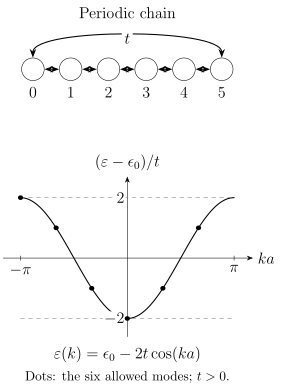
A periodic nearest-neighbor chain is diagonalized by the lattice Fourier transform. The six-site ring samples the cosine curve at six allowed momenta, marked by dots. For the continuous band has edges ; finite rings need not sample both edges.
Dispersion Relation
Section titled “Dispersion Relation”The function is periodic:
This periodicity reflects crystal-momentum equivalence, not repeated physically distinct states. A finite ring samples the dispersion at allowed values; the continuous curve is the large- interpolation.
For real hopping, the dispersion is even:
That equality follows from the combination of real hopping and inversion-symmetric nearest-neighbor geometry.
Band Edges and Bandwidth
Section titled “Band Edges and Bandwidth”For ,
and
The bandwidth of the continuous band is
For arbitrary real ,
The onsite energy shifts the whole band but does not change its width. A finite ring only samples this band. At zero twist, an even- ring contains both and , while an odd- ring misses the upper edge for . Its actual spectral width is , smaller than . A nonzero twist can also move the sampled minimum.
Group Velocity
Section titled “Group Velocity”For a wave packet narrow in crystal momentum, the semiclassical group velocity is
Thus
At a band extremum, the group velocity vanishes even though the eigenstate is spatially extended. Localization and zero group velocity are different statements.
Effective Mass Near a Band Edge
Section titled “Effective Mass Near a Band Edge”For and ,
The band bottom is therefore
Comparing with
gives
At the top of the same band, the curvature is negative and the electron effective mass defined by curvature is negative. Hole variables reorganize nearly filled-band dynamics with a positive hole mass. The compact curvature formula is collected in Effective Mass.
Density of states in the infinite chain
Section titled “Density of states in the infinite chain”For one orbital per site and , the density of states per site is
and zero outside the band. To derive it, replace by in . Each interior energy has two roots, and the delta-function Jacobian is . Integrating over the band gives one state per site. The square-root divergences at the edges are integrable. A finite ring instead has a sum of discrete delta peaks; broadening those peaks is a separate plotting or experimental-resolution choice.
Open Boundary Conditions
Section titled “Open Boundary Conditions”For an open chain, sites are labeled
and the hopping sum contains only
There is no bond between sites and . Translation by one site is not an exact symmetry, so periodic plane waves are not exact finite-chain eigenstates.
The one-particle difference equation in the interior is
Open ends are encoded by
These are endpoint conditions for the discrete recurrence, not extra physical sites.
Standing-Wave Eigenstates
Section titled “Standing-Wave Eigenstates”The normalized open-chain eigenvectors are
where
Their energies are
The variable is dimensionless. A wave number may be defined as , but it is not an eigenvalue of an exact finite-chain translation symmetry.
The open chain has standing-wave modes, exactly matching its sites.
Twisted Boundary Conditions
Section titled “Twisted Boundary Conditions”A twist imposes
Allowed plane waves satisfy
so
The energies are
A twist shifts the finite momentum grid through the same bulk dispersion. Because and describe the same boundary condition,
as an unordered set, although individual level labels can permute.
Boundary Phase and Flux
Section titled “Boundary Phase and Flux”The twist can be placed on the boundary bond,
or distributed uniformly over all bonds by a site-dependent phase redefinition. The spectrum depends on the total loop phase, not on where a particular gauge places it.
For a charged particle on a ring, this total phase can represent an Aharonov–Bohm flux. The gauge principle and its limits are developed in Peierls Phase Preview.
Boundary Comparison
Section titled “Boundary Comparison”| Boundary | Final bond | Exact one-site translation | Natural modes |
|---|---|---|---|
| open | absent | no | standing waves |
| periodic | real hopping | yes | discrete plane waves |
| twisted | phase | gauge-dependent representation of a twisted translation | shifted plane waves |
All three require exactly one-particle eigenstates for single-orbital sites.
Sign of the Hopping
Section titled “Sign of the Hopping”On an open nearest-neighbor chain, the transformation
changes
For a periodic or infinite bipartite chain it shifts the momentum label by ; an open chain has no exact crystal-momentum label. The unitary transformation preserves the energy spectrum, even though the apparent location of the band minimum changes. On a bipartite graph with hopping only between the two sublattices, the same sign change can be made with opposite phases on the two sublattices.
This does not mean that every hopping sign is unphysical. On an odd ring, a uniform sign flip changes the phase accumulated around the loop. With several hopping ranges or frustrated loops, no single site rephasing need remove all relative signs.
Local Basis Phases
Section titled “Local Basis Phases”Under a rephasing
the hopping coefficients in the primed basis are
Individual link phases therefore depend on the localized-orbital convention. Around a closed oriented loop , the phase
is invariant under site rephasings. Spectra can depend on such loop phases.
Real Hopping and Time Reversal
Section titled “Real Hopping and Time Reversal”For a spinless model written in a basis where every hopping and onsite energy is real, complex conjugation satisfies
This is the standard spinless time-reversal symmetry. A loop phase not congruent to or modulo generally obstructs a globally real representation and can break this symmetry. A loop phase can still be represented by real signed hoppings.
For spinful particles, time reversal also acts on spin and squares to for a single spin- particle. Spin-dependent hopping then requires a matrix treatment beyond the scalar real-hopping criterion.
Hypercubic Lattices
Section titled “Hypercubic Lattices”On a -dimensional hypercubic lattice with primitive spacings and real axis-dependent hoppings ,
For isotropic ,
and
The bandwidth is
Coordination and bandwidth are related for this simple lattice, but the exact bandwidth of a general graph is not determined by coordination alone.
General Translation-Invariant Hopping
Section titled “General Translation-Invariant Hopping”Let run over directed displacement vectors and let
Then
has dispersion
up to any separately displayed onsite energy. Hermiticity makes real.
This compact formula is useful, but its bond-counting convention must be stated: the displacement set here includes both directions.
Longer-Range Hopping
Section titled “Longer-Range Hopping”For a one-dimensional inversion-symmetric chain with real hopping across lattice spacings,
Nearest-neighbor tight binding retains only . A next-nearest-neighbor term adds
It can shift band extrema, change curvature, break the simple bipartite spectral symmetry, and alter the density of states. A fit that needs substantial is still tight binding, but it is not a nearest-neighbor model.
Several Orbitals per Unit Cell
Section titled “Several Orbitals per Unit Cell”Let label orbitals or sublattices within each cell. Translation symmetry block-diagonalizes the Hamiltonian as
where
and is an Hermitian matrix.
Fourier transformation resolves translation sectors. A second, generally -dependent unitary transformation diagonalizes inside each sector.
Two-Orbital Bloch Matrix
Section titled “Two-Orbital Bloch Matrix”A generic two-orbital block is
Its two band energies are
Hybridization generally splits levels that would cross in its absence. Symmetry may force to vanish at selected momenta, in which case crossings can remain.
The SSH Model and Graphene Dirac Model are compact examples of multi-sublattice hopping, with further discussion of topology and orbital interpretation.
Wannier and Bloch descriptions
Section titled “Wannier and Bloch descriptions”Within a retained band subspace, a discrete Fourier transform connects a chosen Bloch frame to Wannier orbitals. The transformation is exact; localization is a separate question. An isolated set with a nonzero total Chern number cannot have an exponentially localized orthonormal Wannier basis spanning that set with ordinary lattice translations. Extra symmetry requirements can introduce further obstructions (Marzari et al., 2012).
The Wannier-function construction explains frame choice, topology and disentanglement. Starting from declared lattice orbitals avoids assuming that every isolated band is independently Wannierizable. Selecting a subspace and truncating the resulting hopping range are additional approximations.
Tight Binding Versus Nearly Free Particles
Section titled “Tight Binding Versus Nearly Free Particles”Tight binding begins from localized orbitals and treats intersite hybridization through hopping. A nearly-free-particle expansion begins from plane waves and treats a periodic potential as coupling reciprocal-space modes.
Both can describe the same periodic Hamiltonian in different regimes. Neither slogan alone guarantees quantitative accuracy. The useful basis is the one in which the retained subspace is small and omitted couplings are controlled.
Filling and Statistics
Section titled “Filling and Statistics”The dispersion does not determine a many-body state until statistics and filling are specified. For noninteracting fermions at zero temperature, the ground state fills the lowest available one-particle modes up to the particle number. For noninteracting bosons, repeated occupation of the lowest mode is allowed.
In a grand-canonical description,
The chemical potential changes equilibrium occupations; it does not alter the eigenvectors. At positive temperature, the bosonic grand-canonical trace over these finitely many modes requires . A negative one-particle energy is harmless at fixed particle number, but without a number constraint the corresponding bosonic Hamiltonian is unbounded below. A zero lowest eigenvalue also makes the unrestricted zero-chemical-potential thermal trace diverge.
Calling a tight-binding model metallic, insulating, magnetic, or superconducting requires more than displaying . One must specify filling, degeneracies, gaps to other bands, interactions, disorder, dimension, and the observable criterion.
Spin and Flavor
Section titled “Spin and Flavor”If hopping is independent of a flavor ,
Each one-particle energy is flavor degenerate. Spin-independent hopping alone does not select a unique polarized equilibrium phase. A polarized preparation or a partially filled degenerate shell may carry a moment, but stable magnetic order needs a specified state-selection mechanism and thermodynamic analysis.
Disorder and Inhomogeneity
Section titled “Disorder and Inhomogeneity”An onsite potential
or position-dependent hopping breaks translation symmetry unless its pattern is periodic. The model remains quadratic and exactly reducible to a one-particle matrix, but ordinary Fourier modes no longer diagonalize it.
Real-space eigenvectors, inverse participation ratios, local densities, and boundary sensitivity then become useful. Disorder-induced localization is a deeper subject; a localized finite-size eigenvector by itself does not establish a thermodynamic localization transition.
Sublattice Symmetry
Section titled “Sublattice Symmetry”Consider a bipartite graph with only hopping between sublattices and and no onsite term after subtracting a common . Define
As a one-particle operator,
If , then
The spectrum is symmetric about . Same-sublattice hopping or nonuniform onsite energies generally break this symmetry.
Continuum Limit Near a Band Minimum
Section titled “Continuum Limit Near a Band Minimum”For the nearest-neighbor chain,
Using
one obtains
To approximate a continuum particle of mass , choose
and subtract the divergent energy offset associated with the band minimum as . Merely sending at fixed does not preserve a fixed continuum mass.
Physical Lattice Versus Numerical Grid
Section titled “Physical Lattice Versus Numerical Grid”For a physical lattice, is an atomic, molecular, optical, or synthetic spacing and need not be taken to zero. The band is a physical low-energy structure.
For a numerical grid, the lattice is a regulator. Then is a refinement limit, hopping must scale with , and boundary terms must reproduce the intended continuum operator. The Real-Space Representation explains that continuum–lattice dictionary.
Exact Limits and Checks
Section titled “Exact Limits and Checks”Several limits expose mistakes quickly.
Atomic limit
Section titled “Atomic limit”At ,
Every site orbital has the same one-particle energy in the uniform model.
Dimer limit
Section titled “Dimer limit”For two sites with one bond,
with energies
This is the Tight-Binding Dimer. A two-site periodic-chain sum needs special bond-counting care because the left and right neighbor coincide.
Trace check
Section titled “Trace check”For any finite matrix,
If all onsite energies equal and hopping has no diagonal part,
The hopping redistributes one-particle energies around their mean but does not change the trace.
Mode-count check
Section titled “Mode-count check”One orbital on each of sites gives exactly one-particle eigenvalues, including multiplicities. A Fourier transform, boundary twist, or basis rotation cannot change this count.
Exercises
Section titled “Exercises”Open-chain standing waves
Section titled “Open-chain standing waves”Verify that
solves the open-chain eigenproblem, and find its energy.
Solution
Set
The endpoint conditions hold because
Using
the difference equation gives
Thus
The displayed normalization follows from the discrete sine orthogonality relation.
Flipping the hopping sign
Section titled “Flipping the hopping sign”Show that flips the sign of nearest-neighbor hopping on an open chain. Why does the same argument fail on an odd periodic ring?
Solution
Each nearest-neighbor bilinear transforms as
Thus every open-chain bond changes sign.
On a periodic ring, the boundary bond connects to . Its sign factor is
For odd , this factor is , whereas every ordinary nearest-neighbor bond has factor . One cannot flip all bonds consistently. Equivalently, an odd cycle is not bipartite, and the loop phase is invariant under site rephasings.
Next-nearest-neighbor extrema
Section titled “Next-nearest-neighbor extrema”Consider
Find the stationary-point condition and identify when extrema away from are possible.
Solution
Let . Differentiation gives
Using ,
The usual stationary points satisfy , so or modulo . Additional stationary points satisfy
For , real solutions exist when
Equality places the solution at an existing center or edge point. Additional stationary points away from these require the strict inequality . Their curvature is , so they are minima for and maxima for . When both hoppings vanish, the band is flat and every point is stationary.
Two-orbital bands
Section titled “Two-orbital bands”Diagonalize
When can the two bands touch?
Solution
The characteristic equation is
Therefore
The bands touch only if the square root vanishes, requiring both
and
at the same momentum. A nonzero sublattice offset opens a gap in this two-band model.
References
Section titled “References”- A. Altland and B. Simons, Condensed Matter Field Theory, 2nd ed., Cambridge University Press, 2010.
- N. W. Ashcroft and N. D. Mermin, Solid State Physics, Holt, Rinehart and Winston, 1976.
- P. Coleman, Introduction to Many-Body Physics, Cambridge University Press, 2015.
- E. N. Economou, Green’s Functions in Quantum Physics, 3rd ed., Springer, 2006.
- P. Fazekas, Lecture Notes on Electron Correlation and Magnetism, World Scientific, 1999.
- C. Kittel, Introduction to Solid State Physics, 8th ed., Wiley, 2005.
- M. P. Marder, Condensed Matter Physics, 2nd ed., Wiley, 2010.
- N. Marzari, A. A. Mostofi, J. R. Yates, I. Souza, and D. Vanderbilt, “Maximally localized Wannier functions: Theory and applications,” Reviews of Modern Physics 84, 1419–1475 (2012), doi:10.1103/RevModPhys.84.1419.
- S. H. Simon, The Oxford Solid State Basics, Oxford University Press, 2013.
- J. C. Slater and G. F. Koster, “Simplified LCAO Method for the Periodic Potential Problem”, Physical Review 94, 1498–1524, 1954.
- G. H. Wannier, “The Structure of Electronic Excitation Levels in Insulating Crystals”, Physical Review 52, 191–197, 1937.