

Perturbation Theory in Many-Body Systems
Many-body perturbation theory expands an interacting energy, state, free energy, response, or effective operator around a solvable many-body reference. The algebra begins with the familiar split
but the many-body setting changes what must be controlled:
- the reference is itself a many-particle state or ensemble;
- one interaction connects whole families of particle–hole or occupation-number excitations;
- exact or asymptotic degeneracies proliferate with system size;
- the number of intermediate states grows with volume;
- disconnected terms must cancel from intensive quantities;
- gapless modes can make the effective expansion parameter scale or energy dependent;
- the thermodynamic limit can be nonanalytic even when the target eigenvalue is analytic in each regulated finite system.
The small parameter is therefore not merely a bare coupling . It is the coupling multiplied by the relevant density of states, phase space, matrix-element scale, logarithm, and inverse energy denominator.
A useful summary is
The reference, observable, regulator, volume, and order of limits decide whether the expansion is meaningful.
Helpful background. Rayleigh–Schrödinger theory supplies the finite-system expansion, and reference normal ordering identifies the residual interactions.
Finite-volume reference states
Section titled “Finite-volume reference states”The cleanest order of work is:
- choose a finite volume ;
- impose boundary conditions and a one-particle basis;
- fix a particle-number sector or specify a grand-canonical ensemble;
- regulate any continuum ultraviolet behavior;
- solve the finite reference problem;
- construct perturbative coefficients;
- organize connected and extensive terms;
- only then study and removal of the regulator.
With a finite many-body basis, a self-adjoint Hamiltonian is a finite Hermitian matrix. Finitely many boson orbitals alone do not make unrestricted Fock space finite; fix particle number or impose a justified occupation cutoff. If the chosen eigenvalue is isolated, standard analytic perturbation theory applies within a nonzero neighborhood of . The many-body difficulty is that this neighborhood may shrink with volume, the basis cutoff, or proximity to a phase transition.
Why finite volume is not a mere convenience
Section titled “Why finite volume is not a mere convenience”In a periodic box,
Momentum sums are discrete, shell degeneracies can be identified, and every denominator has a definite value. In the thermodynamic limit the momentum spacing vanishes, sums become integrals, and arbitrarily low-energy excitations may appear.
A divergence that is invisible when one writes an integral from the start can often be diagnosed by how a finite-size coefficient scales with .
Choosing the Reference Hamiltonian
Section titled “Choosing the Reference Hamiltonian”A useful reference Hamiltonian is solvable and already contains the dominant one-body or quasiparticle structure. For a fermionic determinant reference, a common form is
where denotes normal ordering relative to the reference determinant .
The reference obeys
The perturbation can contain off-diagonal one-body terms and a residual two-body interaction:
The factor accompanies unrestricted sums with fully antisymmetrized two-body matrix elements. If ordered pairs are used instead, the prefactor changes.
The split is not unique
Section titled “The split is not unique”One may choose as:
- the noninteracting band Hamiltonian;
- a Hartree or Hartree–Fock mean field;
- a Bogoliubov quasiparticle Hamiltonian;
- a local interacting Hamiltonian in a strong-coupling expansion;
- a symmetry-preserving finite-volume reference;
- a symmetry-broken bulk representative with explicit source and limit prescription.
Different splits have the same exact endpoint but different coefficients, denominators, and convergence properties.
Counterterms and double counting
Section titled “Counterterms and double counting”If contains a mean field derived from the interaction, then must subtract that same mean field. Otherwise selected interaction contributions are counted once in and again in the perturbation.
Writing
is an exact repartitioning. Dropping the subtraction term is not.
Reference quality is observable dependent
Section titled “Reference quality is observable dependent”A Hartree–Fock determinant can give a useful energy reference but a poor starting point for a pairing instability. A number-conserving Fermi sea can be ideal for normal-state response yet singular in the Cooper channel. A broken-symmetry reference can regularize one infrared problem while obscuring finite-volume symmetry restoration.
There is no reference that is uniformly optimal for every observable and scale.
Particle and Hole Intermediates
Section titled “Particle and Hole Intermediates”Let label orbitals occupied in and label unoccupied orbitals. A one-particle–one-hole excitation is
A two-particle–two-hole excitation is
For diagonal ,
The corresponding reference-to-intermediate denominators are
For a nondegenerate independent-particle ground-state filling, both are negative; an open-shell degeneracy needs a model space instead.
The corresponding upward excitation costs are positive:
and similarly for a stable two-pair excitation.
Excitation rank is a selection rule
Section titled “Excitation rank is a selection rule”Acting on the determinant vacuum, a purely reference-normal-ordered one-body residual creates one particle–hole pair, and a purely reference-normal-ordered two-body residual creates two. Terms containing a quasiparticle annihilator give zero. Therefore:
and
with signs fixed by the determinant convention.
A generic two-body Hamiltonian written before reference normal ordering can appear to connect the reference to zero-, one-, and two-pair sectors. The exact normal-ordering decomposition assigns those effects to its zero-body, induced one-body, and residual two-body pieces.
Hartree–Fock removes single excitations at first order
Section titled “Hartree–Fock removes single excitations at first order”For canonical Hartree–Fock orbitals, stationarity gives the Brillouin condition
for occupied and unoccupied in the standard partition. The first state correction then begins with two-particle–two-hole excitations.
This is a consequence of the optimized reference, not a universal property of fermionic perturbation theory.
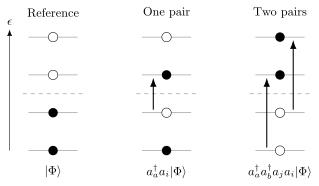
The occupied orbitals are filled circles and empty orbitals are open circles. Moving one fermion gives a one-particle–one-hole intermediate; moving two gives a two-particle–two-hole intermediate. Reference-normal-ordered one- and two-body residuals connect the determinant to the corresponding excitation rank.
Bosonic Occupation Enhancements
Section titled “Bosonic Occupation Enhancements”For bosons, occupation-number states replace a filled Fermi sea. If one mode has occupation ,
and
The square-root factors change perturbative counting. A contact vertex may carry a small coefficient , yet replacing one or more condensate operators by their macroscopically occupied contribution produces factors of .
For example,
At fixed condensate density
this contribution is rather than a small finite correction:
Why the ideal condensate is not the final reference
Section titled “Why the ideal condensate is not the final reference”In a symmetry-breaking displacement,
expanding an interacting Bose gas directly around the ideal condensate produces a hierarchy:
- a zero-body condensate energy of order ;
- linear fluctuation terms of order unless the background satisfies its stationarity equation;
- quadratic normal and anomalous terms that mix creation and annihilation operators;
- cubic and quartic residual interactions.
A number-conserving construction organizes the condensate mode differently but retains the same occupation-enhanced power counting.
Gross–Pitaevskii Equation derives the stationary background. Bogoliubov Theory derives the exact diagonalization of the quadratic fluctuation Hamiltonian and the dilute-gas control parameter.
The perturbative lesson is general:
Macroscopic occupation promotes selected interaction terms to leading order. They must be absorbed into the reference before the remaining residual interaction is counted as small.
Bosons have no Pauli blocking, so low-energy phase space and zero modes can be more infrared sensitive than the corresponding fermionic determinant expansion.
Low-Order Energy and State Corrections
Section titled “Low-Order Energy and State Corrections”For a nondegenerate finite-volume reference, ordinary Rayleigh–Schrödinger theory gives
If the perturbation has been defined as a purely nonconstant normal-ordered residual, then
by bookkeeping. The reference expectation value has already been placed in . If a constant remains in , it must be retained.
The second-order energy is
Using excitation rank,
The first term vanishes for a canonical Hartree–Fock reference. The second is the familiar second-order correlation-energy structure used across electronic, nuclear, and condensed-matter calculations.
Why the factor is one quarter
Section titled “Why the factor is one quarter”With unrestricted labels,
The unrestricted sum counts each unordered occupied pair twice and each unordered unoccupied pair twice. The factor removes the fourfold duplication. If one sums only over and , no such prefactor is needed.
Sign of the second-order energy
Section titled “Sign of the second-order energy”If every connected intermediate determinant lies above the reference in , then
Hence
for the displayed Hermitian coupling. This sign is a useful check, not a theorem for excited-state branches, unstable references, energy-dependent perturbation theories, or effective interactions with different bookkeeping.
First-order state correction
Section titled “First-order state correction”In intermediate normalization,
This formula makes the control problem visible. A small matrix element is not enough; every ratio of a connected matrix element to its energy denominator must be examined, together with the number of states carrying comparable ratios.
Volume Counting in a Uniform Fermi System
Section titled “Volume Counting in a Uniform Fermi System”Consider spinful fermions in a periodic volume :
A translation-invariant two-body interaction can be written as
The factor comes from finite-volume plane-wave normalization. Momentum conservation has already removed one momentum sum.
At second order, a representative two-particle–two-hole contribution has the structure
with spin sums suppressed and
The prefactor assumes unrestricted antisymmetrized pair labels; equivalent conventions rearrange numerical factors.
Why an extensive answer can emerge
Section titled “Why an extensive answer can emerge”For a regular short-range interaction:
- each two-body matrix element contributes ;
- its square contributes ;
- the three independent momentum sums each contribute ;
- a regular denominator is .
Therefore
The energy density
can have a finite thermodynamic limit.
This counting fails if the interaction or denominator is singular. Long-range Coulomb behavior, nesting, van Hove singularities, low-dimensional kinematics, or a soft collective mode can change the power or introduce logarithms.
Pauli blocking is part of the phase space
Section titled “Pauli blocking is part of the phase space”The occupation factors require both initial states to be occupied and both final states to be empty. They are not optional decorations. They:
- restrict intermediate states to allowed particle–hole configurations;
- eliminate many apparent low-energy processes;
- make the geometry of the Fermi surface central;
- change with temperature and with the chosen reference state.
The canonical excitation treatment develops this kinematics in full. Here it determines which perturbative denominators actually occur.
Degeneracy Is the Rule, Not the Exception
Section titled “Degeneracy Is the Rule, Not the Exception”Many-body systems produce several kinds of degeneracy.
Symmetry multiplets
Section titled “Symmetry multiplets”Spin, translation, point-group, or other symmetries can produce exact multiplets. Work in irreducible sectors, then apply degenerate perturbation theory inside any remaining multiplet.
Open shells
Section titled “Open shells”In a finite Fermi system, several orbitals can share the Fermi energy. Different ways of occupying the open shell produce degenerate determinants. Selecting one determinant and inserting zero denominators into a nondegenerate formula is invalid.
The correct first-order problem is
where spans every determinant in the degenerate model space that is connected at the relevant order.
Near-degenerate manifolds
Section titled “Near-degenerate manifolds”If
then the two states must be treated together even if their unperturbed energies are not exactly equal.
For an exactly degenerate unperturbed model space, , the second-order structure is
where and all excluded states are separated from . For a genuinely quasi-degenerate space, retain and the appropriate state-dependent symmetrized denominators; replacing it by can discard splittings of the same order as the interaction. Effective Hamiltonians derives both constructions.
Gapless thermodynamic spectra
Section titled “Gapless thermodynamic spectra”At a Fermi surface or in a system with Goldstone modes, the lowest excitation energy decreases with . A finite system can have a unique ground state while
as .
The ordinary isolated-eigenvalue hypothesis is then not uniform in volume. One should not conclude that all perturbation theory fails. One should instead identify:
- which states are connected by ;
- whether phase space compensates small denominators;
- whether the energy density remains finite;
- which channel requires resummation;
- whether a different quasiparticle or broken-symmetry reference is needed.
Dense spectra do not make every state relevant
Section titled “Dense spectra do not make every state relevant”The full many-body level spacing can be exponentially small in volume. A local few-body perturbation does not couple every pair of eigenstates with equal strength. Symmetry, locality, momentum conservation, and excitation rank strongly restrict connectivity.
The relevant control quantity is not the smallest spacing anywhere in the spectrum. It is the ratio of matrix element to spacing within the states and sectors actually connected to the target.
Linked-Cluster Structure
Section titled “Linked-Cluster Structure”An extensive system exposes a problem hidden in few-level perturbation theory. Naively expanding the state produces products of independent excitations in distant regions. Individual terms can scale as powers of volume larger than one, even though the exact ground-state energy should scale only as .
The cure is not to discard large terms by inspection. It is to organize the expansion so disconnected contributions cancel or exponentiate.
Imaginary-time projection
Section titled “Imaginary-time projection”Use inverse-energy imaginary time here: , , so physical Euclidean time is . For a finite system with
define
As ,
Hence
After dividing by the corresponding reference factor,
The logarithm has the cumulant expansion
Only connected cumulants appear in the logarithm. For a Gaussian Slater reference, Wick’s theorem further resolves these cumulants into linked contraction topologies. The next page develops that diagrammatic language.
Why disconnected vacuum pieces disappear
Section titled “Why disconnected vacuum pieces disappear”Suppose two subsystems do not interact:
Then
Taking the logarithm gives
so
Products in which one perturbation acts independently in and another in occur in the expansion of . They cancel from through the cumulant subtraction. This is the physical core of the linked-cluster theorem.
Size consistency and size extensivity
Section titled “Size consistency and size extensivity”Two related terms should be distinguished:
- size consistency: two infinitely separated subsystems have an energy equal to the sum of their separately calculated energies;
- size extensivity: the energy scales linearly with the number of repeated noninteracting units.
A properly linked perturbative energy is size extensive order by order under its stated assumptions. An arbitrary truncation of the many-body wavefunction need not be, even if it is variational.
What linked does not guarantee
Section titled “What linked does not guarantee”Linked-cluster organization does not guarantee:
- convergence of the series;
- absence of infrared or ultraviolet divergences;
- a correct reference phase;
- conservation laws after an inconsistent truncation;
- accurate spectra or wavefunctions;
- validity at a singular thermodynamic point.
It fixes disconnected volume scaling. Other failures need other reorganizations.
Energy, State, and Observable Expansions Differ
Section titled “Energy, State, and Observable Expansions Differ”The exact energy density can remain smooth even when the exact many-body state becomes nearly orthogonal to the reference.
Fidelity susceptibility
Section titled “Fidelity susceptibility”For a normalized nondegenerate ground state,
The fidelity has the small- form
with
Because the denominator is squared, state overlap is more infrared sensitive than the second-order energy. For an extensive bulk perturbation in a regular correlated phase, often grows as . A local perturbation can have a different scaling, and a perturbation that leaves the eigenvectors unchanged has . For fixed nonzero , the global overlap can vanish as even while local observables change smoothly.
Quantum Phase Transitions develops fidelity susceptibility as a critical diagnostic. Here it shows why wavefunction closeness is too strong a requirement for bulk perturbation theory.
Orthogonality catastrophe
Section titled “Orthogonality catastrophe”A local scattering potential can change the phase shift of every occupied orbital near a Fermi surface. The overlap of the old and new Fermi seas then decays as a power of system size:
The ground-state energy shift can remain finite. Thus a state expansion about can have a singular norm while selected energy differences and local responses remain meaningful after resummation.
Local observables from sources
Section titled “Local observables from sources”For an observable , introduce
When differentiability and normalization conditions hold,
Expanding the linked energy in both and organizes connected contributions to the observable. This is generally safer than inserting an unnormalized truncated state into an expectation value without its norm and operator corrections.
Effective operators matter
Section titled “Effective operators matter”If high-energy states are eliminated by a unitary or similarity transformation, observables must be transformed with the same map:
Using an effective Hamiltonian with the bare projected observable can miss contributions at the same perturbative order as the energy correction.
Infrared Problems
Section titled “Infrared Problems”An infrared problem arises when low-energy modes make denominators, phase-space integrals, or repeated scattering singular.
A small denominator is not sufficient
Section titled “A small denominator is not sufficient”One must combine:
- the denominator’s low-energy scaling;
- the matrix element’s momentum dependence;
- the density of intermediate states;
- Pauli or Bose occupation factors;
- conservation laws and symmetry;
- cancellations among terms.
A gapless spectrum can still have finite perturbative coefficients. Conversely, a logarithmic phase-space enhancement can invalidate fixed-order theory even when no single finite-volume denominator is exactly zero.
Cooper logarithm
Section titled “Cooper logarithm”Near a Fermi surface, repeated scattering of opposite-momentum fermions in an attractive pair channel produces
The effective expansion parameter becomes
not merely . Here is the density of states per spin and per volume in the isotropic two-component pairing convention, while has units of energy times volume. For any fixed attraction, the logarithm grows as . Repeated pair scattering must be resummed, and the normal Fermi-sea reference becomes unstable.
The resulting bound-state and BCS derivations belong to BCS Mean-Field Theory. The lesson here is that an arbitrarily weak bare interaction can be nonperturbative at a sufficiently low scale.
Long-range Coulomb interaction
Section titled “Long-range Coulomb interaction”For a three-dimensional Coulomb interaction,
Small momentum transfer enhances direct perturbative terms. In the high-density electron gas, fixed-order contributions contain infrared singularities even though the final correlation energy is well defined after the leading ring terms are summed.
Random Phase Approximation derives that resummation, screening, and the collective plasmon pole. This example shows why nominal order in the coupling can differ from the physically leading infrared order.
One-dimensional Fermi systems
Section titled “One-dimensional Fermi systems”In one dimension, particle–hole phase space and repeated forward or backscattering generate strong logarithmic structure. The ordinary quasiparticle expansion around a free Fermi sea is generally not the correct low-energy organization. Luttinger Liquid Preview explains the replacement by collective bosonic modes.
Goldstone and critical modes
Section titled “Goldstone and critical modes”If a mode has
as , loop or intermediate-state integrals can be infrared enhanced. Dimension and temperature determine whether the integral is finite. Near a continuous phase transition, a diverging correlation length makes fixed-order expansion around a noncritical reference unreliable.
Large-, renormalization-group, self-consistent, or symmetry-adapted methods can reorganize these fluctuations, but each requires its own control parameter.
Finite size and temperature as regulators
Section titled “Finite size and temperature as regulators”A finite box supplies a lowest nonzero momentum of order . Temperature supplies Matsubara scales and smears a Fermi surface over energies of order . Perturbative expressions may therefore contain
These dependences diagnose the infrared problem. They should not be hidden by reporting only one finite size or temperature.
Ultraviolet Problems
Section titled “Ultraviolet Problems”Short-distance singularities are logically separate from infrared denominators.
Continuum contact interactions
Section titled “Continuum contact interactions”A formal interaction
does not guarantee that perturbative momentum integrals are finite. In two and three dimensions, the bare coupling generally depends on the ultraviolet regulator and must be matched to a scattering observable.
Expanding in a cutoff-dependent bare and then sending the cutoff to infinity can produce meaningless coefficients. Match or renormalize first, then identify the physical small parameter.
Lattice models
Section titled “Lattice models”A lattice supplies a finite Brillouin zone and removes continuum ultraviolet momentum divergence. It does not remove:
- strong local-coupling problems;
- dense low-energy spectra;
- infrared singularities;
- truncation error from omitted bands or orbitals;
- regulator dependence introduced by a later continuum limit.
Effective interactions
Section titled “Effective interactions”Screened, retarded, or low-energy interactions already contain eliminated physics. Their perturbative order must be defined relative to the effective theory, not inferred from the number of microscopic vertices that produced them.
Thermodynamic-Limit Caveats
Section titled “Thermodynamic-Limit Caveats”For finite volume,
may exist within a volume-dependent radius. The desired bulk quantity is
It is not automatic that
Interchanging the sum and limit requires uniform control that often fails near gapless points and phase transitions.
Nonanalytic bulk behavior
Section titled “Nonanalytic bulk behavior”At finite volume, avoided crossings can keep the ground-state energy analytic. In the thermodynamic limit, distinct phases can cross and produce nonanalyticity. Pairing can generate a scale
whose Taylor series at vanishes term by term. No finite-order expansion around the normal state produces this scale.
Correct extensive scaling is necessary, not sufficient
Section titled “Correct extensive scaling is necessary, not sufficient”A coefficient proportional to has the right bulk scaling. It can still:
- diverge with the infrared cutoff;
- depend on an ultraviolet cutoff;
- grow factorially with order;
- describe the wrong phase;
- violate a conservation law under inconsistent truncation.
Boundary conditions and shell effects
Section titled “Boundary conditions and shell effects”Finite-size coefficients can oscillate with particle number or boundary twist because the last occupied shell changes. Useful strategies include:
- closed-shell sequences;
- symmetry-resolved boundary conditions;
- twist averaging for numerical studies;
- explicit finite-size scaling;
- comparing several shape sequences rather than one box.
The extrapolation protocol is part of the perturbative result.
Adiabatic Switching and Its Limits
Section titled “Adiabatic Switching and Its Limits”One formal route to the interacting state turns on the interaction slowly:
Schematically,
The denominator removes disconnected vacuum factors and a divergent phase in the standard construction. The limit requires that the chosen state be connected to the target branch without an obstructing level crossing or uncontrolled degeneracy.
In a many-body system, adiabatic switching can fail or become subtle because:
- the gap closes with volume;
- the reference and target states become orthogonal;
- the interaction changes the phase;
- an infinitesimal source is needed to select a broken-symmetry branch;
- limits , , and do not commute.
The formal switching prescription does not repair a poor reference by itself.
Finite-Temperature Expansion
Section titled “Finite-Temperature Expansion”At temperature , the central object is a trace rather than one eigenstate:
In the interaction representation,
For the displayed fixed-number trace this is the Helmholtz free energy . To obtain a grand potential , replace by and trace over all number sectors. In either case the potential is a logarithm:
Its expansion contains connected thermal cumulants. A quadratic reference in the full grand-canonical Fock trace permits Wick contractions with Fermi–Dirac or Bose–Einstein occupations. A finite fixed- projection is generally non-Gaussian, so this replacement is not automatic. Even in the Gaussian ensemble, thermal energy/free-energy coefficients require the full time integrals and their occupation weights; simply replacing the step functions in a zero-temperature energy formula is not a general derivation.
Finite temperature can regularize some zero-temperature singularities, but it introduces:
- Matsubara zero modes for bosons;
- thermal phase transitions;
- order-of-limits questions between and ;
- analytic continuation if real-frequency response is required.
The full thermal Green-function machinery belongs to the later field-theory bridge and diagrammatic treatment.
When to Reorganize the Expansion
Section titled “When to Reorganize the Expansion”| Diagnostic | Likely response |
|---|---|
| isolated reference with regular denominators | ordinary finite-order perturbation theory |
| exact or near degeneracy among a few states | degenerate or quasi-degenerate model space |
| strong mean one-body field | absorb it into Hartree or Hartree–Fock |
| stable condensate with weak depletion | Gross–Pitaevskii plus Bogoliubov expansion |
| logarithmic pair channel | Cooper or BCS resummation |
| long-range density feedback | RPA or a conserving screened expansion |
| large internal component number | saddle and hierarchy |
| large local repulsion with a low-energy manifold | inverse-coupling effective Hamiltonian |
| repeated short-range scattering | two-body matrix or ladder resummation |
| scale-dependent logarithms across many decades | renormalization-group treatment |
| no small parameter and competing references | cross-method benchmarks or nonperturbative numerics |
Resummation is not “including more terms” in the abstract. It identifies a family of terms enhanced by a physical mechanism and treats that family to all orders.
Exercises
Section titled “Exercises”-
Linked cancellation for separated systems. Let
and define analogously. Expand through second order. Show explicitly that the cross term does not survive.
Solution
First,
Using
gives
The product from is canceled by the cross term in
Equivalently,
-
Open-shell degeneracy. Two orbitals and have the same unperturbed energy, and one fermion occupies the two-dimensional shell. In the basis , the perturbation is
Find the first-order shifts and explain why using either diagonal element alone is not perturbation theory for the degenerate problem.
Solution
The first-order shifts are the eigenvalues of :
The corresponding zeroth-order states are the eigenvectors of this matrix. Choosing and assigning the shift ignores mixing by ; choosing and assigning gives a different arbitrary answer. The unperturbed Hamiltonian did not select either basis vector inside the degenerate shell. The perturbation must be diagonalized there first.
-
Energy versus fidelity denominators. Compare
with
If low-energy states have spectral weight
as , determine the infrared convergence conditions for both quantities.
Solution
At low energy,
This converges at the lower limit when
The fidelity susceptibility behaves as
which converges only when
Thus there is a range
for which the second-order energy is infrared finite while the state overlap is singular.
-
Order of limits. Suppose a finite-size energy-density coefficient behaves as
Here is a fixed length and . Can this define a finite thermodynamic coefficient? How does the correction behave at fixed ? What does the logarithm suggest?
Solution
The coefficient itself is independent of and diverges as grows. Consequently, at fixed nonzero ,
does not exist as a finite number because of the logarithm. The finite-volume coefficient is well defined, but the thermodynamic limit is not uniform at this order.
The logarithm suggests that higher orders may contain powers such as
When
all such terms can become comparable. One should identify the physical channel generating the logarithm and resum or renormalize it before taking the bulk limit. The logarithm alone does not identify which resummation is correct.
References
Section titled “References”- A. A. Abrikosov, L. P. Gorkov, and I. E. Dzyaloshinski, Methods of Quantum Field Theory in Statistical Physics, Dover (1975).
- P. W. Anderson, “Infrared Catastrophe in Fermi Gases with Local Scattering Potentials”, Physical Review Letters 18, 1049–1051 (1967).
- B. H. Brandow, “Linked-Cluster Expansions for the Nuclear Many-Body Problem”, Reviews of Modern Physics 39, 771–828 (1967).
- P. Coleman, Introduction to Many-Body Physics, Cambridge University Press (2015).
- L. N. Cooper, “Bound Electron Pairs in a Degenerate Fermi Gas”, Physical Review 104, 1189–1190 (1956).
- F. J. Dyson, “Divergence of Perturbation Theory in Quantum Electrodynamics”, Physical Review 85, 631–632 (1952).
- A. L. Fetter and J. D. Walecka, Quantum Theory of Many-Particle Systems, Dover (2003).
- M. Gell-Mann and F. Low, “Bound States in Quantum Field Theory”, Physical Review 84, 350–354 (1951).
- M. Gell-Mann and K. A. Brueckner, “Correlation Energy of an Electron Gas at High Density”, Physical Review 106, 364–368 (1957).
- J. Goldstone, “Derivation of the Brueckner Many-Body Theory”, Proceedings of the Royal Society A 239, 267–279 (1957).
- N. M. Hugenholtz, “Perturbation Theory of Large Quantum Systems”, Physica 23, 481–532 (1957).
- T. Kato, Perturbation Theory for Linear Operators, 2nd ed., Springer (1995).
- G. D. Mahan, Many-Particle Physics, 3rd ed., Springer (2000).
- J. W. Negele and H. Orland, Quantum Many-Particle Systems, Westview Press (1998).
- I. Shavitt and R. J. Bartlett, Many-Body Methods in Chemistry and Physics, Cambridge University Press (2009).