

Berry Curvature in Band Dynamics
A Bloch wave packet responds to its eigenvectors as well as its band energy. Berry curvature adds a transverse velocity; the packet’s orbital magnetic moment shifts its energy; and both enter the density and current carried by occupied states. The calculation below develops these related effects for an isolated nondegenerate band in weak, slowly varying electromagnetic fields, with explicit solutions for uniform fields. Local curvature alone does not determine a topological phase or a measured transport coefficient.
Required background. Semiclassical Dynamics of Bloch Electrons supplies the packet and its validity conditions. Berry Curvature supplies the gauge geometry, whose general derivation remains there.
Helpful background. Chern Numbers in Band Theory supplies the full-zone invariant; Hall Effect supplies the transport and measurement distinctions needed after calculating an intrinsic contribution.
Band curvature and orbital magnetic moment
Section titled “Band curvature and orbital magnetic moment”Let , with the cell inner product understood. Use the volume conventions: is signed charge, electrons have , , and
The electromagnetic vector potential below is a different object from the Berry connection . Electromagnetic formulas use SI units; is a wavevector, so has units of length squared.
The packet can circulate about its own center. Its orbital magnetic moment is
For example,
The factors of remove the gauge-dependent derivative component parallel to . Thus is unchanged by and by a constant shift of all energies. This moment is neither the spin Zeeman moment nor the total equilibrium magnetization of an occupied crystal.
The first magnetic energy correction is
A separate spin or other field coupling, when retained by the model, must be included with its own operator and normalization. The orbital formula does not supply an unspecified effective factor.
Interband matrix elements without real transitions
Section titled “Interband matrix elements without real transitions”In a fixed orthonormal representation, differentiating the eigenvalue equation gives
Consequently,
The curvature has two energy-gap denominators. The moment has one fewer after insertion of . An avoided crossing can therefore concentrate both quantities with different momentum profiles.
These are virtual interband contributions to a single-band effective description. They do not mean that a packet has undergone a real Landau–Zener transition. Conversely, a small denominator warns that the single-band approximation needs a stronger adiabaticity test.
An orbital basis that depends on needs its basis connection. Differentiating only a transformed finite matrix can omit embedding or position-matrix elements. The Wannier and Bloch-symmetry treatments fix those representation choices; a change of orbital basis must not change the physical answer.
Geometric terms in the packet equations
Section titled “Geometric terms in the packet equations”For a slowly varying field and a time-independent unperturbed band, the local wave-packet Lagrangian is
A Berry gauge change alters by , a total time derivative. An electromagnetic gauge change also contributes only a total derivative. The equations therefore depend on the two curvatures, not on the gauge choices. This wave-packet construction and its gradient expansion were developed by Sundaram and Niu (1999).
Variation with respect to and gives
The last gradient is at fixed and excludes the electrostatic term already in . It includes a force from an inhomogeneous orbital-moment energy. Spatially varying band parameters can also generate mixed real-space/momentum-space Berry curvatures; that more general problem is outside the uniform-band formulas used here.
At in a uniform electric field,
The second term is the anomalous velocity. It need not point along and does no electrical work: its scalar product with vanishes. A band extremum with zero group velocity can still have a transverse geometric drift.
Solving the coupled electric and magnetic equations
Section titled “Solving the coupled electric and magnetic equations”For spatially uniform fields, define
Solving the two coupled equations yields
One way to check the first result is to take the scalar product of the velocity equation with : . Then use the vector triple-product identity in the force equation. For , .
These rational expressions solve the displayed truncated equations; they do not make the underlying field expansion exact at arbitrarily large . Expand an observable consistently to its claimed field order. In particular, is a breakdown warning, not a predicted infinite velocity in a controlled band theory.
Phase-space density and occupied states
Section titled “Phase-space density and occupied states”The coordinates are not canonical conjugates once both Berry curvature and a magnetic field enter. The symplectic form read from has real-space magnetic, momentum-space Berry and mixed blocks. Its determinant gives, on the weak-field branch , the state-counting measure
For , use the normal components in . The phase-space conservation law is
in a smooth, collisionless, source-free patch of the band description. Thus Liouville conservation holds for the modified measure. The ordinary volume need not be conserved. Xiao, Shi and Niu (2005) derive the associated state-density correction.
For an equilibrium occupation, particle number per physical -volume is
Every actual band, including resolved spin or valley labels, is counted once. Insert a degeneracy factor only for equivalent copies not already in the sum. This is a bulk density; a cell-normalized quantity has the corresponding cell-volume factor.
For , let and . To first order at fixed ,
The first term changes the measure; the second shifts the energies and therefore the occupations. At fixed particle density, the chemical potential must also move. If the compressibility is nonzero, the number constraint gives
This expression is evaluated at zero field and applies to a metal or a thermally compressible state. It cannot be used by dividing by zero in a zero-temperature band gap. In particular, a filled Chern band changes its state density with field even while the chemical potential stays in the gap. An isolated sample at fixed bulk density cannot keep that band exactly filled merely by moving the chemical potential within the same gap; the exercise below explains the distinction.
From packet motion to a physical response
Section titled “From packet motion to a physical response”At , the occupation-weighted anomalous velocity gives the intrinsic charge-current contribution
With ,
In a two-dimensional independent-particle insulator at zero temperature, complete occupied bands give for the stated electron and Berry conventions. The invariant and its hypotheses belong to Chern Numbers in Band Theory. In a metal the occupation-weighted integral is generally not quantized. It also omits collision-dependent side-jump and skew-scattering contributions; the Hall Effect page compares those mechanisms.
Time reversal pairs opposite curvatures at opposite momenta, so a time-reversal-invariant equilibrium occupation cancels this charge Hall term. Inversion instead pairs equal curvatures. For an isolated nondegenerate band preserved by both symmetries, these constraints force zero curvature. With spinful time reversal, track the partner bands and Kramers degeneracies; do not impose a scalar one-band argument at an unresolved degeneracy.
Circulating current is not terminal transport
Section titled “Circulating current is not terminal transport”An orbital moment produces local circulation. Magnetization currents can be present even when no charge is transported between contacts. The transport current subtracts the appropriate equilibrium magnetization current from the local current; thermal-response calculations require the corresponding energy-magnetization subtraction as well.
Even equilibrium orbital magnetization is not merely . For a clean independent-band model, the weak-field grand-potential density is
Differentiating at zero field gives
At zero temperature, . The second term comes from the field-dependent state density. This formula concerns the orbital equilibrium contribution of the model; it is not a spin susceptibility or a complete interacting-material magnetization. Xiao, Chang and Niu (2010) discuss these distinctions and the transport-current subtraction.
Worked example: a massive Dirac patch
Section titled “Worked example: a massive Dirac patch”Consider the two-dimensional local model
where is constant, and . This is a local avoided-crossing model; it does not define a whole Brillouin torus. Its two energies are
The two-level projectors or interband matrix elements give
The two curvatures have opposite signs. The orbital moments have the same sign: their extra interband energy difference also changes sign between the bands. Equivalently,
Using in place of would incorrectly make a constant energy offset change the magnetic moment. This relation is special to the two-band model; it is not a general replacement for the moment formula in a multiband crystal.
For , the upper band at has negative curvature. An electron in a field therefore has
The packet velocity and charge current point in opposite directions. The negative orbital moment also raises this band’s energy for . These provide independent charge-sign checks.
Writing , the normalized profiles are
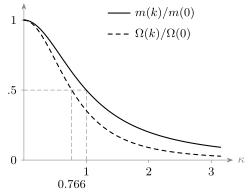
The same avoided crossing produces two different profiles. Dividing each quantity by its value at removes its sign and units: the moment falls as , while the curvature falls faster, as . Their half-maximum radii are and . Curvature alone therefore does not specify the orbital moment.
Validity near degeneracies and in real materials
Section titled “Validity near degeneracies and in real materials”The isolated-band criteria must hold along the packet’s significant momentum region and trajectory. A useful field-driven adiabatic parameter for every other band is
The packet must also resolve a slow external field, and the magnetic energy corrections must remain small compared with the relevant isolation scales. Conditions such as check the measure expansion but do not replace these spectral and spatial tests.
Near a degeneracy. Use a retained multiband subspace with matrix Berry geometry and internal state evolution when splitting that subspace into separate adiabatic bands is invalid. Singular single-band curvature at a touching is not a controlled trajectory through that touching.
With scattering or interactions. A collision operator, lifetime, vertex correction or quasiparticle approximation must be supplied where it is needed. Berry curvature does not create a relaxation time, and a Kohn–Sham band is not automatically the measured quasiparticle dispersion.
With resolved magnetic quantization. Continuous phase-space counting describes a smooth semiclassical contribution. It does not replace Landau levels or their oscillatory occupations. Use Landau Levels in Solids for that comparison.
With spatial textures or time-dependent band parameters. Mixed Berry curvatures and additional forces can enter. Reusing the uniform-field equations while omitting those terms changes the approximation.
Exercises
Section titled “Exercises”1. A signed drift and measure check
Section titled “1. A signed drift and measure check”Use dimensionless units , , . For the upper Dirac band at , take , . Find , , , and from the displayed equations. Distinguish the rational result from an expansion to a chosen order in the fields.
Solution
Here , and . The group velocity including the moment correction vanishes at this symmetric point, and the planar solution gives
This is the algebraic solution of the truncated equations. If keeping only terms linear in the overall field amplitude, the answer is ; the correction from expanding is of order . A calculation retaining that cross term must state which other contributions at the same order it includes.
2. A half-flux is not a lattice Chern number
Section titled “2. A half-flux is not a lattice Chern number”Integrate the upper-band Dirac curvature over a disk . Why does its limit not establish a half-integer Chern number for a two-dimensional crystal?
Solution
The radial integral gives
Its infinite-plane limit is . The continuum patch supplies neither a compact Brillouin torus nor the ultraviolet completion of the occupied bundle. Other momenta and bands in a lattice model determine the full integer invariant. The finite-disk quantity is useful geometric flux, not a topological classification of the crystal.
3. State counting in a filled Chern band
Section titled “3. State counting in a filled Chern band”For one fully occupied two-dimensional band at zero temperature, with the chemical potential remaining in a gap, use the measure correction to find . Compare with the intrinsic Hall formula. Can a fixed-density sample remain in this gap for a continuous range of fields when ?
Solution
There is no Fermi-surface occupation term inside the gap. Since ,
For electrons the first derivative is , while . At fixed chemical potential, a reservoir can supply this changing particle density. At fixed bulk density and zero temperature, shifting within the gap changes no occupations, so it cannot compensate the nonzero derivative when . The clean homogeneous system must leave exact integer filling or change its state. Localized in-gap states, when present, modify this simple clean-band picture.
This is the insulating thermodynamic consistency check. In a metal, the occupation shift and Fermi-surface transport terms prevent identifying this one derivative with the whole measured Hall response.
4. Curvature does not determine a terminal measurement
Section titled “4. Curvature does not determine a terminal measurement”A time-reversal-invariant crystal has two valleys with opposite Berry curvature. A calculation finds large curvature in each valley. State what follows for equilibrium charge Hall response, and what additional information is needed for a valley-selective transport claim.
Solution
Equal equilibrium occupations of time-reversed partners cancel the intrinsic charge Hall integral. Large local curvature is compatible with zero charge Hall conductivity. A valley Hall current can nevertheless exist at equal valley populations: the opposite transverse particle currents cancel in the charge sum but add in a valley-current difference. Such a claim needs a definition of valley current, intervalley relaxation, boundary conditions and a probe that couples to the proposed signal. A net charge Hall signal produced by selecting these time-reversed valleys additionally requires broken occupation balance or another source of time-reversal breaking. Band geometry alone establishes neither the preparation nor the terminal response.
References
Section titled “References”- Sundaram, Ganesh, and Qian Niu. “Wave-packet dynamics in slowly perturbed crystals: Gradient corrections and Berry-phase effects.” Physical Review B 59, 14915–14925 (1999). doi:10.1103/PhysRevB.59.14915. The wave-packet Lagrangian and electromagnetic gradient corrections.
- Xiao, Di, Ming-Che Chang, and Qian Niu. “Berry phase effects on electronic properties.” Reviews of Modern Physics 82, 1959–2007 (2010). doi:10.1103/RevModPhys.82.1959. Orbital moments, magnetization, semiclassical dynamics and response qualifications.
- Xiao, Di, Junren Shi, and Qian Niu. “Berry phase correction to electron density of states in solids.” Physical Review Letters 95, 137204 (2005). doi:10.1103/PhysRevLett.95.137204. Modified state counting and its thermodynamic consequences.