

Band Inversion
Band inversion means that the ordering of specified band characters differs from a declared reference ordering. The characters may be orbital projections, symmetry representations, or a combination of both. An inversion can explain why a low-energy model changes, why hybridization becomes important, or where a topological transition might occur. It is not itself a topological invariant.
The useful question is therefore precise: which states exchange which character, at which momentum, relative to which reference, while which symmetries and gaps remain intact? We answer that question using Hermitian band Hamiltonians, first at one momentum and then for the occupied bands across the crystal.
Required background. Band Theory Overview supplies energies, eigenvectors, filling and gap definitions. Symmetry of Bloch States supplies the little-group labels and selection rules used to decide whether mixing is allowed.
Helpful background. Topological Insulators supplies the insulating classifications; Topological Phase Transitions supplies the global continuity and gap-closing arguments.
Band character and the reference ordering
Section titled “Band character and the reference ordering”An energy-sorted band index is not a character label. At an avoided crossing, the lower eigenvalue stays the lower eigenvalue while its orbital composition can change almost completely. Conversely, an exact symmetry label may follow a branch straight through a crossing, so its energy rank changes.
A reference might be an atomic limit, a particular composition, a thin quantum well, or the same calculated structure with a coupling changed. Keep the orbital subspaces, symmetry labels and momentum being compared fixed while varying that parameter. There is no universal “normal” ordering independent of the reference.
For a fixed physical orbital subspace , define an orthogonal projector and the weight
This weight is invariant under a phase choice for the eigenstate. Under a change of representation, both the eigenvector and must transform; then the weight is unchanged. Changing the physical orbital subspace or the projector construction changes the diagnostic. Overlapping atomic projectors in a nonorthogonal basis require their own normalization and overlap metric, and do not automatically form a set of probabilities summing to one.
Within an exactly degenerate multiplet, individual eigenvectors can rotate. Their separate orbital weights need not be unique. A subspace quantity such as , with the projector onto the isolated multiplet, avoids that arbitrary band-by-band assignment.
An exact inversion parity or rotation eigenvalue is stronger information than “mostly -like.” It is defined only on the relevant invariant momentum locus, using the crystal’s symmetry operation, orbital embedding and reciprocal sewing. In a crystal with more than one orbital center, atomic angular momentum alone does not determine every Bloch parity label. Keep the convention fixed along the comparison.
A coupled pair can exchange character without closing
Section titled “A coupled pair can exchange character without closing”Apply the two-band spectrum from Band Theory Overview at one selected momentum. In a fixed orthonormal basis , write
All three quantities have units of energy. The uncoupled ordering is set by , while mixes the two basis states. The exact energies are
The additional question here is how character follows those energies. For the eigenprojectors are . With , the lower-state character is
For positive much larger than , the lower state is mostly . For large negative , it is mostly . At and nonzero , the two characters are equally mixed. The spectral gap there is , so the exchange can occur smoothly with no degeneracy.
The Hellmann–Feynman check is particularly useful:
where are held fixed in this derivative. Energies and projected characters therefore provide an independent consistency test of a fitted two-band model.
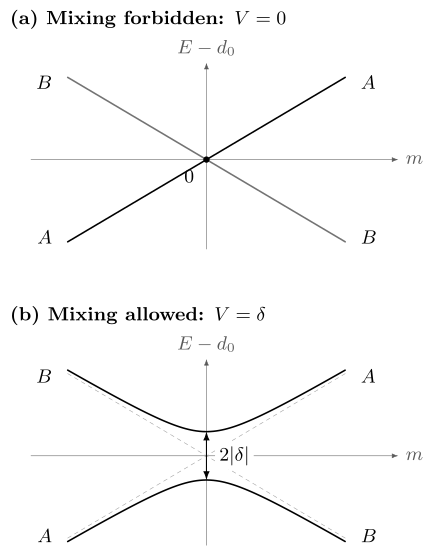
At one specified momentum, tuning reverses the uncoupled ordering. The upper panel has ; the lower has a fixed real . Dashed lines in the lower panel show the uncoupled energies. The end labels indicate dominant character. The avoided crossing exchanges that character without closing the gap; it is allowed only if the retained symmetry representations permit mixing.
Numerical example: a strong character exchange with a finite gap
Section titled “Numerical example: a strong character exchange with a finite gap”Let and , with tuned from to . At the endpoints,
The lower-state weight changes from approximately to , yet the minimum gap along the entire path is . Calling this an orbital-character inversion is reasonable after specifying the reference. Calling it a topological transition from these data alone is not: the displayed family stays nondegenerate, and it has supplied neither a full Brillouin-zone Hamiltonian nor an occupied-band invariant.
There is even a complete atomic counterexample. Put two orbitals transforming in the same onsite symmetry representation in every cell, retain this same matrix in every cell, and set all intercell hopping to zero. Take the orbitals at the same declared center and occupy the lower state once per cell in a spinless model. The occupied states remain localized onsite throughout the tuning path. Their composition can reverse almost completely, while the model stays a gapped atomic insulator. The labels need not be opposite inversion parities.
Symmetry decides whether the crossing can be avoided
Section titled “Symmetry decides whether the crossing can be avoided”Suppose and have different eigenvalues of a unitary symmetry that leaves the selected momentum invariant. The selection rule derived in Symmetry of Bloch States forbids their mixing on that locus. In the simplest opposite-parity example, inversion acts as at an inversion-invariant momentum. Then
The two levels can cross as passes through zero. For the lower occupied state, the parity changes from at to at . The selection rule protects a crossing if the energies meet; it does not force to vanish for a particular material or tuning range.
A constant term opens a gap at this crossing, but it breaks this particular inversion symmetry. It is not an inversion-preserving detour between opposite-parity states. If the two states instead carry the same symmetry representation, such a matrix element may be allowed. Comparing these two cases prevents an apparent contradiction between the avoided-crossing example and symmetry-protected transitions.
Away from the invariant momentum, inversion generally relates and rather than furnishing a parity label within one generic fiber. Opposite-parity basis states can then couple through momentum-odd terms. For example,
obeys when is even. Here has units of energy times length and of energy times length squared. This two-component example demonstrates the local coupling structure; it does not by itself implement spinful time reversal or describe a quantum spin Hall insulator.
Spin–orbit coupling can shift relative levels, mix states with compatible spinful representations, and gap crossings that were protected only in a model without that coupling. One must recompute the relevant representation labels and allowed terms. Merely turning a numerical spin–orbit parameter on and seeing changed colors in a band plot is not a classification. Spin–Orbit Coupling in Solids explains those microscopic and symmetry changes.
From a local inversion to a global topological claim
Section titled “From a local inversion to a global topological claim”The sign of a local Dirac mass has meaning relative to a basis, an orientation and a completion outside the fitted momentum patch. Relabeling and changes the sign assigned to ; the symmetry matrices and the rest of the Hamiltonian change with it. A physical invariant cannot depend on that relabeling.
Even with a fixed basis, the displayed continuum model does not specify the full crystal. Its large-momentum behavior depends on and on omitted terms. Two lattice completions can agree near one avoided crossing but differ elsewhere in their occupied projectors. A local fit therefore cannot replace the full-zone invariant. The explicit curvature example in Berry Curvature in Band Dynamics shows the related failure of treating one continuum cone’s half-flux as a lattice Chern number.
There is a powerful conditional shortcut. For a gapped independent-electron insulator with spinful time reversal and inversion, Fu and Kane (2007) express the two-dimensional index through parity data:
The product uses one parity eigenvalue from each occupied Kramers pair at each of the four time-reversal-invariant momenta . Ordinary inversion commutes with time reversal, so the partners have the same parity. An exchange of one occupied and one empty opposite-parity pair flips one factor. Two such exchanges can cancel in this index. Counting both members separately would square each parity and erase the information.
In three dimensions, the product over all eight such momenta gives the strong index, while products over specified planes give the weak indices. Unchanged strong index does not prove that all weak or crystalline distinctions are unchanged. Without inversion, the parity shortcut is unavailable; the time-reversal invariant can still exist. Without a full insulating gap at the intended filling, the insulating interpretation needs separate qualification. Topological Insulators develops the invariant beyond the parity shortcut.
Bernevig, Hughes and Zhang (2006) supply a concrete material setting: tuning the thickness of a HgTe/CdTe quantum well exchanges electron-like and hole-like subband order in an effective spinful model. Their quantum spin Hall conclusion uses that model’s symmetry, global topological structure and boundary spectrum, not the word “inverted” alone. A material example makes the diagnostic useful; it does not remove its hypotheses.
What a band plot can establish
Section titled “What a band plot can establish”Three distinct observations are often compressed into a single claim: exchanged character, reopened local direct gap, and insulating topological response. Keep the evidence for each one visible.
| Observation | What it establishes | What is still needed |
|---|---|---|
| Projected orbital weights exchange | A change relative to the declared projectors and reference | Symmetry labels, robustness to projector construction, and the physical gap |
| Opposite symmetry sectors cross | Mixing is forbidden on the specified invariant locus | A tuning parameter that actually reaches the crossing and the full occupied-state diagnosis |
| A plotted direct gap reopens | Separation along the plotted momenta | Full-zone direct and indirect gaps, the intended filling and an invariant |
| The total Fu–Kane parity product changes | A change under the stated Fu–Kane hypotheses | Verification of those hypotheses and the correct occupied Kramers pairs |
| A boundary-like spectral feature appears | A feature localized near a chosen termination in that calculation or probe | Its bulk connection, protecting symmetry and separation from ordinary surface resonances |
A positive direct separation at every momentum does not ensure insulating occupation: the bottom of the upper band may lie below the top of the lower band at another momentum. An isolated lower-band projector can still carry geometric data in that case, but they are not automatically the response of the metallic ground state. The explicit examples in Band Gaps separate this indirect overlap from a true insulating gap.
Reordering occupied states need not change the occupied subspace
Section titled “Reordering occupied states need not change the occupied subspace”If two states within the occupied subspace exchange order while staying separated from empty states, their individual labels may rearrange without changing the total occupied projector. A topological classification of that occupied subspace does not change just because the energy ordering inside it changes. Track the gap across the intended occupation boundary, not every crossing in the spectrum.
Photoemission intensity depends on matrix elements and accessible occupied states; a local tunneling gap does not resolve every momentum-dependent band character. Combining these measurements with calculations requires the same crystal structure, magnetic state and energy reference. Band-Structure Workflows explains that comparison in detail.
Exercises
Section titled “Exercises”1. Character weights and an energy derivative
Section titled “1. Character weights and an energy derivative”In the coupled-pair model, set , and . Find the gap, lower-state weight and at fixed . Would changing the phase of alone change these answers?
Solution
, so the gap is and . The derivative is , equal to . These quantities depend on , so a phase change alone leaves them unchanged. Other observables can depend on phases relative to additional matrix elements in a larger model; the conclusion concerns this isolated two-state diagnostic.
2. Which perturbation removes the crossing?
Section titled “2. Which perturbation removes the crossing?”At a symmetry-invariant momentum, let the symmetry matrix be and . Test whether a constant real preserves . Find the gap at if this perturbation is present.
Solution
, so a nonzero breaks the specified symmetry. It gives eigenvalues at and gap . The unperturbed crossing is protected against perturbations preserving , not against arbitrary symmetry-breaking terms. This is the same representation selection rule used for crystalline crossings, independently of the particular symmetry’s name.
3. One inversion or two?
Section titled “3. One inversion or two?”A two-dimensional time-reversal- and inversion-symmetric band insulator has occupied-pair parity products at its four invariant momenta. Compare two gapped endpoints with products and . What follows about their indices, and what does not follow?
Solution
The initial product is , so . The first endpoint has product , hence ; the second has product , hence . The first must differ from the initial state in this invariant under the stated hypotheses. The second has the same index, but that does not prove equivalence under additional crystalline constraints or supply a symmetry-preserving interpolation. The endpoint parity data also do not establish the detailed spectrum along a proposed tuning path.
4. A representation change cannot invert a physical orbital
Section titled “4. A representation change cannot invert a physical orbital”Take the state and physical projector . Apply to the representation of both the state and projector. Compare the properly transformed weight with the result of rotating only the state.
Solution
The consistent transformation gives
If the projector is incorrectly held fixed, the reported value becomes . That change compares different physical projectors rather than different representations of the same question. It is not evidence for a material inversion.
References
Section titled “References”- Bernevig, B. Andrei, Taylor L. Hughes, and Shou-Cheng Zhang. “Quantum spin Hall effect and topological phase transition in HgTe quantum wells.” Science 314, 1757–1761 (2006). doi:10.1126/science.1133734; author preprint. A material-specific subband inversion and its effective-model topological diagnosis.
- Fu, Liang, and C. L. Kane. “Topological insulators with inversion symmetry.” Physical Review B 76, 045302 (2007). doi:10.1103/PhysRevB.76.045302; author preprint. The conditional parity criterion, including the distinction between strong and weak indices.