

Dephasing and Amplitude Damping
Population relaxation and loss of phase coherence affect different parts of a qubit’s density matrix. When matched exponential decay measurements support a constant-rate model, and determine a finite-time channel after its equilibrium population and coherent phase are specified. Relaxation already destroys some coherence, so adding dephasing requires subtracting that contribution once. This page works through the conversion, its exact physicality condition, and the limitations of composing fitted channels.
Helpful background. Quantum channels introduces Kraus and Choi representations; dephasing versus dissipation explains population flow versus coherence loss. Hardware metrics describes how measured decay times depend on the experimental protocol.
Population relaxation and complex coherence
Section titled “Population relaxation and complex coherence”Use the energy basis with lower and upper, and
Consider the finite-time family
with , , and complex subject to the positivity bound below. Here contracts the population difference from equilibrium; is the fixed excited population, not automatically a temperature. The complex factor both attenuates coherence and rotates its phase. These maps commute with rotations about , a property called phase covariance. This restricted relaxation family is not a parameterization of every phase-covariant qubit channel; some other finite channels have negative longitudinal eigenvalues.
For , the population fixed point is unique. At , populations are unchanged and drops out of the map. A qubit channel is also inappropriate if appreciable population leaves the two chosen levels: include leakage explicitly instead of silently renormalizing the surviving population.
Writing and gives
For positive , input acquires positive : yields . Checking both quadratures catches a phase-sign error that a coherence-magnitude fit cannot.
From transition rates to a finite channel
Section titled “From transition rates to a finite channel”In a constant-rate two-level model, the excited population obeys
For ,
Thus alone fixes the sum of rates, not their ratio. Knowing as well gives and . If both rates vanish, populations do not relax and no population fixed point is selected. A thermal interpretation additionally requires detailed balance and suitable bath assumptions.
Put . Generalized amplitude damping is a mixture of downward and upward damping, with Kraus operators
Their completeness sum is . They produce the stated population update and coherence factor , regardless of . At only the first pair remains, giving zero-temperature amplitude damping. At , population relaxation is unital even though energy exchange occurs. A Kraus label represents a particular realization; it need not be a physically observed jump unless the environment is measured accordingly.
Adding pure dephasing once
Section titled “Adding pure dephasing once”For a matched constant-rate relaxation-plus-dephasing model,
Amplitude damping already gives on coherence. The additional dephasing channel must therefore use
Using again as the additional factor would count relaxation twice. Nonnegative pure-dephasing rate implies in this model. A violation in fitted central values warrants checking uncertainties, levels, pulse sequences, operating conditions and fit functions; it should not be repaired by silently clipping a reported time.
The dephasing pair , has . For ,
An alternative phase-damping convention uses . Complete dephasing means , not : the latter applies a unitary and preserves coherence magnitude. Negative real coherence factors are also valid phase-flip mixtures, with ; alternatively one can factor off a unitary and retain a nonnegative attenuation. See dephasing channels for the constructions.
For finite positive , is the additional attenuation only if it is at most one. At the complete-relaxation endpoint , this quotient is undefined; use the channel itself rather than dividing by zero.
Exact physicality versus constant-rate interpolation
Section titled “Exact physicality versus constant-rate interpolation”Use the unnormalized output–input Choi convention from quantum channels, in basis . Define
Applying the map to matrix units gives
Tracing out the output gives . The two isolated eigenvalues are nonnegative. The remaining two-dimensional block is positive precisely when
This is the exact one-step complete-positivity condition, including the endpoints (Ruskai, Szarek, and Werner, 2002). The constant-rate construction above obeys the stronger condition . At zero temperature the two bounds coincide; for an interior fixed population they differ.
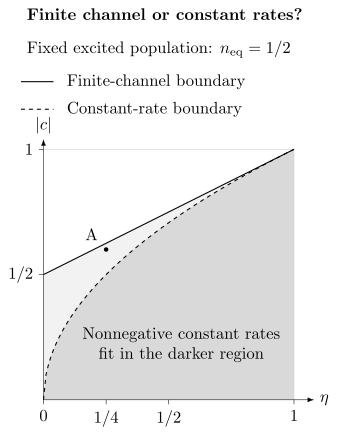
At , a finite channel permits (solid boundary). Constant nonnegative relaxation and pure-dephasing rates require (dashed boundary). Point A, , is a valid finite channel in the narrow region between them. It does not admit the proposed constant-rate interpolation with these parameters.
For point A, the Choi eigenvalues are , , , and , all positive. Trying to interpolate exponentially to half the duration gives
That candidate fails the half-time Choi bound. A physical endpoint does not justify an arbitrarily chosen interpolation. Nor does this example exclude every possible physical path to the endpoint; it rejects the specific matched constant-rate construction.
Worked thermal idle and observable predictions
Section titled “Worked thermal idle and observable predictions”Take , , , zero coherent phase, and duration . Then
The input Bloch vector becomes
Hence and . Six decimals are shown for readability; the exact exponential expressions define the calculation.
The same map predicts both population-preparation experiments:
Their difference equals , which separates relaxation from the fixed-population offset. With the same rates at all times, the predictions below are rounded to six decimals.
| Duration () | ||
|---|---|---|
For the identity target, the raw average gate fidelity is
Applying the phase correction replaces by . That is the fidelity of the corrected idle, not the uncorrected one. For this zero-phase example both are approximately . The translation does not enter this Haar average, even though it matters strongly for the population predictions. An average fidelity alone therefore cannot determine .
Composing intervals in the right order
Section titled “Composing intervals in the right order”For two valid intervals in the same basis, their composition has
Equal fixed points reduce the translation to . Four identical applications in the worked example give , and .
Different fixed points make order matter even for ordinary memoryless maps. If both contractions equal , applying A then B minus B then A changes the translation by . Noncommutation alone is not a memory witness.
A basis-changing gate also requires full matrix composition. In Pauli order the channel matrix is
An ideal gate between the intervals gives , not a scalar product of relaxation factors. For example, a Hadamard turns a preceding translation into an translation. Even correctly multiplying finite maps predicts a real repeated experiment only when each map remains applicable after the earlier operations; environmental memory can invalidate that premise.
Ramsey decay, echo and divisibility
Section titled “Ramsey decay, echo and divisibility”A Ramsey decay time, a Hahn-echo decay time and a dynamical-decoupling decay time describe different pulse sequences. Echo refocuses static detuning, while finite-frequency noise and pulse errors need not cancel (Hahn, 1950; Cywiński et al., 2008). State the sequence and fit function when using or ; changing the sequence does not merely improve an estimate of one universal constant.
For a Gaussian-distributed static detuning with variance ,
Every finite-time dephasing map is CPTP, but for positive : the maps do not form a time-homogeneous semigroup. With ,
Nevertheless this family is CP-divisible. For , the coherence ratio
defines a CPTP intermediate dephasing map. The same unperturbed family also solves the time-local equation
These one-time facts do not establish absence of memory under interventions (Milz et al., 2019). In the static-detuning realization, an ideal midpoint pulse reverses the second half’s phase and produces a perfect echo, apart from the known pulse. Composing only the averaged divisible maps around that pulse instead predicts the same attenuation as without echo. The intervention distinguishes processes sharing identical unperturbed maps. Markovian and non-Markovian noise develops the multitime description.
When checking a fitted channel, use both ground/excited preparations and transverse states, and measure both transverse quadratures. Compare new durations and relevant operating contexts while accounting for preparation and readout errors. A new pulse sequence requires a model of how the pulse acts on the process; independently fitting its decay curve is not a prediction of that sequence from the original .
Exercises
Section titled “Exercises”1. Convert dephasing conventions
Section titled “1. Convert dephasing conventions”For , calculate and and identify complete dephasing and unitary- endpoints.
Solution
and . Complete dephasing has , , . At , the coherence factor is : its sign changes but its magnitude remains one.
2. Solve the thermal population equation
Section titled “2. Solve the thermal population equation”Derive the fixed population and finite-time solution for constant upward and downward rates, including the zero-rate case.
Solution
For , setting gives . Subtracting this value yields , so
For both nonnegative rates vanish, giving ; the ratio defining is then undefined and unnecessary.
3. Reproduce the thermal idle
Section titled “3. Reproduce the thermal idle”For the worked interval, find the output density matrix, average fidelity and result after four identical intervals.
Solution
With the output Bloch coordinates already derived, the density matrix has diagonal entries approximately and upper off-diagonal entry . The lower entry is its conjugate. Its average idle fidelity is .
After four intervals,
These repeated-use predictions require the same channel to remain applicable between intervals.
4. Check an endpoint and its proposed square root
Section titled “4. Check an endpoint and its proposed square root”For , , , check complete positivity. Then test the candidate half-time parameters with the same fixed point.
Solution
The endpoint Choi block has diagonal entries and off-diagonal entries . Its eigenvalues are and ; the other two are . At half time the block diagonal is and off-diagonal is , so one eigenvalue is . The endpoint is physical, but this proposed square root is not CP. No conclusion about all other possible interpolations follows.
5. Compose different fixed points
Section titled “5. Compose different fixed points”Take two maps with , one with and one with . Compare both orders.
Solution
A then B gives ; B then A gives . Their difference is in the first-minus-second convention. Contracting an earlier translation by the later map causes the order dependence.
6. Separate three statements about decay
Section titled “6. Separate three statements about decay”For Gaussian , determine whether each finite map is CPTP, whether the family is a time-homogeneous semigroup, and whether it is CP-divisible. Can those answers alone predict the static-detuning echo?
Solution
Each finite map is CPTP because . The family is not a semigroup since the exponent contains , not . It is CP-divisible because for . None of these answers specifies the response to an intervening pulse. For static detuning, for every , so the phase refocuses exactly. The averaged time-local description without that environmental correlation predicts residual attenuation instead.
7. Extract phase as well as attenuation
Section titled “7. Extract phase as well as attenuation”Assume calibrated preparations/readout and the stated phase-covariant family. At one duration measure , , and output from . Find , raw fidelity and ideally phase-corrected fidelity.
Solution
The population difference gives , then . Since for this input, . Thus and . The CP bound is satisfied: .
Raw fidelity is . Applying gives . This higher number assumes the phase correction is actually implemented. Measuring as well tests the assumed transverse rotation symmetry rather than merely refitting these three parameters.
References
Section titled “References”- H.-P. Breuer and F. Petruccione, The Theory of Open Quantum Systems, Oxford University Press, 2002, doi:10.1093/acprof:oso/9780199213900.001.0001.
- L. Cywiński, R. M. Lutchyn, C. P. Nave, and S. Das Sarma, “How to enhance dephasing time in superconducting qubits,” Physical Review B 77, 174509 (2008), doi:10.1103/PhysRevB.77.174509.
- E. L. Hahn, “Spin echoes,” Physical Review 80, 580–594 (1950), doi:10.1103/PhysRev.80.580.
- S. Milz, M. S. Kim, F. A. Pollock, and K. Modi, “Completely positive divisibility does not mean Markovianity,” Physical Review Letters 123, 040401 (2019), doi:10.1103/PhysRevLett.123.040401.
- M. A. Nielsen and I. L. Chuang, Quantum Computation and Quantum Information, 10th anniversary edition, Cambridge University Press, 2010, doi:10.1017/CBO9780511976667.
- M. B. Ruskai, S. Szarek, and E. Werner, “An analysis of completely-positive trace-preserving maps on M2,” Linear Algebra and its Applications 347, 159–187 (2002), doi:10.1016/S0024-3795(01)00547-X.