

Cat Codes
A cat code uses superpositions of coherent states related by rotations in oscillator phase space. Their separation can suppress certain transitions, while their number-parity or rotation sectors organize photon losses. Two common constructions use this idea differently: a two-component cat qubit makes one logical error direction much rarer than the other; a four-component cat code moves a single loss into a distinguishable error subspace.
The logical basis, the measured syndrome, and the finite cat amplitude matter. We will calculate the loss action explicitly, including finite-amplitude points at which the four-component code exactly corrects the operator set . That exact statement is narrower than correcting the full finite-time loss channel.
Required background. Bosonic Codes supplies the channel–encoding–recovery framework. Coherent States in Phase Space explains coherent-state overlap, Number States supplies ladder operators, and Erasure and Loss Channels describes attenuation.
Parity cats and the exact loss action
Section titled “Parity cats and the exact loss action”Let . Coherent states obey , and opposite components have overlap . Their normalized parity superpositions are
The even cat contains only even number states, and the odd cat only odd ones. They are exactly orthogonal at any nonzero amplitude, although the coherent components are not. With , they have parity . As along a fixed phase, the even cat approaches vacuum and the odd cat approaches the one-photon state, up to that phase.
Writing , the loss action is
Thus the two mean occupations are and . At large they approach , but they differ at finite amplitude. The symbol is the component occupation; it is not exactly the occupation of every cat superposition.
Two logical bases, two names for the same error
Section titled “Two logical bases, two names for the same error”First use the parity basis , . The exact restricted loss operator is
Now change to the orthonormal coherent-like basis
These approach and as grows. A Hadamard basis change gives
For , and . At finite the restricted jump is not proportional to a unitary Pauli: the unequal norms also filter amplitudes. Calling a loss a bit or phase flip without specifying this basis can therefore be misleading.
| Two-component basis | Parity measurement | Large-cat loss |
|---|---|---|
| Parity cats | Logical | Logical |
| Coherent-like states | Logical | Logical |
Parity is not a harmless loss syndrome for this two-dimensional code. It measures a logical observable and can destroy an unknown logical superposition. The error set is not correctable here: is nonzero and not scalar. Increasing does not change that fact; it makes the loss approach a clean logical error instead of eliminating it.
Stabilization and biased noise
Section titled “Stabilization and biased noise”For the rest of this section use the coherent-like basis. An ideal two-photon process has jump operator
Both coherent components are annihilated by . Every superposition in their span is therefore dark in this ideal model. Mirrahimi and collaborators (2014) develop such multiphoton stabilization schemes. The process can restore excursions away from the manifold, but it does not diagnose a single-photon jump that acts logically inside it.
For a fixed-degree normally ordered polynomial , the matrix element is a polynomial factor times . This helps explain why some transitions between separated components can be strongly suppressed. It is not a universal bound on all physical errors: large displacements, uncontrolled rotations, or a faulty ancilla may connect the components by another mechanism.
With strong confinement and large , the leading effective single-loss channel has jump . Its master equation is approximately . Logical off-diagonal coherence then decays as ; the equivalent phase-flip probability is
The jump rate and coherence-decay rate differ by a factor two. This effective description assumes confinement remains faster than the relevant noise and control dynamics. Without confinement, ordinary attenuation also shrinks the coherent amplitudes.
A Kerr Hamiltonian confines differently
Section titled “A Kerr Hamiltonian confines differently”At zero detuning, choose a rotating-frame convention with and
Here and have units of angular frequency. Set . Then
The two cats are exact degenerate eigenstates of this ideal Hamiltonian, not merely semiclassical fixed points. Puri, Boutin, and Blais (2017) exploit this factorization. With the displayed negative-Kerr convention they lie at the top of this effective spectrum; this rotating-frame Hamiltonian is not a bounded-below laboratory energy. Detuning and additional terms can alter the degeneracy and leakage spectrum.
Hamiltonian evolution alone does not remove entropy or relax every leaked state back into the manifold. Spectral separation can suppress unwanted transitions, while dissipative stabilization has an attracting dynamics. Neither automatically preserves the bias during a gate. The gate’s full fault propagation and leakage need separate analysis.
Four components separate one-loss errors
Section titled “Four components separate one-loss errors”Define unnormalized number-sector functions
The normalized sector cats are
They can also be obtained by projecting onto one number class, or by combining with appropriate phases. All four sectors are exactly orthogonal. Useful closed forms are
Choose and . Both have even parity. One loss gives
with labels modulo four. Thus moves to and to . A parity measurement separates the original code from these odd error states without learning the logical label. Measuring the full number class modulo four would instead distinguish from , or from , and reveal logical information. The coarseness of the syndrome is essential.
Orthogonal error images do not alone preserve the relative amplitudes: their norms must also agree. The mean occupations of the two logical states are
Generic finite amplitudes give , so loss carries some logical-state information. However, equality occurs at special finite amplitudes. Substituting the closed forms reduces the condition to
or . The first positive solution is , where and . Because by parity and , all conditions for hold exactly at that amplitude. Albert and collaborators (2018) discuss these finite-amplitude sweet spots and their channel-dependent extensions.
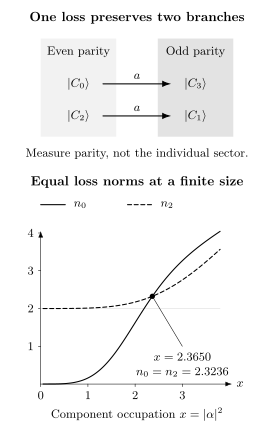
Top: a one-loss error sends both logical branches from even to odd parity without merging them. The parity bit is a syndrome; the individual sector label contains logical information. Bottom: equal norms of the two error states require equal mean occupations. The first crossing is at component occupation , where the restricted error set is exactly correctable.
What the exact point does and does not correct
Section titled “What the exact point does and does not correct”At the crossing, define the coherent recovery on the odd space by and . The common loss amplitude means this map restores every superposition after the jump. A complete recovery also specifies its action on the even code and on any unused states.
Two losses exchange the logical sectors. In fact,
This is an amplitude-filtered logical exchange, approaching only when the normalization factors become equal. Four annihilations obey exactly, but the complete finite-time channel contains more than these bare monomials.
The no-loss operator sends each sector cat at to the same sector at , with amplitude . Even at a single-loss sweet spot, the higher moments differ and these no-loss probabilities are not generally equal. Active recovery must also address shrinkage and unobserved multiple losses. Thus exact correction of does not make a finite-energy cat immune to attenuation.
Repeated parity measurements can distinguish successive losses if the intervening sign changes are reliably resolved. Two jumps between samples have the same final parity as no jump. False readouts, ancilla faults, and missed changes must enter the decoder’s likelihoods. A record chosen only from successfully identified trajectories is a conditional performance measure.
More sectors, useful gates, and an outer code
Section titled “More sectors, useful gates, and an outer code”For rotated components, logical number sectors separated by can distinguish losses through number modulo . Measuring modulo , rather than , avoids directly distinguishing the two logical sectors. Equal error norms and the other Knill–Laflamme products remain necessary. At fixed , increasing the component count also brings neighboring phase-space points closer. Sector resolution and component separation are different design constraints; Grimsmo, Combes, and Baragiola (2020) develop the rotation-symmetric framework.
A multiphoton jump has all coherent components as dark states. It confines their span but does not by itself select a two-dimensional code or correct every logical error inside it. Pump imperfections and parasitic lower-order processes can change the channel.
In the two-component coherent-like basis, a bias-preserving gate keeps dominant -type faults predominantly -type throughout the operation, including propagation to other qubits. A Hadamard, for example, interchanges and ; a generic gate set does not preserve the idle bias. Puri and collaborators (2020) construct gates using controlled cat-manifold dynamics. A correct projected rotation alone does not prove that faults during the pulse remain correctable; see Bosonic and Encoded Computation Models.
An outer repetition code can suppress the dominant phase errors while the cat encoding suppresses the rare opposite errors. Guillaud and Mirrahimi (2019) analyze this concatenation with specified operations. The advantage depends on bias during preparation, idling, measurements, and gates, not just on one storage lifetime. Bosonic Qubits discusses physical controls, while Error-Correction Case Studies compares experimental performance under stated conditions.
Exercises
Section titled “Exercises”1. Normalize and take the small-cat limit
Section titled “1. Normalize and take the small-cat limit”Derive the parity-cat normalization and mean occupations. What happens as ?
Solution
The squared norms of are . Opposite parities make their overlap zero. Applying gives squared norms and . Their limits are zero and one, respectively. Both original coherent components approach vacuum, but their normalized difference approaches a one-photon state; normalization must be taken before the limit.
2. Why parity can destroy the two-component qubit
Section titled “2. Why parity can destroy the two-component qubit”Start in . Measure parity and discard the result. Find the final state and its overlap with the input.
Solution
The output is
In the coherent-like basis this is , with input overlap . Parity has measured logical rather than a syndrome independent of the logical amplitudes. For the four-component code, by contrast, parity is positive on every original logical state and negative on the single-loss subspace.
3. Compare jumps with coherence decay
Section titled “3. Compare jumps with coherence decay”In the large-cat effective model, assume independent phase-flip jumps at rate . Derive the phase-flip probability after time and the off-diagonal decay.
Solution
Only an odd number of jumps changes the final Pauli frame. For Poisson count , , so . The mixture of identity and multiplies the logical off-diagonal by . Two jumps cancel, and the long-time probability tends to rather than growing indefinitely as .
4. Derive the finite single-loss point
Section titled “4. Derive the finite single-loss point”Show that reduces to . Why is there a unique solution in , and why does it establish correction of ?
Solution
Cross multiplication gives
Canceling common terms yields . On that interval, rises strictly from to a positive value, since its derivative is . The root is . Different number sectors make off-diagonal number matrix elements vanish; parity makes ; equal diagonal means give . Together with , these are the complete error-product conditions.
5. The sweet spot is not full-channel correction
Section titled “5. The sweet spot is not full-channel correction”At the first single-loss point, use to compare the second factorial moments of and . What does this imply for no-loss probabilities when ?
Solution
The moments are approximately and . Expanding the exact no-loss probability gives
The linear difference vanishes, but . Higher-order number dependence still distinguishes logical states. The finite set omits that information as well as two-loss logical exchanges.
6. Follow the sector without measuring it
Section titled “6. Follow the sector without measuring it”List the sector pair descended from after zero through four annihilations. What information should a parity apparatus reveal?
Solution
| Loss count | Descendant sectors | Parity |
|---|---|---|
| 0 | Even | |
| 1 | Odd | |
| 2 | Even | |
| 3 | Odd | |
| 4 | Even |
The two entries label coherent logical branches, not alternatives to distinguish in a measurement. The apparatus should report their common parity. Resolving which entry occurred would collapse the encoded superposition. Final parity identifies only loss count modulo two; relative amplitudes also depend on the loss operator and any intervening no-loss evolution.
7. Find a finite optimum in a toy bias model
Section titled “7. Find a finite optimum in a toy bias model”For , minimize , where . Explain the limits of interpreting this as a physical error probability.
Solution
The derivative is and the second derivative is positive. The constrained minimum is
The formula assumes the two fitted contributions apply at the chosen size and operation duration. The linear phase term is a small-error approximation, while an outer code weights logical directions differently. Thus the expression illustrates competing costs rather than supplying a universal device optimum.
8. Correct the outer-code counting
Section titled “8. Correct the outer-code counting”Use outer checks . Independent local errors have probability , and independent local errors have probability . Find the majority-decoder failure from the first type and the undetectable logical-error probability from the second type, treating each channel separately.
Solution
Two or three errors cause majority failure, giving . For local errors, every even-weight pattern is a stabilizer and every odd-weight pattern is in the same nontrivial logical class. Therefore
This differs from the probability of at least one event: two faults are harmless in this ideal code. Both expressions begin with , so leading-order statements alone conceal the distinction. The outer code protects the dominant direction only; the cat mechanism must keep the orthogonal direction small throughout its circuits.
References
Section titled “References”- V. V. Albert et al., “Performance and structure of single-mode bosonic codes,” Physical Review A 97, 032346 (2018), doi:10.1103/PhysRevA.97.032346, arXiv:1708.05010.
- A. L. Grimsmo, J. Combes, and B. Q. Baragiola, “Quantum computing with rotation-symmetric bosonic codes,” Physical Review X 10, 011058 (2020), doi:10.1103/PhysRevX.10.011058, arXiv:1901.08071.
- J. Guillaud and M. Mirrahimi, “Repetition cat qubits for fault-tolerant quantum computation,” Physical Review X 9, 041053 (2019), doi:10.1103/PhysRevX.9.041053, arXiv:1904.09474.
- M. Mirrahimi et al., “Dynamically protected cat-qubits: a new paradigm for universal quantum computation,” New Journal of Physics 16, 045014 (2014), doi:10.1088/1367-2630/16/4/045014, arXiv:1312.2017.
- S. Puri, S. Boutin, and A. Blais, “Engineering the quantum states of light in a Kerr-nonlinear resonator by two-photon driving,” npj Quantum Information 3, 18 (2017), doi:10.1038/s41534-017-0019-1, arXiv:1605.09408.
- S. Puri et al., “Bias-preserving gates with stabilized cat qubits,” Science Advances 6, eaay5901 (2020), doi:10.1126/sciadv.aay5901, arXiv:1905.00450.
Further reading
Section titled “Further reading”J. Guillaud, J. Cohen, and M. Mirrahimi, “Quantum computation with cat qubits,” Les Houches lecture notes (2022), arXiv:2203.03222, develops stabilized dynamics and gate constructions in more detail.