

Pauli Group and Stabilizers
Pauli stabilizers describe a quantum subspace by the measurements that always return on it. The signs matter: and can both have eigenvalue , but their product is , so adding as another constraint makes the equations impossible. Keeping this minus sign is the first step toward understanding quantum codes.
This page develops small examples by direct multiplication. The stabilizer formalism extends these ideas to binary linear algebra, code projectors, logical operators and Clifford circuits.
Required background. Pauli matrices supplies the Hermitian matrices and tensor products. Subscripts label physical qubits; an omitted factor is the identity.
Helpful background. Why quantum error correction is possible explains what a code must preserve when errors occur.
Pauli strings, phases and checks
Section titled “Pauli strings, phases and checks”A Pauli string is a tensor product of . The full -qubit Pauli group also includes scalar phases:
where and each . These phases make the set closed under multiplication. For example, is not one of the four phase-free single-qubit matrices.
Use the standard Hermitian convention . A binary check is then a signed Hermitian Pauli , with and . The nonidentity checks have eigenvalues . The exceptional checks and have only one eigenvalue: the former imposes no constraint, while the latter has no eigenvector. Elements are anti-Hermitian and cannot themselves be binary observables.
To stabilize means to satisfy . Changing to selects the opposite eigenspace of the underlying observable. This use of a sign is different from an unobservable overall phase multiplying a state vector.
Multiply locally, then combine the phases
Section titled “Multiply locally, then combine the phases”The cyclic products are
Reversing either pair gives a minus sign. Multiply tensor factors in their original order and keep every scalar phase:
For commutation, a shorter calculation suffices. At a given qubit, distinct nonidentity Pauli letters anticommute; equal letters or a pair containing commute. If counts the anticommuting positions, then
Thus two strings commute when this count is even. For example, commutes with because qubits 1 and 2 each contribute a minus sign. But anticommutes with . Overall signs do not change commutation, although they do change products and selected eigenspaces.
Compatible checks and independent constraints
Section titled “Compatible checks and independent constraints”A stabilizer group is a commuting subgroup of that excludes . Its common eigenspace is
The two conditions have different jobs. Anticommuting checks cannot share a nonzero eigenvector: if , then but also . Commuting checks can still be inconsistent if a product equals , because their equations would imply .
By contrast, a product equal to indicates a repeated constraint. For a consistent list, independence means that no nonempty product of the generators equals . If independent generators act on qubits, then
Each independent commuting Pauli condition halves the dimension. Merely appending a product of existing generators does not halve it again. The projector derivation proves this count and explains why .
A minus sign selects a Bell state
Section titled “A minus sign selects a Bell state”For two qubits,
The checks and are independent and have a one-dimensional common sector, spanned by
Adding repeats their product and changes nothing. Adding is inconsistent: the product of all three proposed generators is . In terms of eigenvalues, any joint eigenstate obeys , where are its results. Only two of these signs are independent.
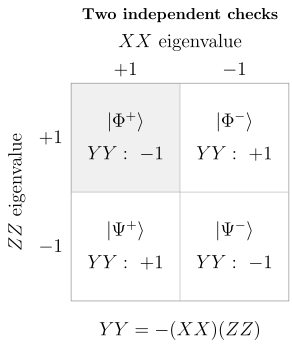
The four Bell states occupy the four simultaneous eigenspaces of and . Here and . The sign is fixed by ; it cannot be chosen as a third independent sign.
For small lists, generate all products while retaining their signs. A product signals inconsistency; repeated products reveal dependence. For larger lists the number of products grows exponentially, so the binary methods in the next page become useful (Gottesman, 1997).
Commutation signs predict the syndrome
Section titled “Commutation signs predict the syndrome”Let be independent stabilizers. For a Pauli error , define
If lies in the code, then
The signs therefore give the ideal check outcomes after that Pauli error: its syndrome. The equivalent bit is , with zero for commutation and one for anticommutation. This algebra predicts ideal outcomes; syndrome measurement explains the circuits and their possible faults.
The signs respect products:
To see this, move past and then , collecting the two commutation signs. Thus a redundant check must satisfy . Arbitrary independent sign choices for all three would be inconsistent. Replacing by does not change its commutation sign with ; it changes the code sector from which the error starts.
Different errors can have the same syndrome. If and do, commutes with every check. It may act trivially on the code or may change the logical information. A syndrome identifies an eigensector, not necessarily a unique error.
Three-qubit example with two mixed checks
Section titled “Three-qubit example with two mixed checks”Take and . They commute, and
Their group contains exactly , , and . It excludes , so two independent checks on three qubits leave a two-dimensional code space.
| Error | sign | sign |
|---|---|---|
| , , | ||
| , | ||
| , , | ||
| , |
The table groups the listed errors by syndrome; it is not an enumeration of all three-qubit Paulis. For example, differs from only by a phase, so its two signs are the products of the and signs.
To see why an all-plus result need not mean no error, choose the basis
Both satisfy the two checks. But swaps and , whereas and leave both unchanged. This is a valid one-logical-qubit code, but it does not protect against every single-qubit error: an undetected weight-one operator changes the encoded state. The general language for these actions is developed in logical operators.
Exercises
Section titled “Exercises”Exercise 1: Multiply a Signed Pauli String
Section titled “Exercise 1: Multiply a Signed Pauli String”Calculate
State whether each result is Hermitian. Identify the phase error made by replacing every local product with only its resulting Pauli letter.
Solution
For , keep the leading minus sign and use and :
The two factors of multiply to , which cancels the supplied minus sign. Thus is Hermitian. For ,
This element is anti-Hermitian and is not a binary check. Ignoring local phases loses the sign cancellation in and the decisive factor in .
Exercise 2: Test Overlap Parity
Section titled “Exercise 2: Test Overlap Parity”Let and on four qubits. Compute and decide whether and commute. Then replace by and repeat.
Solution
For and , qubit 1 contributes one anticommutation because and differ, qubit 2 contributes none because both letters are , qubit 3 contributes none because has , and qubit 4 contributes one because and differ. Hence and
For , qubits 1, 2, and 4 each contain distinct nonidentity letters. Thus and
The first pair commutes and the second anticommutes. No overall phase calculation is needed for this binary decision.
Exercise 3: Separate inconsistent and redundant checks
Section titled “Exercise 3: Separate inconsistent and redundant checks”Compare the two signed two-qubit lists
Both lists are pairwise commuting. Decide which third entry is redundant and which list is inconsistent. Give the independent rank and stabilized dimension wherever those quantities exist.
Solution
The product of the first two checks is
In , the third check is exactly the product of the first two. It is redundant, so the raw list length is three but the independent rank is . The group excludes , and for its all-plus sector has dimension .
In , multiplying all three listed checks gives . The list is therefore inconsistent and has no nonzero common vector. The phase sign distinguishes harmless redundancy from a fatal obstruction.
Exercise 4: Replace Generators Without Changing the Sector
Section titled “Exercise 4: Replace Generators Without Changing the Sector”For the worked group generated by and , replace with . Show directly that generates the same group, has the same independent rank, and stabilizes the same sector.
Solution
The new generator belongs to the original group, so every product of and belongs to . Conversely,
where commutation and were used. Thus each old generator is generated by the new pair, and the groups coincide. Neither new generator is , and their product is , so the pair remains independent with and .
If a vector has eigenvalue under and , it has eigenvalue under their product . Conversely, eigenvalue under and implies eigenvalue under . The stabilized sectors are identical.
Exercise 5: Errors with the same syndrome
Section titled “Exercise 5: Errors with the same syndrome”For the worked generators and , compute the signatures of , , , and . Identify a pair with the same syndrome and two distinct all-plus operators. Use the explicit basis to decide whether the four errors are jointly correctable.
Solution
Both and commute with and anticommute with , so each has signature . They have the same syndrome. Character multiplication gives
so has . Directly, its two overlaps with also give even parity. The operator commutes with because its only nonidentity letter equals the third , and it has disjoint support from , so it too has .
Thus are a pair with the same syndrome, while and are distinct undetected Paulis. The explicit basis above gives and . Thus is not scalar on the code: the pair already fails the Knill–Laflamme test, and the four-error set is not jointly correctable.
Exercise 6: Find a state from three checks
Section titled “Exercise 6: Find a state from three checks”Analyze the three-qubit list
Check Hermiticity, pairwise commutation, independence, and exclusion of ; state the group size and stabilized dimension; and compute the signature of . Identify the normalized state in the stabilized sector.
Solution
Each is a Hermitian signed Pauli string and squares to . The first pair has two distinct nonidentity overlaps and therefore commutes; has disjoint support from both and . The product of the first pair is
The four products generated by are , all acting trivially on qubit 3. Multiplying any of them by gives a distinct string with nonidentity third support. Hence no nonempty product is or : the list is independent, has rank , and generates elements without the minus identity. With ,
For , the factor commutes with and anticommutes with , while anticommutes with . Therefore
The stabilized state is . The first two checks fix the Bell pair and fixes the third qubit. A one-dimensional code space specifies a known state; it has no freedom to encode an unknown logical qubit.
References
Section titled “References”- D. Gottesman, Stabilizer Codes and Quantum Error Correction, Ph.D. thesis, California Institute of Technology (1997), chapter 3, arXiv:quant-ph/9705052 — signed Pauli groups, stabilized subspaces and error syndromes.
- D. Gottesman, “An introduction to quantum error correction and fault-tolerant quantum computation,” Proceedings of Symposia in Applied Mathematics 68, 13–58 (2010), arXiv:0904.2557 — introductory stabilizer calculations and their relation to error correction.
- M. A. Nielsen and I. L. Chuang, Quantum Computation and Quantum Information, 10th anniversary ed., Cambridge University Press (2010), chapter 10, doi:10.1017/CBO9780511976667 — textbook treatment and examples.