

Bosonic Codes
A bosonic code encodes a finite logical system in one or more oscillator modes. The oscillator’s many number states provide room to separate likely errors from the protected information. Protection depends on the encoding, the physical noise, and the recovery together: simply choosing two orthogonal states in a large Hilbert space does not make loss reversible.
This page develops that common framework. A dual-rail example will distinguish detecting loss, recovering information, and conditioning on survival. We then connect loss moments, phase-space shifts, energy constraints, and imperfect recovery to the choice between cat, binomial, and GKP constructions.
Required background. Why Quantum Error Correction Is Possible explains error correction without measuring logical amplitudes. Bits, Qubits, Qudits, and Modes distinguishes logical dimension from the physical carrier. Number States supplies the ladder operators, and Erasure and Loss Channels derives attenuation and flagged erasure.
Oscillator encodings and the recovered logical channel
Section titled “Oscillator encodings and the recovered logical channel”One mode has basis , with
An isometry maps a -dimensional logical space into the Hilbert space of modes. Its projector is , with . For a logical qubit, its two codewords must be orthonormal; a state carries an unknown superposition, not a known label to be identified.
Let , let be physical noise, and let be recovery. A complete decoding channel gives
If recovery always returns to the code, decoding can use on that output. Otherwise that projection discards leakage and is not trace preserving. One must retain a failure flag, or specify how leaked states become logical outputs. Renormalizing the projected state describes a conditional experiment and changes the quantity being assessed.
For Kraus operators of , exact correctability is characterized by
The right side is independent of the logical state. Thus the environment can learn an error syndrome but cannot learn the encoded amplitudes. This is the Knill–Laflamme condition from the linked correctability page. Its linear-span property is especially useful here: correcting a finite set of ladder-operator monomials corrects channels in their span, but not automatically a full finite-time attenuation channel. Chuang, Leung, and Yamamoto (1997) developed bosonic codes adapted to amplitude damping.
Dual rail: a loss flag does not reconstruct a qubit
Section titled “Dual rail: a loss flag does not reconstruct a qubit”Encode one excitation across two modes:
Assume independent, zero-temperature loss with the same transmissivity in both modes. On this encoded space, the no-loss branch multiplies every state by . Either one-loss branch ends in the orthogonal vacuum . The output is
An ideal nondestructive total-number measurement detects whether the excitation survived without identifying its mode. Survival preserves the entire qubit and occurs with probability , independent of . Loss is flagged, but the lost branch cannot be repaired from the vacuum alone. The environment’s two loss modes carry the original superposition. An outer erasure code, or a protocol that prepares another copy from known classical instructions, must handle that failure; an unknown state cannot simply be reconstructed.
This is a genuine erasure-channel reduction under the stated equal-loss and ideal-flag assumptions. Fixed excitation by itself is insufficient to correct an unknown loss location. More redundant multimode encodings can meet the loss-correction conditions, as discussed by Wasilewski and Banaszek (2007).
Unequal loss also filters the surviving state
Section titled “Unequal loss also filters the surviving state”Let the two transmissivities be . In the logical basis, the no-loss operator is
For input , survival now has probability
Conditional on that outcome, the amplitudes are proportional to and . The survival flag itself carries information about the input populations. It is therefore not enough to say “no photon was lost, so no error occurred.”
For , , and input , survival probability is and the normalized output is . Its logical expectation is , instead of zero. For a general input population imbalance ,
The normalized conditional map is nonlinear in because its denominator depends on . The underlying unnormalized quantum instrument remains linear and completely positive.
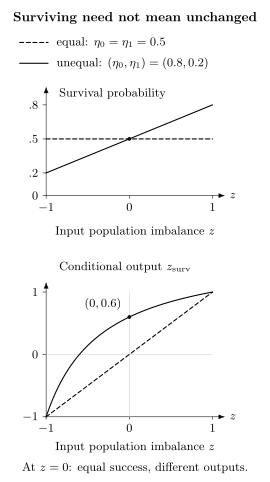
Equal attenuation gives input-independent survival and preserves the conditional qubit. Unequal attenuation has the same average survival for a maximally mixed input, but favors logical zero. At , both cases survive with probability while the unequal-loss output has . Matching a survival rate does not match the recovered quantum channel.
Photon loss, no-loss evolution, and number moments
Section titled “Photon loss, no-loss evolution, and number moments”For a single mode and , pure loss has Kraus operators
The operator order matters. Acting on gives
Consequently, the number of lost excitations is binomial conditional on the initial number . It is not generally Poisson. The no-loss operator also changes relative amplitudes between different number states.
Writing , on states for which the required moments are controlled,
These are short-time expansions on the relevant states or a fixed cutoff, not uniform operator-norm expansions over the entire unbounded oscillator space. A small alone is insufficient if appreciable probability sits at arbitrarily large occupation.
For the leading error set , the conditions include
If the code lies in one number-parity sector, . The second relation requires equal mean loss exposure for every logical superposition, including vanishing off-diagonal logical matrix elements. Equal means of two basis states alone need not establish that operator identity.
For multiple losses, products must satisfy the same scalar-compression test. In particular,
introduces factorial moments. For a number distribution with finite relevant moments, the probability of exactly two losses in a short interval is
The displayed remainder requires sufficient higher-moment control. Replacing the factorial moment by assumes Poisson number statistics; it is not a generic oscillator identity.
| Initial number statistics | Mean | Second factorial moment |
|---|---|---|
| Number state | ||
| Coherent state | ||
| Thermal state |
These are illustrative physical states, not three proposed logical codes. At mean occupation two, their leading two-loss coefficients differ by factors of two. Mean energy alone does not determine rare-event exposure.
Finite-support binomial codes choose number spacing and weights to enforce specified polynomial-error conditions; Michael and collaborators (2016) construct these families. Their finite-time performance still requires the no-loss deformation and omitted loss orders. The specialist page gives the single-loss code and its explicit recovery, rather than repeating that construction here.
Other oscillator errors and code geometries
Section titled “Other oscillator errors and code geometries”Thermal excitation introduces , and frequency noise introduces number-dependent phases. A common Markovian model is
Here and are rates, and is a dimensionless bath occupation. This convention gives number-basis dephasing rate for coherence . The equation defines a channel only after an evolution time is chosen; it does not select a recovery or show that its implementation is reliable.
Rotation symmetry and modular number
Section titled “Rotation symmetry and modular number”The rotation obeys
Thus a code in one common rotation eigenspace moves to another sector after loss. A modular-number measurement can reveal loss count modulo without resolving logical amplitudes, provided those amplitudes occupy the same measured sector. Counts separated by collide. A symmetry does not by itself make their logical effects correctable.
Grimsmo, Combes, and Baragiola (2020) organize rotation-symmetric encodings in a common framework. Both coherent-state cat codes and finite number-state constructions can use this symmetry. Increasing coherent-component separation may suppress one logical error while increasing occupation and loss exposure. The error bias must survive the gates and measurements needed by the computation.
Displacements and grid cells
Section titled “Displacements and grid cells”Use dimensionless quadratures , with
The displacement shifts these coordinates. For the ideal square GKP qubit, commuting translations can be written
Gottesman, Kitaev, and Preskill (2001) use their joint eigenspace to encode a qubit. The ideal combs are nonnormalizable. Finite-energy states have finite peak width and an envelope, so ideal translation-eigenstate formulas become approximations. GKP Codes gives the lattice construction and finite-energy conventions.
The modular syndrome retains a continuous position inside the decision cell. A value close to a boundary is less reliable than one near the center. Decoders should compare the sum of probabilities for all shifts in each logical class; comparing two neighboring shifts is only a small-noise approximation. Noh and Chamberland (2020) exploit analog information in a specified surface–GKP architecture. Its numerical performance depends on that architecture and noise model.
Recovery, gates, and finite resources
Section titled “Recovery, gates, and finite resources”A measurement-based recovery is an instrument followed by conditional corrections:
The record may be a parity history, a modular quadrature, or a loss flag. The maps include measurement backaction. A classical label with no associated quantum map cannot establish coherence preservation. Degenerate errors need not be distinguished if they have the same protected action; the useful information is the correctable class rather than a unique microscopic history.
Engineered dissipation can provide recovery continuously, but confinement to a manifold alone does not prove preservation of logical information. Uncontrolled channels, auxiliary-mode noise, and operations that leave the protected manifold still matter. Bosonic Qubits describes the physical controls and measurement systems.
A compressed Hamiltonian is not a logical gate
Section titled “A compressed Hamiltonian is not a logical gate”For a code-preserving operator, require . Merely checking leaves the leakage block unchecked. For a Hamiltonian, both the intended compression and vanishing leakage block are needed to infer the encoded unitary evolution.
For example, on single rail , the drive compresses to . Yet it also couples to with matrix element . Its full evolution is a displacement, not a closed two-level rotation. Exercise 7 quantifies the leakage. Even exact code preservation is only an ideal-gate property; preserving the correctability of faults during a gate is an additional requirement.
Fidelity includes every input and every outcome
Section titled “Fidelity includes every input and every outcome”For a trace-preserving logical channel, define entanglement fidelity by
where purifies . This is a squared-overlap convention. Worst-case performance minimizes over ; optimizing recovery is a separate step. Bény and Oreshkov (2010) formulate approximate correctability using worst-case entanglement fidelity. An optimized mathematical recovery gives a bound on what can be achieved, not a demonstration that a particular device implements it.
Testing only the logical basis is inadequate: complete logical dephasing preserves both basis states but destroys their superpositions. Conditioning on accepted runs can also hide failure probability. If erasures are retained as orthogonal output flags, their overlap with the desired logical state is zero. An accepted fidelity of one therefore does not make the unconditional channel perfect.
Energy comparisons should bound occupation across logical states, for example , where sums over the storage modes. A mean bound and a hard occupation cutoff are different assumptions. Numerical truncation must control discarded probability and the moments needed by the calculation; a tiny high-number tail can strongly affect higher-order loss terms.
Finally, a recovery cycle takes time and introduces faults. Reducing the interval suppresses multiple losses between corrections but increases the number of imperfect corrections. Compare full logical channels at a common storage time, with the actual storage and auxiliary modes, energy constraint, cycle duration, and acceptance rule. Albert and collaborators (2018) illustrate channel-matched comparisons of bosonic code families. No ordering obtained for one noise channel and optimized recovery is universal across hardware and tasks.
Exercises
Section titled “Exercises”1. Why single rail fails for loss
Section titled “1. Why single rail fails for loss”For and , evaluate the two nontrivial Knill–Laflamme blocks for .
Solution
They are and . Neither is a scalar multiple of . The first says a loss moves logical one directly to logical zero. The second says the event probability distinguishes logical populations. Orthogonality of the original codewords solves neither problem.
2. Equal mean, unequal loss statistics
Section titled “2. Equal mean, unequal loss statistics”Compare a number state with the distribution assigning equal probability to and . Find the means, second factorial moments, and leading two-loss probabilities. Does this test alone establish a quantum code?
Solution
Both means are two. The factorial moments are and , respectively. Their leading two-loss probabilities are and . Equal mean exposure thus does not equalize higher-order events. These diagonal statistics alone do not test the cross products or off-diagonal code-space matrix elements needed for quantum error correction. A coherent encoding must satisfy the full operator conditions.
3. Undo unequal attenuation probabilistically
Section titled “3. Undo unequal attenuation probabilistically”After dual-rail survival with , consider the additional successful-filter operator . Find the joint success probability and the accepted logical channel.
Solution
The product is . Thus the two-stage procedure succeeds with probability for every input and restores the accepted qubit exactly. It is a valid filter because ; a complementary Kraus operator describes failure. For input , the first stage succeeds with probability and the second succeeds conditionally with probability . The accepted fidelity is one, but of attempts fail. Deterministic recovery cannot invert the unequal singular values without an additional failure outcome.
4. Modular information can collide
Section titled “4. Modular information can collide”For codewords sharing an eigenvalue of , derive the rotation-sector shift after losses. What happens to losses and ?
Solution
From , conjugating by multiplies it by . Acting on an initial rotation eigenstate therefore shifts its eigenvalue by this factor. Adding losses gives the same factor. A modular measurement cannot separate those events; their residual logical actions must be assessed rather than assumed equivalent. Measuring a symmetry shared by the code avoids directly resolving its logical amplitudes, but does not supply unlimited loss correction.
5. Use the whole displacement class
Section titled “5. Use the whole displacement class”Let a one-dimensional square-grid syndrome be . Under Gaussian displacement noise of variance , write the even- and odd-cell likelihoods. Recover the two-neighbor approximation for .
Solution
The two unnormalized class likelihoods are
For small and away from equal-weight competing odd images, retain shifts and . Their log-likelihood ratio is
At , the two nearest odd images are equally likely, so their sum has an extra factor two that a one-image approximation misses. At a cell boundary the exact even and odd sums are equal. Retaining the full likelihood ratio conveys reliability to an outer decoder; keeping only a preferred class discards it.
6. Optimize a stated cadence model
Section titled “6. Optimize a stated cadence model”Suppose each recovery adds logical failure probability . Model all two-loss events as failures and neglect other storage errors, with constant across logical inputs. Minimize failure per unit time in the short-interval regime.
Solution
The toy rate is
Its stationary point and minimum are
The second derivative is positive. The familiar replacement is valid for Poisson statistics only. If , this model has no finite optimum; another error mechanism or storage-time constraint is needed. A real code may also have no-loss deformation at the same order, nonunit failure probability after two losses, and a minimum realizable cycle duration. Those effects change the coefficient or the allowed interval.
7. A logical matrix with physical leakage
Section titled “7. A logical matrix with physical leakage”For single rail and , start in . Find the leading probability to leave the code during a short time , although .
Solution
The first-order amplitude in is , so
The exact unitary is . With , its total single-rail survival probability is , obtained from the and amplitudes. Expanding its complement gives the same leading coefficient. A projection can reproduce a desired matrix while missing the coupling that invalidates its two-level dynamics.
8. A small tail can dominate a moment
Section titled “8. A small tail can dominate a moment”For integer , consider . Find its mean, second factorial moment, and trace distance from vacuum. What does this imply for a mean-energy truncation rule?
Solution
The mean is , independent of , but grows without bound. The discarded tail probability is , and the pure-state trace distance from vacuum is , which tends to zero. Thus small state-distance error need not mean small error in an unbounded moment or a short-time expansion coefficient.
For any state with mean at most , the probability above cutoff is bounded by . That controls discarded probability, but additional moment assumptions are required to control uniformly. The limits of large and short time cannot be exchanged without such control.
References
Section titled “References”- V. V. Albert et al., “Performance and structure of single-mode bosonic codes,” Physical Review A 97, 032346 (2018), doi:10.1103/PhysRevA.97.032346, arXiv:1708.05010.
- C. Bény and O. Oreshkov, “General conditions for approximate quantum error correction and near-optimal recovery channels,” Physical Review Letters 104, 120501 (2010), doi:10.1103/PhysRevLett.104.120501, arXiv:0907.5391.
- I. L. Chuang, D. W. Leung, and Y. Yamamoto, “Bosonic quantum codes for amplitude damping,” Physical Review A 56, 1114–1125 (1997), doi:10.1103/PhysRevA.56.1114, arXiv:quant-ph/9610043.
- D. Gottesman, A. Kitaev, and J. Preskill, “Encoding a qubit in an oscillator,” Physical Review A 64, 012310 (2001), doi:10.1103/PhysRevA.64.012310, arXiv:quant-ph/0008040.
- A. L. Grimsmo, J. Combes, and B. Q. Baragiola, “Quantum computing with rotation-symmetric bosonic codes,” Physical Review X 10, 011058 (2020), doi:10.1103/PhysRevX.10.011058, arXiv:1901.08071.
- M. H. Michael et al., “New class of quantum error-correcting codes for a bosonic mode,” Physical Review X 6, 031006 (2016), doi:10.1103/PhysRevX.6.031006, arXiv:1602.00008.
- K. Noh and C. Chamberland, “Fault-tolerant bosonic quantum error correction with the surface–Gottesman–Kitaev–Preskill code,” Physical Review A 101, 012316 (2020), doi:10.1103/PhysRevA.101.012316, arXiv:1908.03579.
- W. Wasilewski and K. Banaszek, “Protecting an optical qubit against photon loss,” Physical Review A 75, 042316 (2007), doi:10.1103/PhysRevA.75.042316, arXiv:quant-ph/0702075.