

Binomial Codes
A binomial code stores a qubit in finite superpositions of oscillator number states. Spacing the occupied numbers separates losses from gains; binomial probabilities make selected number moments equal in the two logical states. The first property helps identify errors, and the second prevents their probabilities from revealing the logical state.
These codes exactly correct a chosen finite set of operators. Correcting a physical channel over a finite interval requires more: no-loss evolution changes amplitudes, several events can share a syndrome, and the recovery itself can fail. We will start with the smallest example, prove the general construction, and distinguish the measurements needed for loss and for dephasing.
Required background. Bosonic Codes introduces oscillator encodings and channel-level recovery. Why Quantum Error Correction Is Possible explains the Knill–Laflamme condition, and Number States supplies the ladder-operator action. Erasure and Loss Channels derives attenuation.
A qubit that survives one annihilation
Section titled “A qubit that survives one annihilation”Write and choose
Both states have even parity and mean occupation two. The vacuum component of logical zero balances its four-photon component. Applying gives
For any normalized logical amplitudes , the normalized one-loss state is . The amplitudes survive because both branches acquire the same factor . Odd parity identifies the error subspace without distinguishing the two branches. Measuring the exact number, however, distinguishes them and destroys their coherence.
A coherent recovery maps back to and back to . These are maps between orthonormal pairs, so a unitary extension exists. It must restore both the energy and the superposition; a parity measurement alone does neither. Michael and collaborators (2016) introduced this code as the simplest member of the binomial family.
For code projector , the error set obeys
The first identity follows from parity; the second uses equal means and disjoint number supports. Together with , these are all the error-product conditions. Two losses already fail:
Their images overlap the original code, and their norms differ. Returning to even parity therefore does not establish successful storage.
Finite binomial weights and separated number states
Section titled “Finite binomial weights and separated number states”Suppose the desired error set contains losses through , gains through , and number powers through :
Omit any range whose upper order is zero. The order describes a polynomial approximation to number dephasing, not a universal count of phase-noise events. Correction of this set also corrects its linear span; it does not automatically include arbitrary products of its members.
Use spacing and moment order . We consider , as occurs for every nontrivial choice above. Define, for ,
Thus logical zero selects even , and logical one selects odd . The sum of the even binomial coefficients and the sum of the odd coefficients both equal . The states are normalized and have disjoint support, hence are exactly orthogonal. Their largest occupied number and common mean are
Finite support makes preparation and numerical representation concrete. Increasing the protection order nevertheless increases the required cutoff and generally the mean loss rate . The construction is sufficient for the stated error set; it is not a proof of globally minimal energy among all possible codes. Larger or can supply additional separation or matched moments.
Spacing removes nonzero number shifts
Section titled “Spacing removes nonzero number shifts”Each product either preserves number or changes it by a nonzero integer of magnitude at most . A nonzero shift in this range cannot connect two occupied numbers, since every occupied number is a multiple of . Its entire compression to the code therefore vanishes.
This includes products between a loss or gain and a power of : diagonal number factors change the weights but not the shift. It also includes a loss–gain cross product, whose shift can be as large as . Choosing would not generally separate that pair.
Zero-shift products are diagonal polynomials in . They have no off-diagonal logical matrix elements because the two codewords occupy disjoint number states. We still need their two diagonal expectations to agree.
Finite differences match the diagonal moments
Section titled “Finite differences match the diagonal moments”The difference between logical expectations of is
The alternating sum is the st finite difference of a polynomial of degree . Such a difference vanishes when . To see why, start with and apply : this produces the same weighted sum, and for every term still contains a positive power of . Evaluation at gives zero.
Therefore the codewords match every number moment through order . The products relevant for loss and gain are falling and rising factorials,
These have degree . Products of the number-dephasing errors reach degree , explaining the choice of . Consequently every required compression has the form . The spacing and moment arguments solve different parts of the Knill–Laflamme condition; neither replaces the other.
The first unmatched moment is also informative. For , the alternating sum is , so moment matching stops at a definite order rather than continuing indefinitely.
Modular syndromes and the missing dephasing information
Section titled “Modular syndromes and the missing dephasing information”The rotation acts as identity on the code. A measurement of number modulo resolves its eigenspaces. Starting from residue zero, losses give residue and gains give , both modulo . The integers fill different residues, so the modeled loss and gain events are distinguishable.
For example, when and , :
| Event | Net number shift | Residue |
|---|---|---|
| No shift | 0 | 0 |
| One loss | 3 | |
| Two losses | 2 | |
| One gain | 1 |
The measurement must preserve coherence within each residue. Resolving the full photon number would reveal which logical support was occupied. Also, is only one check: its identity eigenspace contains infinitely many states outside the finite binomial code.
Number dephasing does not change the residue
Section titled “Number dephasing does not change the residue”A power of leaves every number label unchanged. Modular measurement cannot by itself distinguish from , even when the code mathematically corrects both. The error images can overlap without violating correction: their Gram matrix need not be diagonal. A recovery can first choose orthogonal combinations of those images.
Take , so :
Both means are three and both second moments are twelve. The two states
are normalized, orthogonal to each other, and orthogonal to the original code. They remain even, so parity does not distinguish the two subspaces. Yet
where . Projecting onto the code or the two-dimensional error subspace preserves in either outcome. The latter outcome needs the coherent map . This illustrates the additional measurement required for number dephasing; Michael and collaborators discuss such orthogonalized error spaces explicitly.
For noisy repeated measurements, the residue is only one input to a decoder. Several events can have the same final residue, and readout errors can mimic changes. In a pure-loss interval the lowest code has no initial support above four photons, so odd parity can mean one or three losses, not arbitrarily many. Gain, drives, or previous faulty operations can change that support and the appropriate probabilities.
Finite-time loss changes more than the residue
Section titled “Finite-time loss changes more than the residue”For transmissivity , the pure-loss Kraus operators are
Their ordering matters: lowers the state before attenuation acts on the remaining occupation. On the full oscillator there are infinitely many operators. On a code with cutoff , every branch with vanishes. Exact full-channel correction still fails in general; an infinite number of nonzero loss branches is not the reason.
For the lowest code, the no-loss operator gives
The no-loss probabilities are and . Their difference is , positive for every . Thus the environment can learn something about the logical state even by seeing no emitted photons. No deterministic recovery can exactly correct that information loss for all unknown inputs.
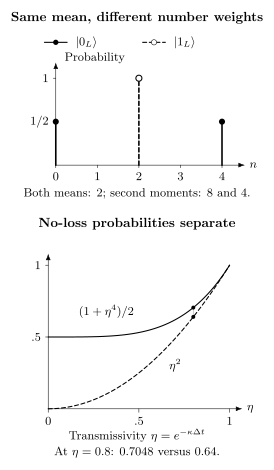
Top: the logical states have equal means, but different second moments. Bottom: their exact no-loss probabilities agree to first order near , then separate. Finite support and exact correction of do not remove this state dependence of the finite-time channel.
There is also deformation outside the original code. With ,
The leakage amplitude is first order in , although its probability is second order. Saying that the first projected correction is scalar does not mean the full state stayed in the code.
Higher-order binomial codes match more moments and correct more loss operators. Expanding attenuation and designing the corresponding recovery gives systematic small-time improvements. The coefficients depend on factorial moments such as , not only on the mean occupation. Albert and collaborators (2018) compare complete bosonic channels and optimized recoveries; the finite operator count alone is not a performance metric.
For example, gives , with number support and mean . It corrects , but increases raw loss exposure and recovery complexity. Shorter cycles reduce unobserved multiple losses while invoking faulty ancillas and controls more frequently. Their balance sets a useful cadence.
Logical rotations and errors during gates
Section titled “Logical rotations and errors during gates”The half-angle rotation is logical : it multiplies a component by . A generic intermediate rotation does not necessarily preserve the code, since components within one logical word acquire different phases. Logical requires a coherent exchange of the two finite envelopes; it is not supplied by the modular check.
Rotation-symmetric methods can use number-selective control, additional modes, or teleportation to implement gates and recovery; Grimsmo, Combes, and Baragiola (2020) develop this broader framework. Physical controls and ancilla imperfections are discussed in Bosonic Qubits.
An error-transparent Hamiltonian produces the same logical evolution in the code and the modeled error spaces. A sufficient intertwining condition is
It makes the recovered operation independent of when that particular error occurred. A scalar energy offset in an error sector changes only its overall trajectory phase and can be allowed as well. The condition must be tested for the relevant faults: protecting a bare jump does not alone protect no-jump deformation or ancilla failure. Ma and collaborators (2020) demonstrate error-transparent phase operations, while Wetherbee and collaborators (2025) analyze amplitude-mixing constructions and distinguish jump protection from full-channel protection.
As a concrete memory benchmark, Ni and collaborators (2023) reported a corrected binomial memory exceeding their stated physical reference lifetime by about 16%. Such a fixed-code comparison tests a complete correction protocol; it does not by itself establish suppression with increasing code order or protected universal gates. Error-Correction Case Studies develops those comparisons in context.
Exercises
Section titled “Exercises”1. Normalize the code and find its mean
Section titled “1. Normalize the code and find its mean”Use to prove normalization and the common occupation for . What changes at ?
Solution
Evaluation at and gives a total coefficient sum and alternating sum zero. Each parity sum is . Applying first gives total first-moment sum and alternating first-moment sum zero for . Divide each parity half by and multiply by to obtain the mean. At the two words are and : they remain normalized but do not have equal means. This is the trivial no-protection limit.
2. Locate the first unequal moment
Section titled “2. Locate the first unequal moment”Evaluate and check it for the lowest code.
Solution
Only the term with derivatives survives at , yielding
For , this is four. Directly the second moments are eight and four. The matched first moments therefore do not imply equal number distributions.
3. Recover a superposition after one loss
Section titled “3. Recover a superposition after one loss”Apply to in the lowest code. Compare parity measurement with exact number measurement.
Solution
The normalized error state is . Its parity is certainly odd, so an ideal parity measurement leaves it unchanged. The coherent inverse map restores the input. A number measurement instead yields three or one with equal probability and removes the relative phase; even if each observed state is re-encoded correctly, the average result is an incoherent mixture.
4. Test spacing with both losses and gains
Section titled “4. Test spacing with both losses and gains”For , find , the codewords, and all four modeled residues. Why does fail to distinguish the errors?
Solution
Here , so
No shift, one loss, two losses, and one gain give residues . With spacing three, two losses and one gain both give residue one. Their cross product can shift number by three and connect occupied components. Matching diagonal moments does not repair this missing error separation.
5. Construct and check a two-loss code
Section titled “5. Construct and check a two-loss code”Take . Write the codewords and calculate the common squared norm of .
Solution
The parameters are , giving
Both means are and both second moments are . Therefore in either word, which is the common squared two-loss norm. The cutoff is nine. Number residues separate losses zero, one, and two; the matched second moments also permit correction of the operator , with the additional subspace measurement described above.
6. Quantify no-loss deformation
Section titled “6. Quantify no-loss deformation”For the lowest code at , find the two no-loss probabilities and the population in conditioned on no loss for input .
Solution
The probabilities are and . The unnormalized orthogonal amplitude is , so the conditional population is . A state can acquire deformation even when the detector observes no photon. These probabilities refer to the emitted-photon trajectory, not merely to an even endpoint parity, which also includes two- and four-loss events.
7. Find a useful correction interval
Section titled “7. Find a useful correction interval”For , minimize the toy logical error rate , where . State its physical assumptions.
Solution
Differentiation gives , hence
The data term assumes a small-time expansion with leading uncorrectable probability proportional to per cycle. The control term assumes a small fixed error per cycle and negligible cycle duration. A real optimum must respect control time, correlations and the validity range of both approximations.
8. Build the additional dephasing syndrome
Section titled “8. Build the additional dephasing syndrome”For the code, calculate . Show how the same recovery corrects any error on every encoded superposition.
Solution
The orthonormal error words are
They are orthogonal to both original words but share their even parity. For any ,
Project onto the code and error subspaces without distinguishing their individual basis states. The first outcome already has the right logical amplitudes; the second needs . Both branch probabilities are independent of those amplitudes. A full recovery completes the map on the remaining oscillator states. Parity alone gives the same answer in both branches and cannot implement this recovery.
References
Section titled “References”- V. V. Albert et al., “Performance and structure of single-mode bosonic codes,” Physical Review A 97, 032346 (2018), doi:10.1103/PhysRevA.97.032346, arXiv:1708.05010.
- A. L. Grimsmo, J. Combes, and B. Q. Baragiola, “Quantum computing with rotation-symmetric bosonic codes,” Physical Review X 10, 011058 (2020), doi:10.1103/PhysRevX.10.011058, arXiv:1901.08071.
- Y. Ma et al., “Error-transparent operations on a logical qubit protected by quantum error correction,” Nature Physics 16, 827–831 (2020), doi:10.1038/s41567-020-0893-x, arXiv:1909.06803.
- M. H. Michael et al., “New class of quantum error-correcting codes for a bosonic mode,” Physical Review X 6, 031006 (2016), doi:10.1103/PhysRevX.6.031006, arXiv:1602.00008.
- Z. Ni et al., “Beating the break-even point with a discrete-variable-encoded logical qubit,” Nature 616, 56–60 (2023), doi:10.1038/s41586-023-05784-4.
- O. C. Wetherbee, S. Roy, B. Royer, and V. Fatemi, “A mathematical structure for amplitude-mixing error-transparent gates for binomial codes,” Quantum 9, 1890 (2025), doi:10.22331/q-2025-10-21-1890, arXiv:2412.08870.