

Bosonic and Hybrid Error Correction
A hybrid error-correction architecture combines two kinds of protection. An oscillator encoding suppresses, detects or reshapes physical noise; an outer code then corrects the remaining faults across several encoded oscillators. The outer decoder needs both the residual noise and the information gathered during inner recovery. Counting oscillator modes alone does not describe that protected computation.
Helpful background. Bosonic codes explains oscillator encodings and recovery; decoders explains inference from syndromes. The cat, binomial, and GKP pages develop the individual constructions.
Inner recovery supplies a state and a measurement record
Section titled “Inner recovery supplies a state and a measurement record”Let be the logical input state. Encoding, physical noise, recovery and decoding produce a family of completely positive maps , one for each recorded outcome . The output before normalization is . Its trace is the outcome probability:
When , the state conditioned on that record is . This normalized update is generally nonlinear in when the outcome probability depends on the input. The subnormalized maps, together with their probabilities, are the linear quantum instrument. Summing over all outcomes gives the average channel
An outer decoder receiving only this average loses information that can distinguish reliable inner corrections from uncertain ones. The probability model must also retain leakage or rejection outcomes. Projecting onto the encoded subspace and silently renormalizing does not produce the unconditional logical channel.
Shared ancillas, control fields or recovery steps can correlate faults across modes and across time. Concatenating codes does not remove those correlations. Terhal, Conrad and Vuillot analyze finite-energy GKP recovery and its ancilla circuits in the context of larger codes. Terhal et al. (2020)
Analog information changes which correction is most likely
Section titled “Analog information changes which correction is most likely”In a GKP correction, a measured displacement close to the middle of a correction cell is usually less ambiguous than one near a cell boundary. Reducing both measurements to the same rounded bit discards that distinction. The GKP likelihood calculation derives the competing even and odd lattice classes for a Gaussian displacement model.
The same inference principle appears in a two-bit example. Suppose inner records imply independent error probabilities and . An ideal outer parity check reports odd error parity. There are two possibilities:
Conditioning on their sum assigns probability to the second bit. Equal hard-decision weights would miss this strong preference. For independent binary faults, log odds such as can become decoding weights. Correlated faults or uncertain syndrome measurements require a joint model instead.
Finite-energy GKP states, imperfect ancillas, backaction and repeated recovery can change the likelihood. A simplified Gaussian-shift model is useful only within its assumptions; the analog record does not calibrate its own probability law.
Bias must survive the complete correction circuit
Section titled “Bias must survive the complete correction circuit”A cat encoding can make one logical Pauli error much rarer than the other. The error names depend on the chosen logical basis: a photon loss is approximately a phase flip in the large-cat coherent-like basis, but has a different label in the parity basis. Cat codes derives this basis dependence.
Consider a simplified outer phase-error repetition code of odd length , with codewords and . Assume ideal syndrome extraction and recovery. On each inner qubit, apply a error with probability and independently an error with probability , independently across sites. Both can occur, producing a up to phase. These are fixed per-interval Pauli probabilities, not jump rates.
Majority correction fails in the protected sector with probability
In the complementary sector, every single acts nontrivially on the encoded information, while an even number cancels modulo the repetition stabilizers. Its exact residual probability is
The leading small- approximation is . Under the specified independent-sector model, the probability of a nonidentity outer logical Pauli is
For , and , the two contributions are about and , giving . Raising the rare-sector probability to increases the total to about , even though the protected phase-error probability is unchanged.
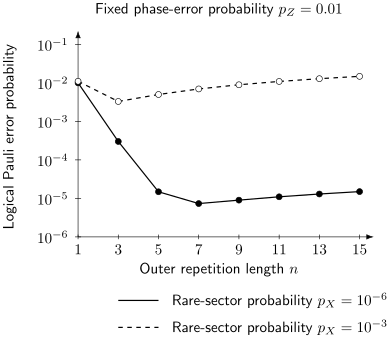
Illustrative independent-Pauli model with , perfect checks and fixed inner error probabilities. Longer repetition suppresses majority errors but exposes more qubits to the complementary fault. Among the plotted odd lengths, the best length is seven for and three for . A physical device’s probabilities can also change with circuit length and duration.
This calculation explains why idle-noise bias alone is insufficient. Preparation, entangling gates, measurements and recovery must preserve useful asymmetry. Putterman and colleagues demonstrated a cat/repetition-code memory in which the oscillator stabilization suppresses bit flips and an outer distance-five repetition code corrects phase flips. Its experiment uses a more detailed noise model than this illustration. Putterman et al. (2025)
Compare protected work rather than carrier counts
Section titled “Compare protected work rather than carrier counts”Match the logical operation, failure criterion and elapsed time. Include oscillator occupation and lifetime, ancillary systems and reset, recovery duration, intermode gates, decoder timing and rejected preparations. A single mode can use many number states, but driving and measuring it still takes physical resources.
Increasing energy can improve one protection mechanism while increasing photon-loss exposure or nonlinear effects. Likewise, a longer outer code can reduce one logical error and increase another. These tradeoffs must be evaluated for the requested state or operation, not only for the easiest measured decay direction.
The bosonic research guide discusses selected demonstrations and open questions. Logical benchmarking explains matched memory and gate comparisons; resource estimation carries them into an algorithm’s schedule and error allowance.
Exercises
Section titled “Exercises”1. Change the inner reliability
Section titled “1. Change the inner reliability”Repeat the two-bit parity example with . Which bit is more likely to have erred?
Solution
Both candidates have probability , so each has conditional probability one half. The earlier strong preference came from the different inner reliabilities, not from the parity bit alone. This inference assumes independent errors and a reliable parity measurement.
2. Count accepted preparations
Section titled “2. Count accepted preparations”A preparation takes two milliseconds and accepts with probability 0.4. Find its accepted-output rate and explain what the outer code still needs to know.
Solution
Independent serial attempts supply accepted states per second on average. The outer code still needs the accepted-state noise, correlations with other systems, and the waiting-time distribution relative to memory lifetimes. Mean supply alone gives neither quality nor delivery by a deadline.
3. Can normalized recovery be treated as a channel?
Section titled “3. Can normalized recovery be treated as a channel?”Suppose an accepted branch maps to , where . Compare its acceptance probabilities on , and .
Solution
The probabilities are , and . The conditioned maximally mixed input becomes , whereas averaging the two separately conditioned basis states gives . Thus normalization is not linear on the original input ensemble. Retain the subnormalized map and outcome probability when composing instruments; a complementary rejection branch completes the physical operation.
4. Explain the finite optimum
Section titled “4. Explain the finite optimum”Why does the plotted logical error eventually rise with repetition length, even though the phase-error majority term falls?
Solution
The repetition code corrects only one sector. At fixed nonzero , the odd-parity term grows toward one half as increases. For small it grows approximately as . Once that term dominates, adding more sites worsens the combined channel. Better bias preservation or another outer code is needed to suppress both sectors.
References
Section titled “References”- H. Putterman et al., “Hardware-efficient quantum error correction via concatenated bosonic qubits,” Nature 638, 927–934 (2025). doi:10.1038/s41586-025-08642-7.
- B. M. Terhal, J. Conrad, and C. Vuillot, “Towards scalable bosonic quantum error correction,” Quantum Science and Technology 5, 043001 (2020). doi:10.1088/2058-9565/ab98a5.