

Modular and Networked Quantum Computers
A networked quantum computer must supply entanglement when the computation needs it and preserve it until use. More connected modules do not automatically mean faster computation: the links may become the bottleneck. The central questions are how many remote operations cross a network boundary, how long their entangled pairs take to arrive, and how waiting changes those pairs.
Helpful background. Modular architectures explains physical interfaces and shared faults; distributed quantum computing develops remote operations. Here we use those operations to estimate communication demand as a machine grows.
A network cut bounds execution time
Section titled “A network cut bounds execution time”Partition a machine into sets of modules and . Suppose a chosen implementation consumes usable Bell pairs across this cut and starts with usable pairs already stored. In a fluid-rate approximation, take as an upper bound on the aggregate rate of newly delivered usable pairs. Even with free local computation, this model gives
The familiar bound assumes an initially empty buffer. Preparing a stock in advance moves work outside the timed execution; its preparation and eventual replenishment still belong in an end-to-end or amortized cost. A stochastic mean rate alone is not a bound on every finite-run realization: the waiting-time model below supplies the required distribution.
This is a resource bound for that implementation, not a theorem that every possible algorithm must consume pairs. Changing the encoding, algorithm, placement, or remote-gate protocol can change demand. The rate must refer to pairs of the required quality after failed attempts, purification, switching, and scheduling.
The bound exposes a common scaling problem. Increasing the number of local qubits while keeping the boundary ports fixed can increase demand without increasing cut capacity. Local gate speed then ceases to determine throughput. Monroe and collaborators’ modular architecture illustrates why local interactions and photonic interfaces must be treated as distinct levels of the machine.
Heralded links have waiting-time distributions
Section titled “Heralded links have waiting-time distributions”Assume one attempt every seconds succeeds independently with probability . The number of attempts is geometrically distributed on , so
With independent parallel modes per attempt window, the probability of at least one success is . This increases delivery probability but requires physical modes, usable switching, and enough memory. The independent-mode assumption can fail under common laser, detector, or calibration noise.
Suppose a computation needs eight Bell pairs available together, with eight independent link channels and one stored success per channel. At the end of windows, the probability all are ready is
For , achieving requires 64 windows. At that is , even though an individual link’s mean waiting time is . Synchronization turns a typical-link latency into a tail problem.
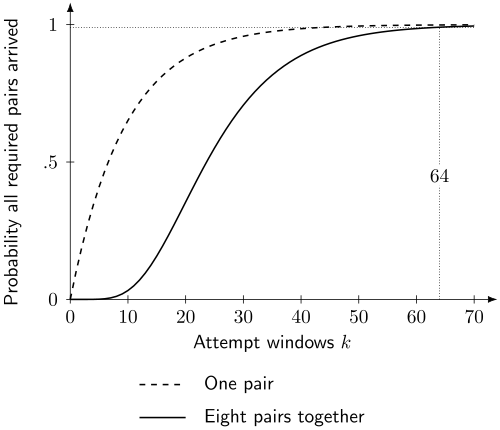
Calculated arrival probabilities for per link and window, with independent links and perfect storage. At ten windows, a single pair has arrived with probability about 0.651, but all eight have arrived with probability only 0.0324. The dotted line marks 99% readiness. This plot counts successful arrivals; finite memory lifetime can make some stored pairs unusable before the last arrives.
Stored entanglement changes while waiting
Section titled “Stored entanglement changes while waiting”For illustration, take an initially perfect Bell pair and independent pure dephasing of each member, with single-qubit coherence factor . Its fidelity with the initial Bell state becomes
Thus a fidelity requirement translates into an age limit. If the first of several required pairs waits for the last, a successful herald does not guarantee the pair remains usable at consumption time. Purification consumes additional pairs and time; error-corrected memory consumes space and syndrome bandwidth. Neither is a free repair.
A scheduler must choose whether to store early pairs, discard stale ones, reserve a communication buffer, or change operation order. These choices affect both demand and supply. A queue simulation that ignores quantum-state aging may systematically overestimate delivered throughput.
Match communication to the logical workload
Section titled “Match communication to the logical workload”A useful placement objective weights a circuit edge by how often and when its qubits interact, rather than treating every edge equally. Clustering strongly interacting qubits reduces network traffic, but can overload local factories or memory. Dynamic remapping can reduce later traffic while adding teleportations now.
For a toy workload with cross-module operations, each consuming one usable Bell pair, a cut gives a 100 s lower bound in the initially empty, fluid-rate model. Reducing cross-cut demand to through placement reduces that bound to 10 s. It does not prove the whole job runs in 10 s: local critical paths, communication dependencies, and pair quality still constrain it.
For fault-tolerant workloads also ask whether link failure is heralded, whether it stalls syndrome extraction, and how correlated faults cross module boundaries. Modularity can contain some faults but can also introduce shared timing and optical infrastructure. Interconnects and transduction provides the physical channel context.
What an integrated demonstration establishes
Section titled “What an integrated demonstration establishes”Remote entanglement generation, a remote gate, and sustained distributed error correction test different capabilities. A complete architecture claim needs a compatible combination: pair-rate and quality distributions, memory under simultaneous networking, local-operation errors, decoder deadlines, and a representative compiled workload.
These models identify bottlenecks; the best implementation for a particular workload remains an active design question. The modular-computing research guide discusses selected experiments and open problems.
Exercises
Section titled “Exercises”A cut delivers raw pairs per second. A purification routine consumes four raw pairs per attempt and accepts with probability . Ignoring other delays, find the usable-pair rate and the lower bound for consuming operations.
Solution
The maximum mean purified output rate is pairs per second. In the fluid-rate approximation with an empty initial buffer, the resulting lower bound is s. It assumes accepted pairs meet the required fidelity and no extra queue or memory loss. Individual stochastic completion times need not exceed their fluid-model estimate.
Under the dephasing model above, how long can a pair wait while retaining fidelity at least ?
Solution
Solve , giving . A long quoted coherence time can still allow only a short wait at stringent fidelity.
Eight first-success times, in units of , are . Suppose every pair starts perfect and follows the two-memory dephasing model with ms. Are all eight pairs ready with fidelity at least when the last one arrives?
Solution
All have been generated, but the first has waited . Its fidelity is
below the requested threshold. The allowed age is only about . Counting eight heralds is therefore insufficient; an age-aware protocol must refresh early pairs, improve storage or change the consumption schedule. Such changes also alter the simple first-success readiness distribution.
References
Section titled “References”- C. Monroe et al., “Large-scale modular quantum-computer architecture with atomic memory and photonic interconnects,” Physical Review A 89, 022317 (2014). Author preprint.
- S. Wehner, D. Elkouss, and R. Hanson, “Quantum internet: A vision for the road ahead,” Science 362, eaam9288 (2018). doi:10.1126/science.aam9288.
Further reading
Section titled “Further reading”Network case studies separates link, memory, protocol, and system evidence; decoding and real-time control supplies the classical timing budget.