

Hardware Scaling Frontier
Scaling quantum hardware means increasing the reliable, programmable work a complete machine can deliver. More physical carriers help only if their connections, calibration, error correction and operating availability remain useful together. DiVincenzo’s implementation criteria identify the foundational capabilities. Here we examine why usable topology, control capacity and correlated faults can matter as much as physical count.
Helpful background. Hardware metrics defines performance measures; control, readout, and calibration supplies the physical–classical loop. Platform-specific mechanisms remain in the hardware chapter.
Device yield and usable topology differ
Section titled “Device yield and usable topology differ”If components independently work with probability , the expected number of working components is . If a design requires every component, its all-good probability is
For and , the expectation is 9990 working components but . A high expected yield can coexist with a negligible chance of a defect-free large system.
This toy model explains the value of redundancy, repair, and layouts tolerant of missing sites. It does not determine the performance of an actual code: a connected defect cluster can be worse than the same number of isolated defects, and fabrication faults need not be independent. The relevant object is the usable interaction graph together with its measured operation-quality distribution.
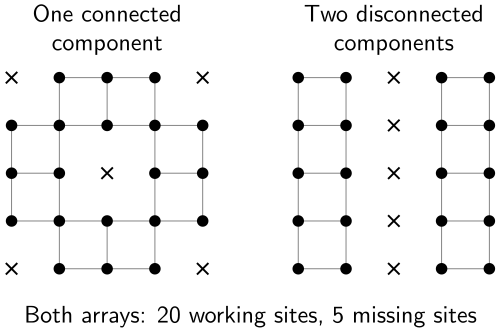
Both arrays retain 20 of 25 sites, but their usable connections differ. Black dots are working sites, crosses are missing sites, and lines are remaining nearest-neighbor couplings. The left graph is connected; the right has two disconnected ten-site components. This is a connectivity example, not a calculation of code distance or logical error: those require a specified code, measurement schedule and noise model.
Postselecting only exceptional devices can establish feasibility for those devices while leaving manufacturing yield unanswered. Conversely, accepting imperfect devices can be effective if routing and coding are designed around their defects.
Calibration is a capacity constraint
Section titled “Calibration is a capacity constraint”Suppose a machine has independently maintained parameters, each calibration takes , and calibrations can run in parallel without corrupting one another. A complete sweep requires at least
If relevant drift occurs on timescale , a full-sweep strategy usually seeks . The actual allowable delay depends on drift amplitude and the acceptable control error; this informal timescale comparison is neither a universal necessity nor a sufficient condition. Measurements can be noisy, tuning one parameter can perturb another, and continuous tracking may avoid full sweeps entirely.
Consider parameters, s per calibration, and 100-way effective parallelism. Even the ideal sweep takes 100 s. If important parameters drift over 10 s, faster individual gates do not solve the maintenance problem. One needs improved stability, more effective parallelism, shared models, continuous estimation, or fewer independent controls.
A calibration performed in isolation may miss simultaneous-operation crosstalk. Testing the concurrent schedule reveals whether the calibrated parameters still describe the running workload. Calibration loops explains feedback and model tracking.
Rare correlated faults can set a logical floor
Section titled “Rare correlated faults can set a logical floor”Error correction is sensitive to fault structure, not just average physical infidelity. Suppose an unhandled global event occurs with probability per run and always causes failure. Conditional on no such event, let the failure probability be . The law of total probability gives
If is fixed and tends to zero, failure approaches . Better local suppression cannot remove that floor. No independence assumption is needed when the local term is defined conditionally as above. If a larger code makes the run longer, even can change: a constant global-event hazard over run time gives . Codes, scheduling, shielding, and recovery can handle some correlated events; the model concerns only the remaining unhandled ones.
Temporal bursts, leakage propagation, common control signals, and shared infrastructure can create correlations. The threshold theorem applies under stated noise and locality assumptions; its existence is not a certificate for every large device.
Infrastructure must scale with useful operations
Section titled “Infrastructure must scale with useful operations”Cooling, vacuum, lasers, microwave routing, detector recovery, classical bandwidth, and repair effort can each constrain a platform. A useful resource vector includes physical count, footprint, power, operation rate, calibration duty, and availability. There need not be a single scalar ranking.
For example, if a controller produces bytes of syndrome data per cycle per protected block, then blocks at cycle time produce bytes per second before compression and transport overhead. Moving computation to cryogenic electronics can reduce wiring while adding local heat. Optical multiplexing can reduce some wiring while introducing switching loss and synchronization. A system improvement often redistributes cost between subsystems.
Beverland and collaborators’ resource framework demonstrates how algorithm requirements connect to physical qubit properties and error correction. Its numerical estimates are application- and model-specific; the general lesson is that qubit number, speed, and control assumptions must enter together.
Assess scaling on the same workload
Section titled “Assess scaling on the same workload”Choose a representative logical task, output error, failure budget, and operating duration. Then measure or estimate the complete pipeline under increasing system size. Track tails and downtime, not only best calibrated performance. A larger processor that completes fewer accepted jobs per day has not improved that workload’s throughput.
These models expose constraints on useful scaling; they do not select a universally best platform. The hardware-scaling research guide discusses selected experiments, competing explanations and open questions.
Exercises
Section titled “Exercises”A system has an unhandled global-event probability per run. Its local logical failure is reduced from to . Compute the total failure before and after.
Solution
The mixture gives approximately initially and afterward. A thousandfold reduction of the local term yields only about an elevenfold reduction overall because the global term dominates.
A machine doubles physical size and halves cycle duration. If the number of syndrome bytes per cycle grows proportionally to size, how does the required bandwidth change?
Solution
It increases fourfold: twice as much data arrive twice as often. A faster cycle can therefore move the bottleneck to transport or decoding unless those resources scale too.
References
Section titled “References”- M. E. Beverland et al., “Assessing requirements to scale to practical quantum advantage,” arXiv:2211.07629 (2022). Author preprint.
- D. P. DiVincenzo, “The physical implementation of quantum computation,” Fortschritte der Physik 48, 771–783 (2000). Author preprint.
Further reading
Section titled “Further reading”Materials and fabrication interfaces treats device manufacture; cryogenic and vacuum infrastructure and modular architectures supply platform and integration context.