

Unconventional Superconductivity
Unconventional superconductivity concerns the internal structure and symmetries of paired electrons beyond the simplest isotropic gap. Crystal representation, nodes, relative phase, spin structure and microscopic pairing interaction are related questions, but they are not interchangeable. A sign-changing state can preserve the crystal symmetries, while a nontrivial representation need not identify the interaction that selected it.
Here we classify uniform, zero-center-of-mass-momentum pairing and connect it to measurements. Pair-density waves require additional spatial structure; topological superconductors require a separate BdG invariant. Current material and mechanism questions are discussed in Research.
Required background. BCS Theory supplies the paired-state benchmark; Symmetry of Bloch States supplies crystal representations and changes of Bloch frame. Helpful background. Ginzburg–Landau Theory explains order-parameter energetics, and spin–orbit coupling explains why pseudospin need not be physical spin.
Gap matrices and fermion exchange
Section titled “Gap matrices and fermion exchange”Let be a column of annihilation operators in a specified orbital, sublattice and spin basis. Define the gap coefficient by
This sign convention defines the matrix used below. It can differ by an overall sign from another definition of the pair potential without changing physics. For even-frequency pairing, exchanging the two fermions requires
A frequency-dependent anomalous self-energy obeys the fuller relation , with . For factorized spin, orbital, momentum and frequency tensors, their exchange signatures satisfy . An orbital-antisymmetric factor therefore permits even-frequency, even-parity spin-triplet pairing; “triplet means odd parity” assumes an orbital-symmetric channel.
Under a change of frame ,
An individual matrix entry or raw band phase depends on this frame. The full BdG spectrum and consistently transformed response operators do not. Relative gap phases become physically meaningful through a specified interband coupling or probe, with its matrix elements transformed in the same frame.
Singlet, triplet and pseudospin
Section titled “Singlet, triplet and pseudospin”Any two-by-two pairing matrix can be expanded algebraically as
This decomposition does not require inversion symmetry. Its interpretation does require knowing what the two basis states represent. In a physical-spin basis, and are singlet and triplet amplitudes. In a well-separated centrosymmetric Kramers doublet with a suitable pseudospin frame, they describe pseudospin singlet and triplet channels. For even frequency and an orbital-symmetric channel, antisymmetry makes even and odd.
Inversion permits a state to have definite parity. Without inversion, singlet and triplet components can coexist, even though each still obeys its own exchange constraint in a consistently chosen basis. Strong spin–orbit coupling also means that a pseudospin label does not directly predict the physical-spin susceptibility: magnetic matrix elements, interband contributions and orbital backgrounds matter (Anderson, 1984; Smidman et al., 2017).
For pure triplet pairing,
A unitary state has . Otherwise the two gap singular values can differ. For example, at a point where , their squares are and : a nonzero matrix can leave one branch ungapped. The momentum dependence must still satisfy the exchange constraint.
Crystal representations and actual quasiparticle nodes
Section titled “Crystal representations and actual quasiparticle nodes”For a unitary crystal operation, use the sewing convention
The transformed gap is
Classify the span of allowed matrices under this action. A channel can be written ; the basis matrices describe the representation and the complex coefficients select a state within it. Nonsymmorphic operations, magnetic symmetries and antiunitary operations require their corresponding sewing or corepresentation rules.
Simple tetragonal, even-parity scalar examples are
The scalar harmonics are not the complete classification when orbital matrices transform too. Nor does the irrep fix every coefficient or gap minimum.
In the isolated, unitary, intraband limit, . A node requires both and . A basis function can vanish far from every Fermi surface without producing a low-energy excitation. When interband pairing or nonunitary structure matters, diagonalize
Here includes the chemical potential. A zero of one orbital entry is not a node criterion. Band separation large compared with interband pairing allows a projection; near degeneracies, a scalar sheet approximation must be checked against the full matrix.
Enforced nodes, accidental nodes and deep minima
Section titled “Enforced nodes, accidental nodes and deep minima”Consider a cylindrical Fermi surface and measure its angle from the crystal axis. A scalar state has diagonal nodes. A diagonal mirror leaves those momenta fixed but acts with character , forcing the gap to vanish in this model.
By contrast, the family
has accidental sign-changing zeros for , touching zeros at , and no zeros for . Varying preserves the representation. In particular, gives a nonzero minimum , which a coarse measurement might mistake for a node.
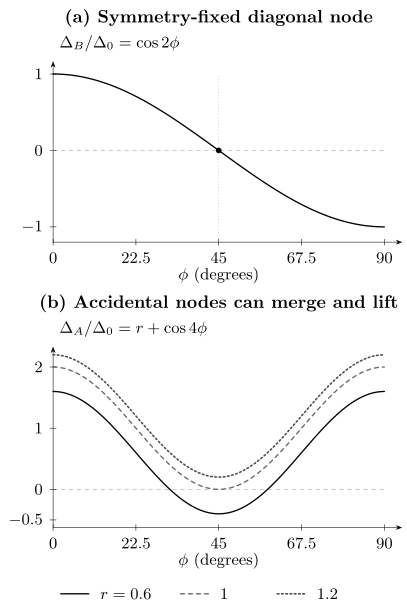
The upper gap changes sign at the diagonal direction. In the lower panel, all three curves belong to , while their zeros change as passes through 1. The vertical axis shows a signed scalar gap in one fixed frame, not a tunneling spectrum; a magnitude-only probe would see its absolute value.
Low-temperature power laws constrain the available low-energy phase space rather than uniquely naming a representation. For ordinary linear nodal dispersion, line nodes in three dimensions and point nodes on a two-dimensional Fermi line give and electronic ; ordinary three-dimensional point nodes give and . These statements assume clean bulk quasiparticles and nonvanishing probe weights. Disorder, nonlinear nodes, extra bands and nonlocal response can change the apparent powers.
Weak coupling does not always mean the isotropic ratios
Section titled “Weak coupling does not always mean the isotropic ratios”For a separable single-band weak-coupling interaction, write with and a normalized density-of-states-weighted Fermi-surface average. Eliminating the coupling and high cutoff between the zero-temperature and linearized gap equations gives
The associated heat-capacity jump is
These formulas assume a real form factor of fixed shape, constant normal density of states over the pairing shell and weak coupling. For a circular cylinder with , they give and . Thus a measured maximum-gap ratio above 3.528 is not by itself evidence for strong coupling. Gap anisotropy also changes the heat-capacity jump (Johnston, 2013).
Multicomponent order and time reversal
Section titled “Multicomponent order and time reversal”A useful two-component illustration is
At fixed , a common-phase real vector has , while has . Positive favors the real manifold; negative favors the chiral pair. Quartic stability requires and, when , also . Other crystal-allowed invariants can select an orientation, and can occur at the same quartic order; this two-coefficient example is not the most general crystal functional.
In a real representation basis, time reversal complex-conjugates . The bilinear
is gauge invariant and odd under time reversal. It equals for the two chiral partners. It is not a Chern number. A real state can break crystal rotation and be nematic, but its residual symmetry must be checked from the actual representation.
Strain can couple to , train domains and split transitions. A split transition alone does not determine representation: gradients, competing orders and inhomogeneity can also produce multiple anomalies. Likewise, Kerr or local magnetic signals require checks for trapped flux, magnetic inclusions and domain weighting before supporting superconducting time-reversal breaking (Sigrist and Ueda, 1991; Kallin and Berlinsky, 2016).
What complementary probes can establish
Section titled “What complementary probes can establish”Different measurements test different parts of a gap matrix:
| Measurement | Primary constraint and limitation |
|---|---|
| Heat capacity, screening, transport | bulk transition and low-energy excitations; backgrounds and connectivity matter |
| ARPES and tunneling | momentum- or surface-weighted gap magnitudes; no direct general measurement of relative sign |
| Oriented Josephson junctions | relative phase with known geometry, facets and electromagnetic response |
| NMR and susceptibility | physical magnetic response; pseudospin, orbital and interband terms must be separated |
| Neutron response and QPI | conditional coherence-factor information; interaction, impurity and orbital vertices matter |
| Strain, ultrasound and spontaneous fields | additional symmetry breaking, subject to domains and backgrounds |
For a scalar tetragonal candidate, . Controlled corner junctions can compare the two orientations and detect the associated shift. The Josephson page explains how junction asymmetry, loop inductance and trapped flux enter the interpretation. Such phase tests are stronger than identifying an irrep from one power law (Tsuei and Kirtley, 2000).
In a two-sheet example, suppose gap magnitudes are and , with an observed neutron feature at . If the relevant momentum connects Fermi points with these locally constant gaps, the two-quasiparticle threshold is . More generally it is . A feature below that threshold can support a spin-exciton interpretation in a specified susceptibility model, but kinematics alone does not determine relative sign.
Even the claim “nodeless multigap ” requires more than those magnitudes. They support resolved nodeless gaps only down to the measured resolution; assigning additionally requires symmetry information or a restricted candidate model. Within two already-assumed candidates, and have the same gap magnitudes and differ in an intersheet phase tested by a consistently transformed probe (Hirschfeld et al., 2011).
Disorder can lift accidental nodes, broaden deep minima or break pairs. Rapid suppression of is not a unique representation measurement. Surfaces can reconstruct, and different probes can weight different domains or sheets. Comparing the same thermodynamic state across measurements is therefore essential. Proximity Effect explains induced interface correlations, which need not constitute a separate bulk phase.
Exercises
Section titled “Exercises”1. Apply the complete exchange constraint
Section titled “1. Apply the complete exchange constraint”For even frequency, find the momentum parity of spin-singlet and spin-triplet states with either orbital-symmetric or orbital-antisymmetric tensors.
Solution
From , an orbital-symmetric singlet is even and an orbital-symmetric triplet is odd. Orbital antisymmetry reverses both answers: the singlet is odd and the triplet even. Odd frequency reverses them again. This classification assumes the indicated factors have definite exchange parity; a general mixed tensor should be tested with the full matrix relation.
2. Check a change of Bloch frame
Section titled “2. Check a change of Bloch frame”Show that the stated frame transformation preserves fermionic antisymmetry and the BdG eigenvalues.
Solution
Transposing the transformed matrix at gives
The normal block transforms as . The full Nambu transformation is unitary with particle block and hole block , so it preserves all eigenvalues. The sewing matrices and probe vertices must be transformed too. This is the same unitary equivalence used for ordinary operators, now applied to paired Bloch states.
3. Evaluate the anisotropic weak-coupling benchmark
Section titled “3. Evaluate the anisotropic weak-coupling benchmark”For on a uniform circular cylinder, evaluate the averages entering the maximum-gap ratio and heat-capacity jump.
Solution
The averages are
The logarithmic average follows by differentiating the integral of with respect to at 2. Substitution gives
The different numbers arise within weak coupling. Comparing an experiment requires matching its Fermi-surface weights and gap definition to the model.
4. Minimize the two-component example
Section titled “4. Minimize the two-component example”Compare , and . Determine their quartic energies and whether time reversal can be restored by a global phase.
Solution
The first two have and . The third has and . Its conjugate has the same energy and opposite . No common phase maps to : the first component requires phase , the second phase . The chiral partners break time reversal; the real states preserve it in this basis. The displayed functional leaves their real orientations degenerate.
5. Resolve an accidental node
Section titled “5. Resolve an accidental node”For , find the zeros in at . What changes at and 1.2?
Solution
The zeros are and , about 31.72° and 58.28°. They merge at 45° when , where the touching zero is quadratic in angular displacement. At 1.2 the minimum is and no zero remains. All three states have the same symmetry. Their low-energy phase space differs, and a measurement with resolution wider than the minimum may not distinguish the last state from a nodal one.
References
Section titled “References”- P. W. Anderson, “Theory of Dirty Superconductors,” Journal of Physics and Chemistry of Solids 11, 26–30 (1959), doi:10.1016/0022-3697(59)90036-8.
- P. W. Anderson, “Structure of ‘Triplet’ Superconducting Energy Gaps,” Physical Review B 30, 4000–4002 (1984), doi:10.1103/PhysRevB.30.4000.
- P. J. Hirschfeld, M. M. Korshunov, and I. I. Mazin, “Gap Symmetry and Structure of Fe-Based Superconductors,” Reports on Progress in Physics 74, 124508 (2011), doi:10.1088/0034-4885/74/12/124508.
- D. C. Johnston, “Elaboration of the α-model derived from the BCS theory of superconductivity,” Superconductor Science and Technology 26, 115011 (2013), doi:10.1088/0953-2048/26/11/115011.
- C. Kallin and J. Berlinsky, “Chiral Superconductors,” Reports on Progress in Physics 79, 054502 (2016), doi:10.1088/0034-4885/79/5/054502.
- V. P. Mineev and K. V. Samokhin, Introduction to Unconventional Superconductivity, Gordon and Breach (1999), ISBN 978-90-5699-209-5.
- R. Prozorov and R. W. Giannetta, “Magnetic Penetration Depth in Unconventional Superconductors,” Superconductor Science and Technology 19, R41–R67 (2006), doi:10.1088/0953-2048/19/8/R01.
- M. Sigrist and K. Ueda, “Phenomenological Theory of Unconventional Superconductivity,” Reviews of Modern Physics 63, 239–311 (1991), doi:10.1103/RevModPhys.63.239.
- M. Smidman, M. B. Salamon, H. Q. Yuan, and D. F. Agterberg, “Superconductivity and Spin–Orbit Coupling in Non-Centrosymmetric Materials: A Review,” Reports on Progress in Physics 80, 036501 (2017), doi:10.1088/1361-6633/80/3/036501.
- C. C. Tsuei and J. R. Kirtley, “Pairing Symmetry in Cuprate Superconductors,” Reviews of Modern Physics 72, 969–1016 (2000), doi:10.1103/RevModPhys.72.969.