

Pair-Density Waves and Exotic Orders
A pair-density wave (PDW) is superconducting order whose Cooper pairs carry a nonzero center-of-mass crystal momentum. Its pair field contains one or more Fourier components at instead of only the uniform component at . The state can therefore combine superconducting phase coherence with translation-symmetry breaking, generate secondary charge or nematic order, and support defects that bind a fractional superconducting vortex to a density-wave dislocation.
The definition concerns the anomalous pair field, not merely a modulated tunnelling gap or charge density. An ordinary charge-density wave can modulate a uniform superconductor’s local gap, and disorder can modulate both. Conversely, a single plane-wave pair field can have constant magnitude even though its pair momentum is nonzero. Establishing a PDW therefore requires a phase-sensitive or pair-sensitive observable plus symmetry, wavevector, and control-parameter consistency.
Required background. Order Parameters supplies symmetry transformations and composite-order diagnostics. Ginzburg–Landau Theory supplies the superconducting pair field, gauge covariance, and vortex scales. Charge and Spin Density Waves supplies modulation wavevectors and harmonics, while Competing Orders supplies the coupled-order stability and coexistence tests used to distinguish primary and induced order.
The Finite-Momentum Pair Field
Section titled “The Finite-Momentum Pair Field”Microscopic definition
Section titled “Microscopic definition”Let be relative momentum and the center-of-mass crystal momentum. Suppressing orbital and form-factor indices, a pair component can be written
where fixes spin and internal pairing symmetry. With electron charge and , this annihilation-pair field has signed electric charge . The conventional labels “charge-” and “charge-” below denote charge magnitudes. The corresponding slowly varying real-space pair field is
A uniform superconductor has . A pure PDW has at least one and ; a mixed state can contain both. On a lattice, momenta are defined modulo reciprocal lattice vectors, and a commensurate permits additional Umklapp terms.
Crystal momentum is specified in a fixed electromagnetic gauge and relative to the crystal. A uniform imposed phase gradient is not, by itself, a new equilibrium PDW phase. For a one-component plane wave, a translation can be compensated by a common phase change, so gauge-invariant local densities need not break translation symmetry. Opposite-momentum components give a more direct spatial modulation.
The terminology “pair density” is historical. The complex is gauge charged and is not itself an ordinary density. Its phase is observable relative to another condensate through Josephson interference, while gauge-neutral bilinears of PDW components can appear in diffraction, spectroscopy, or local density maps.
Symmetry transformations
Section titled “Symmetry transformations”For an electron phase rotation , a lattice translation by , and singlet time reversal , use
Point-group operations rotate and the internal form factor. Thus a square lattice can support components at and ; unequal weight in the two directions is a superconducting nematic. Unequal weight at and can break inversion and time reversal, but it should not automatically be called an equilibrium current: condensate, quasiparticle, and lattice contributions must be combined.
Plane-wave and standing-wave states
Section titled “Plane-wave and standing-wave states”A one-component Fulde–Ferrell-like field is
Its magnitude is constant. A two-component Larkin–Ovchinnikov-like state with equal amplitudes can be parameterized as
so that
The phase is the common superconducting phase; slides the modulation. The nodes of the cosine are sign changes of the pair field, not automatically lines of zero charge density.
Worked example: the pair period and the intensity period
Section titled “Worked example: the pair period and the intensity period”For the real standing wave with ,
The signed pair amplitude has period , while its squared magnitude has period . Thus a Fourier peak in an intensity cannot be assigned the pair momentum until the measurement’s dependence on is known. A charge modulation can couple to this neutral bilinear, but charge density is not generally equal to .
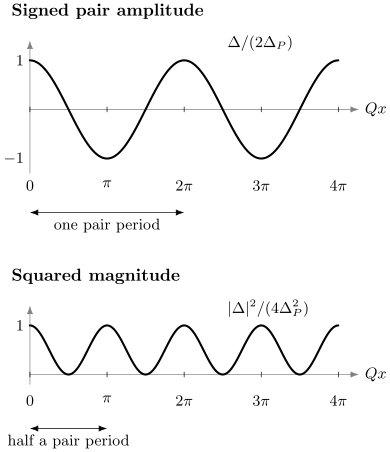
The functions and , plotted over two pair periods. The lower curve loses the sign information and contains a constant plus a harmonic. It illustrates an intensity dependence, not a universal formula for the tunnelling conductance or electronic density.
Relation to FFLO physics
Section titled “Relation to FFLO physics”Fulde–Ferrell and Larkin–Ovchinnikov states are weak-coupling finite-momentum superconductors driven by spin imbalance or Zeeman splitting. “PDW” is broader: it includes lattice- and correlation-driven finite- pairing, multi- states, and coexistence with uniform superconductivity even without a large spin polarization.
The relationship is conceptual, not an identification rule. A field-induced modulated state near the Pauli limit should be tested against orbital depairing, dimensionality, impurity scattering, and spin polarization. A zero-field modulation in a correlated lattice should be tested against charge-order-induced gap modulation and structural superlattices.
Minimal Coupled Theory
Section titled “Minimal Coupled Theory”After the preferred wavevectors have been selected microscopically, a minimal envelope free energy is
with
For , , and , the uniform amplitude problem favors both components for and one component for ; is degenerate at this order. If , higher powers must be examined. These are envelope fields: penalizes slow distortions around the already selected , not gradients of the full oscillatory pair field. Crystal symmetry generally adds couplings among rotated wavevectors, while commensurability permits phase-locking terms only when their net momentum is a reciprocal lattice vector.
This functional starts after is known. A microscopic calculation or a gradient expansion with a finite-wavevector minimum must explain why pairing is strongest at that . Nesting alone is not sufficient: the interaction, pair susceptibility, form factor, and positive superfluid stiffness must be checked.
Induced and Vestigial Orders
Section titled “Induced and Vestigial Orders”Charge order and charge-4e order
Section titled “Charge order and charge-4e order”Two opposite PDW components generate gauge-neutral and higher-charge composites. Introduce a charge modulation and a uniform charge- field . The lowest couplings are
For positive and , minimization gives
The first field is charge neutral and carries momentum . The second carries signed charge and zero momentum. When both opposite components and the corresponding nonzero couplings are present, these are induced responses. Symmetry permits a coupling but does not require its coefficient to be nonzero; internal form factors can select bond rather than ordinary charge modulation. A nonzero charge- composite inside a charge- condensate is not by itself a distinct charge- phase. Such a phase requires the higher-charge coherence to survive after ordinary pair coherence is lost.
If uniform superconductivity coexists with the PDW, another invariant is allowed:
Thus a mixed uniform–PDW state can induce charge order at , whereas a pure PDW naturally induces it at . Wavevector arithmetic is one of the most useful consistency tests in experiment.
Nematic and time-reversal-breaking composites
Section titled “Nematic and time-reversal-breaking composites”For square-lattice components, a gauge-neutral nematic variable is
A nonzero breaks fourfold rotation even if translational PDW correlations are short-ranged. A neutral relative-phase bilinear carries momentum modulo a reciprocal lattice vector. It can be uniform only for equal crystal momenta modulo that vector, including distinct internal components at the same momentum. A proposed uniform time-reversal-breaking composite must also have the correct time-reversal transformation; generic multi-wavevector components require a product with actual momentum closure, which may be of higher order. Calling such an order “vestigial” requires evidence that it descends from fluctuations of the multicomponent parent rather than from an independent instability with the same symmetry.
| Composite | Momentum | Charge magnitude | Broken symmetry or response |
|---|---|---|---|
| charge or bond modulation | |||
| charge- coherence; not necessarily a separate phase | |||
| defined above | rotational symmetry | ||
| modulo a reciprocal vector | relative-phase order; uniform chirality requires additional momentum and symmetry checks |
Defects and Partial Melting
Section titled “Defects and Partial Melting”With , single-valuedness of each component requires
Three elementary defect classes follow:
| Common-phase winding | Sliding-phase winding | Interpretation | |
|---|---|---|---|
| ordinary superconducting vortex | |||
| double density-wave dislocation | |||
| half vortex bound to a single dislocation |
The composite defect is allowed because a sign change from is cancelled by the sign change of the cosine under . For a charged standing-wave state with equal component stiffnesses, no common/sliding phase-gradient mixing, and no uniform condensate locking the phases, the magnitude of the ideal flux is
provided screening and boundary conditions allow the asymptotic flux to be defined. With unequal isotropic stiffnesses and and no drag term, vanishing net charge current far from a defect instead gives
The sign uses the annihilation-pair convention . For and equal stiffnesses the magnitude is . A uniform condensate or commensurate locking can attach a domain wall to a fractional defect and confine it; allowed winding numbers do not alone establish isolated low-energy defects.
Different defect proliferation sequences produce different descendants. Disorder of can destroy translational PDW order while preserving coherence of , yielding charge- superconductivity. Disorder of can leave the density composite coherent. Proliferation of both destroys both composites, possibly leaving only nematic order. For an incommensurate state on a two-dimensional lattice with a fixed stripe direction and short-range phase elasticity, thermal correlations can be algebraic before defects unbind. A rotationally invariant continuum smectic has softer bending fluctuations and need not retain even that translational order. Commensurate pinning and electromagnetic screening change the long-distance problem. These distinctions are central to the analyses by Berg, Fradkin, and Kivelson and by Radzihovsky and Vishwanath cited below.
What pair-sensitive measurements reveal
Section titled “What pair-sensitive measurements reveal”Pair-sensitive probes
Section titled “Pair-sensitive probes”In scanned Josephson tunnelling microscopy, a superconducting tip probes the local critical pair current rather than only the single-particle density of states. Spatial modulations in the pair channel are stronger information than a normal-tip gap map. But a local critical current is a magnitude: in an ideal weak junction with a uniform reference and position-independent coupling, . Some phase-diffusive measurements infer a quantity proportional to . Neither map alone recovers the sign changes of a standing wave. A controlled phase reference or interference experiment is needed to recover the relative pair phase, and spatial variation of the tunnel matrix element must be separated from variation of the sample condensate.
Extended Josephson junctions provide a momentum filter. A spatially uniform junction averages a sign-changing PDW toward zero, while junction roughness, facets, an applied magnetic phase gradient, or a patterned counterelectrode can supply the missing momentum. Orientation and field dependence should follow the same inferred .
Spectroscopy and imaging
Section titled “Spectroscopy and imaging”A PDW reconstructs the Bogoliubov–de Gennes problem: the pair term couples an electron at to the hole associated with a missing electron at . The paired electron momenta therefore sum to . Consequences can include gap modulations, Andreev states near sign changes, particle–hole-related features at and , or residual Bogoliubov pockets whose electron-weighted spectra look arc-like. These signatures are model dependent. Charge order, pair-breaking disorder, structural supermodulation, quasiparticle interference, and setup effects require explicit forward modelling.
Normal-tip scanning tunnelling spectroscopy measures local single-particle spectral weight. It can support a PDW when the energy, phase, particle–hole symmetry, defect structure, and field dependence match a common finite-momentum pairing model, but it is not intrinsically phase sensitive to the pair field.
Bulk response and flux
Section titled “Bulk response and flux”Layer decoupling, anisotropic stiffness, unusual Josephson interference, and field-enhanced modulations constrain a PDW theory but are not unique. A charge- descendant would ideally show flux periodicity together with thermodynamic and phase-coherence evidence. Fractional periodicities can also arise from multi-junction paths, nonequilibrium switching, or device geometry, so the circuit model is part of the claim.
Diffraction is bulk sensitive to a charge or lattice modulation, not directly to a charge- anomalous expectation value. A bulk PDW case is strongest when diffraction or another bulk probe confirms the required secondary order while phase-sensitive local or junction measurements identify the pair channel at a consistent wavevector.
Primary versus induced pairing in materials
Section titled “Primary versus induced pairing in materials”In -, Liu and collaborators measured Josephson and gap modulations at wavevectors of the pre-existing charge-density wave. Uniform superconductivity and charge order provide the two factors that can induce . A finite-momentum pair component can therefore be present without being the leading superconducting instability.
Hamidian and collaborators found local Cooper-pair-density modulations in Bi-2212 coexisting with a strong uniform condensate. Such a measurement addresses local pair modulation; its interpretation as a primary bulk PDW additionally depends on phase information, surface sensitivity, and the coupled-order theory.
Layer decoupling in stripe-ordered cuprates supplies a complementary, indirect argument: alternating stripe directions can frustrate the leading interlayer Josephson term of a sign-changing PDW. Berg and collaborators developed that mechanism. It must still be compared with conventional junction frustration and dimensional crossover. In each example, correlation length, ordered volume, and the difference between a surface measurement and a bulk phase are physical parts of the conclusion.
Other meanings of unconventional order
Section titled “Other meanings of unconventional order”Finite center-of-mass momentum, internal pair symmetry, and relative-frequency dependence are independent properties. Unconventional Superconductivity describes crystal and spin representations; Topological Superconductors describes protected bulk and boundary structure. Neither an unusual internal form factor nor a PDW automatically establishes topological superconductivity.
Composite nematicity and chirality can descend from a multicomponent pair field, but the same symmetries can break through independent particle–hole instabilities. Orbital-current proposals must specify gauge-invariant bond currents; multipolar proposals must specify the ordered tensor moment. Hastatic order is a particular spinorial hybridization proposal for non-Kramers Kondo systems. These distinctions require different operators and probes, not a common test for everything called “exotic.”
Odd-frequency pairing
Section titled “Odd-frequency pairing”For the time-ordered anomalous correlator, fermion exchange requires
with any orbital indices exchanged as well. An odd-frequency component is odd under in a specified spin, orbital, and spatial channel. Its equal-relative-time pair amplitude vanishes; a time derivative, composite operator, or frequency-resolved anomalous response is needed to characterize it. The extra minus sign in frequency changes which spin and spatial parities satisfy the Pauli constraint. This concerns relative time, whereas PDW concerns center-of-mass position.
An odd-frequency component induced near an interface does not automatically define a separate bulk thermodynamic phase. Linder and Balatsky discuss this distinction and the response needed for a stability analysis.
Exercises
Section titled “Exercises”1. Derive the composite quantum numbers
Section titled “1. Derive the composite quantum numbers”Use the symmetry transformations of to determine the charge and momentum of and .
Solution
Under , . Therefore
so this bilinear is charge neutral. Translation contributes from and another from , giving momentum .
For the second product,
while the momenta and cancel. It is a uniform charge- field.
2. Integrate out a secondary charge modulation
Section titled “2. Integrate out a secondary charge modulation”Starting from the terms in , minimize over and find the induced quartic interaction among PDW components.
Solution
For real ,
Stationarity gives
Substitution yields
A soft charge channel therefore favors simultaneous opposite-momentum components and can convert a traveling-wave preference into a standing-wave preference.
3. Classify a half vortex
Section titled “3. Classify a half vortex”Take in the equal-stiffness standing wave without phase locking to a uniform condensate. Show that the pair field is single-valued and determine the ideal flux magnitude.
Solution
The windings are
The common phase changes the pair field’s sign. The sliding phase changes
so the two signs cancel. The superconducting phase winding is half the ordinary value, hence the ideal flux magnitude is under the stated stiffness and screening assumptions. The defect cannot be treated as an isolated half vortex without its attached density-wave dislocation.
4. Derive the Josephson momentum filter
Section titled “4. Derive the Josephson momentum filter”A uniform reference superconductor is coupled across a junction of length to . For uniform local coupling, evaluate the leading Josephson amplitude.
Solution
Up to constants and the reference phase, the amplitude is
For , positive and negative lobes cancel. If a magnetic field, patterned junction, or second modulated condensate supplies momentum , then
which peaks near momentum matching . Junction nonuniformity can also relax the selection rule and must be measured independently.
5. Distinguish a primary from an induced PDW
Section titled “5. Distinguish a primary from an induced PDW”A material has a CDW at above . Below , uniform superconductivity and a pair modulation at the same appear. What does symmetry imply, and what would be needed to claim a primary PDW?
Solution
The invariant
acts as a linear source for once and are nonzero. An induced PDW is therefore the default symmetry explanation. A primary claim needs information about the leading pair instability beyond the existence of the modulation: for example, finite- pairing when the source CDW or uniform condensate is absent, or a coupled-susceptibility analysis supported by selective tuning. When a CDW is already present, uniform and finite-momentum pair fields can mix in the same critical eigenmode; a second observed amplitude need not imply a second transition.
6. Recover the wavevector from a magnitude measurement
Section titled “6. Recover the wavevector from a magnitude measurement”Let and suppose an ideal local Josephson measurement returns , with constant . What periods occur in and ? Does either measurement reveal the sign of ?
Solution
Both magnitudes repeat after , half the pair-field period. The squared current is
It has a constant term and a harmonic. The unsquared absolute cosine also has higher even harmonics. Neither records the sign of the pair amplitude; a phase reference is needed. Adding a uniform real component changes the harmonics: for , its square contains . This is the same versus distinction predicted by the composite couplings.
References
Section titled “References”- D. F. Agterberg and H. Tsunetsugu, “Dislocations and vortices in pair-density-wave superconductors”, Nature Physics 4, 639–642 (2008). Composite defects and induced order.
- D. F. Agterberg et al., “The physics of pair-density waves: cuprate superconductors and beyond”, Annual Review of Condensed Matter Physics 11, 231–270 (2020). Comprehensive review and evidence assessment.
- E. Berg et al., “Dynamical layer decoupling in a stripe-ordered high- superconductor”, Physical Review Letters 99, 127003 (2007). PDW explanation of frustrated interlayer coherence.
- E. Berg, E. Fradkin, and S. A. Kivelson, “Charge-4e superconductivity from pair-density-wave order in certain high-temperature superconductors”, Nature Physics 5, 830–833 (2009). Charge- vestigial order.
- E. Berg et al., “Striped superconductors: how spin, charge and superconducting orders intertwine in the cuprates”, New Journal of Physics 11, 115004 (2009). Coupled stripe phenomenology.
- P. Chandra, P. Coleman, and R. Flint, “Hastatic order in the heavy-fermion compound URuSi”, Nature 493, 621–626 (2013). Spinorial hybridization order.
- E. Fradkin, S. A. Kivelson, and J. M. Tranquada, “Colloquium: Theory of intertwined orders in high temperature superconductors”, Reviews of Modern Physics 87, 457–482 (2015). Symmetry and cuprate context.
- P. Fulde and R. A. Ferrell, “Superconductivity in a strong spin-exchange field”, Physical Review 135, A550–A563 (1964). Plane-wave finite-momentum pairing.
- M. H. Hamidian et al., “Detection of a Cooper-pair density wave in BiSrCaCuO”, Nature 532, 343–347 (2016). Scanned Josephson evidence.
- A. Himeda, T. Kato, and M. Ogata, “Stripe states with spatially oscillating -wave superconductivity in the two-dimensional –– model”, Physical Review Letters 88, 117001 (2002). Strong-coupling lattice realization.
- A. I. Larkin and Y. N. Ovchinnikov, “Nonuniform state of superconductors”, Soviet Physics JETP 20, 762–769 (1965). Standing-wave finite-momentum pairing.
- J. Linder and A. V. Balatsky, “Odd-frequency superconductivity”, Reviews of Modern Physics 91, 045005 (2019). Frequency-odd anomalous pairing.
- X. Liu, Y. X. Chong, R. Sharma, and J. C. S. Davis, “Discovery of a Cooper-pair density wave state in a transition-metal dichalcogenide”, Science 372, 1447–1452 (2021). Josephson imaging of an induced PDW in NbSe.
- L. Radzihovsky and A. Vishwanath, “Quantum liquid crystals in an imbalanced Fermi gas: fluctuations and fractional vortices in Larkin–Ovchinnikov states”, Physical Review Letters 103, 010404 (2009). Smectic fluctuations and half defects.