

Electron–Phonon Coupling
Electron–phonon coupling is the change in an electronic Hamiltonian produced by a quantized ionic displacement. Its central material input is a matrix element between specified Bloch states and a specified phonon mode. The same matrix element enters electronic spectra, phonon shifts and damping, current relaxation and pairing, but each observable contracts and weights it differently. A measured linewidth or a fitted coupling constant therefore does not determine all four.
We construct the vertex for an equilibrium crystal and use it in an effective Hamiltonian. A first-principles screened vertex requires extra care: some electronic response is already included in the reference calculation and must not be counted again.
Required background. Phonons supplies normalized displacement modes and their phase convention. Band Theory Overview supplies Bloch labels, occupations and the distinction between a reference band and an interacting spectrum.
Helpful background. Fermi Surface supplies metallic phase space; Diagrammatic Methods supplies perturbative contractions; Spectral Functions supplies poles, residues and line shapes. Boltzmann Transport supplies the collision-operator reasoning needed for current relaxation.
From ionic displacement to a Bloch-state vertex
Section titled “From ionic displacement to a Bloch-state vertex”Take primitive cells of volume , with periodic boundaries and total volume . Electronic states are orthonormal over the whole crystal. The label includes spin when spin is resolved; no extra spin factor will be inserted into sums. The reference one-electron operator is , with eigenvalues .
Use the real-force-constant harmonic modes of Phonons, with positive frequencies and a paired polarization gauge at and . Exact rigid translations are excluded from the oscillator coordinates. To expose the one cell-count factor, write
Here , and omits the already displayed in . It differs by precisely that factor from a convention that includes the cell count inside . The polarization is mass-weighted as in Phonons, and .
Expand about the chosen structure. Its first derivative defines
The operator carries crystal wavevector ; it is not itself a cell-periodic scalar potential before its Bloch phase is removed. The intensive vertex has energy units. Second quantization gives
Do not attach another to . A transition amplitude contains the displayed factor; its squared matrix element and the final-state sum yield an intensive rate. Giustino’s review (2017), together with its 2019 erratum, is useful here: the erratum explicitly corrects a duplicated normalization in several model vertices. Exercise 1 checks this convention directly in real space.
Hermiticity and gauge changes
Section titled “Hermiticity and gauge changes”For the paired branch and a Hermitian electronic Hamiltonian,
With and , where , the vertex transforms as
The transformations and cancel these phases in . Folding across a zone boundary requires the corresponding Bloch sewing convention. In degenerate band subspaces the transformation is , and a single matrix entry is basis dependent. Degenerate phonons also require a consistent mode-space rotation. Compare invariant transition strengths or contracted density matrices.
Coupling models encode different perturbations
Section titled “Coupling models encode different perturbations”Acoustic deformation potential. In an isotropic bulk scalar model, a dilation changes the electronic energy by . For mass density and longitudinal polarization ,
The factor follows from the positive Fourier phase above. For linear sound, . The absence of transverse coupling belongs to this scalar dilation model, not to every real crystal. Shear, orbital and spin-orbit responses can supply other vertices.
Polar optical coupling. In the three-dimensional isotropic long-wavelength Fröhlich model, with no additional free-carrier screening, the magnitude is
Here , is the vacuum permittivity, and are relative dielectric constants excluding and including the ionic contribution, respectively. This is a rationalized-SI formula. A monolayer, a gated film or a doped polar crystal needs the appropriate electrostatic kernel and screening; substituting a nominal thickness into this bulk expression is not a general derivation. The phase of depends on the polarization convention, which is why only its magnitude is specified here.
Local optical coupling. A Holstein model changes an onsite energy:
With canonical lattice Fourier transforms its intensive momentum-space vertex is . It describes a local density coupled to a local oscillator, rather than the long-range electric field of a polar mode.
Hopping modulation. A Peierls or SSH-type model changes a hopping matrix element. For an oriented bond set counted once, a term is , with linear in selected displacements. Bond geometry produces momentum and orbital factors. If the hopping carries an electromagnetic Peierls phase, the interaction contributes to the physical current and contact term obtained by differentiating that same Hamiltonian. Kubo Formula in Materials derives that response from the Hamiltonian.
These models need not be mutually exclusive in one material. Their parameters have different meanings; a deformation potential, a local energy modulation and a dimensionless metallic average cannot be substituted for one another.
Electron self-energy and the quadratic displacement term
Section titled “Electron self-energy and the quadratic displacement term”Use electronic energies , phonon energies , and a retarded energy argument . Let and be equilibrium Fermi and Bose occupations of the reference states.
At second order in the linear vertex, an electron propagates to an intermediate band while creating or absorbing a phonon. The intermediate resolvents have denominators . The electron-addition and electron-removal contractions supply the equilibrium factors. For a nondegenerate external band, the diagonal Fan contribution is
Both infinitesimals have the same retarded sign. Taking the imaginary part replaces each resolvent by a negative delta function; its support identifies the emission and absorption thresholds with Pauli blocking included. The real part shifts and bends the dispersion. Threshold structure can generate a kink, but a kink alone does not identify a phonon: other bosonic channels and band hybridization can produce changes in slope. The spectral interpretation is developed by Engelsberg and Schrieffer (1963).
This equilibrium retarded width is not simply the out-scattering probability of one tagged electron. At finite temperature it combines addition and removal processes. Irreversible rates also require a continuum/long-time or bath approximation; a closed finite crystal represented by a finite grid has discrete poles before such a limit.
Why the second derivative cannot be omitted
Section titled “Why the second derivative cannot be omitted”The same expansion of contains . Define the second-order vertex without absorbing the Taylor half:
The associated Hamiltonian has prefactor multiplying . Contracting the harmonic coordinates uses and yields the leading Debye–Waller energy shift
This static real correction is an electronic energy shift; it is not the diffraction intensity’s Debye–Waller factor. Consistently related first and second derivatives are needed for translation constraints and band shifts. A change of equilibrium volume gives a separate thermal-expansion contribution, already distinguished in Anharmonic Lattice Dynamics.
A two-level check shows why both orders matter. Let , where is a real rotation and . Its eigenvalues never change. The linear off-diagonal perturbation gives the lower state a second-order shift ; the explicit quadratic diagonal term gives . Keeping only one produces a false energy change. This check illustrates a cancellation, without identifying the rotation parameter with a particular crystal’s acoustic displacement.
Residue, width and mass measure different derivatives
Section titled “Residue, width and mass measure different derivatives”For a scalar isolated pole satisfying ,
The derivatives are evaluated at the pole; the momentum derivative in the last line is at fixed energy. Here is an energy half width. The velocity formula follows by differentiating the pole equation, and shows why is not universally a mass ratio. For a suitable isotropic dispersion with negligible momentum dependence of the self-energy, the Fermi-velocity mass ratio becomes , where . A phonon contribution to that slope is not the entire many-body mass enhancement. In a mixed band subspace, retain the matrix self-energy.
The electron bath acts back on the phonon
Section titled “The electron bath acts back on the phonon”The phonon self-energy contains an electron–hole contraction of the same vertex. To keep energy units throughout this section, define
For one isolated branch with reference energy ,
The independent-electron Lehmann sum has a particle–hole denominator and an occupation difference. At order for this effective Hamiltonian,
There is no extra factor two because the state labels already include spin. For a passive equilibrium electron bath, the positive-energy absorptive part is nonpositive. As a check, take a Hermitian interband vertex between a filled and an empty level separated by , at zero temperature with the chemical potential in their gap. The forward transition contributes and the reverse contributes . Their static sum is , a softening in this model. At general fixed , reversing a transition also reverses its transferred wavevector; this particular two-level reduction is not automatic. The available electron–hole phase space and its momentum dependence govern where damping or a Kohn anomaly can appear. A peak in an unweighted susceptibility is insufficient if the actual vertex vanishes there.
If the pole shift is small compared with the reference phonon energy and derivative renormalizations are negligible, the on-shell energy half width is . For an isolated Markov mode without independent dephasing, the excess-population relaxation rate in this same weak-renormalization limit is
The occupation difference follows from , the difference of phonon absorption and emission coefficients. It is not the absolute downward transition rate of an already occupied mode. More generally multiply by the pole factor in the narrow-pole limit.
The translation to the frequency-normalized propagator on Anharmonic Lattice Dynamics is and . Thus energy FWHM is , amplitude lifetime is , and the qualified population lifetime is . Probe resolution, other decay channels and branch mixing must be separated before applying these conversions to data.
A model bubble is not an exact DFPT screening identity
Section titled “A model bubble is not an exact DFPT screening identity”In density-functional perturbation theory (DFPT), the differentiated Kohn–Sham operator includes the self-consistent electronic potential. It is not the derivative of the bare nuclear Coulomb potential. Moreover, an adiabatic DFPT phonon already incorporates a static electronic response. Adding the entire model bubble again to that reference would generally count the static response twice.
A dynamical correction needs consistent reference force constants, screening and vertices, often organized schematically as . The subtraction removes the static part in such a construction; it does not make an arbitrary screened bubble exact. The full response can have a different vertex structure. Its derivation must specify which static response was included in the reference force constants and which screening was included in the vertices.
Metallic averages and their normalization
Section titled “Metallic averages and their normalization”For a metal with suitable quasiparticles, define the total spin-counted DOS per primitive cell at the reference Fermi level,
Define an energy-argument spectral function by
The delta functions refer to converged Brillouin-zone integrals or a specified thermodynamic limiting procedure, not literal isolated levels on one finite mesh. With this convention has inverse-energy units and is dimensionless as a distribution of an energy argument. In three dimensions becomes .
The compatible angular-frequency notation on BCS Theory is
For example, one Einstein component is . Substituting transforms its delta function too. An additional prefactor would define a different spectral density and require a different formula for . Translate the spectral function, its argument, the DOS and the integral together.
In a metallic adiabatic/wide-band approximation with sufficiently smooth electronic phase space, gives the DOS-weighted Fermi-surface average of the band- and momentum-resolved phonon contribution to . Identifying it with one common slope additionally requires that the slope be effectively uniform over the relevant states. This is not an algebraic identity for every finite-band Hamiltonian. A band-resolved slope, this Fermi-surface average, a transport average and a pairing-kernel eigenvalue remain distinct quantities. A semiconductor with no Fermi surface does not acquire a meaningful metallic merely by broadening its gap until the numerical DOS is nonzero.
A finite band changes the low-energy slope
Section titled “A finite band changes the low-energy slope”At , take one spinless band with constant DOS per cell on , a momentum-independent vertex , and one phonon energy . Half filling sets . Write , with energy units. The Fan sum becomes
The first term describes empty intermediate states and phonon emission; the second is its occupied-state partner. On the real axis, away from the four thresholds,
Near the Fermi energy, Pauli blocking and the finite phonon cost leave no decay channel. Differentiating the real part at zero gives
The second expression follows directly from the Fermi-surface definition above. They approach one another for ; when , the actual slope is only half that estimate. This is a lowest-order model calculation, not a treatment of strong coupling or a material DOS with sharp structure.
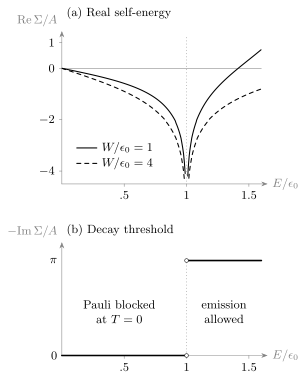
The calculated self-energy for and , at equal . The real part has slopes and in the displayed units. The logarithmic singularities at and the sharp rate steps arise from the ideal zero-temperature Einstein mode and abrupt constant DOS; the curves are truncated near the singularity. Positive energy is shown; the real part is odd and the decay function is even.
Current relaxation and retarded attraction
Section titled “Current relaxation and retarded attraction”Equal single-particle rates can give very different transport
Section titled “Equal single-particle rates can give very different transport”For a spherical fixed-speed Fermi surface, quasielastic scattering and phonons held in equilibrium by a bath, let be a differential angular rate. The angular collision operator acting on a current-like first harmonic gives
Small-angle scattering changes a state but barely changes the direction of its current. Backscattering reverses it. Exercise 2 constructs equal total rates whose transport rates differ by more than two orders of magnitude. Allen (1978) develops a systematic collision-equation treatment for metals; in anisotropic, multiband or inelastic problems the simple angular factor must be replaced by that problem’s actual velocity and collision structure.
The equilibrium-phonon assumption is consequential. In a closed clean electron–phonon system, normal collisions can transfer momentum between subsystems while leaving a protected component of the total current. A finite electronic spectral width need not imply finite bulk dc resistivity. Phonon drag and momentum loss through Umklapp, disorder, boundaries or an external bath must be treated consistently. Use Boltzmann Transport for the kinetic closure and Kubo Formula in Materials for the full current/contact/vertex response.
Phonon elimination produces a frequency-dependent kernel
Section titled “Phonon elimination produces a frequency-dependent kernel”Let be a bosonic Matsubara energy. For a scalar Hermitian density vertex, contracting the Gaussian phonon yields
This is an intensive interaction energy coefficient in a frequency-dependent density-pair effective action. After a static reduction, the density-pair Hamiltonian has the associated factor . The sign and static factor can also be checked by completing the oscillator square. A general multiband pair-scattering matrix uses the two appropriate vertices, not an arbitrary replacement of their product by one modulus squared.
The attraction is retarded. Its continued real-frequency kernel is not negative at every frequency, and a static attractive component does not fix the superconducting eigenchannel or transition temperature. Coulomb repulsion, momentum and band dependence, competing orders and lattice stability remain necessary inputs. BCS Theory gives the material interpretation; BCS Mean-Field Theory derives the reduced pairing saddle and gap equation.
In a regular broad-band metal the usual Migdal estimate for omitted vertex corrections is of order , with a small adiabatic phonon/electronic ratio. Migdal (1958) derives the expansion in a normal-metal setting. This is not a universal bound for an arbitrary momentum-selective vertex. Sharp forward transfer can introduce a much smaller electronic scale ; low density, narrow bands, singular phase space and nearby instabilities require separate control. Conversely, need not itself be infinitesimal for an adiabatic treatment to be useful. Ionic mass alone does not establish the approximation’s validity.
Comparing material calculations with spectra
Section titled “Comparing material calculations with spectra”Wannier interpolation makes dense momentum sums practical, but the electronic gauges, phonon phases and zone-boundary transformations must remain compatible. Matching interpolated eigenvalues alone does not check interaction matrix elements. Polar systems also need a consistent separation of long-range electrostatics from the short-range remainder; see Poncé et al. (2016) and Wannierization Workflows.
The observable determines the next step. Photoemission needs a spectral and probe model; phonon scattering needs displacement and polarization weights; mobility needs the nonequilibrium collision problem; pairing needs the retarded kernel and repulsion. Converging the electronic and phonon momentum meshes together with the energy-conservation integration is essential. A broad numerical delta function can hide poorly sampled thresholds.
A large fitted coupling or a sharp electronic kink alone does not establish phonon-mediated superconductivity. Conversely, weak current relaxation does not exclude strong forward-scattering spectral effects. These conclusions require the momentum, occupation and probe weights developed above.
Exercises
Section titled “Exercises”1. One finite-size factor
Section titled “1. One finite-size factor”On a periodic chain of sites, take and canonical transforms , . Find the amplitude for one electron to emit a phonon of momentum , and sum its squared vertex over all final phonon momenta before imposing energy conservation. What fails if is also divided by ?
Solution
The site sum imposes in the annihilation term and for emission. Thus
Between normalized zero- and one-phonon states, the emission amplitude is . There are allowed emitted momenta, so their summed squared vertex is . A duplicate factor instead gives , which incorrectly vanishes as the crystal grows. This sum checks normalization, not a rate: energy conservation, occupations and the continuum limit still matter. Rephasing Bloch or paired phonon states changes the amplitude’s phase but leaves its modulus and the full Hamiltonian invariant.
2. Equal widths, unequal current relaxation
Section titled “2. Equal widths, unequal current relaxation”Let two normalized differential rates have the same . The first is uniform per solid angle in a three-dimensional cone of half-angle around the forward direction; the second occupies an equal cone around the backward direction. In the stated isotropic quasielastic bath model, calculate and their ratio.
Solution
For the forward cone, solid-angle integration gives
The backward cone has the opposite mean. Consequently
The backward transport rate is about times the forward one, despite equal total angular rates. A real-material resistivity additionally needs the current-carrying states, density and compatible kinetic assumptions. For a closed momentum-protected electron–phonon system, the bath-based inference may fail altogether.
3. Two phonon scales in one metallic average
Section titled “3. Two phonon scales in one metallic average”Take Einstein energies and with partial couplings and . Construct , calculate the total and logarithmic energy, and estimate only in the wide-band momentum-independent approximation. Define the logarithm using an arbitrary positive reference energy .
Solution
The two spectral areas are , or and . Thus is their weighted sum of delta functions and . For ,
The reference cancels because the weights sum to :
Under the stated additional approximation, . This does not specify a transport coupling, an anisotropic mass tensor or a transition temperature. Finite electronic bandwidth or a strongly varying DOS can also break the identification of this spectral average with the actual low-energy self-energy slope.
4. Static attraction and retardation
Section titled “4. Static attraction and retardation”For one density-coupled optical mode with and , find and . Check the static coefficient using for a fixed commuting density . Does this determine a superconducting transition?
Solution
The interaction coefficient is and . Completing the square gives
The static density energy is , consistent with the factor two in the pair kernel. For a spinful local orbital, : the one-body shift and the opposite-spin attraction are distinct terms. For a spinless single orbital, , so this isolated onsite static term alone is only a one-body shift. Retarded propagation, other channels, Coulomb repulsion, filling and phase coherence remain necessary to infer superconductivity. The algebraic attraction by itself supplies no transition temperature.
References
Section titled “References”- P. B. Allen, “New method for solving Boltzmann’s equation for electrons in metals,” Physical Review B 17, 3725–3734 (1978), doi:10.1103/PhysRevB.17.3725.
- S. Engelsberg and J. R. Schrieffer, “Coupled Electron-Phonon System,” Physical Review 131, 993–1008 (1963), doi:10.1103/PhysRev.131.993.
- F. Giustino, “Electron-phonon interactions from first principles,” Reviews of Modern Physics 89, 015003 (2017), doi:10.1103/RevModPhys.89.015003, author manuscript; Erratum, Reviews of Modern Physics 91, 019901 (2019), doi:10.1103/RevModPhys.91.019901.
- A. B. Migdal, “Interaction between Electrons and Lattice Vibrations in a Normal Metal,” Soviet Physics JETP 7, 996–1001 (1958), journal full text.
- S. Poncé, E. R. Margine, C. Verdi and F. Giustino, “EPW: Electron–phonon coupling, transport and superconducting properties using maximally localized Wannier functions,” Computer Physics Communications 209, 116–133 (2016), doi:10.1016/j.cpc.2016.07.028, author manuscript.