

Quantum Transduction for Communication
Quantum transduction changes the carrier of quantum information while preserving a declared encoding. In a communication protocol, its output must be a usable state in the receiver’s accepted mode, or a trustworthy herald for a usable shared resource. Converted power alone measures neither of these outcomes.
Interconnects and Transduction explains converter physics, input–output models, efficiency, bandwidth and noise. Here we use those measurements to predict a communication link’s performance. It treats direct state transfer and heralded entanglement distribution separately, because the two tasks tolerate loss and noise differently.
Required background. Interconnects and Transduction supplies the physical converter model; Quantum Channels for QI supplies channel composition and conditional operations.
Carrier conversion must preserve the encoding
Section titled “Carrier conversion must preserve the encoding”An ideal converter acts as an isometry on the entire input code space. For orthonormal logical states, its desired action is
The relative phase must be known or tracked if the task requires coherent use of the output. A stable phase can be corrected. An unrecorded fluctuating phase becomes dephasing after averaging.
For polarization, time-bin, or dual-rail qubits, both logical components must be accepted with the specified temporal, spectral, and spatial relations. Transferring each basis state with high conditional fidelity is insufficient if the device treats their coherent superposition differently.
Consider a success branch with Kraus operator
For input , its success probability is
After success, the output amplitudes are proportional to and . When , the converter filters the state even if it introduces no extra random noise. This is a physical trace-decreasing operation, but the normalized conditional transformation depends on the input and is not a linear quantum channel.
Unequal efficiencies can hide in basis tests
Section titled “Unequal efficiencies can hide in basis tests”Take , , and a corrected phase . Each logical basis input is returned perfectly whenever it succeeds. For , however, success occurs with probability and the conditional output is
Its overlap with the intended is , not unity. The output can be balanced by attenuating the stronger branch until both efficiencies are . Within this ideal model, the accepted state is then correct for every input, but the success probability is only . Balancing trades yield for state preservation; it does not recover the lost photons.
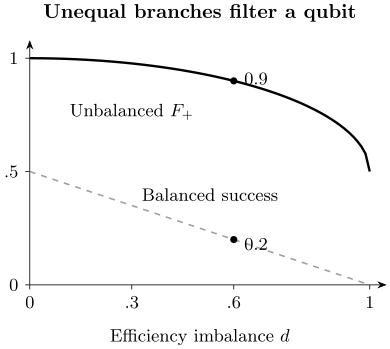
Let and , with corrected phase and . The mean efficiency is always . The solid curve gives the conditional overlap of a transmitted ; the dashed curve gives the state-independent success probability after attenuating the stronger branch to match the weaker one. At , these are and . At , balancing gives zero probability, so there is no successful balanced output.
The calculation also explains why a reported mean conversion efficiency is incomplete without the encoding and branch dependence. Process Tomography describes reconstruction of a process; a success-conditioned experiment must retain its input-dependent acceptance probabilities.
A receiver accepts a mode, not all output light
Section titled “A receiver accepts a mode, not all output light”Let be a normalized single-photon spectral amplitude, and let be the converter’s complex transfer amplitude in a passive, linear, noise-free model. Normalize the spectral convention so that . If the receiver accepts normalized mode , the useful transfer amplitude is
The total converted-photon probability is
The inequality follows from Cauchy–Schwarz. Equality requires that the output wavepacket match the accepted mode up to a constant. A broad power spectrum with distorted spectral phase can therefore have a large integrated conversion probability and poor capture by the receiver.
For two-photon interference, the relative modes of the photons matter as well. Spectral filtering can improve their indistinguishability while lowering detection rate. Any comparison must include the filter and the accepted detection window in both its efficiency and noise definitions. The scalar model above omits added photons, gain, saturation, and correlations; those require the fuller channel description in the linked hardware treatment and the task-dependent analysis of Zeuthen and colleagues (2020).
Direct transfer and entanglement-first communication
Section titled “Direct transfer and entanglement-first communication”In direct transfer, an unknown input passes through conversion, propagation, capture, and decoding. In a simple state-independent loss model, success efficiencies multiply:
Use efficiencies measured at consistent boundaries and for the same modes. This product assumes the stated conditional probabilities are applicable in sequence; it is not valid to multiply independently optimized values from incompatible operating points. An input lost during an unprotected transfer cannot be recovered by preparing another copy of the unknown state.
An entanglement-first protocol instead generates a shared state before consuming the data qubit. Failed attempts can be retried while the data remains local. Once the required pair is available, Quantum Teleportation consumes it along with a local measurement and classical communication. This changes the consequences of loss, but does not remove the need to account for false heralds, memory aging, local gate error, and classical latency.
The review by Lauk and colleagues organizes several physical conversion approaches. Choosing among them for a network requires a task specification: target state, encoding, allowed heralding, receiver mode, fidelity threshold, and delivered rate. A microwave–optical interface suitable for probabilistic entanglement generation need not meet the requirements for deterministic transfer of an arbitrary oscillator state.
False heralds dilute the accepted resource
Section titled “False heralds dilute the accepted resource”Suppose one attempt produces a genuine accepted entangled pair with probability and a false herald with probability . Treat these as disjoint event probabilities; simultaneous events must already be classified in the model. If genuine events have target Bell overlap and false events leave a maximally mixed two-qubit state, then
The maximally mixed false-event model is an explicit assumption, not a generic property of detector noise. Background light correlated with the matter qubits, multiple excitations, or biased postselection can produce a different state.
For a numerical example, take , , , and attempts per second with no dead time. There are 120 accepted heralds per second, but their Bell overlap is only
Reporting the genuine-event overlap together with the total herald rate would assign the wrong quality to that rate. Background subtraction can estimate a physical mechanism, but a deployed protocol receives the actual accepted ensemble unless it has an operational way to reject those false events.
To reach a requested overlap in this model, with , one needs
For and , the allowed ratio is at most . This is a communication-level noise budget. Translating it into input-referred noise photons requires the actual source brightness, bandwidth, filtering, detector response, and herald rule.
Joining the converter to a network
Section titled “Joining the converter to a network”Follow the converted state to the operation that consumes it. The encoding, phase convention and accepted mode determine whether that operation can use the state. Its rate must include reset, pump stabilization, detector dead time and memory occupation, alongside the probabilities of true and false heralds.
If classical acknowledgement takes time , evaluate the stored state after , rather than combining its initial fidelity with a later delivery rate. Quantum Memories for Communication supplies the age-dependent calculation. If the output is consumed by a detector used for characterization, distinguish that test from a nondestructively available state for the next node.
Finally, conversion and link characterization do not establish cryptographic security by themselves. The security proof specifies trusted devices, adversarial access, and side channels. Quantum Key Distribution and Network Verification explain those protocol-level questions.
Exercises
Section titled “Exercises”Recover the equal-efficiency limit
Section titled “Recover the equal-efficiency limit”Show that implements a known unitary on successful inputs precisely when is proportional to the identity on the logical code space, assuming nonzero efficiency. Apply this condition to the two-branch converter.
Solution
If on the code, then . Conversely, the polar decomposition gives an isometry times the positive factor ; if that factor is , normalization leaves the same isometry for every input. For equal input and output code dimensions this is unitary between the code spaces. Here the condition is , with the relative phase calibrated.
A noisy herald threshold
Section titled “A noisy herald threshold”For , , and required overlap , find the largest false-herald probability allowed by the maximally mixed background model. Compare with .
Solution
The bound gives . The proposed is too large. Reducing the acceptance window may reduce , but it can also reduce and change ; all three must be remeasured for that window.
A mode-matching loss
Section titled “A mode-matching loss”Suppose the converter produces from a normalized input and the normalized receiver mode satisfies . Find the useful transfer efficiency and identify where the missing probability goes in the receiver model.
Solution
The useful efficiency is . Conversion loss accounts for of the input probability, while another reaches modes orthogonal to the accepted mode. Orthogonal-mode photons can be treated as loss only if they do not trigger erroneous accepted events or disturb the receiver; otherwise the channel needs additional noise outcomes. This is the same projection principle used for Quantum States in an orthonormal measurement basis.
References
Section titled “References”- N. Lauk, N. Sinclair, S. Barzanjeh, J. P. Covey, M. Saffman, M. Spiropulu, and C. Simon, “Perspectives on quantum transduction,” Quantum Science and Technology 5, 020501 (2020), doi:10.1088/2058-9565/ab788a. Physical approaches and application-dependent requirements.
- E. Zeuthen, A. Schliesser, A. S. Sørensen, and J. M. Taylor, “Figures of merit for quantum transducers,” Quantum Science and Technology 5, 034009 (2020), doi:10.1088/2058-9565/ab8962. Relation between conversion efficiency, added noise, and the communication task.