

Entanglement Swapping
Entanglement swapping consumes two neighboring entangled links and performs a joint measurement on their middle systems so that the unmeasured endpoints become entangled, conditioned on the measurement record. The endpoints need not have interacted, shared a source, or exchanged a quantum system directly.
The word conditioned is essential. In the ideal qubit protocol, a Bell measurement produces one of four two-bit outcomes. Given that outcome, the endpoints share a known Bell state. If the outcome is ignored, their averaged state is maximally mixed and separable.
Required background. Bell states and conditional states define the states and measurement branches. Entanglement sharing explains entanglement across different cuts. Teleportation and multi-qubit gates supply the Bell-measurement and Pauli-correction conventions.
Two links and a middle Bell measurement
Section titled “Two links and a middle Bell measurement”Four qubit registers are involved:
- and share one Bell pair;
- and share a second Bell pair;
- a middle station can jointly measure and ;
- and are the remote endpoint registers.
For the ideal protocol, the initial state is
where
The middle station measures in the complete Bell basis and records . Conditioned on this result, is a known Bell state. An endpoint can apply a Pauli correction or retain the record to interpret subsequent measurements. Two elementary pairs have been consumed to make one endpoint pair.
The ideal analyzer always returns one of the four outcomes. A probabilistic physical analyzer also needs a success flag with probability . The fidelity of accepted pairs and the number delivered per second answer different questions.
Bell-basis identity
Section titled “Bell-basis identity”Use the same phase-bit and parity-bit convention as in Superdense Coding:
Here . Thus
Regrouping the four-register state by the middle pair and endpoint pair gives the swapping identity
This is a change of basis. In the order , the input has four nonzero terms:
Regroup the entries as and , then express each pair in the Bell basis. The cross terms cancel and the two Bell labels agree. Exercise 1 makes that cancellation explicit. The protocol’s original proposal used the middle record to select pairs for an event-ready Bell experiment (Żukowski et al., 1993).
Conditional projection
Section titled “Conditional projection”Let
The middle marginal is . Thus every rank-one Bell projector has probability
After normalization, the endpoint state is
The four cases are therefore:
| Outcome | Bell result | Endpoints | Correction |
|---|---|---|---|
Applying to the first endpoint converts the conditional state to , up to an irrelevant global phase. The endpoint need not apply this correction immediately. It can store as a Pauli frame and reinterpret later Clifford operations or measurement outcomes.
Measurement circuit and network view
Section titled “Measurement circuit and network view”A complete Bell measurement can be implemented abstractly with an inverse Bell transform:
- apply ;
- apply ;
- measure and in the computational basis.
The first measurement bit is the phase label and the second is the parity label under the convention above.
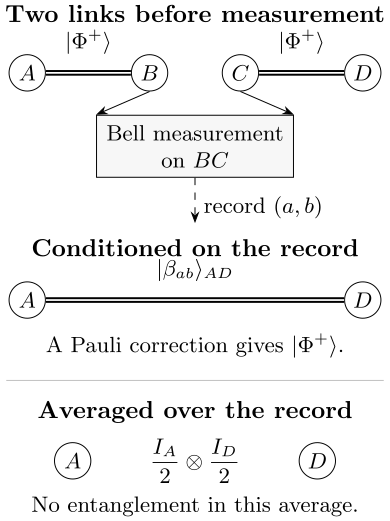
The same two-link input has different descriptions depending on which record is available. The and links are consumed by a Bell measurement on . Conditioned on the classical record , the untouched endpoints share ; the record can be used as a Pauli-frame update. If that record is ignored, the endpoint average is , a product of two maximally mixed states.
The circuit is deterministic when the platform provides a deterministic two-qubit entangling gate and reliable measurements. A photonic Bell analyzer may instead identify only a subset of Bell outcomes. The abstract protocol and the physical analyzer must therefore be kept separate.
Why the classical record matters
Section titled “Why the classical record matters”Before the middle outcome is known, the endpoint state is
This is exactly the marginal before the Bell measurement. The central operation changes the ensemble decomposition associated with the measurement record, but it does not change the unconditioned remote density operator. Neither endpoint can detect whether the Bell measurement occurred by looking only at local data.
Once arrives through an ordinary classical channel, the endpoints can sort their records into the appropriate conditional ensemble and align the Pauli frame. This does not make the entanglement unreal before the message arrives. It means that the usable operational description includes a classical side record.
This is the same conditional-versus-unconditioned distinction developed in No-Cloning and No-Signaling and Conditional States.
Relation to teleportation and entanglement across cuts
Section titled “Relation to teleportation and entanglement across cuts”Swapping is teleportation applied to one half of an entangled pair. The input to that teleportation is correlated with a remote reference, which becomes the other endpoint. Unlike a task that delivers a newly supplied state, the desired output here is an entangled link.
The operation also differs from the unitary SWAP gate, which exchanges two register states. Here a measurement consumes the original links and gives a conditional endpoint state; it does not exchange and .
The middle operation is local to a station only because and are accessible there together. Across the cut , one ebit initially crosses through and one ebit remains across after an ideal swap. The useful pair has changed location. Local operations and classical communication cannot perform this conversion starting from a fully separable four-party state.
Bell-diagonal noise
Section titled “Bell-diagonal noise”Assume the two links are independently prepared, so the full input is . An analytically useful model assigns a classical Pauli-error label to each Bell pair:
and
After an ideal Bell measurement and correction for its reported outcome, the endpoint Pauli label is the modulo-two sum of the two link errors. Its distribution is the group convolution
Each link contributes a binary phase-and-parity error, and the corrected output carries their sum. The product is where independence enters. For a correlated distribution , use
For example, if both links have exactly the same random error label, their errors cancel: , and ideal correction gives the target Bell pair. Their separate error distributions alone would not reveal that fact. Shared source drift can therefore invalidate a prediction made only from two measured link fidelities.
A further convolution describes an imperfect measurement only when its errors can be modeled as an independent additive Pauli or reported-label error. Coherent errors, false heralds or state-dependent acceptance generally need the actual measurement instrument.
Isotropic links
Section titled “Isotropic links”For the two-qubit isotropic Bell-diagonal model
two identical links produce
For ,
The distance has increased while the Bell-state fidelity has decreased. For this model, the swapped state is entangled exactly when
which requires
Thus two input links can each be entangled, with , while their swapped output is not entangled. Repeaters need purification, error correction, or sufficiently high-quality elementary links; swapping alone does not repair noise.
Partially entangled pure links
Section titled “Partially entangled pure links”Consider two identical nonmaximally entangled pairs
Take . For input , a outcome leaves the unnormalized endpoint state
After normalization this is a maximally entangled Bell state. Each such outcome has probability , so accepting either odd-parity Bell outcome succeeds with probability
The even-parity outcomes instead give
with probability
for each sign.
This example exposes the cost hidden by postselection. For , the odd-parity branch yields a Bell pair but appears in only of ideal attempts. Reporting only its conditional fidelity would omit most of the protocol.
Bell-measurement success and loss
Section titled “Bell-measurement success and loss”The logical Bell measurement has four orthogonal outcomes and is deterministic in the circuit model. Hardware can impose stricter limits.
For two photonic qubits encoded in two optical modes each, passive linear optics with vacuum auxiliary modes and photon counting cannot unambiguously resolve four equiprobable Bell states with average success above (Calsamiglia and Lütkenhaus, 2001). Additional photons, other degrees of freedom, nonlinear interactions or encoded resources can change the available operations. The bound is specific to its measurement model.
Source emission, transmission, detection and pattern selection all enter the heralding probability. A product of independently measured marginal efficiencies is valid only under an independence model. A product of properly ordered conditional efficiencies follows the probability chain rule and does not require independence. Avoid counting the same detector or acceptance loss twice.
A herald is not necessarily a correct herald. For mutually exclusive genuine and false-herald events with probabilities and and respective conditional Bell fidelities and , the accepted state has fidelity
when . Dark counts or multipair events can raise the herald count while lowering its state quality. A demonstration that measures the endpoints to verify their correlations also consumes those particular outputs; it does not simultaneously deliver them for later computation.
From one swap to a repeater chain
Section titled “From one swap to a repeater chain”A single swap describes what happens once both neighboring links exist. Quantum repeaters addresses how to create, store and connect many such links when preparation is stochastic (Dür et al., 1999).
For elementary links arranged in a line, connecting the two endpoints requires at least swapping operations. In a single-shot model with independent swap success probability , the probability that all swaps succeed is
That formula is not generally the repeater rate. A repeater creates elementary links stochastically, stores successful links, schedules swaps when neighboring memories are ready, and may retry failed levels. The rate depends on attempt duration, heralding latency, memories, multiplexing, local errors and the chosen restart rule. Without memories, many links must succeed in the same trial. With memories, successful sublinks can wait for their neighbors, but they decohere during that wait. Quantum memories explains this storage tradeoff; memory hardware describes physical performance measures.
Nested repeaters use swapping recursively. Two length- links make a length- link, two of those make a length- link, and so on. Swapping changes the spatial extent of entanglement. Purification or quantum error correction controls the accumulated noise. These are separate protocol layers and should not be credited to swapping alone.
What the endpoint measurement establishes
Section titled “What the endpoint measurement establishes”Pan et al. (1998) demonstrated conditional entanglement of photons that had not interacted. A real-time herald, independent source preparation and an output that survives for later use are distinct experimental properties. A postselected fourfold coincidence can verify a projection and its correlations without establishing all of those properties.
For a target Bell state, fidelity
is a sufficient witness of two-qubit entanglement. A value below does not prove separability, because the chosen target and witness may be suboptimal. A high conditional value also does not by itself establish a useful network rate.
Delayed-choice ordering
Section titled “Delayed-choice ordering”Endpoint measurements can be recorded before the middle station chooses or implements its joint measurement. Later sorting the endpoint data by the middle outcome can reveal Bell-type correlations in the corresponding subensembles. This is often called delayed-choice entanglement swapping (Ma et al., 2012).
No past event is changed. For each chosen set of measurements, quantum theory assigns a joint probability distribution to their recorded outcomes. Operations on the disjoint endpoint and middle registers commute in this subsystem model. Conditioning that distribution on the later middle record selects different subensembles:
The unconditioned endpoint distribution
is unchanged by whether or when the remote parties learn . The experiment tests quantum conditional correlations and causal ordering; it does not provide retrocausal communication.
Qudit extension
Section titled “Qudit extension”For dimension , define
and generalized Pauli operators
With
define . The swapping identity becomes
where the sum runs over and is understood modulo . A complete generalized Bell measurement has equiprobable outcomes. Its label has entropy bits, while one fixed-length binary record needs bits. For the stated convention, applying to endpoint removes the output frame. Physical distinguishability of the outcomes depends on the analyzer.
Exercises
Section titled “Exercises”1. Verify the swapping identity
Section titled “1. Verify the swapping identity”Expand the four Bell products on the right-hand side of
and show that all unwanted computational-basis terms cancel.
Solution
Using the standard Bell states,
Here the first ket in each product refers to and the second to . Multiplying the sum by and restoring register order gives
which is the original product of Bell pairs.
2. Compute the endpoint state without the record
Section titled “2. Compute the endpoint state without the record”Suppose the Bell measurement is complete but its result is erased. Find and decide whether it is entangled.
Solution
Each outcome has probability , so
Since
the state is a product state and therefore separable. Entanglement is present in the outcome-conditioned ensemble, not in the averaged endpoint density operator.
3. Pauli-frame correction
Section titled “3. Pauli-frame correction”For outcome , the endpoint state is . Show that applying to the first endpoint recovers up to global phase.
Solution
By convention,
Therefore
The inverse order matters algebraically: . Using as the correction instead would give a physically irrelevant minus sign. The endpoint can also retain the two-bit Pauli frame and defer any physical correction.
4. Bell-diagonal convolution
Section titled “4. Bell-diagonal convolution”Two identical isotropic links have . Calculate their ideal swapped fidelity and determine whether the Bell-fidelity witness certifies entanglement.
Solution
The swapped fidelity is
Because , fidelity with the target Bell state certifies that the swapped pair is entangled. Its fidelity is nevertheless lower than the input fidelity.
5. Entangled inputs can yield a separable swapped output
Section titled “5. Entangled inputs can yield a separable swapped output”Use two isotropic links with . Are the input links entangled? Does the same Bell-fidelity criterion certify the swapped output?
Solution
Each input is entangled because . The swapped fidelity is
For an isotropic two-qubit state, entanglement occurs exactly when . The swapped state in this model is therefore separable. Swapping extends distance but can destroy entanglement when elementary links are too noisy.
6. Postselected concentration
Section titled “6. Postselected concentration”For two pure links with , calculate the total probability of obtaining either or at the Bell analyzer. What is the normalized endpoint state in those branches?
Solution
The total odd-parity probability is
Conditioned on either accepted outcome, the endpoint state is respectively or , hence maximally entangled. The protocol has concentrated entanglement in an subset of ideal trials; the conditional Bell fidelity must not be reported without that success probability.
7. Single-shot chain success
Section titled “7. Single-shot chain success”Four elementary links are joined by three independent Bell analyzers, each with success probability . In a protocol that restarts the entire trial if any analyzer fails, what is the chain success probability?
Solution
All three swaps must succeed:
This is a single-shot probability, not a complete repeater rate. A memory-based protocol can retain successful sublinks and retry only failed portions, while memory decoherence and control latency introduce new costs.
8. Delayed-choice consistency
Section titled “8. Delayed-choice consistency”Why can endpoint measurements be recorded before the Bell measurement without allowing a controllable signal from the future middle station?
Solution
The endpoint laboratories observe the marginal distribution , which is independent of the later middle measurement choice when all its outcomes are averaged. Bell-type correlations appear only after all records are compared and the endpoint data are conditioned on . The later record changes which subensemble is selected from the joint distribution for the chosen settings; it does not alter an already recorded local outcome or transmit a usable message backward in time.
References
Section titled “References”- J. Calsamiglia and N. Lütkenhaus, “Maximum efficiency of a linear-optical Bell-state analyzer,” Applied Physics B 72, 67–71 (2001), doi:10.1007/s003400000484.
- W. Dür, H.-J. Briegel, J. I. Cirac, and P. Zoller, “Quantum repeaters based on entanglement purification,” Physical Review A 59, 169–181 (1999), doi:10.1103/PhysRevA.59.169.
- X.-S. Ma, S. Zotter, J. Kofler, R. Ursin, T. Jennewein, Č. Brukner, and A. Zeilinger, “Experimental delayed-choice entanglement swapping,” Nature Physics 8, 479–484 (2012), doi:10.1038/nphys2294.
- J.-W. Pan, D. Bouwmeester, H. Weinfurter, and A. Zeilinger, “Experimental entanglement swapping: Entangling photons that never interacted,” Physical Review Letters 80, 3891–3894 (1998), doi:10.1103/PhysRevLett.80.3891.
- M. Żukowski, A. Zeilinger, M. A. Horne, and A. K. Ekert, “Event-ready-detectors Bell experiment via entanglement swapping,” Physical Review Letters 71, 4287–4290 (1993), doi:10.1103/PhysRevLett.71.4287.