

Quantum Memories for Communication
A quantum memory lets a communication protocol retain a quantum state while a remote event, classical message, or second entanglement link is pending. Its usefulness depends on the state delivered at the time the protocol actually requests it. A long coherence time measured in isolation does not determine that delivery rate or quality.
The memory hardware treatment explains write–store–read channels and physical storage mechanisms. Here we use those channels to calculate the state delivered by a communication protocol, keeping its timing and retrieval failures explicit.
Required background. Quantum Memory Hardware supplies storage channels and efficiency conventions; Entanglement Swapping supplies the protocol that joins two stored links.
Stored entanglement and the remote reference
Section titled “Stored entanglement and the remote reference”A memory must preserve quantum correlations with systems that never enter the device. Suppose Alice stores system of an entangled state , where is a remote reference. At storage age , the joint output is
Testing only the populations of can miss the loss of those correlations. For example, complete dephasing preserves both computational-basis states exactly but turns a stored half of a Bell pair into a separable mixture. Population lifetime and entanglement lifetime answer different questions.
For a simple illustration, condition on successful, state-independent retrieval and let the remaining noise be qubit dephasing,
This exponential law is an assumed effective model for the specified operating conditions. It need not describe drift, echo revivals, or control-dependent noise. If the input is , the conditional output is
Its overlap with the target Bell state is . The reference system exposes a coherence failure that a basis-state survival measurement would miss. A fidelity above certifies entanglement with that Bell target; a particular cryptographic or distributed-computing task may require much more.
If retrieval succeeds with probability , the accepted entanglement and the erasure outcome must both remain in the model. A Bell overlap conditioned on retrieval is not the probability of delivering a correct pair per attempted write.
Timing changes the state that is delivered
Section titled “Timing changes the state that is delivered”Communication produces a distribution of storage ages. A herald takes time to propagate; two independent links become ready at different attempts; a busy switch may delay the read command. Let be the probability that a candidate pair reaches an eligible read request in age bin , with . These probabilities are conditional on the candidate-generation stage stated in the experiment.
Let be an acceptance policy, such as rejecting all pairs older than a cutoff. With state-independent retrieval probability and conditional state , the delivered state is
For a fixed pure target, overlap is linear in the state, so
The weights include efficiency. Averaging over all attempted writes, or inserting the mean age into , generally gives a different answer. If loss depends on the input state, this scalar-efficiency model is inadequate: propagate the trace-decreasing success map and its probability for each input instead. Normalizing a successful branch does not turn it into a linear trace-preserving channel.
This use of the age distribution leaves its generation to Quantum Repeaters, which derives synchronization and discusses cutoff scheduling. A measured histogram can be used directly, provided it includes the relevant accepted and rejected attempts and the policy is not selected retrospectively to favor the result.
A two-age delivery example
Section titled “A two-age delivery example”Consider a deliberately simplified source producing 100 eligible candidates per second. Half request retrieval at age and half at age . Let retrieval efficiency be at either age. In the dephasing model, the two conditional Bell overlaps are and .
Accepting both bins gives
Accepting only the younger bin gives with unit overlap in this idealized model. If the task requires overlap at least for the delivered ensemble, the first policy fails and the second passes. If the task instead distills pairs, neither raw overlap nor raw rate alone determines the final useful rate.
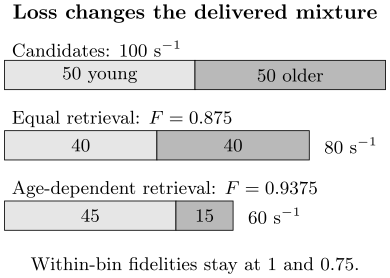
The same source produces 50 young and 50 older candidates each second, with conditional Bell overlaps and . Uniform retrieval efficiency delivers 40 of each. Efficiencies and instead deliver 45 young and 15 older pairs: the rate falls from 80 to 60 per second while the delivered overlap rises from to . Preferential loss changes the mixture; it does not improve either age bin’s storage channel. The first exercise computes these weights.
The arithmetic assumes rejection does not change candidate production. In a real repeater, freeing a memory slot changes later attempts and the age distribution itself. A scheduling comparison must recompute both and the candidate rate under each policy.
Heralds, acknowledgements, and usable memory slots
Section titled “Heralds, acknowledgements, and usable memory slots”A herald must specify the event it certifies. Detection of a photon at a middle station can signal successful entanglement generation. Detection of a retrieved photon can certify a destructive readout. Neither is automatically a nondestructive signal that an unknown state is still available for later use.
To use a stored pair, the controller needs the input or pair identifier, write time, storage mode, accepted herald, known Pauli frame, expiry time, requested read mode, and final disposition. The quantum state and its classical record form one protocol resource. Losing the record can make a physically intact state unusable.
Three timing intervals should remain distinct:
- Physical dwell time: elapsed storage time that enters the noise channel.
- Herald latency: delay before the controller knows whether the stored resource exists.
- Occupation time: the interval until the slot can be safely reused, including readout, acknowledgement, and reset.
For example, a successful write may occupy a mode while its herald travels back. A failed attempt also occupies that mode until the failure is known or a timeout expires. Parallel modes can increase throughput, but a quoted mode count is useful only if those modes can be addressed, read, and reset under the required schedule. Quantum Network Architectures explains reservation, routing and multiuser control of those slots.
Certifying the communication task
Section titled “Certifying the communication task”For deterministic storage of a uniformly distributed unknown pure qubit, the best measure-and-prepare strategy has average state fidelity , as follows from optimal qubit state estimation (Massar and Popescu). That benchmark has a specific input ensemble and scoring rule. It is not a universal threshold for every optical-memory demonstration.
Weak coherent input pulses can contain zero, one, or multiple photons. A device allowed to abstain may select multiphoton inputs that provide more copies of the encoded state, while detector conditioning changes the tested ensemble. For the ideal uniform single-copy pure-qubit ensemble, abstention by itself does not raise the conditional benchmark: every covariant one-copy outcome has the same optimal posterior score. Compare against a classical strategy with the same source statistics, acceptance probability, side information, and output rule. Specht and colleagues provide a concrete experimental example in which process characterization and an appropriate classical comparison accompany storage and retrieval.
For networking, add a test with a remote reference or another entanglement-sensitive witness. State whether the output is available for a later operation or consumed by the test. Test the storage ages actually used by the application, including control operations on neighboring modes; an isolated idle measurement does not cover cross-talk during network activity.
Network Verification treats the larger inference problem. Successful characterization of one memory does not establish end-to-end network security, scalability, or a useful distributed computation.
Exercises
Section titled “Exercises”A delivery-weighted fidelity
Section titled “A delivery-weighted fidelity”Repeat the two-age example with retrieval efficiencies and for the younger and older bins. Find the rate and delivered overlap when both are accepted.
Solution
The delivery probability is , giving . The delivered overlap is
The higher conditional overlap than in the equal-efficiency example results from preferential loss of older states. It does not show improved storage dynamics. Report the reduced yield alongside the overlap.
A memory that passes the wrong test
Section titled “A memory that passes the wrong test”Apply complete dephasing to one half of . Show that computational-basis states survive perfectly while the resulting two-party state is separable. Relate the answer to the Composite Systems distinction between classical correlation and entanglement.
Solution
The off-diagonal terms vanish, leaving
This is explicitly a convex mixture of product states, although its measurement outcomes are perfectly correlated in the computational basis. Testing only those basis states cannot distinguish this channel from an ideal memory on that test set.
A necessary age cutoff
Section titled “A necessary age cutoff”In the exponential dephasing model, require the conditional Bell overlap of every accepted age bin to be at least , with . Derive the maximum accepted age.
Solution
The condition gives
This is a quality constraint under a fitted model, not an optimal scheduling theorem. Imperfect initial entanglement, readout errors, and uncertainty in require a revised bound.
References
Section titled “References”- K. Hammerer, A. S. Sørensen, and E. S. Polzik, “Quantum interface between light and atomic ensembles,” Reviews of Modern Physics 82, 1041–1093 (2010), doi:10.1103/RevModPhys.82.1041. Physical interfaces and memory mechanisms; the device-level treatment is linked above.
- S. Massar and S. Popescu, “Optimal Extraction of Information from Finite Quantum Ensembles,” Physical Review Letters 74, 1259–1263 (1995), doi:10.1103/PhysRevLett.74.1259. State-estimation basis for the deterministic qubit benchmark.
- H. P. Specht, C. Nölleke, A. Reiserer, M. Uphoff, E. Figueroa, S. Ritter, and G. Rempe, “A single-atom quantum memory,” Nature 473, 190–193 (2011), doi:10.1038/nature09997. Storage, retrieval, and experimentally matched benchmarking.