

Stoner Criterion
The Stoner criterion is the local mean-field stability test for a spatially uniform, unpolarized metal against an infinitesimal spin polarization. In a scalar one-band convention with density of states per spin and Stoner interaction , the paramagnetic state loses quadratic stability when
The compact inequality requires a specified density-of-states and interaction convention. Whether is per spin or spin summed, per atom or per volume, and whether multiplies particle-number polarization or magnetic moment all change the symbols appearing in the formula. A factor-of-two error can turn a strongly enhanced paramagnet into a claimed ferromagnet.
The derivation below connects a fixed-density spin transfer to the magnetic susceptibility, then shows what changes at finite temperature and beyond quadratic order. Itinerant Magnetism develops the material band spectra and nonuniform instabilities; Ferromagnetism describes the ordered phase and domains.
Required background. Density of States supplies the per-spin state-counting convention, while Mean-Field Theory supplies the self-consistent closure and local-stability logic.
Helpful background. Itinerant Magnetism supplies the material and exchange-split band context. Fermi Surface and Susceptibilities provide the geometric and response tools for extensions.
Rigid-band reference and uniform instability
Section titled “Rigid-band reference and uniform instability”The textbook criterion assumes:
- a metallic paramagnetic reference state;
- a rigid spin-degenerate band structure for the kinetic-energy estimate;
- a uniform collinear polarization;
- a static, momentum-independent effective interaction;
- a mean-field treatment of that interaction;
- an expansion about zero polarization;
- a density of states smooth enough for the chosen expansion.
Relaxing these assumptions can change the instability wavevector, transition order, ordered moment, transition temperature, or even the appropriate low-energy variables. The criterion is therefore a controlled statement inside a model, not a theorem that every large-density-of-states metal must become ferromagnetic.
What “local stability” means
Section titled “What “local stability” means”Let denote the spin-population difference in a fixed normalization unit. If the zero-field energy is
then the unpolarized state is locally stable when and locally unstable when . The Stoner criterion determines the sign of in the simplest rigid-band mean field.
It does not by itself determine the global minimum. If and a positive sixth-order term stabilizes the energy, a finite- state can become globally favorable while remains locally stable. That is a first-order transition, and its coexistence point need not satisfy .
Density of States, Polarization, and Interaction
Section titled “Density of States, Polarization, and Interaction”Density of states per spin
Section titled “Density of states per spin”Let
denote the density of states for one spin species in the unpolarized reference. Here is either the sample volume or the number of primitive cells, atoms, or formula units used to normalize the state count. Thus is per energy per volume, or per energy per specified counting unit. Energies below are normalized in the same way. The interaction has units of energy times volume for volume densities, or energy when populations are numbers per cell, atom, or formula unit.
The spin-summed density of states is
when spin degeneracy is intact. With the interaction convention used below,
is equivalent to
Writing without redefining is the common factor-of-two mistake.
Polarization and magnetic moment
Section titled “Polarization and magnetic moment”Define
The arrows on this page label magnetic-moment orientation: carries a moment along . For physical electron angular momentum with positive , this is the negative- state, since . When translating to physical-spin labels, interchange the populations; do not change the sign of the Zeeman energy while leaving the labels fixed. The magnetic-moment operator and projected convention are developed in Magnetic Moments.
Here is a particle-number difference, not yet a magnetic moment. Let
be the magnitude of the magnetic moment associated with one unit of spin-population imbalance. The spin magnetization is then
For , . In tables that quote a moment in per atom, the numerical values of and may coincide, but their dimensions and definitions do not.
Interaction parameter
Section titled “Interaction parameter”Use the scalar interaction energy
At fixed ,
so
In a single-band Hubbard mean field, can coincide with the on-site parameter under a matching normalization. In a multiorbital material or density-functional calculation, an effective Stoner parameter contains orbital projection and exchange-correlation information. It should not be identified automatically with a bare Coulomb integral.
Derivation from Spin Transfer
Section titled “Derivation from Spin Transfer”Transfer at fixed total density
Section titled “Transfer at fixed total density”Begin with equal spin populations and transfer
particles from the down-spin Fermi sea to the up-spin Fermi sea. The total density remains fixed:
Near the Fermi energy, take the one-spin density of states to be locally constant:
Adding particles raises one spin-resolved Fermi edge by
while removing particles lowers the other by the same amount.
Band-energy cost
Section titled “Band-energy cost”The incremental energy to transfer an additional amount grows linearly with the separation of the two spin-resolved Fermi edges. Integrating both contributions gives
This is the Pauli cost of making two Fermi seas unequal. A large density of states makes the cost small because many states are available within a narrow energy interval.
Exchange-energy gain
Section titled “Exchange-energy gain”The interaction contribution found above is
The minus sign does not mean that every repulsive interaction favors bulk ferromagnetism. It means that, within this mean-field decoupling, polarization reduces the probability of opposite-spin occupancy and therefore lowers the interaction energy.
Total curvature
Section titled “Total curvature”Combining the two pieces,
The curvature at the origin is
Therefore:
| Stoner product | Quadratic curvature | Scalar mean-field conclusion |
|---|---|---|
| positive | unpolarized state locally stable | |
| zero | marginal at quadratic order | |
| negative | unpolarized state locally unstable |
The instability condition is
Derivation from Susceptibility
Section titled “Derivation from Susceptibility”The same condition follows from the response to a uniform magnetic source.
Couple an external field
Section titled “Couple an external field”Introduce a uniform Zeeman source in tesla. The spin contribution to the energy is
To quadratic order,
Minimizing with respect to gives
Pauli susceptibility and enhancement
Section titled “Pauli susceptibility and enhancement”For volume-normalized and , . In the intrinsic thermodynamic convention take , where the demagnetizing field has already been accounted for. This source is not the macroscopic total induction ; replacing one by the other would feed the magnetization into its own source incorrectly. The dimensionless intrinsic SI spin susceptibility is
The noninteracting Pauli value in this convention is
so the Stoner enhancement is
For a stable paramagnet,
This is an equilibrated static response about . For an isolated spin-conserving system, the uniform longitudinal spin commutes with the Hamiltonian, so its finite-frequency retarded response cannot repopulate the spin sectors. The equilibrium susceptibility instead allows repopulation; see the static/dynamic distinction in Itinerant Magnetism. Continuing it to and reporting a negative paramagnetic susceptibility is not a physical prediction; it is the signal that the assumed reference state is unstable.
Equality is not a complete transition theory
Section titled “Equality is not a complete transition theory”At , the scalar mean-field inverse susceptibility vanishes and the quadratic energy is flat. Higher-order band curvature, finite temperature, nonuniform channels, anisotropy, disorder, and fluctuations then matter. The equality marks a local mean-field boundary, not automatically an experimentally observed continuous critical point.
Self-Consistent Exchange Splitting
Section titled “Self-Consistent Exchange Splitting”The curvature argument can be written as a self-consistency equation.
Splitting convention
Section titled “Splitting convention”Let the spin-resolved quasiparticle energies be shifted by
with
The factor of two in the Zeeman contribution appears because is the full separation between the two spin energies.
Nonlinear equation
Section titled “Nonlinear equation”For a rigid one-spin density of states,
At zero field, a nonzero solution must satisfy this equation together with and the fixed-density condition. Linearizing in gives
where is the thermally averaged density of states defined below. A nonzero infinitesimal solution appears when
Why a constant density of states does not fix the moment
Section titled “Why a constant density of states does not fix the moment”An exactly constant, infinitely wide density of states makes both the band cost and exchange gain purely quadratic. Above threshold the truncated energy has negative curvature but no stabilizing scale. The model then says that is unstable without determining the new minimum.
The ordered moment comes from information absent from the criterion:
- band edges and total filling;
- energy dependence of the density of states;
- orbital-dependent exchange;
- self-consistent changes of the bands;
- higher-order interaction and correlation effects.
The inequality predicts the loss of stability, not the magnitude of the resulting magnetization.
Finite Temperature
Section titled “Finite Temperature”Thermal density of states
Section titled “Thermal density of states”At temperature , the Fermi edge is broadened. Define
The kernel is positive, normalized, and concentrated within an energy window of order around . At zero temperature,
The finite-temperature scalar condition is
At fixed particle number, is determined from the number equation. Its first-order change under an infinitesimal spin splitting cancels between the two spin species, but its ordinary temperature dependence must still be included.
Smooth-density expansion
Section titled “Smooth-density expansion”If is smooth on the thermal scale, the Sommerfeld expansion gives
Thermal smearing can either raise or lower the averaged density of states depending on local curvature and on the shift of . Near a sharp van Hove feature, this smooth expansion may fail and the integral definition should be used directly.
Mean-field Curie–Weiss form
Section titled “Mean-field Curie–Weiss form”On the paramagnetic side,
If crosses smoothly and its derivative at is nonzero, then
which produces a mean-field Curie–Weiss-like pole. Its slope is controlled by the thermally averaged band structure in this model.
An infinitely wide constant density of states has and therefore supplies no temperature scale at all. A finite requires band structure, self-consistency, or physics beyond that caricature. There is no universal rule that converts directly into a reliable material Curie temperature.
Energy-Dependent Density of States
Section titled “Energy-Dependent Density of States”The quadratic criterion can be extended systematically for a smooth rigid band.
Fixed-density expansion
Section titled “Fixed-density expansion”Write
At zero temperature, transfer particles between spin species while keeping total density fixed. To see how the fourth-order term appears, let be the band energy of one spin species. Since adding the next particle costs its Fermi-edge energy, and
Expanding cancels odd powers. The quadratic term is and the quartic term is , giving
Including the scalar exchange term,
with
The formula assumes a smooth one-spin density of states, rigid bands, zero temperature, and a fixed total density. It is not valid directly at a singularity or band edge.
Continuous and first-order mean-field outcomes
Section titled “Continuous and first-order mean-field outcomes”If , the simplest Landau picture permits a continuous onset when the quadratic coefficient changes sign. If , a positive sixth-order term may stabilize a finite-polarization minimum, allowing a first-order transition before the Stoner equality is reached.
This distinction is crucial:
- locates a quadratic spinodal of the unpolarized state;
- equality of two free-energy minima locates first-order coexistence;
- the two conditions generally differ.
For example, in rescaled units has equal minima at and when . The curvature at the origin is still positive. This is a simple demonstration of coexistence before the quadratic spinodal; Exercise 3 derives the result.
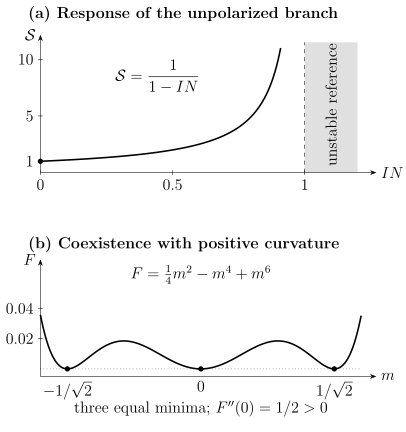
Top: applies to the stable unpolarized branch and starts at one for . Bottom: the separate illustrative free energy has three equal minima with positive local curvature. The Stoner curvature test locates a spinodal, whereas equality of minima locates a first-order transition.
Electronic soft modes can also generate nonanalytic terms that are not captured by a regular polynomial in . In clean low-temperature itinerant ferromagnets, such correlations can preempt the continuous mean-field quantum critical point.
Relation to Fermi-Liquid Theory
Section titled “Relation to Fermi-Liquid Theory”The Stoner denominator has a close but convention-sensitive Fermi-liquid counterpart.
For an isotropic Fermi liquid,
where is the quasiparticle density of states including mass renormalization and is the spin-antisymmetric Landau parameter. The uniform spin Pomeranchuk boundary is
In the simplest Stoner identification,
but an interacting material need not separate cleanly into a bare density of states and one static . Self-energy and vertex effects contribute differently to and . Fermi-Liquid Theory Preview develops the general response framework. The scalar form assumes a conserved spin channel and an appropriate moment vertex; strong spin–orbit coupling requires tensor and interband contributions.
Nonuniform and Multiorbital Instabilities
Section titled “Nonuniform and Multiorbital Instabilities”The scalar criterion tests one uniform channel. Spin-density waves, orbital-dependent polarization, and spin–orbit entanglement require a matrix response. Define a spin-source feedback and solve
For the half-imbalance variable and its conjugate source, and , recovering . For stable static channels and a Hermitian vertex, the largest eigenvalue of reaching one locates a local instability. The wavevector need not be zero. Itinerant Magnetism gives the spin-source convention and Random Phase Approximation explains matrix ordering and the closure assumptions.
A subthreshold scalar product therefore does not rule out a finite-wavevector instability or a first-order transition. Conversely, a negative uniform curvature alone does not determine the ordered moment, transition temperature, easy axis, domains, or magnon spectrum. Those quantities need nonlinear, spatial, and dynamical information beyond one number at the Fermi energy.
Connecting the Criterion to Data
Section titled “Connecting the Criterion to Data”Susceptibility enhancement
Section titled “Susceptibility enhancement”If the spin susceptibility and the appropriate Pauli baseline are known,
The experimental total susceptibility is not generally . One must account for:
- core diamagnetism;
- orbital and Landau diamagnetism;
- Van Vleck contributions;
- impurity Curie tails;
- demagnetizing fields;
- mass renormalization in the quasiparticle density of states;
- temperature-dependent spin fluctuations.
Subtracting uncertain components can dominate the inferred Stoner product.
Specific heat and the Wilson ratio
Section titled “Specific heat and the Wilson ratio”The electronic specific-heat coefficient probes a renormalized quasiparticle density of states,
Comparing with through a Wilson-type ratio helps distinguish density-of-states enhancement from an additional spin-channel vertex enhancement. The interpretation is Fermi-liquid based and is not reliable when quasiparticles are incoherent or strong critical fluctuations dominate.
Fixed-spin-moment curvature
Section titled “Fixed-spin-moment curvature”An electronic-structure calculation can constrain the spin moment and fit
In the scalar rigid-band model,
so
This extraction is meaningful only if , , , and share the same atom, cell, volume, and magnetic-moment convention.
Exchange splitting is not the criterion
Section titled “Exchange splitting is not the criterion”In the simple closure,
Thus may be estimated from a slope of exchange splitting versus constrained polarization. A measured splitting alone is not , and a large does not determine without a matching moment and density of states. Surface sensitivity, orbital-dependent splittings, spin–orbit mixing, and self-energy effects further complicate the extraction.
Worked Convention Check
Section titled “Worked Convention Check”Suppose a nonmagnetic band calculation reports a spin-summed density of states
and an interaction parameter
for polarization measured per cell. The one-spin density of states is
Therefore
so the uniform paramagnet is locally stable in this model. Its predicted enhancement is nevertheless large:
Using the spin-summed value directly would give and reverse the conclusion. The arithmetic is easy; the normalization is the physics.
Limitations and Correlation Effects
Section titled “Limitations and Correlation Effects”Spin fluctuations
Section titled “Spin fluctuations”Static mean field neglects the feedback of spatial and temporal spin fluctuations. These fluctuations generally reduce ordered moments and transition temperatures relative to a bare Stoner estimate. Near an itinerant magnetic instability they can dominate thermodynamics and transport.
Moriya-type self-consistent renormalization treats fluctuation spectra beyond the static criterion. Modern many-body approaches may instead use diagrammatic vertices, dynamical mean-field theory, quantum Monte Carlo where feasible, or material-specific extensions. No single correction is uniformly controlled across weak itinerant, Hund-metal, and Mott-adjacent regimes.
Low dimensions
Section titled “Low dimensions”A scalar mean field can predict finite-temperature order in a strictly two-dimensional short-range spin-rotation-invariant system. That result ignores infrared transverse fluctuations. Interlayer coupling, magnetic anisotropy, dipolar interactions, or explicit spin–orbit terms are needed to evade the corresponding continuous-symmetry constraints.
The Stoner product may still diagnose a strong tendency or a zero-temperature instability, but it cannot by itself establish a nonzero ordering temperature.
Nonanalytic metallic response
Section titled “Nonanalytic metallic response”At very low temperature, gapless particle–hole excitations couple to the uniform magnetization. In sufficiently clean itinerant ferromagnets this coupling can make the free energy nonanalytic and drive the transition first order, replacing the continuous quantum critical point suggested by an analytic mean-field expansion.
Disorder, spin–orbit coupling, dimensionality, and competing finite-wavevector correlations alter that conclusion. The modern statement is conditional, not that every metallic ferromagnetic transition is first order.
Strong and orbital-selective correlations
Section titled “Strong and orbital-selective correlations”Near a Mott transition or in a Hund metal, local moments can form on short time scales before coherent quasiparticles emerge. A single Kohn–Sham or bare-band density of states may then be the wrong input. The magnetic response depends on frequency, orbital character, vertex corrections, and coherence scale.
The scalar criterion is most trustworthy as a weak- to intermediate-coupling diagnostic whose failure is itself informative.
Exercises
Section titled “Exercises”1. Catch the factor of two
Section titled “1. Catch the factor of two”A calculation gives a spin-summed density of states
and . Determine the scalar Stoner product and enhancement in the convention of this page.
Solution
The one-spin density of states is
Therefore
The paramagnetic state is locally stable in this scalar mean field, with enhancement
Using the spin-summed density directly would produce and the wrong stability conclusion.
2. Thermal averaging of a curved density of states
Section titled “2. Thermal averaging of a curved density of states”Near the chemical potential, suppose
Use the smooth-density expansion to find through order . What does the sign of imply?
Solution
Here
Therefore
If , thermal averaging samples a density of states larger than the central value and raises . If , the chemical potential lies near a local maximum and thermal smearing lowers . A temperature-dependent chemical potential can add another order- contribution at fixed density.
3. Coexistence before the quadratic instability
Section titled “3. Coexistence before the quadratic instability”In rescaled units, let with . Find the value of and the nonzero magnetization at which and both are local minima. Compare with the loss of stability of .
Solution
For a nonzero stationary point, set . Equal energy requires , while stationarity requires . Subtraction gives , hence
At coexistence, and the nonzero minima have . The unpolarized minimum loses quadratic stability only at . Thus the coexistence point precedes its spinodal as decreases. For , the illustrated minima are at .
4. Extract an effective interaction from curvature
Section titled “4. Extract an effective interaction from curvature”A fixed-spin calculation using in particles per cell fits
with per cell. The one-spin density of states is states per eV per cell. Find the effective and the Stoner product.
Solution
From
we obtain
Numerically,
Thus
The fitted unpolarized state is locally stable but strongly enhanced. The extraction would change if were measured in under a different energy convention.
References
Section titled “References”- N. W. Ashcroft and N. D. Mermin, Solid State Physics (Holt, Rinehart and Winston, 1976), Chapters 31 and 32.
- D. Belitz, T. R. Kirkpatrick, and T. Vojta, “First Order Transitions and Multicritical Points in Weak Itinerant Ferromagnets,” Physical Review Letters 82, 4707–4710 (1999), doi:10.1103/PhysRevLett.82.4707.
- M. Brando, D. Belitz, F. M. Grosche, and T. R. Kirkpatrick, “Metallic Quantum Ferromagnets,” Reviews of Modern Physics 88, 025006 (2016), doi:10.1103/RevModPhys.88.025006.
- J. F. Janak, “Uniform Susceptibilities of Metallic Elements,” Physical Review B 16, 255–262 (1977), doi:10.1103/PhysRevB.16.255.
- T. Moriya, Spin Fluctuations in Itinerant Electron Magnetism (Springer, 1985), doi:10.1007/978-3-642-82499-9.
- E. C. Stoner, “Collective Electron Ferromagnetism,” Proceedings of the Royal Society A 165, 372–414 (1938), doi:10.1098/rspa.1938.0066.