

Kondo Effect
The Kondo effect is the many-body screening of a localized magnetic degree of freedom by low-energy electrons in a conducting environment. In the ordinary spin-, one-channel case, antiferromagnetic exchange drives a crossover from an approximately free local moment at high temperature to an entangled singlet and a local Fermi liquid at low temperature. The crossover reorganizes scattering, thermodynamics, and spectroscopy around an emergent scale called the Kondo temperature .
A resistance minimum, a low-bias resonance and a reduced magnetic susceptibility probe different aspects of this crossover. This page explains how to connect them in dilute alloys and nanostructures. The Kondo model develops the exchange flow and fixed point; the Anderson impurity explains how the local moment forms.
Required background. Kondo Model Preview supplies the exchange model, renormalization-group flow, and fixed-point language.
Helpful background. Exchange Interactions provides the mechanism comparison, Boltzmann Transport provides resistivity language, and the Anderson Impurity Model Preview explains local-moment formation.
Local moments coupled to conduction electrons
Section titled “Local moments coupled to conduction electrons”The conventional metallic crossover requires a local moment, a conducting bath and antiferromagnetic exchange. Each assumption can be checked separately.
A stable local moment
Section titled “A stable local moment”An atom, defect, molecule, or confined electronic level must retain a low-energy spin or pseudospin. For a single correlated orbital with energy , charging energy , and chemical potential , the local-moment window is schematically
Hybridization broadens the orbital by an energy . A recognizable local moment requires charge fluctuations to be sufficiently costly on the scale of and temperature. Outside that regime, mixed-valence fluctuations can produce a broad zero-bias feature without a clean separation between charge and spin scales.
In a bulk host, the moment may arise from a transition-metal impurity, a rare-earth ion, an actinide ion, a vacancy, or a correlated cluster. In a quantum dot, an odd-occupancy Coulomb-blockade valley often supplies an effective spin-. In scanning-tunnelling experiments, a magnetic adatom or molecule can play the same role.
A bath with low-energy states
Section titled “A bath with low-energy states”The environment must provide electronic states capable of exchanging spin with the moment. For the textbook metallic effect, the local density of states at the Fermi energy is smooth and nonzero:
Here is the local density of states per spin. A gap, pseudogap, superconducting gap, strong spin polarization, or finite-size level spacing can interrupt the flow toward ordinary screening. The bath geometry also determines how many independent screening channels couple to the moment.
Antiferromagnetic exchange
Section titled “Antiferromagnetic exchange”Using the convention
the ordinary Kondo effect requires . The impurity spin and bath spin are dimensionless angular momenta in units of . Here the local conduction spin is for the normalized local bath orbital defining . This is antiferromagnetic exchange. Some historical papers define the exchange term with an overall minus sign, so their antiferromagnetic coupling is written with the opposite sign. The Hamiltonian, not the symbol alone, fixes the physics.
Dilution or controlled isolation
Section titled “Dilution or controlled isolation”The single-impurity picture assumes that moments can be treated independently over the temperature range of interest. In an alloy this requires a sufficiently small impurity concentration. At higher concentrations, indirect exchange, disorder, clustering, and lattice coherence can compete with single-impurity screening. A quantum dot provides a cleaner realization because occupancy, level position, tunnel coupling, field, and bias can often be adjusted independently.
Minimal Low-Energy Description
Section titled “Minimal Low-Energy Description”After impurity charge excitations have been removed, the conventional one-channel Hamiltonian is
describes potential scattering. It can alter line shapes and phase shifts, but it does not by itself generate spin screening. The dimensionless bare exchange is
For , repeated spin-flip scattering increases the effective coupling as the probe energy is lowered. In the one-loop convention used here,
The solution is
This formula is controlled only while . Its apparent pole marks the failure of weak coupling, not a divergent observable. The formal derivation and its density-of-states conventions live in Kondo Model Preview.
The Kondo Temperature
Section titled “The Kondo Temperature”The scale at which the running coupling becomes strong is exponentially smaller than the electronic cutoff:
This expression uses a per-spin and the one-loop beta function above. If a spin-summed density of states is used, the same exponent is written . Higher-order scaling, band shape, potential scattering, and the chosen observable modify the prefactor. A source using instead has ; its exponent describes the same Hamiltonian, as explained at the coupling-convention derivation.
The exponential is physically decisive. Modest changes in hybridization, pressure, local coordination, carrier density, or gate voltage can move by orders of magnitude. It also explains why Kondo correlations may be visible at kelvin scales even when the host bandwidth is measured in electronvolts.
There is no unique numerical definition
Section titled “There is no unique numerical definition”labels a universal crossover, but its numerical value depends on the convention used to locate that crossover. Common operational definitions use:
- the zero-temperature impurity susceptibility;
- a specified fraction of the impurity entropy ;
- the half-width of a zero-bias spectral feature after deconvolution;
- the half-maximum of a quantum-dot conductance curve;
- a fitted universal scaling function for conductance, susceptibility, or heat capacity;
- a renormalization-group convention tied to the running coupling.
Two careful analyses can therefore report Kondo temperatures differing by a constant factor while describing the same device. A quoted value should name the observable, fit function, and convention.
Gate-controlled Anderson estimate
Section titled “Gate-controlled Anderson estimate”For a wide, approximately flat bath and a single-level Anderson impurity with energy measured from and , define using the local per-spin bath density. This is the energy half-width at half maximum of the noninteracting resonance, not its full width . In the local-moment regime , the Haldane scaling estimate is
The prefactor is convention dependent, and the expression is not reliable deep in mixed valence. It nevertheless explains two robust observations: rises rapidly as tunnel coupling grows, and it is usually smallest near the center of an odd-occupancy Coulomb-blockade valley.
Perturbations measured against the scale
Section titled “Perturbations measured against the scale”Thermal energy, Zeeman energy, and source–drain bias compete with screening through the ratios
Here the Landé factor in the Zeeman energy is distinct from the running coupling . Universal scaling is expected only after nonuniversal backgrounds, lead asymmetry, voltage division, orbital effects, and heating are controlled. A magnetic field does not generally split a measured zero-bias peak at one universal value of ; instrumental broadening and the observable itself matter.
Why a Resistance Minimum Appears
Section titled “Why a Resistance Minimum Appears”The historical signature is a minimum in the resistivity of a dilute magnetic alloy. An approximate dilute-scatterer decomposition is
where is the magnetic-impurity concentration. On cooling, the phonon contribution decreases. In the weak-coupling Kondo regime, spin-flip scattering grows, so the two trends can produce a minimum.
Perturbative logarithm
Section titled “Perturbative logarithm”For , the leading-logarithmic scattering strength behaves schematically as
The omitted proportionality coefficient contains the spin trace and transport geometry; it is not fixed by the running coupling alone. Expanding this result at weak bare coupling reproduces the logarithmic increase found in perturbation theory. Neither form should be extrapolated through into zero temperature.
For a simple low-temperature phonon law and a perturbative logarithm,
the minimum occurs where
This approximation requires and a range where the host phonon contribution follows the Bloch–Grüneisen law. If is proportional to impurity concentration, it gives scaling. The result is a balance between two temperature derivatives. It does not identify with .
Strong-coupling saturation
Section titled “Strong-coupling saturation”For a fully screened spin- impurity with negligible additional potential scattering, the zero-energy phase shift approaches and the scattering channel reaches its unitarity limit. In the ideal symmetric Kondo limit of a dilute alloy,
where the dimensionless variables are
The expansion has positive coefficients that depend on the definition of . Potential scattering adds a phase shift : a fully screened channel then has , so its elastic probability need not be maximal. The low-temperature resistivity remains finite, but the displayed maximum and correction signs are not unrestricted claims about every asymmetric impurity.
For a symmetrically coupled, single-level dot in series with normal leads, near the particle–hole-symmetric Kondo limit and with symmetric bias, the same resonance increases the conductance toward its unitarity limit:
Here .
A bulk resistivity measures impurity-induced scattering, whereas a dot in series conducts through the interacting level. In a zero-temperature, zero-field Fermi liquid with a flat bath, the series-dot transmission is
where and for the single-level Anderson model under these assumptions. Unequal contacts reduce the maximum even if the moment is fully screened. A dot attached to the side of an otherwise ideal one-channel wire has a direct path: in the symmetric elastic limit its transmission instead follows . Screening can then produce an antiresonance, as in the experiment of Sato et al. (2005).
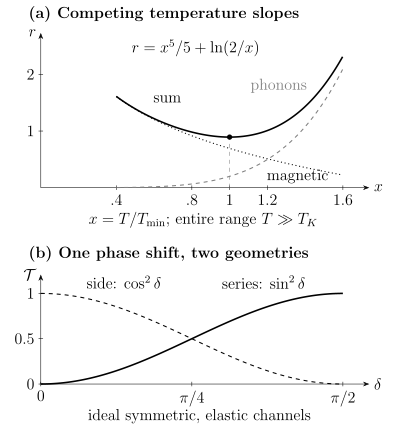
Top: the illustrative curve , with , has its minimum at . The whole plotted interval is assumed well above ; this is not a low-temperature crossover fit. Bottom: ideal symmetric series and side-coupled geometries turn the same phase shift into opposite transmission trends. A phase shift alone does not specify a measured conductance.
A logarithm is not a fingerprint
Section titled “A logarithm is not a fingerprint”A resistance upturn approximately linear in can also arise from weak localization, interaction corrections in disordered conductors, granular transport, structural two-level systems, or a crossover in carrier density. A credible Kondo assignment should seek several mutually consistent signatures:
- independent evidence for local moments;
- systematic scaling with magnetic-impurity concentration or dot occupancy;
- suppression or crossover under a Zeeman field of the expected scale;
- saturation or Fermi-liquid behavior below the inferred ;
- thermodynamic or spectroscopic evidence using the same scale;
- dimensionality and field dependence inconsistent with the leading localization correction.
Magnetoresistance alone is not decisive because orbital transport, weak localization, spin-disorder scattering, and multiband effects can all respond to field.
Screening and the Kondo Cloud
Section titled “Screening and the Kondo Cloud”Above , the impurity acts approximately as a free moment with weak, scale-dependent coupling to the bath. Below , a spin- impurity coupled to one channel is absorbed into an entangled many-body singlet. “Screening” means that the bath carries compensating spin correlations; it does not mean that one conduction electron occupies a hydrogen-like orbit around the impurity.
A natural spatial observable is
can oscillate on the Fermi-wavelength scale while its envelope crosses over on the much larger Kondo length
The precise spatial profile depends on dimension, band structure, channel geometry, temperature, and which correlator is measured. is therefore a crossover length, not a sharp boundary. The cloud carries spin correlations with little or no accompanying long-range charge accumulation.
Why direct detection is difficult
Section titled “Why direct detection is difficult”For and , is of order a micrometre. That is enormous compared with a lattice spacing, yet ordinary bulk probes average over many impurities and over rapid oscillations. Surface disorder, dephasing, finite temperature, and competing impurities further obscure the envelope.
Mesoscopic devices turn the large length into an advantage. If a coherent reservoir or interferometer arm has size comparable to , finite-size changes in conductance or phase can reveal the crossover. Borzenets and collaborators reported such evidence in a quantum-dot interferometer by tuning the effective reservoir size. The result is strong evidence for the predicted scale dependence in a controlled device; it should not be described as a real-space image of a universal bulk cloud.
Thermodynamic Signatures
Section titled “Thermodynamic Signatures”Transport is only one projection of the crossover.
Entropy
Section titled “Entropy”The thermodynamic impurity entropy is the difference , with the same bath reference and temperature. In the spin- local-moment window, above but below charge or higher-multiplet excitations,
For the fully screened one-channel problem,
The entropy difference changes through . It is not the von Neumann entropy of the impurity reduced density matrix. A spin- in a pure rotationally invariant singlet has reduced state and entanglement entropy , even though the pure total state has zero entropy. Thus screening removes the thermodynamic free-moment entropy while leaving the spin strongly entangled with its surroundings.
Susceptibility and heat capacity
Section titled “Susceptibility and heat capacity”Within the local-moment window, define the per-impurity susceptibility as the derivative of magnetic moment with respect to the applied Zeeman field in tesla. It is approximately Curie-like:
For susceptibility with respect to in SI, multiply by and by impurity number density if a volume susceptibility is wanted. Screening cuts off this divergence, leaving a finite of order . The low-temperature impurity heat capacity is linear,
For the ideal particle–hole-symmetric spin- Kondo model, the appropriately normalized Wilson ratio approaches . In a real material, subtracting host backgrounds, crystal-field levels, inter-impurity coupling, and nuclear terms can be more uncertain than the universal impurity prediction.
Spectroscopy and Nanostructures
Section titled “Spectroscopy and Nanostructures”Tunnelling line shapes
Section titled “Tunnelling line shapes”Scanning tunnelling spectroscopy near a magnetic adatom often shows an asymmetric low-bias anomaly. Interference between tunnelling into a broad conduction channel and into an impurity-mediated channel motivates the phenomenological Fano form
is an interference parameter, and is a fitted width. The line shape is not the impurity spectral function itself, and is not automatically a convention-independent . Temperature scaling, field response, adsorption-site dependence, and microscopic modelling are needed.
Quantum dots
Section titled “Quantum dots”A semiconductor quantum dot offers a tunable impurity:
- Coulomb blockade identifies charge sectors;
- a nondegenerate odd orbital valley often supplies spin ;
- gate voltage adjusts ;
- barrier voltages adjust ;
- source–drain bias probes nonequilibrium response;
- a magnetic field controls Zeeman energy.
The characteristic signature is enhanced zero-bias conductance in an odd valley, followed by scaling with , , and . Agreement across those axes is much stronger evidence than a zero-bias peak alone. Cotunnelling thresholds, superconducting coherence peaks, weak localization, heating, and accidental resonances are common alternatives.
From One Impurity to a Kondo Lattice
Section titled “From One Impurity to a Kondo Lattice”When a local or nearly local -electron degree of freedom occurs in every primitive cell, the same conduction sea couples to a dense array of moments. The antiferromagnetic exchange and the single-impurity convention for remain useful local inputs, but the many-body problem is no longer a sum of independent screening centers.
The lattice adds conduction-mediated intersite exchange, translational coherence, a Fermi-volume question, and the possibility of ordered or fractionalized phases. Its resistivity maximum need not coincide with the impurity , and its low-temperature state cannot be inferred by multiplying a single-impurity response by the number of sites.
Kondo Lattices develops the dense Hamiltonian and the competition with RKKY exchange. Heavy Fermions connects coherent bands to measured masses and characteristic material scales.
Boundaries and Variants
Section titled “Boundaries and Variants”The ordinary screened singlet is not the outcome of every exchange-coupled impurity.
| Setting | Low-energy result |
|---|---|
| Ferromagnetic exchange | Coupling weakens; no ordinary screening scale |
| Too few screening channels | Residual moment |
| Too many equivalent channels | Possible non-Fermi-liquid behavior |
| Several impurity orbitals | Multiple or anisotropic crossovers |
| Pseudogapped bath | Possible screening transition |
| Superconducting bath | Competing singlet and doublet; subgap states |
| Mixed valence | Charge fluctuations remain important |
| Dense moment array | RKKY coupling and coherent lattice motion |
Overscreened non-Fermi-liquid behavior requires channel symmetry and the absence of destabilizing fields. In a pseudogapped bath, the depleted low-energy density of states can allow a transition between screened and local-moment phases. In a superconducting bath, the gap competes with the Kondo scale, replacing ordinary metallic scaling. Mixed valence can invalidate a spin-only Kondo description, while a dense moment array invalidates independent-impurity additivity.
Two-channel Kondo behavior, charge Kondo effects, orbital Kondo effects, and topological or superconducting hosts each require an explicit identification of the effective pseudospin, bath channels, and symmetry protection.
Exercises
Section titled “Exercises”1. A small energy and a large length
Section titled “1. A small energy and a large length”For and , estimate from the one-loop scale. Separately estimate for and . Why do these two estimates not describe the same impurity?
Solution
The first estimate gives , or . The second gives . They use different : for the first impurity and the same velocity the length would be about . A small formal scale does not guarantee accessible screening if finite size, coherence loss or another interaction cuts it off first.
2. Which temperature moves with concentration?
Section titled “2. Which temperature moves with concentration?”For with , find the minimum and check its curvature. Suppose rises by a factor of 32 when impurity concentration rises, while the host and single-impurity coupling stay fixed.
Solution
Setting gives . At this point . The minimum temperature doubles. The intrinsic single-impurity need not change; the result remains usable only while independent impurities and both temperature laws remain valid.
3. Contact asymmetry and a side path
Section titled “3. Contact asymmetry and a side path”At , compare the conductance of a series dot with to that of an ideal symmetric side-coupled dot. Quote values in units of .
Solution
The series dot gives . The ideal side-coupled device gives . Both can have a fully screened spin: unequal contacts limit one transmission, while interference suppresses the other. These values assume zero temperature and bias, coherent single-channel transport and no additional scattering path.
4. Two meanings of entropy
Section titled “4. Two meanings of entropy”For , calculate the entropy of the full state and of the first spin. Does the second answer contradict vanishing thermodynamic impurity entropy at the screened fixed point?
Solution
The full density matrix is a rank-one projector, so its entropy is zero. Tracing over the second spin gives , with entropy . Neither reduced-state entropy nor a two-spin bath-subtraction calculation is the continuum thermodynamic definition . The example isolates entanglement; it is not a model of the full Kondo crossover or its spatial cloud.
References
Section titled “References”- I. V. Borzenets et al., “Observation of the Kondo Screening Cloud,” Nature 579, 210–213 (2020), doi:10.1038/s41586-020-2058-6.
- S. M. Cronenwett, T. H. Oosterkamp, and L. P. Kouwenhoven, “A Tunable Kondo Effect in Quantum Dots,” Science 281, 540–544 (1998), doi:10.1126/science.281.5376.540.
- D. Goldhaber-Gordon et al., “Kondo Effect in a Single-Electron Transistor,” Nature 391, 156–159 (1998), doi:10.1038/34373.
- F. D. M. Haldane, “Scaling Theory of the Asymmetric Anderson Model,” Physical Review Letters 40, 416–419 (1978), doi:10.1103/PhysRevLett.40.416; erratum 40, 911 (1978), doi:10.1103/PhysRevLett.40.911.2 — local-moment scaling estimate for the Anderson impurity.
- A. C. Hewson, The Kondo Problem to Heavy Fermions (Cambridge University Press, 1993), doi:10.1017/CBO9780511470752.
- J. Kondo, “Resistance Minimum in Dilute Magnetic Alloys,” Progress of Theoretical Physics 32, 37–49 (1964), doi:10.1143/PTP.32.37.
- P. Nozières, “A Fermi-Liquid Description of the Kondo Problem at Low Temperatures,” Journal of Low Temperature Physics 17, 31–42 (1974), doi:10.1007/BF00654541.
- M. Sato, H. Aikawa, K. Kobayashi, S. Katsumoto, and Y. Iye, “Observation of the Fano-Kondo Antiresonance in a Quantum Wire with a Side-Coupled Quantum Dot,” Physical Review Letters 95, 066801 (2005), doi:10.1103/PhysRevLett.95.066801.
- W. G. van der Wiel et al., “The Kondo Effect in the Unitary Limit,” Science 289, 2105–2108 (2000), doi:10.1126/science.289.5487.2105.
- K. G. Wilson, “The Renormalization Group: Critical Phenomena and the Kondo Problem,” Reviews of Modern Physics 47, 773–840 (1975), doi:10.1103/RevModPhys.47.773.