

Trapped-Ion Control
Trapped-ion control uses phase-coherent electromagnetic fields to couple long-lived internal states to one another and, when desired, to quantized collective motion. Carrier drives rotate an internal qubit without changing the secular quantum number to leading order. Red and blue sidebands exchange or jointly create internal and motional excitations. Bichromatic combinations of those sidebands can drive a closed, spin-dependent trajectory in motional phase space, leaving an entangling phase after the motion returns to its starting point.
The derivation assumes harmonic secular modes, a resolved internal qubit, and controlled rotating-wave and Lamb–Dicke approximations. The force-gate result is exact within its effective Hamiltonian; it is not exact for arbitrary motional amplitude or arbitrary spin-dependent forces.
Required background. Ion traps supplies confinement and normal modes, the two-level atom supplies drive conventions, the Jaynes–Cummings model supplies exchange dynamics, and laser cooling explains motional preparation.
Internal States and Secular Motion
Section titled “Internal States and Secular Motion”Consider one internal transition
with angular frequency . Let one secular mode have angular frequency and ladder operators . The uncoupled Hamiltonian is
The zero-point length along the mode coordinate is
Take and . For a monochromatic effective drive:
- is the optical frequency, microwave frequency, or Raman difference frequency;
- is the detuning;
- is the on-resonance angular carrier Rabi frequency before motional matrix elements;
- is the controllable drive phase in the convention below;
- is the projection of the effective wavevector on the selected mode;
- is the signed Lamb–Dicke parameter.
For direct optical control, is the laser wavevector projection. For stimulated Raman control,
and and are likewise frequency and phase differences. Copropagating Raman beams can nearly suppress motional coupling, while counterpropagating beams can enhance it. The phrase “Raman sideband” is therefore incomplete without beam geometry.
From the Optical Phase to Spin–Motion Coupling
Section titled “From the Optical Phase to Spin–Motion Coupling”Semiclassical interaction
Section titled “Semiclassical interaction”After reducing the internal spectrum to two levels and making the optical rotating-wave approximation, choose the interaction
This convention makes a resonant carrier phase generate the equatorial Pauli operator
Other phase conventions shift or reverse the sign of but do not change measurable predictions.
In the interaction picture of ,
This compact expression contains the carrier and every motional sideband. A sideband approximation must follow from its matrix elements and frequency separation; it should not be inserted by naming a laser detuning.
Exact motional matrix elements
Section titled “Exact motional matrix elements”For number states and , define
The magnitude of the displacement-operator matrix element is
where is an associated Laguerre polynomial. The corresponding complex matrix element has the factor in place of and the signed Laguerre polynomial in place of its absolute value. Its phase matters in coherent sequences even though a population Rabi frequency uses its magnitude.
This formula contains three experimentally important effects:
- the factor is a zero-point Debye–Waller factor;
- sideband order brings powers of ;
- even a nominal carrier has -dependent coupling through .
At larger or , a carrier can become weak or pass through a matrix element zero. The statement “the carrier does not change motion” refers to , not to an exactly motion-independent Rabi frequency.
Lamb–Dicke Regime
Section titled “Lamb–Dicke Regime”Small spatial phase
Section titled “Small spatial phase”The Lamb–Dicke regime requires the drive phase to vary little across the occupied motional wavepacket. For a centered number-diagonal state of one mode,
so a useful criterion is
For several uncorrelated number-diagonal modes,
is a stronger global condition for expanding the complete spatial phase. Correlated or squeezed modes require the full phase variance, including cross-covariances; the mean occupations alone do not specify it.
The first-order expansion is
The three terms become resonant at three different detunings.
Distinct approximations
Section titled “Distinct approximations”The following conditions are related but not identical:
| Approximation or regime | Representative condition | What it permits |
|---|---|---|
| internal multipole expansion | atomic size optical wavelength | retain the leading allowed internal multipole; a forbidden E1 transition may use E2 or M1 |
| Lamb–Dicke expansion | truncate the motional phase | |
| resolved sidebands | exceeds linewidths, Rabi rates, and pulse bandwidth | spectrally select carrier or sideband |
| vibrational rotating-wave approximation | unwanted terms oscillate rapidly relative to coupling | retain one resonant exchange process |
| effective two-level model | leakage and off-resonant levels are perturbative | use Pauli operators |
One condition does not imply the others. A tightly localized ion may be in the Lamb–Dicke regime while a broad transition leaves sidebands unresolved. A narrow transition may resolve sidebands even when a hot mode invalidates a first-order Lamb–Dicke expansion.
Carrier and Sideband Hamiltonians
Section titled “Carrier and Sideband Hamiltonians”Assume a constant over one idealized pulse and that the selected resonant term is well separated from all others.
Carrier
Section titled “Carrier”At , the leading interaction is
It couples
The ideal pulse implements
Beyond leading order, the carrier rate is
Here is a signed coupling amplitude; its absolute value is the population oscillation rate. Its sign changes the rotation axis by . A distribution over can therefore dephase carrier Rabi oscillations even without environmental decoherence.
Red sideband
Section titled “Red sideband”At , the first red sideband is
It couples
with small- angular Rabi frequency
This is the Jaynes–Cummings exchange. The state has no lower motional partner and is dark to the ideal red sideband.
Blue sideband
Section titled “Blue sideband”At , the first blue sideband is
It couples
with
This is the anti-Jaynes–Cummings interaction. Starting from , a blue-sideband pulse can create an internal–motional superposition, while a full pulse prepares in the ideal two-state subspace.
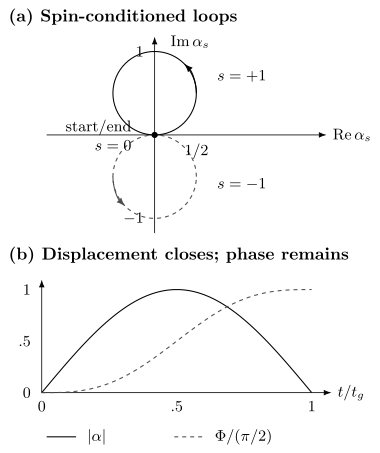
For and , spin eigenvalues trace in the complex displacement plane; remains at the origin. Both loops have the same oriented area, so both acquire the same phase. At , motion closes and . The lower panel separates the transient displacement from the accumulated geometric phase.
Beyond the First-Order Picture
Section titled “Beyond the First-Order Picture”Higher sidebands
Section titled “Higher sidebands”The th motional sideband changes by and has a leading matrix element proportional to . Higher sidebands are weak in a deep Lamb–Dicke regime but can be intentionally driven for state synthesis or can appear as leakage when the mode is hot.
Off-resonant terms
Section titled “Off-resonant terms”Driving the red sideband also drives the carrier off resonance by and other sidebands by integer multiples of . A rough rectangular-pulse scale for an off-resonant carrier contribution is
away from accidental cancellations. This is not a universal error formula: the exact probability depends on pulse duration, detuning, phase, AC Stark shifts, and all other levels and modes. It does show why increasing optical power does not indefinitely speed a spectrally selective sideband pulse.
AC Stark shifts
Section titled “AC Stark shifts”Off-resonant carrier, sideband, and auxiliary-level couplings shift the qubit resonance. A compensated pulse may use:
- a calibrated frequency offset;
- balanced red and blue components;
- pulse shaping;
- additional compensation light;
- a symmetric echo sequence.
The compensation must be validated over intensity and detuning drift. Canceling the mean shift does not automatically cancel its noise.
Direct Optical, Raman, and Microwave Control
Section titled “Direct Optical, Raman, and Microwave Control”Direct optical qubits
Section titled “Direct optical qubits”A narrow optical transition can directly couple and . Its phase is inherited from the optical local oscillator at the ion. For a quadrupole transition, the internal matrix element involves the field gradient; the center-of-mass plane-wave phase still gives motional sidebands. Direct sidebands use the single-beam wavevector projection and can be highly resolved, but gate and Ramsey coherence depend on optical phase stability and the excited-state lifetime.
Stimulated Raman transitions
Section titled “Stimulated Raman transitions”Two optical fields can couple two long-lived states through one or more off-resonant excited states. In a simple three-level, large-detuning model,
with convention-dependent factors and multilevel sums. The same elimination produces differential AC Stark shifts and spontaneous scattering. Increasing suppresses excited-state population but requires more optical power for a fixed effective rate within that single-intermediate-state regime. At detunings comparable to or larger than fine-structure splittings, interfering paths change both the coupling and scattering scaling.
Raman control separates two design choices:
- the frequency difference addresses the qubit;
- the wavevector difference controls motional sensitivity.
Thus one can use nearly copropagating beams for motion-insensitive rotations and a larger for sidebands and forces.
Microwave and magnetic-gradient control
Section titled “Microwave and magnetic-gradient control”Microwave wavelengths make the free-space Lamb–Dicke parameter extremely small. Near-field magnetic gradients can restore spin–motion coupling by making the field amplitude or phase vary across the ion wavepacket. These methods can reduce spontaneous optical scattering, but electrode currents, gradient calibration, motional-mode orientation, and microwave crosstalk become central.
Multi-Ion and Multimode Coupling
Section titled “Multi-Ion and Multimode Coupling”Write the physical displacement of ion as
The real vectors diagonalize the mass-weighted Hessian . They include the local polarization, which need not be the same at every ion. Then
For a Cartesian mode one may factor ; the vector form also covers mixed masses and coupled spatial directions without ambiguity.
The interaction phase contains all modes:
This expression gives several immediate lessons:
- an ion can be nearly dark to a mode because its participation vector is small;
- a laser can be dark to a mode because its wavevector is perpendicular to the polarization;
- lower-frequency modes have larger zero-point extent and therefore larger , all else equal;
- every spectator mode contributes a diagonal motional matrix element, including the vacuum Debye–Waller factor;
- a multi-ion gate must close the phase-space displacement of every significantly coupled mode, not just the target mode.
Mode-frequency drift and avoided crossings can change both and . Recalibrating only one resonance may miss a changing mode participation pattern.
State Preparation and Ground-State Cooling
Section titled “State Preparation and Ground-State Cooling”Internal preparation
Section titled “Internal preparation”Optical pumping prepares a chosen Zeeman or hyperfine state by repeated absorption and spontaneous emission. A complete preparation model includes polarization impurity, magnetic-field alignment, branching ratios, off-resonant excitation, metastable leakage, and repumping. A dark fluorescence result after pumping can represent successful preparation, population in an unintended dark level, or loss; independent checks are needed.
Motional preparation
Section titled “Motional preparation”In resolved-sideband cooling, the controlled step
is followed by dissipative repumping that returns the internal state while usually preserving in the Lamb–Dicke regime. Repetition drives population toward .
The control perspective emphasizes three requirements:
- the red-sideband pulse must address the occupied range of -dependent Rabi frequencies;
- repumping must remove internal entropy without adding too many motional quanta;
- all modes needed by the subsequent operation must be cooled or shown to be harmless.
Continuous sideband cooling, pulsed sequences, Raman sideband cooling, EIT cooling, and sympathetic cooling solve different versions of this control problem. Their general dissipative and thermodynamic treatment is developed in Laser Cooling.
Verifying preparation
Section titled “Verifying preparation”For any number-diagonal mode under weak Lamb–Dicke resolved-sideband probing,
The platform-level assumptions behind this thermometer are discussed in Ion Traps. For coherent control, one should also inspect Rabi data, because different nonthermal distributions can share the same mean occupation or integrated sideband ratio.
Single-Qubit Control
Section titled “Single-Qubit Control”Resonant rotations
Section titled “Resonant rotations”A resonant carrier pulse realizes . Two orthogonal phase choices supply - and -axis rotations. A frame update changes the phase assigned to subsequent drives and implements an idealized virtual rotation without waiting for physical precession.
For a constant detuning error , the rotating-frame Hamiltonian is
The rotation axis tilts and the angular rate becomes
Amplitude, phase, detuning, and timing errors therefore correspond to different geometric errors on the Bloch sphere and should be calibrated separately.
Composite and shaped pulses
Section titled “Composite and shaped pulses”Composite pulses can suppress selected systematic errors by arranging a sequence whose leading error terms cancel. Smooth envelopes can limit spectral leakage and transient response. Numerically optimized pulses can address mode crowding, crosstalk, or bandwidth constraints.
Robustness is never absolute. A pulse optimized against quasistatic amplitude error may be more sensitive to high-frequency phase noise or transfer-function distortion. Optimal Control and Dynamical Decoupling develop the general control theory.
Motion as a Quantum Bus
Section titled “Motion as a Quantum Bus”The Coulomb interaction makes the secular normal modes collective. A field focused on ion can add a phonon amplitude to a shared mode, and a field on ion can respond to that same mode. Motion therefore mediates an interaction between internal states that do not directly couple at useful strength.
The relevant limitations are:
- the bus contains several modes, not one ideal oscillator;
- heating and dephasing occur while the bus is used;
- the coupling is set by and optical phase;
- residual spin–motion entanglement is coherent gate error, not merely a hot final state;
- a gate can be insensitive to the initial motional state only under declared approximations and closure conditions.
Cirac–Zoller Gate Principle
Section titled “Cirac–Zoller Gate Principle”The original Cirac–Zoller proposal uses sideband pulses to map the state of a control ion onto a shared phonon, applies a phonon-conditioned operation to a target ion, and maps the phonon back. In schematic form,
An auxiliary internal level and number-selective sideband dynamics provide the conditional phase. The construction made the physical role of a quantized bus explicit and motivated the first trapped-ion quantum logic experiments.
Its strict form requires near-ground-state motion and precise individual addressing. Modern gates more often use spin-dependent forces whose phase-space loop closes without populating a definite one-phonon bus state. The Cirac–Zoller protocol remains conceptually important because it exposes the sequence of mapping, conditional action, and unmapping.
Closed-Loop Spin-Dependent-Force Gates
Section titled “Closed-Loop Spin-Dependent-Force Gates”Effective force Hamiltonian
Section titled “Effective force Hamiltonian”A bichromatic field with components near the red and blue sidebands can be chosen at
where is the symmetric detuning from one selected mode. After the internal and vibrational rotating-wave approximations, balanced phases give a spin-dependent force.
Write a convenient one-mode convention as
where:
- is a collective spin operator;
- is a calibrated force rate proportional to a sideband coupling;
- phases have been absorbed into and the oscillator coordinates.
For two equally driven ions, take
Exact propagator in the effective model
Section titled “Exact propagator in the effective model”Because is linear in and and its commutator at two times is proportional to , the Magnus expansion terminates after the second term. The propagator is
where
and
The geometric phase is
The displacement entangles spin and motion during the gate. For a closed loop, is twice the signed geometric area in the plane. With dimensionless quadratures , , it equals the signed area in the plane. At intermediate times the integral can be closed by a straight radial segment, which contributes zero.
Loop closure and entanglement
Section titled “Loop closure and entanglement”At
the displacement closes:
The remaining ideal operation is
For two ions,
Apart from a global phase,
A maximally entangling operation has
which in this convention corresponds to
Different definitions of , , or bichromatic amplitude move factors of two between and . A reported gate parameter set must state the Hamiltonian convention or provide a direct calibration.
Why thermal motion can cancel
Section titled “Why thermal motion can cancel”If , the ideal final propagator contains no oscillator operator. It therefore acts identically on every initial motional state in the effective model. This is the central robustness of Mølmer–Sørensen and related geometric-phase gates.
It does not mean cooling is unnecessary. The derivation still requires:
- Lamb–Dicke validity over the occupied distribution;
- negligible heating and mode-frequency drift during the loop;
- closure for every coupled mode;
- sufficiently uniform force over the wavepacket;
- controlled off-resonant carrier and spectator transitions.
The correct statement is that the gate need not resolve or populate one specific motional Fock state when the force loop closes.
Multimode Gate Design
Section titled “Multimode Gate Design”For fixed commuting spin operators , the effective propagator contains a spin-conditioned multimode displacement of the form
conditioned on collective spin operators. A spin-only gate requires
for every appreciably coupled mode . If mode-dependent forces use noncommuting spin axes, their cross-commutators generate additional terms; closing the scalar displacement integrals alone no longer proves a spin-only propagator.
A rectangular pulse tuned to one mode generally leaves spectator displacements. For shaped forces, closure constrains the Fourier integrals for every coupled mode. This explains why amplitude/phase modulation can cancel several residual displacements, but also why a shifted mode frequency can spoil the cancellations. Roos gives a detailed treatment of amplitude-modulated gates.
Worked Example: Optical Sidebands
Section titled “Worked Example: Optical Sidebands”Consider an idealized ion with a secular mode at
For a direct optical drive whose wavevector makes a angle with the mode,
Using gives
and
Suppose the calibrated carrier rate is
The carrier time is
For , the leading red-sideband rate is
so
The rough off-resonant-carrier scale is
This is only a scale: the actual error can oscillate with pulse duration and contains AC Stark shifts and other modes. For , the Lamb–Dicke parameter over the thermal extent is
which supports a first-order treatment. At , the same quantity is , so the geometry and trap frequency alone do not establish the Lamb–Dicke regime.
The example also shows a speed trade-off. Raising shortens the sideband pulse but increases off-resonant coupling unless the mode frequency or pulse design changes.
Bell-State Coherence and Gate Fidelity
Section titled “Bell-State Coherence and Gate Fidelity”A phase-sensitive Bell-state overlap
Section titled “A phase-sensitive Bell-state overlap”For a target state
the fidelity at the specified phase is
Maximizing over the target phase gives
A parity oscillation after a phase-scanned analysis pulse can measure a contrast
so under the declared analysis model,
For a normalized two-qubit state, certifies entanglement. The optimized value certifies proximity to some Bell phase; the parity phase must also be measured to assess a specified gate phase. With leakage, use unconditional qubit-block probabilities when discussing the full preparation; renormalizing selected outcomes changes the claim.
Why Bell fidelity is not gate fidelity
Section titled “Why Bell fidelity is not gate fidelity”A Bell-state experiment combines:
- state preparation;
- one or more single-qubit rotations;
- the entangling pulse;
- idle evolution;
- analysis pulses;
- fluorescence measurement.
Its fidelity is a sequence-level state metric. It does not by itself identify the average fidelity of the entangling operation on arbitrary inputs.
A perfect Bell output for one input can coexist with a poor average gate fidelity, as Exercise 8 demonstrates. Process tomography or a suitable benchmarking protocol samples more of the operation, with its own assumptions about preparation, measurement, leakage, and drift. These are different questions from whether a particular output is entangled.
Corrections to the Force-Gate Model
Section titled “Corrections to the Force-Gate Model”Residual displacement
Section titled “Residual displacement”If a mode does not close, the final displacement leaves spin and motion entangled. For an initially uncorrelated thermal mode, the coherence between eigenvalues and is multiplied by
This exact characteristic-function result within the force model shows why the same closure error has different effects on different spin coherences, and why thermal occupation amplifies it.
Motional heating and dephasing
Section titled “Motional heating and dephasing”Heating during the gate changes the enclosed trajectory stochastically and prevents perfect return. Mode-frequency noise changes both closure and geometric phase. A single pre-gate measurement does not bound either effect; gate-duration heating and frequency-noise measurements are needed.
Spontaneous scattering
Section titled “Spontaneous scattering”Raman or optical forces can scatter photons through off-resonant excited states. The error scale contains
but Raman, Rayleigh, leakage, and recoil channels have different effects. Detuning, polarization, fine structure, and laser power determine the trade-off.
Off-resonant excitation and light shifts
Section titled “Off-resonant excitation and light shifts”Fast gates increase carrier and spectator-sideband coupling. Unbalanced bichromatic fields produce differential Stark shifts and can rotate the spin while applying the force. Pulse shaping can suppress selected terms but may increase duration and heating exposure.
Lamb–Dicke breakdown
Section titled “Lamb–Dicke breakdown”Higher powers of make the force depend on motional amplitude and invalidate exact phase-space closure. A useful diagnostic scale is
The distribution tail can matter even when the mean passes a nominal test.
Qubit and control noise
Section titled “Qubit and control noise”Laser phase noise, microwave phase noise, magnetic-field fluctuations, intensity noise, timing jitter, addressing crosstalk, and waveform distortion act during carrier and entangling operations. Their impact depends on noise spectrum and control filter functions, not only RMS drift.
Preparation and measurement
Section titled “Preparation and measurement”SPAM error does not cease to matter because an experiment reports a background-subtracted contrast. State leakage, dark-state decay, camera crosstalk, threshold bias, and imperfect analysis rotations can all bias an inferred gate metric.
Exercises
Section titled “Exercises”Exercise 1: Identify carrier and sidebands
Section titled “Exercise 1: Identify carrier and sidebands”Using the interaction
expand to first order in and identify the resonant term for .
Solution
The first-order expansion is
At , the constant term is stationary and gives
At , the factor multiplies and is stationary:
At , the factor multiplies and is stationary:
All other first-order terms rotate at or and are neglected only when the vibrational rotating-wave approximation is valid.
Exercise 2: Number-dependent Rabi rates
Section titled “Exercise 2: Number-dependent Rabi rates”Starting from the first-order sideband Hamiltonians, derive the red and blue Rabi rates from an initial state . Evaluate their ratio for .
Solution
The ladder-operator matrix elements are
Therefore
For ,
The red rate vanishes at , whereas the blue rate remains because it can create a phonon.
Exercise 3: Exact carrier correction
Section titled “Exercise 3: Exact carrier correction”Use the exact carrier matrix element
to recover its expansion through order . For , compare the approximate carrier rates for and .
Solution
For small ,
With ,
For ,
whereas
The difference is about of the bare rate. A broad number distribution therefore produces visible collapse and dephasing of carrier Rabi oscillations even in a closed system.
Exercise 4: A small detuning error at nominal closure
Section titled “Exercise 4: A small detuning error at nominal closure”Set and , with . The actual detuning is , but the pulse length and force amplitude are unchanged. Find the leading residual displacement and phase error.
Solution
Substitution in the exact effective-model solution gives
and
The phase error is first order, while loss of a thermal coherence is second order in : . A closure scan alone therefore does not determine the coherent gate-angle error. Retuning the duration to the actual loop period would close the motion, but the enclosed area would still change unless were also restored.
Exercise 5: Sideband thermometry and model checking
Section titled “Exercise 5: Sideband thermometry and model checking”A mode has measured weak-probe sideband ratio . Infer and the thermal ground-state probability. Explain why observing the same ratio at twice the probe power is not automatically a successful consistency check.
Solution
For the ideal weak-probe relation (which does not require thermality),
Hence
For a thermal oscillator,
At larger probe power, saturation, power broadening, off-resonant carrier excitation, and probe-induced heating can change red and blue areas. If both areas are biased by similar factors, their ratio may remain despite a failed weak-probe model. A useful check also varies pulse duration, fits Rabi data, examines residuals, and tests for nonthermal populations.
Exercise 6: A mode-dark ion
Section titled “Exercise 6: A mode-dark ion”Three equal ions have an ideal axial mode with normalized participation vector
All ions are illuminated with the same wavevector projection and optical Rabi frequency. Compare their Lamb–Dicke parameters and explain the control consequence.
Solution
For equal masses and a common beam geometry,
Therefore
for an appropriate common scale .
The middle ion is dark to this mode at first order, although its carrier can still be driven. The two outer ions couple with equal magnitude and opposite sign, which changes the phase of a spin-dependent force. Addressing the middle ion cannot directly add a phonon to this ideal mode; any observed coupling constrains symmetry breaking, mode mixing, beam gradients, or an incorrect mode assignment.
Exercise 7: Closed-loop entangling phase
Section titled “Exercise 7: Closed-loop entangling phase”For
show that the displacement closes at . If and , find and . Is the two-ion gate maximally entangling in the convention of this page?
Solution
The displacement is
At
the exponential is unity, so .
For ,
The geometric phase is
With , this gives the entangling part
up to a global phase. It is maximally entangling.
Exercise 8: A perfect Bell state from an imperfect gate
Section titled “Exercise 8: A perfect Bell state from an imperfect gate”Let be the intended gate and let the actual unitary be , where in the computational basis. Compare the Bell output from and the average gate fidelity.
Solution
Since , both gates give exactly
The Bell-state fidelity for this input is one. For two unitaries on a -dimensional space, the uniform pure-state average is
Here and , so . Relative phases on other inputs are wrong despite the perfect tested output. Nielsen derives the general average-fidelity identity.
References
Section titled “References”- C. D. Bruzewicz, J. Chiaverini, R. McConnell, and J. M. Sage, “Trapped-ion quantum computing: Progress and challenges,” Applied Physics Reviews 6, 021314 (2019), doi:10.1063/1.5088164.
- J. I. Cirac and P. Zoller, “Quantum computations with cold trapped ions,” Physical Review Letters 74, 4091–4094 (1995), doi:10.1103/PhysRevLett.74.4091.
- F. Diedrich, J. C. Bergquist, W. M. Itano, and D. J. Wineland, “Laser cooling to the zero-point energy of motion,” Physical Review Letters 62, 403–406 (1989), doi:10.1103/PhysRevLett.62.403.
- H. Häffner, C. F. Roos, and R. Blatt, “Quantum computing with trapped ions,” Physics Reports 469, 155–203 (2008), doi:10.1016/j.physrep.2008.09.003.
- D. F. V. James, “Quantum dynamics of cold trapped ions with application to quantum computation,” Applied Physics B 66, 181–190 (1998), doi:10.1007/s003400050373.
- D. Leibfried, R. Blatt, C. Monroe, and D. Wineland, “Quantum dynamics of single trapped ions,” Reviews of Modern Physics 75, 281–324 (2003), doi:10.1103/RevModPhys.75.281.
- D. Leibfried, B. DeMarco, V. Meyer, D. Lucas, M. Barrett, J. Britton, W. M. Itano, B. Jelenković, C. Langer, T. Rosenband, and D. J. Wineland, “Experimental demonstration of a robust, high-fidelity geometric two ion-qubit phase gate,” Nature 422, 412–415 (2003), doi:10.1038/nature01492.
- D. M. Meekhof, C. Monroe, B. E. King, W. M. Itano, and D. J. Wineland, “Generation of nonclassical motional states of a trapped atom,” Physical Review Letters 76, 1796–1799 (1996), doi:10.1103/PhysRevLett.76.1796.
- C. Monroe, D. M. Meekhof, B. E. King, W. M. Itano, and D. J. Wineland, “Demonstration of a fundamental quantum logic gate,” Physical Review Letters 75, 4714–4717 (1995), doi:10.1103/PhysRevLett.75.4714.
- M. A. Nielsen, “A simple formula for the average gate fidelity of a quantum dynamical operation,” Physics Letters A 303, 249–252 (2002), doi:10.1016/S0375-9601(02)01272-0.
- C. F. Roos, “Ion trap quantum gates with amplitude-modulated laser beams,” New Journal of Physics 10, 013002 (2008), doi:10.1088/1367-2630/10/1/013002.
- A. Sørensen and K. Mølmer, “Quantum computation with ions in thermal motion,” Physical Review Letters 82, 1971–1974 (1999), doi:10.1103/PhysRevLett.82.1971.
- A. Sørensen and K. Mølmer, “Entanglement and quantum computation with ions in thermal motion,” Physical Review A 62, 022311 (2000), doi:10.1103/PhysRevA.62.022311.
- D. J. Wineland, C. Monroe, W. M. Itano, D. Leibfried, B. E. King, and D. M. Meekhof, “Experimental issues in coherent quantum-state manipulation of trapped atomic ions,” Journal of Research of the National Institute of Standards and Technology 103, 259–328 (1998), doi:10.6028/jres.103.019.