

Rydberg Blockade
Rydberg blockade is the suppression of simultaneous Rydberg excitation because the doubly excited state is shifted away from the laser resonance by the Rydberg–Rydberg interaction. It is a dynamical statement, not a geometric prohibition. Double excitation is reduced continuously as the interaction shift becomes large compared with the relevant drive, detuning, linewidth, or pulse bandwidth.
That distinction is the organizing idea of this page. A circle called a “blockade radius” is a useful summary only after one states what comparison scale defines the circle and what error is acceptable. Inside the circle, finite-blockade leakage, coherent phase shifts, weak angular channels, motion, and dissipation remain. Outside it, interactions do not abruptly vanish.
Blockade has three closely related uses:
- it converts a collection of atoms into a superatom with at most one Rydberg excitation;
- it makes the response of one qubit conditional on another, enabling entangling gates; and
- it projects many-body dynamics into a constrained Hilbert space.
Required background. Rydberg atoms supplies excitation, motion, and detection; Rydberg atoms basics supplies pair-interaction mechanisms; Rabi oscillations and Bell states supply coherent transfer and entangled-state notation.
Two Driven Atoms
Section titled “Two Driven Atoms”Rotating-frame Hamiltonian
Section titled “Rotating-frame Hamiltonian”Let each atom have a ground state and a selected Rydberg state . For equal real single-atom Rabi frequency , detuning , and pair interaction , define the angular-frequency interaction shift
The rotating-frame Hamiltonian is
where
In the ordered basis
this becomes
This matrix already shows the mechanism. The laser addresses each atom locally, while the interaction changes only the energy of in this reduced model. Blockade is the resulting off-resonant dynamics, not an extra rule imposed by hand.
Bright and dark one-excitation states
Section titled “Bright and dark one-excitation states”Introduce
Uniform, phase-matched driving couples only the symmetric bright state. In the basis
the bright-sector Hamiltonian is
The antisymmetric state is dark with energy . Because a two-state Hamiltonian convention writes an off-diagonal coupling as , the transition has collective Rabi frequency
The same enhancement couples onward to . Blockade does not remove that matrix element; it makes the final state energetically off resonant.
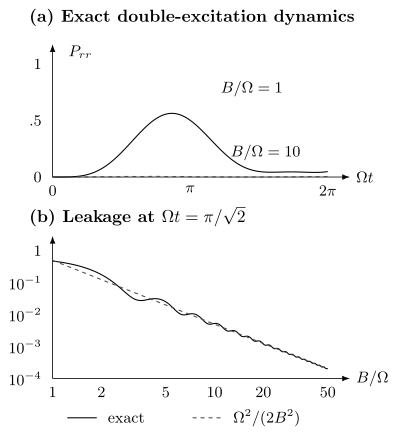
Exact three-state evolution from at . Top: double excitation is substantial at and suppressed at . Bottom: at the fixed ideal collective transfer time , the exact leakage approaches only in the strong-blockade regime. Small oscillations reflect coherent off-resonant dynamics; the dashed estimate is not a uniform finite-pulse upper bound.
What breaks the dark-state decomposition
Section titled “What breaks the dark-state decomposition”The simple bright and dark states assume equal drive amplitudes and phases. For complex site-dependent couplings , the state reached directly from is instead
where
The normalized orthogonal state
is dark to , but generally not to :
Thus unequal magnitudes spoil exact decoupling in the full four-state model. Fixed spatial phases alone do not: equal-magnitude drives still define a phase-weighted dark state and retain the enhancement. Differential detunings or time-dependent phases can mix bright and dark states. In the ideal projected one-excitation model the state orthogonal to the instantaneous ground-to-bright drive is dark, but changing that bright vector in time can still populate its orthogonal sector.
Finite Blockade
Section titled “Finite Blockade”Eliminate the doubly excited state
Section titled “Eliminate the doubly excited state”On single-atom resonance, set . If
the amplitude follows the bright-state amplitude approximately:
Substitution gives the leading effective Hamiltonian in :
Finite blockade therefore has two leading consequences:
-
residual double-excitation probability,
-
a coherent bright-state energy shift,
The first is leakage; the second is a phase and detuning error. A model that keeps only a hard no-double-excitation rule misses the coherent correction. The sign of does not affect the leading leakage probability but does reverse the coherent shift.
At nonzero detuning, the energy separation between and is
so the more general leading expressions are
These expressions approximate a dressed level near the one-excitation energy . To eliminate from dynamics involving the whole retained sector, it must also be separated from the dressed ground-like levels. Near , for example, and can exchange population through a second-order pair resonance even though . The relevant denominators and operation time must both be checked; Exercise 5 derives that slower transition.
Worked finite-blockade example
Section titled “Worked finite-blockade example”Take
The ideal collective pi-pulse duration is
At maximum bright-state population, the leakage scale is
The coherent shift is
During the ideal collective pi pulse, this shift accumulates a phase scale
The precise final leakage and phase require solving the three-level Hamiltonian with the actual pulse envelope. The example shows why a small double-excitation probability does not by itself establish a high-fidelity coherent operation.
Multilevel blockade
Section titled “Multilevel blockade”Real Rydberg pair states form a manifold. If the laser-coupled state overlaps several pair eigenstates , there is generally no unique scalar . Leakage contains weighted inverse-square energy denominators:
where is the coupling to pair eigenstate and is its drive-frame energy separation. Weakly shifted channels can dominate even if the mean pair interaction is large.
This is especially important with Zeeman degeneracy, anisotropic states, or a nearby Förster resonance. A reported blockade strength should state the atomic state, quantization axis, pair orientation, external fields, and how the effective shift was extracted.
Blockade Radius
Section titled “Blockade Radius”A family of crossover radii
Section titled “A family of crossover radii”For a van der Waals interaction
a drive-defined blockade radius is often written
This means . It does not mean double excitation is already negligible at . Substituting into the strong-blockade expansion is uncontrolled. Exact evolution from at , for example, gives at the nominal collective pi time . The crossover probability depends on the pulse and detuning; it is not fixed by the radius definition.
Other legitimate definitions include
where is an effective excitation linewidth and is a pulse-bandwidth scale. Collective excitation may require comparing with rather than .
An error-defined radius
Section titled “An error-defined radius”If the target is
in the ideal resonant two-atom model, then
Within this leading, strong-blockade estimate, the corresponding radius is
This estimate is not a guarantee for every pulse shape or duration; a hard error bound requires the full evolution and other error channels. The weak dependence
means that a much stricter leakage target reduces the radius only gradually. It also means a single significant digit in a quoted radius can hide a large change in the implied error.
Numerical comparison
Section titled “Numerical comparison”Consider an illustrative isotropic coefficient
and . Because both and may be compared in angular-frequency units, the same ratio can be evaluated using and ordinary frequencies.
| Definition | Comparison scale in ordinary frequency | Radius |
|---|---|---|
| drive equality, | ||
| spectral width example | ||
| ideal target |
The conventional drive-equality radius is therefore almost seventy percent larger than the radius associated with a leakage target. Neither number is wrong; they answer different questions.
Angular and statistical radii
Section titled “Angular and statistical radii”If , then
The blockade region need not be circular or spherical. Position uncertainty also makes a random variable. For ,
so the tails of the position distribution can dominate rare double excitations.
For a general comparison scale ,
and small independent calibration shifts obey
The sixth root makes the radius numerically robust while the blockade error, which depends roughly on , remains much more sensitive.
Blockade, Facilitation, and Pair Resonance
Section titled “Blockade, Facilitation, and Pair Resonance”The rotating-frame energies of the one- and two-excitation sectors are
Three conditions answer different questions:
| Condition | Interpretation |
|---|---|
| suppresses the direct transition from the one-excitation sector to | |
| adding a second excitation next to an existing Rydberg excitation is resonant; facilitation condition | |
| and are on two-photon pair resonance |
Thus a large bare does not guarantee blockade under every detuned protocol. Detuning can compensate the interaction. Deliberately using such a condition is called facilitation or antiblockade in different contexts; the name should be accompanied by the actual resonance condition.
The sign matters. Repulsive and attractive pair shifts move resonances in opposite detuning directions. A scan that measures only the magnitude of double-excitation suppression can miss this information, while spectroscopy retains it.
Collective Excitation and Superatoms
Section titled “Collective Excitation and Superatoms”N uniformly driven atoms
Section titled “N uniformly driven atoms”For atoms initially in
define the symmetric one-excitation state
The uniform drive
has matrix element
If every doubly excited state is sufficiently detuned, the ensemble behaves as a two-state system with collective Rabi frequency
This is the superatom limit. The single Rydberg excitation is shared coherently among the atoms. It is not correct to say that one unknown atom was excited unless a measurement localizes the excitation.
Phase-matched collective state
Section titled “Phase-matched collective state”If the laser phase at site is , the bright state is
For spatial phase , motion dephases the collective spin wave. De-excitation into a selected optical mode also depends on this phase pattern. The state is symmetric in population but not necessarily in optical phase.
For nonuniform couplings, replace by
and weight the bright state by . Inferring atom number from a measured collective Rabi frequency is valid only after coupling inhomogeneity is bounded.
Finite blockade in an ensemble
Section titled “Finite blockade in an ensemble”Let be the interaction shift of the doubly excited pair . Starting from a normalized symmetric one-excitation state, the coupling to that pair is . In the simplest nondegenerate, resonant elimination,
Define a harmonic-type effective blockade shift by
Then
For uniform , this reduces to
The sum weights weakly blockaded pairs strongly. Increasing atom number at fixed geometry and drive can therefore worsen leakage even while the desired collective coupling grows as .
The formula assumes independent pair eigenstates and weak admixture. Pair state mixing, anisotropy, nonuniform drive, and several-excitation pathways require the full multilevel Hamiltonian.
Double Excitation and Collective Dynamics
Section titled “Double Excitation and Collective Dynamics”A low measured must be compared with independent atoms driven by the same pulse: weak excitation alone also gives little double population. Collective Rabi oscillations at , together with suppressed double excitation, test the coherent bright-state mechanism. Gaëtan and colleagues observed this combination for two individually trapped atoms.
Interaction-shifted spectroscopy versus separation, orientation, and detuning then distinguishes a scalar pair shift from weak angular channels or a nearby pair resonance. Walker and Saffman’s analysis shows why the weakest coupled channels can dominate blockade errors.
Loss-based detection requires particular care. Two binary site outcomes provide four probabilities, insufficient to reconstruct arbitrary populations in and an additional loss sector without further information. Prepared-state calibrations, additional detection channels, or explicit conditional assumptions are needed; a product of single-site readout models also fails when errors are correlated.
Two-Qubit Gates
Section titled “Two-Qubit Gates”Conditional dynamics
Section titled “Conditional dynamics”Encode qubits in long-lived states and , and couple only to . A standard conceptual sequence is
where c and t label control and target.
- The first control pi pulse maps .
- If the control is not Rydberg excited, a target pulse executes a closed Rabi cycle and contributes a phase.
- If the control occupies , the interaction shifts the target’s doubly excited state and suppresses that cycle.
- The final control pi pulse returns population to the computational subspace.
For one simple pulse-phase convention, the computational basis transforms as
The diagonal unitary
is locally equivalent to a controlled- gate. Its gauge-invariant two-qubit phase is
Single-qubit phase corrections convert it to the usual convention. Actual pulse phases and level shifts must be tracked; population return alone does not establish the entangling phase.
Beyond the three-pulse picture
Section titled “Beyond the three-pulse picture”Modern blockade gates can use global symmetric pulses, time-dependent phase or detuning, dark-state paths, adiabatic dressing, optimal control, or direct multi-qubit protocols. These methods redistribute time spent in lossy states and sensitivity to calibration errors. The three-pulse sequence remains a clear mechanism, not a universal optimum.
Intrinsic trade-off
Section titled “Intrinsic trade-off”A useful schematic error model is
where is the Rydberg lifetime and depend on the pulse protocol. Driving faster reduces time exposed to decay but worsens finite-blockade error. Minimization gives the scaling
This is not a complete experimental error budget. Intermediate-state scattering, Doppler shifts, laser phase and intensity noise, adjacent Rydberg levels, pulse rise time, differential light shifts, addressing crosstalk, motion, and readout can dominate.
What constitutes gate evidence
Section titled “What constitutes gate evidence”Different measurements support different claims.
| Measurement | What it establishes | What it does not establish alone |
|---|---|---|
| truth table | basis-state population transfer | coherent phase or action on superpositions |
| Bell-state populations and parity | entanglement-generation fidelity or lower bound | average fidelity of an arbitrary gate input |
| process tomography | reconstructed process under model assumptions | scalable, drift-robust average performance |
| repeated-gate or randomized protocol | per-gate decay metric over a sampled ensemble | every coherent and leakage mechanism separately |
| leakage or erasure detection | probability and location of detectable failures | unconditional success when failed shots are discarded |
A conditional Bell-state fidelity after erasure excision and an unconditional average gate fidelity are both useful, but they are not interchangeable. Similarly, correcting state-preparation-and-measurement errors can isolate an operation estimate, but the correction model and uncertainty must be stated.
Blockade in Quantum Simulation
Section titled “Blockade in Quantum Simulation”Soft-interaction Hamiltonian
Section titled “Soft-interaction Hamiltonian”The calibrated array begins with
This is a soft constraint: doubly excited configurations remain in the Hilbert space but cost interaction energy. The full long-range tail can influence phase boundaries and dynamics even when nearest neighbors are strongly blockaded.
Projected nearest-neighbor limit
Section titled “Projected nearest-neighbor limit”In a one-dimensional chain with
and an initial state with no adjacent Rydberg excitations, project onto that approximately invariant sector. For repulsive interactions it is the low-interaction-energy sector; attractive interactions instead make it an excited, dynamically restricted sector. The pure nearest-neighbor model also requires negligible longer-range interactions on the time scale considered. Define
A site may flip only if both neighbors are in , giving
At , the name PXP refers to the projector–flip–projector structure. Boundary terms contain only the available neighbor projector. This Hamiltonian describes constrained dynamics and underlies the connection between Rydberg chains and quantum many-body scars.
Finite blockade produces leakage and virtual corrections of order
where the first quantity is a leakage amplitude (the probability is second order) and the second is an angular-frequency correction. Longer-range interactions remain as diagonal terms inside the constrained space. For a uniform van der Waals chain, : increasing without bound eventually makes this tail important. A simple PXP approximation requires a window such as , with stricter limits set by the desired accuracy and duration, rather than just taking the overall interaction to infinity. The controlled derivation can be organized with a projection or Schrieffer–Wolff transformation.
Blockade graphs and independent sets
Section titled “Blockade graphs and independent sets”Construct a graph whose vertices are atoms and whose edges connect pairs treated as mutually blockaded. In the hard-constraint idealization, an allowed Rydberg configuration is an independent set: no occupied vertices share an edge.
For positive detuning in the convention used here, the term
favors more Rydberg excitations. At an ideal hard-constraint endpoint with and no residual interaction within the allowed sector, the lowest-energy configurations maximize the number of occupied, mutually nonadjacent vertices. This gives the hardware-efficient connection to the maximum-independent-set problem.
The graph itself is model-dependent. A finite, anisotropic interaction does not create a sharp edge, and interactions beyond chosen edges shift different independent sets unequally. Claims about optimization performance must include the soft interaction Hamiltonian, preparation schedule, readout correction, and classical comparison protocol.
Ordered phases and nonequilibrium dynamics
Section titled “Ordered phases and nonequilibrium dynamics”Blockade plus detuning can favor spatially ordered Rydberg patterns. Quenches from special product states can show long-lived revivals described by constrained models. These phenomena are applications of the blockade Hamiltonian, not additional evidence that blockade is perfect.
Transverse-field Ising model develops the many-body interpretation. The microscopic interaction tails, detunings, and virtual shifts determine which constrained approximation is appropriate; they cannot be inferred from a sharp blockade graph alone.
Exercises
Section titled “Exercises”Exercise 1: Derive the bright-sector Hamiltonian
Section titled “Exercise 1: Derive the bright-sector Hamiltonian”Starting from the four-state two-atom Hamiltonian, transform to the basis
Show that decouples under uniform driving and derive the three-state bright-sector Hamiltonian.
Solution
The laser couples
Similarly,
whereas
The detuning gives energy to both one-excitation states and to . The interaction adds only to . Therefore
Removing the isolated dark-state row and column gives
Exercise 2: A weak channel dominates
Section titled “Exercise 2: A weak channel dominates”Suppose the squared normalized coupling weights to two pair eigenchannels are and , with shifts and , respectively. Compute the inverse-square-weighted effective blockade shift. Does a mean shift near imply strong blockade? Assume both denominators are still large enough for perturbation theory.
Solution
The relevant weighted denominator is
Thus , while the weighted arithmetic mean is . The one-percent channel dominates the leakage by about two orders of magnitude over the strongly shifted channel. If its coupling is not small compared with , even this perturbative estimate fails and that channel must be retained explicitly.
Exercise 3: Three blockade radii
Section titled “Exercise 3: Three blockade radii”Take
Calculate:
- the drive-equality radius ;
- the radius obtained with a excitation-width scale;
- the ideal target-error radius for .
Explain why the three answers can all be valid.
Solution
Using ordinary-frequency quantities,
For the drive equality,
For a width,
The leakage target requires
Thus the interaction-frequency scale is
and
The definitions compare the same interaction with different physical scales: coherent drive, spectral resolution, and a specified leakage target.
Exercise 4: N-atom collective coupling and leakage
Section titled “Exercise 4: N-atom collective coupling and leakage”For uniformly driven atoms:
- derive the coupling between and ;
- show that the collective Rabi frequency is ;
- assume every pair has the same blockade shift and derive the leading total double-excitation probability at .
For and , estimate .
Solution
Acting on the collective ground state,
Therefore
For a particular double excitation , there are two paths from , one from its component and one from its component. Their total matrix element is
Elimination gives probability
in each of the pair states. Hence
For and ,
This estimate assumes equal nondegenerate pair shifts and no coupling among the double-excitation states.
Exercise 5: Blockade or facilitation?
Section titled “Exercise 5: Blockade or facilitation?”For the two-atom Hamiltonian with detuning :
- find the energy cost for adding a second Rydberg excitation when one is already present;
- find the condition for and to be degenerate in the rotating frame;
- evaluate both conditions for .
Solution
The one-excitation energy is
and the double-excitation energy is
Adding the second excitation costs
It is resonant when
The pair state is degenerate with when
or
For , the facilitation condition for adding a second excitation is , while the two-photon pair-resonance condition is .
For at , eliminate the off-resonant instead. In ,
Both diagonal shifts are equal, so the pair resonance remains at in this symmetric model. If and , the pair Rabi frequency is about and the pi time is . A large one-to-two energy denominator therefore does not exclude a slower two-photon transfer from the ground state.
Exercise 6: Entangling phase of the three-pulse gate
Section titled “Exercise 6: Entangling phase of the three-pulse gate”Assume the blockade-gate sequence produces
in the ordered basis .
- Calculate the entangling phase .
- Find local operations that convert to .
- Explain why a truth-table measurement would not determine .
Solution
Choose phases
Then
Apply to both qubits:
A truth table records only output populations for computational-basis inputs. Every diagonal unitary has the identity truth table, regardless of its relative phases. Superposition inputs and phase-sensitive measurements are required.
Exercise 7: Optimize a schematic gate error
Section titled “Exercise 7: Optimize a schematic gate error”Let
with . Find and show that the optimized error scales as . At the optimum, what is the ratio of the lifetime term to the blockade term?
Solution
Differentiate:
Setting this to zero gives
or
Substitution shows that both terms scale as
so
The stationarity equation may be rearranged as
Thus the lifetime contribution is twice the blockade contribution in this particular two-term model.
Exercise 8: Count the constrained states
Section titled “Exercise 8: Count the constrained states”For an open chain of two-state atoms, let count configurations with no adjacent Rydberg excitations. Find a recurrence and the allowed configurations for . Then explain why increasing a common does not yield a pure nearest-neighbor PXP Hamiltonian at fixed lattice spacing.
Solution
If the first site is in , there are choices for the rest. If it is in , the second must be in , leaving choices. Therefore
so with . For three sites the allowed states are
The projected drive connects two listed configurations when one allowed single-site flip relates them. In a van der Waals chain the last state also carries the next-neighbor energy . Scaling upward increases this energy together with the forbidden nearest-neighbor penalties. The five-state space is a useful projection, but its Hamiltonian includes the surviving tail unless that term is negligible or separately engineered.
References
Section titled “References”- H. Bernien, S. Schwartz, A. Keesling, H. Levine, A. Omran, H. Pichler, S. Choi, A. S. Zibrov, M. Endres, M. Greiner, V. Vuletić, and M. D. Lukin, “Probing many-body dynamics on a 51-atom quantum simulator,” Nature 551, 579–584 (2017), doi:10.1038/nature24622.
- P. Fendley, K. Sengupta, and S. Sachdev, “Competing density-wave orders in a one-dimensional hard-boson model,” Physical Review B 69, 075106 (2004), doi:10.1103/PhysRevB.69.075106.
- A. Gaëtan, Y. Miroshnychenko, T. Wilk, A. Chotia, M. Viteau, D. Comparat, P. Pillet, A. Browaeys, and P. Grangier, “Observation of collective excitation of two individual atoms in the Rydberg blockade regime,” Nature Physics 5, 115–118 (2009), doi:10.1038/nphys1183.
- D. Jaksch, J. I. Cirac, P. Zoller, S. L. Rolston, R. Côté, and M. D. Lukin, “Fast quantum gates for neutral atoms,” Physical Review Letters 85, 2208–2211 (2000), doi:10.1103/PhysRevLett.85.2208.
- M. D. Lukin, M. Fleischhauer, R. Côté, L. M. Duan, D. Jaksch, J. I. Cirac, and P. Zoller, “Dipole blockade and quantum information processing in mesoscopic atomic ensembles,” Physical Review Letters 87, 037901 (2001), doi:10.1103/PhysRevLett.87.037901.
- M. Saffman, T. G. Walker, and K. Mølmer, “Quantum information with Rydberg atoms,” Reviews of Modern Physics 82, 2313–2363 (2010), doi:10.1103/RevModPhys.82.2313.
- C. J. Turner, A. A. Michailidis, D. A. Abanin, M. Serbyn, and Z. Papić, “Weak ergodicity breaking from quantum many-body scars,” Nature Physics 14, 745–749 (2018), doi:10.1038/s41567-018-0137-5.
- T. G. Walker and M. Saffman, “Consequences of Zeeman degeneracy for the van der Waals blockade between Rydberg atoms,” Physical Review A 77, 032723 (2008), doi:10.1103/PhysRevA.77.032723.
- X. L. Zhang, L. Isenhower, A. T. Gill, T. G. Walker, and M. Saffman, “Fidelity of a Rydberg-blockade quantum gate from simulated quantum process tomography,” Physical Review A 85, 042310 (2012), doi:10.1103/PhysRevA.85.042310.