

Ideal Bose Gas
The ideal Bose gas is a system of noninteracting identical bosons. Its Hamiltonian is a sum of one-particle energies, but its thermodynamics is not classical because every mode can hold any nonnegative number of bosons.
For a uniform gas in a cubic box of volume ,
The number operator is
The model is exactly solvable because all number operators commute and the many-body eigenstates are occupation-number states. Its importance is disproportionate to its simplicity: it isolates the thermodynamic consequences of Bose statistics, supplies the reference point for weakly interacting gases, and shows how a macroscopic ground-mode occupation can emerge from a one-particle spectrum.
Here we derive the thermodynamics of one spinless species in a three-dimensional periodic cubic box at positive temperature, with ground energy zero. The thermodynamic limit takes at fixed density. In grand-canonical equations and denote mean populations; an exactly fixed total number requires the canonical ensemble. The two-mode canonical example makes the difference explicit in a finite system.
Helpful background. Bose–Einstein statistics supplies the mode weights, and the thermodynamic limit explains why a finite spectrum can develop a phase transition.
The periodic-box spectrum
Section titled “The periodic-box spectrum”Periodic boundary conditions give normalized one-particle eigenfunctions
with allowed wavevectors
The lowest mode is . Its energy is chosen to be zero:
An occupation configuration
has
total particle number
and energy
The particles do not interact. All nonclassical thermodynamics comes from bosonic state counting and the density of one-particle levels.
Why the Ground Mode Must Be Separated
Section titled “Why the Ground Mode Must Be Separated”The excited levels become dense as , so their sum can be replaced by an energy integral. The ground state remains one distinguished mode and should be kept explicit:
Here
is the ground-mode occupation, while sums all modes.
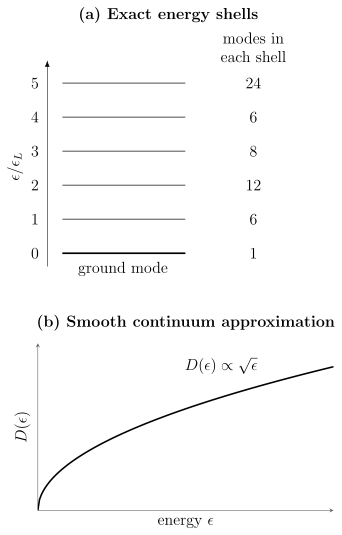
The first periodic-box shells have energies and degeneracies , where . The lower curve is the smooth continuum density of excited states in arbitrary vertical units, not the exact discrete spectrum. A macroscopically occupied ground mode must be kept separately.
Replacing the entire spectrum by one continuum integral can erase the very mode whose macroscopic occupation defines ideal-gas condensation.
Grand Partition Function
Section titled “Grand Partition Function”Introduce the fugacity
Because the ground energy is zero, convergence requires
or equivalently
for a finite grand-canonical system.
The mode factor is
Therefore
and
Separating the ground mode gives
The first term is the exact ground-mode contribution. At finite volume and positive temperature the quadratic spectrum makes the excited-mode sum converge; this is the additional condition required beyond convergence of each geometric factor. The excited contribution becomes extensive in the thermodynamic limit.
Mode Occupations and Number Equation
Section titled “Mode Occupations and Number Equation”Every momentum mode has mean occupation
For the ground mode,
The exact finite-volume number equation is
At specified mean , volume , and temperature , this grand-canonical equation determines and therefore . It does not impose an exact particle count in every configuration.
The equation also exposes the two distinct ways to store particles: distribute them among excited modes, or accumulate them in the single ground mode as .
Energy-zero covariance
Section titled “Energy-zero covariance”The general convergence condition is , where is the lowest one-particle energy. Changing that energy zero by a constant requires shifting the chemical potential along with the spectrum:
Then , and the grand-canonical generator is unchanged:
Every occupation and grand-canonical probability therefore stays the same. Shifting the spectrum alone at fixed changes the state. At exactly fixed , the added energy is instead common to all configurations, so it cancels from their normalized canonical probabilities.
Counting One-Particle States
Section titled “Counting One-Particle States”In a large periodic box, one momentum state occupies volume
in -space. The leading continuum approximation to the number of spinless modes with magnitude below is
Using
the integrated density of states is
Differentiation gives the three-dimensional density of states
An internal degeneracy multiplies both and when the components are independent and share the same dispersion and chemical potential.
When the Continuum Approximation Applies
Section titled “When the Continuum Approximation Applies”The first nonzero momentum has magnitude , so the first excitation scale is
The excited-state sum is well approximated by an integral when thermally relevant functions vary slowly across the level spacing. A useful condition is
Then
Finite-size corrections become important near the lowest excitations, in small traps or boxes, and when a precise transition crossover is required.
Thermal de Broglie Wavelength
Section titled “Thermal de Broglie Wavelength”Define the thermal de Broglie wavelength
It is the natural length scale obtained by comparing thermal kinetic energy with quantum wavelength. The dimensionless phase-space density is
When
the relevant modes have small mean occupation and Maxwell–Boltzmann thermodynamics is accurate. This criterion concerns phase-space occupation, not the width of an arbitrarily chosen wave packet. Quantum degeneracy becomes important when is of order one.
The convention for matters. Factors of move if a different thermal-wavelength definition is used, so formulas should not mix conventions.
Bose Integrals and Polylogarithms
Section titled “Bose Integrals and Polylogarithms”For , define
For real and , an equivalent integral representation is
These functions are also called Bose functions in statistical mechanics. At and ,
The limiting values needed most often are
Excited-State Number
Section titled “Excited-State Number”Using the density of states,
Set
The integral becomes
Thus the thermodynamic-limit number equation is
In the normal phase, vanishes in the thermodynamic limit and
This equation determines from density and temperature. The MB-B006 ideal-gas benchmark supplies numerical checks of the Bose functions, a normal-state fugacity root, and the condensate fraction. Bracket a normal-state root within and compare its number residual with the numerical integration or series error. If the specified density exceeds the excited-state capacity, separate the ground mode instead of searching for an unphysical .
Maximum Excited-State Density
Section titled “Maximum Excited-State Density”Because and increases with ,
The excited modes therefore have a finite maximum density at fixed temperature:
If the total density exceeds this value, the excess cannot be accommodated by changing while keeping . In the thermodynamic limit, and the excess occupies the ground mode macroscopically.
The corresponding ideal-gas temperature scale is
For the uniform three-dimensional ideal gas, the thermodynamic-limit condensate fraction below this scale is
For the uniform gas, the one-body density matrix is diagonal in momentum and its eigenvalues are these mode occupations. The Penrose–Onsager criterion states condensation more generally through an extensive eigenvalue of that density matrix, without relying on a plane-wave basis. The condensation page develops its relation to coherence, experiments, and interactions.
Grand Potential and Pressure
Section titled “Grand Potential and Pressure”For the excited modes,
The ground-mode term
is not extensive for fixed . Along a condensed sequence with proportional to , , so this term grows only as and again vanishes after division by . The grand potential density in the homogeneous thermodynamic limit is therefore
Using gives
At finite volume mechanical pressure is , not automatically . The periodic-box ground energy is independent of volume, so its grand-potential term has zero such derivative. The zero-momentum particles carry no kinetic energy and no mechanical pressure in this ideal model.
Internal Energy
Section titled “Internal Energy”The ground state has zero one-particle energy, so
Evaluating the integral gives
Therefore
This relation follows from the quadratic nonrelativistic dispersion in three dimensions. It is not universal for lattice bands, relativistic particles, harmonic traps, or other dispersions.
Entropy
Section titled “Entropy”The grand-potential identity gives
In the normal phase, where the ground-mode density is negligible,
In the condensed thermodynamic-limit ideal gas, and the ground mode contributes no extensive entropy. A finite-volume grand-canonical ground-mode mixture can have subextensive entropy, while the thermal cloud carries the entropy density.
Equation of State in the Normal Phase
Section titled “Equation of State in the Normal Phase”When is negligible,
and
Hence
For , this ratio is less than one. At the same density and temperature, Bose statistics lowers the ideal-gas pressure relative to the Maxwell–Boltzmann result because it favors multiple occupation of already populated states.
Dilute pressure correction
Section titled “Dilute pressure correction”Expanding the Bose integrals and eliminating fugacity gives
The negative correction is statistical, not an attractive interparticle potential. The classical-limit derivation gives the series inversion, internal-degeneracy factor, and interaction qualifications.
Compressibility and Density Fluctuations
Section titled “Compressibility and Density Fluctuations”In the normal phase,
As ,
The ideal gas therefore becomes extremely compressible near the condensation boundary. Through the grand-canonical fluctuation relation, this is accompanied by enhanced number fluctuations.
A stable weak repulsive interaction gives a finite bulk inverse compressibility away from critical singularities and qualitatively changes the low-energy response. The infinite compressibility of the condensed uniform ideal gas is one reason the noninteracting model is not a complete description of a physical superfluid.
Below the Ideal Condensation Scale
Section titled “Below the Ideal Condensation Scale”In the thermodynamic limit below ,
The excited population is
and the pressure is
Because ,
within the uniform ideal model below .
The condensate changes the density without changing the ideal-gas pressure at fixed temperature. For a stable dilute repulsive gas, the interaction energy supplies a density-dependent pressure and removes this ideal-gas softness away from critical singularities.
Why Dimensionality Matters
Section titled “Why Dimensionality Matters”For a quadratic dispersion in spatial dimensions, the low-energy density of states scales as
At , the low-energy excited-number integral behaves as
This integral converges at the lower limit only when
Consequently, a uniform ideal Bose gas with quadratic dispersion has no ordinary finite-temperature Bose–Einstein condensation in the one- or two-dimensional thermodynamic limit.
This statement has precise boundaries. Finite systems have crossovers, trapping changes the density of states, and interacting two-dimensional systems can exhibit Berezinskii–Kosterlitz–Thouless physics rather than ideal-gas condensation. Low-Dimensional Quantum Gases develops those boundaries and the associated one- and two-dimensional state counting.
Internal Degeneracy
Section titled “Internal Degeneracy”Suppose there are independent internal components with equal masses, dispersions, and chemical potentials. In the normal phase,
and
The condensation structure depends on whether the internal states interconvert, whether their populations are separately conserved, and whether the ground state is degenerate. A degeneracy factor should not be inserted mechanically without specifying those constraints.
Finite Size and Ensemble Choice
Section titled “Finite Size and Ensemble Choice”At finite :
- the spectrum is discrete;
- a normalizable positive-temperature grand-canonical state requires strictly below the ground energy;
- is finite;
- all thermodynamic functions are smooth;
- there is no exact nonanalytic phase transition.
The grand-canonical ground-mode variance is
If is macroscopic, this predicts relative fluctuations of order one:
This is the grand-canonical condensate-fluctuation problem, sometimes called the grand-canonical catastrophe. It reflects the combination of an ideal zero-energy mode and unrestricted particle exchange. A fixed- ensemble suppresses total-number fluctuations, and interactions alter condensate fluctuations further.
Ensemble equivalence must therefore be stated observable by observable. Bulk pressure and energy can agree while the condensate-number variance does not.
Fixed-number counting
Section titled “Fixed-number counting”For a finite set of modes labeled by , the canonical partition function sums only configurations with the declared total number:
The same information is encoded in the grand partition function as a generating series:
Here means the coefficient of . Extracting that coefficient does not introduce a particle reservoir into the fixed- model. It enforces the number constraint that prevents the canonical trace from factorizing into independent mode sums. The construction also applies to the box spectrum when the traces converge.
The normalizable grand-canonical thermal state of this quadratic Hamiltonian is Gaussian: different momentum modes are statistically independent, and its correlation functions obey Wick factorization. Projecting onto an exact total number generally gives a non-Gaussian state with correlated occupations. Canonical averages must therefore use the constrained weights rather than assume independent Bose–Einstein occupations or apply Gaussian Wick contractions without justification.
Two bosons in two modes
Section titled “Two bosons in two modes”Restrict the one-particle space to a nondegenerate ground mode of energy and one excited mode of energy , and fix . The allowed Fock states are
with energies . With , their weights give
As , and both particles occupy the ground mode. As in this fixed two-mode model, , the three configurations become equally likely, and . There is no extra multiplicity for “which particle” is excited: the Fock states already count identical bosons. This high-temperature limit refers to the truncated model, not to a full gas in which additional levels become accessible. No phase transition occurs in this finite example.
At , the respective probabilities are , , and . Direct averaging gives
and hence
The negative covariance follows from and ensures . Independent grand-canonical modes instead have zero cross-mode covariance and a fluctuating total number, even if their chemical potential is chosen to reproduce the same mean total population. The Hamiltonian alone does not determine these fluctuation predictions; the ensemble matters.
Traps, lattice bands, and interactions
Section titled “Traps, lattice bands, and interactions”The uniform continuum formulas depend on the spectrum. In a three-dimensional harmonic trap the semiclassical density of states scales as above the ground level, giving different condensation powers. Quantum gases in traps derives the corresponding number integrals. On a lattice one instead integrates over the actual band; van Hove singularities and band edges can alter the result.
Trapping can also change the dimensional capacity criterion. The harmonic-trap analysis permits finite excited-state capacity in two dimensions under the appropriate trap thermodynamic limit, unlike the uniform quadratic gas. The trap limit and dimensional crossover must be specified before transferring such conclusions between geometries.
An ideal gas has no collisions to establish equilibrium by itself. Its Gibbs state is a statistical model of an equilibrated or prepared population, not a mechanism for equilibration. It also omits interaction-induced depletion, sound, and vortex-core structure. Condensation alone is not a proof of superfluid behavior: the uniform ideal gas has quadratic excitations and zero Landau critical velocity. The weakly interacting gas explains how stable repulsion supplies a finite inverse compressibility and a linear phonon spectrum. Superfluid response and metastable flow require their own criteria, beyond a condensate count.
Equilibrium photons and phonons usually have because their number can change through exchange with the material system. They obey a Bose occupation law, but are not the conserved-particle gas whose number constraint produces the condensation calculation above. Effective conservation or driven preparation requires a separate model.
Exercises
Section titled “Exercises”Evaluate the excited-state number
Section titled “Evaluate the excited-state number”Use the series
to show that
Solution
After substituting , the excited-state integral is proportional to
Expand the denominator:
Then
Combining the prefactor from with gives . Hence
Diagnose condensate fluctuations
Section titled “Diagnose condensate fluctuations”Show that the grand-canonical relative ground-mode fluctuation approaches one when , and explain why this does not imply that every physical condensate has order-one relative fluctuations.
Solution
For one ideal thermal bosonic mode,
Therefore
The result assumes an ideal zero-energy mode exchanging particles with a reservoir. A canonical ensemble fixes total and correlates the ground and excited populations. Interactions also impose an energetic cost for density fluctuations. The ideal grand-canonical result is therefore ensemble- and model-specific, not a universal prediction for laboratory condensates.
A large occupation with subextensive entropy
Section titled “A large occupation with subextensive entropy”In a grand-canonical ground mode set with fixed positive density . Find , , the growth of , and the leading ground-mode entropy. Why does not give its finite-volume mechanical pressure?
Solution
From , and . Thus . The geometric-mode entropy is
Both are subextensive. Mechanical pressure differentiates at fixed , where is fixed and has no explicit volume dependence. Hence . Differentiating along the imposed path would change and answer a different question.
Shift the one-particle energy zero
Section titled “Shift the one-particle energy zero”Show that is unchanged under and . What changes if only is shifted?
Solution
The occupation depends only on the difference:
Shifting both quantities leaves , so every occupation and grand-canonical weight is unchanged. Shifting the spectrum at fixed changes this difference by and therefore describes a different grand-canonical equilibrium state. For comparison, at fixed one has , and the common factor cancels from all normalized probabilities.
Test a general infrared dispersion
Section titled “Test a general infrared dispersion”Let , with , near an isolated minimum in uniform spatial dimensions. Determine when the saturated excited-state number is infrared finite.
Solution
The low-energy density of states scales as . At saturation, , so the number integral near its lower endpoint is proportional to
It converges when , or . Equality gives a logarithmic divergence. For quadratic dispersion, , this recovers . This local test diagnoses infrared capacity; a full critical temperature additionally requires the density of states over the thermally occupied spectrum and a stated thermodynamic limit.
Find the two-mode canonical energy
Section titled “Find the two-mode canonical energy”For the two-boson example, compute the mean energy from and find its low- and high-temperature limits.
Solution
Since ,
As , and . As within this two-mode model, and , the average of the three equally weighted energies .
Bracket the normal-state fugacity
Section titled “Bracket the normal-state fugacity”Show that the normal-state benchmark equation has exactly one root in . Why is bracketing preferable to an unconstrained Newton iteration?
Solution
For ,
The function is continuous and strictly increasing from to , so it crosses the target exactly once. A bracket with opposite residual signs keeps the iteration in the physical interval. An unconstrained Newton step can leave that interval and encounter an unphysical branch, including . The root residual must also be checked against the error in evaluating the Bose function.
References
Section titled “References”- F. Dalfovo, S. Giorgini, L. P. Pitaevskii, and S. Stringari, “Theory of Bose–Einstein condensation in trapped gases”, Reviews of Modern Physics 71, 463–512 (1999).
- A. L. Fetter and J. D. Walecka, Quantum Theory of Many-Particle Systems, Dover (2003).
- K. Huang, Statistical Mechanics, 2nd ed., Wiley (1987).
- M. Kardar, Statistical Physics of Particles, Cambridge University Press (2007).
- L. D. Landau and E. M. Lifshitz, Statistical Physics, Part 1, 3rd ed., Butterworth–Heinemann (1980).
- R. K. Pathria and P. D. Beale, Statistical Mechanics, 3rd ed., Elsevier (2011).
- C. J. Pethick and H. Smith, Bose–Einstein Condensation in Dilute Gases, 2nd ed., Cambridge University Press (2008).
- L. Pitaevskii and S. Stringari, Bose–Einstein Condensation and Superfluidity, Oxford University Press (2016).