

Classical Limit of Quantum Statistics
Maxwell–Boltzmann statistics emerges from Bose–Einstein or Fermi–Dirac statistics when occupation of every relevant one-particle mode is small. For a homogeneous nonrelativistic ideal gas in spatial dimensions, a convenient degeneracy parameter is
where is the total number density, is the internal-state degeneracy for equally populated components, and
is the thermal de Broglie wavelength. The dilute nondegenerate regime is
In that regime, the Bose and Fermi mean occupations both reduce to
and the leading Maxwell–Boltzmann canonical expression for identical noninteracting particles is
For large , this is a leading thermodynamic approximation: small corrections to need not give a small relative error in itself. The factor remains essential. The classical regime does not turn identical quantum particles into fundamentally labeled objects; it makes exchange corrections too small for the observables and accuracy under consideration.
The leading corrections remember the exchange symmetry. At fixed density and temperature in three dimensions,
where
Bosonic exchange lowers the ideal-gas pressure at fixed , while fermionic exchange raises it. Both effects disappear continuously as .
Helpful background. Grand-canonical states define fugacity; the ideal-gas overview compares Bose and Fermi occupations.
Dilute occupation and exchange symmetry
Section titled “Dilute occupation and exchange symmetry”Take a positive-temperature ideal gas with quadratic dispersion, a sufficiently large homogeneous box, and degenerate internal components at equal chemical potential. The one-particle ground energy is set to zero. These assumptions give the thermal-wavelength criterion; discrete spectra and traps are treated below with mode activities instead.
The approximation suppresses exchange corrections to ordinary thermodynamic densities. It preserves the Bose or Fermi exchange symmetry. Normalized coincidence correlations can still reveal that symmetry even when their absolute counting rates are tiny.
What Becomes Classical?
Section titled “What Becomes Classical?”Several different approximations are called a classical limit. They should not be conflated.
Classical statistics
Section titled “Classical statistics”Exchange corrections are negligible when thermally occupied one-particle states are much more numerous than particles. Bose and Fermi thermodynamics then agree to the desired accuracy with Maxwell–Boltzmann thermodynamics.
Semiclassical one-particle motion
Section titled “Semiclassical one-particle motion”A sum over discrete translational states may be replaced by a phase-space integral when thermal and geometric scales do not resolve individual levels. This is controlled by quantities such as
or
where is a length over which an external potential varies appreciably. This approximation can hold even when exchange remains important, and exchange can be negligible in a dilute gas whose one-particle motion is still strongly quantized.
Classical ideal-gas behavior
Section titled “Classical ideal-gas behavior”In addition to negligible exchange, interactions and bound-state effects must be negligible. The condition controls quantum degeneracy; it does not by itself make an interacting gas ideal.
Classical-field behavior
Section titled “Classical-field behavior”Highly occupied bosonic modes are sometimes described by a classical field or Rayleigh–Jeans approximation. That regime has
which is the opposite of the Maxwell–Boltzmann condition .
Decohered trajectories
Section titled “Decohered trajectories”Environmental decoherence can make localized trajectories or classical records useful. It does not alter the equilibrium exchange symmetry or automatically imply Maxwell–Boltzmann statistics.
The present page concerns the first limit and its relation to the next two.
One-Particle State Counting
Section titled “One-Particle State Counting”Consider a free particle in a large box of volume with dispersion
If there are internal states with the same energy, the continuum one-particle partition function is
Thus
is the number of thermally accessible translational states per particle, up to the continuum approximation implicit in .
If the mean interparticle spacing is
then
The thermal-wavelength language is therefore a phase-space statement: exchange becomes important when wave packets associated with thermally occupied states overlap enough that permutations cannot be neglected.
This picture is heuristic rather than a claim that particles are hard spheres of diameter . The exact criterion comes from occupation factors or exchange terms in the partition function.
A Unified Bose–Fermi Notation
Section titled “A Unified Bose–Fermi Notation”Let
For a noninteracting mode of energy , define
where
is the fugacity in the chosen energy-zero convention. The exact mean occupation is
Whenever
the geometric expansion gives
The Maxwell–Boltzmann term is
The first exchange correction is positive for bosons and negative for fermions:
Mode-by-mode small occupation is the most general criterion in a noninteracting system. The thermal-wavelength criterion follows after converting the mode sum to a homogeneous continuum density.
Energy-Zero Convention
Section titled “Energy-Zero Convention”The statement is meaningful only after an energy zero is chosen. If every one-particle energy shifts by ,
then thermodynamic invariance requires
Consequently,
is not invariant, but
is invariant. Setting the lowest one-particle energy to zero makes
a convenient sufficient criterion for every mode to have small occupation. The invariant statement is
Grand Partition Function and Cluster Expansion
Section titled “Grand Partition Function and Cluster Expansion”For ideal bosons or fermions,
Expanding each logarithm gives
where
The term is Maxwell–Boltzmann. Terms with encode exchange cycles and quantum-statistical corrections.
For a homogeneous free gas,
Therefore
The density follows from :
The pressure is
These are fugacity expansions, not expansions in interaction strength. For bosons with the one-particle ground energy set to zero, the normal-state expansion is controlled by . For fermions the exact occupation formula remains valid at , but the low-fugacity power series does not describe the degenerate low-energy modes.
Maxwell–Boltzmann Order
Section titled “Maxwell–Boltzmann Order”Keeping only gives
so
The pressure becomes
and the chemical potential is
Thus implies
relative to a ground energy set to zero. A merely negative chemical potential is not enough: ideal bosons have throughout the normal phase, including regimes where quantum degeneracy is strong.
In the canonical ensemble, the corresponding free-particle partition function is
The Gibbs factor removes overcounting of permutations of identical particles. Replacing this expression by would describe permanently labeled species, not one dilute gas of identical particles.
Leading Bose and Fermi Corrections
Section titled “Leading Bose and Fermi Corrections”Retain the first two fugacity terms. With
the density relation is
Inverting gives
The pressure expansion is
Eliminating yields
In three dimensions,
The ideal quantum-statistical second virial coefficient is therefore
Similarly,
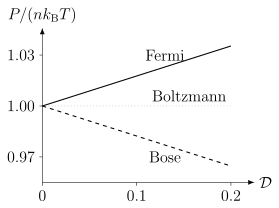
Leading three-dimensional corrections . The vertical axis magnifies deviations from one. Only the dilute interval is shown; the lines are first-order expansions, not full equations of state.
The phrases statistical attraction for bosons and statistical repulsion for fermions summarize these signs. They do not mean that an interparticle potential has appeared. Exchange changes state counting and correlations even when the Hamiltonian contains no force between particles.
Exchange Cycles in the Canonical Ensemble
Section titled “Exchange Cycles in the Canonical Ensemble”The two-particle partition function makes the origin of the correction explicit. For two identical noninteracting particles,
The first term is the Maxwell–Boltzmann contribution . The second is the two-cycle exchange contribution.
For a free gas in dimensions,
and
Their ratio is
For particles, the number of possible exchanged pairs grows with . The correction to an extensive thermodynamic quantity is therefore controlled per particle by
not by alone.
There is an important distinction between a partition function and its logarithm. The leading two-cycle contribution gives
The last expression is the leading dilute bulk result. Thus the free-energy correction per particle is small when , even if the ratio differs exponentially from one for a macroscopic . Treating that ratio itself as a small correction additionally requires (and control of higher cycles). Thermodynamic smallness is not the same as relative accuracy of a many-body partition function. The recurrence and higher permutation cycles are developed in Partition Functions.
Occupation Fluctuations
Section titled “Occupation Fluctuations”In the grand-canonical state of an ideal gas, an independent quantum mode has
Writing , this exact quadratic expression is
The leading Maxwell–Boltzmann result is Poisson-like,
Bosons have a positive bunching correction; fermions have a negative exclusion correction. The distinction survives first in quantities of second order in the small occupation.
The exact probability laws remain geometric for a bosonic mode and Bernoulli for a fermionic mode. Their absolute probabilities approach one another as occupation falls. This does not make every normalized correlation classical: a thermal bosonic mode has , while a fermionic mode has zero double occupation and this ratio is zero. A Poisson law would give one. Resolving rare coincidences can therefore reveal exchange even in a dilute gas. Fixed-number conditioning also correlates different modes, so the independent-mode fluctuation formula must not be transferred unchanged to a canonical trace.
Internal Degeneracy and Mixtures
Section titled “Internal Degeneracy and Mixtures”The factor needs a physical interpretation. If orthogonal internal states have equal energy, equal chemical potential, and equal populations, then each component has density approximately . Exchange operates only between particles in the same orthogonal internal state, giving
For a mixture with component densities , the safer criteria are
for every identical component . A single total- formula can fail when populations are polarized, masses differ, chemical potentials differ, or internal states are not conserved.
If component particle numbers are separately fixed, the Maxwell–Boltzmann canonical factor is
not one denominator for physically distinguishable species.
Internal degeneracy weakens exchange corrections at fixed total density because particles are distributed among more orthogonal one-particle states. It does not make particles of the same internal state distinguishable.
Relation to the Fermi Temperature
Section titled “Relation to the Fermi Temperature”For a homogeneous three-dimensional ideal Fermi gas with equal population of components,
and
The degeneracy parameter becomes
Thus
is the Fermi-gas form of the Maxwell–Boltzmann criterion. The numerical coefficient depends on the convention used to define and on dimensionality, but the parametric statement does not.
For an ideal uniform Bose gas, quantum degeneracy becomes important when is of order one. Bose–Einstein condensation in three dimensions occurs at
under the standard ideal-gas and component assumptions. The Maxwell–Boltzmann regime lies parametrically far from that threshold.
Dimensionality
Section titled “Dimensionality”The general free-particle criterion is
where is the -dimensional density. The leading ideal exchange correction is
Changing dimension changes the density of states, the powers in the fugacity expansion, infrared behavior, and condensation criteria. One must not insert a three-dimensional into a quasi-one-dimensional or quasi-two-dimensional gas without first deciding which transverse levels are thermally active.
If transverse gaps greatly exceed , the gas is effectively lower dimensional. If many transverse levels are populated, the full trapped or anisotropic one-particle partition function should be used instead of a pure -dimensional continuum formula.
Trapped and Inhomogeneous Gases
Section titled “Trapped and Inhomogeneous Gases”For a slowly varying potential , the local semiclassical occupation is
Define the local activity
The Maxwell–Boltzmann approximation requires the maximum relevant to be small. At leading order,
so the local degeneracy parameter is
The center of a trapped cloud can be quantum degenerate while its dilute wings remain Maxwell–Boltzmann. A criterion based only on the cloud-averaged density can miss this coexistence of regimes.
For a high-temperature -dimensional harmonic trap with frequency ,
A useful global estimate is
but local central occupation remains the sharper diagnostic.
Finite and Discrete Spectra
Section titled “Finite and Discrete Spectra”The continuum thermal wavelength is not universal. In a small box, lattice, molecule, or finite trap, the exact one-particle spectrum may be sparse. The robust criterion is
If this holds, the occupation expansion is classical even when the sum over states cannot be replaced by a momentum integral. The one-particle partition function should remain
rather than being forced into .
Conversely, a continuum approximation can be excellent while is not small. A degenerate Fermi gas in a macroscopic box has nearly continuous levels but is not Maxwell–Boltzmann.
On a lattice, low filling can help suppress exchange occupancy effects, but the band width, lattice spacing, multiple orbitals, and interactions replace the simple free-space thermal-wavelength picture. Low fugacity and small mode occupations remain the portable criteria.
Massless and Nonconserved Quanta
Section titled “Massless and Nonconserved Quanta”For photons and phonons in equilibrium, particle number is not generally conserved and the chemical potential is usually
Then
Low-energy modes have of order one, so the whole equilibrium distribution is not globally Maxwell–Boltzmann. Only the high-energy Wien tail,
has
Raising the temperature does not create a small fugacity for a species whose equilibrium chemical potential remains zero; it shifts the set of thermally important modes. The homogeneous massive-particle criterion should not be imported unchanged.
Interactions and the Virial Expansion
Section titled “Interactions and the Virial Expansion”Low fugacity also organizes an interacting gas, but the coefficients are no longer determined only by exchange. The density virial expansion has the form
For a one-component ideal quantum gas in three dimensions,
before internal-degeneracy factors are included. With interactions,
The interaction contribution can contain scattering phase shifts and bound-state terms. Strong scattering, resonances, or weakly bound molecules can make it important even when exchange degeneracy is modest.
Therefore
does not by itself imply
It implies that exchange corrections are small. Ideal-gas behavior additionally requires
with analogous control of higher virial terms. The Beth–Uhlenbeck relation is the canonical scattering-theory refinement of ; its full derivation lies beyond this page.
The ħ → 0 Perspective
Section titled “The ħ → 0 Perspective”At fixed , , and ,
so
drives
This formal limit suppresses exchange corrections and often supports a phase-space approximation simultaneously. It is only one route to Maxwell–Boltzmann statistics. Holding fixed and taking also gives , even if one-particle motion retains discrete quantum structure.
Likewise, taking decreases for massive nonrelativistic particles, but an effective Hamiltonian, internal excitation spectrum, ionization threshold, relativistic crossover, or interaction potential may change before the formal limit is reached.
Semiclassical Limits and Correspondence develops the broader action-based classical limit. The present criterion concerns exchange statistics.
Accuracy Estimates
Section titled “Accuracy Estimates”The approximation should be tied to an observable and tolerance.
Mode occupation
Section titled “Mode occupation”For one mode with ,
The relative error is controlled locally by .
Pressure
Section titled “Pressure”For a homogeneous free gas,
The numerical coefficient can make the pressure accurate even when is not extremely tiny, but other observables can have larger corrections.
Fluctuation statistics
Section titled “Fluctuation statistics”The relative correction to a one-mode Poisson variance is of order . Two-particle coincidences and short-distance correlations are therefore often more sensitive to exchange than the equation of state.
Nonuniform systems
Section titled “Nonuniform systems”Use the largest local activity or degeneracy parameter in the region sampled by the observable. A global mean can underestimate the error in a dense center.
Terms labeled require control of higher coefficients. For an interacting gas, a deeply bound molecular contribution can make a cluster coefficient large even at low fugacity; inspect those coefficients rather than the activity alone.
Exercises
Section titled “Exercises”Energy-zero invariance
Section titled “Energy-zero invariance”Show that is convention dependent but is not.
Solution
Under
the fugacity becomes
Its numerical size changes. The mode activity is
Equivalently, . Small mode activity is the invariant condition. One may use after setting the lowest one-particle energy to zero.
Unequal internal populations
Section titled “Unequal internal populations”A two-component gas has equal masses but densities and . State the classicality criterion and the leading ideal exchange contribution to the pressure in three dimensions.
Solution
The two orthogonal components exchange only within themselves. The criteria are
For fermionic components, each contributes
Thus
Only for equal populations can this be rewritten with total density and in the simple form used in the main text.
Classical wings of a trapped gas
Section titled “Classical wings of a trapped gas”In a slowly varying trap with minimum , show that classical wings can coexist with a degenerate center. Use the exact local mode activity, without applying the Maxwell–Boltzmann density formula where it is invalid.
Solution
The largest activity at position occurs at zero momentum:
Even if is order one (or much larger for fermions), sufficiently large makes this activity small. Only in those wings may we conclude . One must not extrapolate this Boltzmann density relation back into a degenerate center; there the full Bose or Fermi integral determines the density.
Fermi temperature criterion
Section titled “Fermi temperature criterion”For a homogeneous three-dimensional gas with
derive in terms of .
Solution
Use
Since
one finds
Therefore
Hence is equivalent to up to an order-one coefficient.
A small density correction and a large partition-function ratio
Section titled “A small density correction and a large partition-function ratio”For a three-dimensional ideal gas with and , estimate the leading magnitude of the exchange correction to pressure and to . Does a nearly classical pressure imply ?
Solution
The pressure correction has relative magnitude . The logarithmic partition-function correction has magnitude . It has positive sign for bosons and negative sign for fermions, while the pressure correction has the opposite sign. The partition-function ratio is consequently exponentially far from one, even though thermodynamic corrections per particle are small. Higher orders change the numerical logarithm but not this distinction.
References
Section titled “References”- R. Balian, From Microphysics to Macrophysics, Volume I, Springer (1991), chapters 7–9.
- E. Beth and G. E. Uhlenbeck, “The Quantum Theory of the Non-Ideal Gas. II. Behaviour at Low Temperatures”, Physica 4, 915–924 (1937).
- K. Huang, Statistical Mechanics, 2nd ed., Wiley (1987), chapters 9–12.
- M. Kardar, Statistical Physics of Particles, Cambridge University Press (2007), chapters 5–7.
- L. D. Landau and E. M. Lifshitz, Statistical Physics, Part 1, 3rd ed., Butterworth–Heinemann (1980), sections 40–58.
- R. K. Pathria and P. D. Beale, Statistical Mechanics, 4th ed., Elsevier (2021), chapters 6–8.
- G. E. Uhlenbeck and L. Gropper, “The Equation of State of a Non-Ideal Einstein–Bose or Fermi–Dirac Gas”, Physical Review 41, 79–90 (1932).